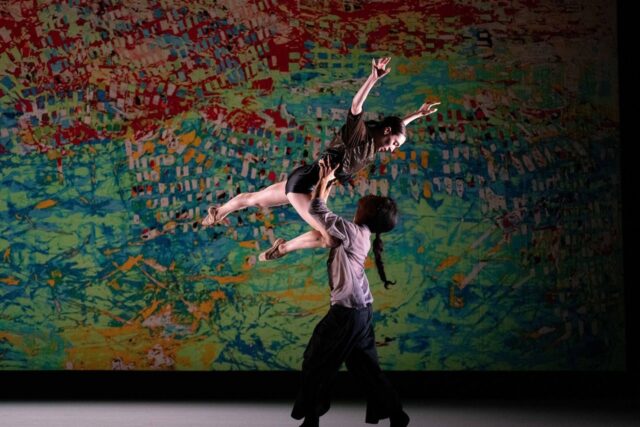
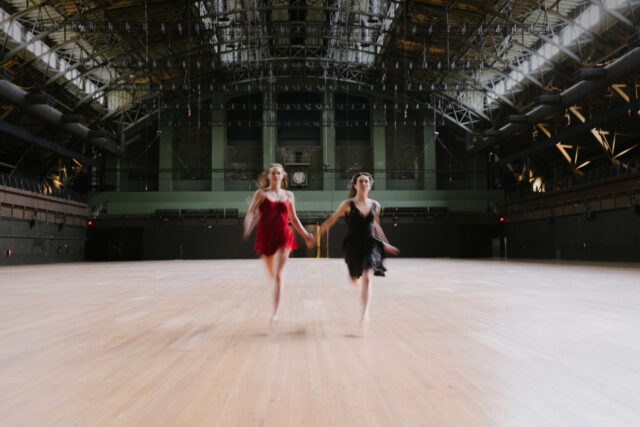
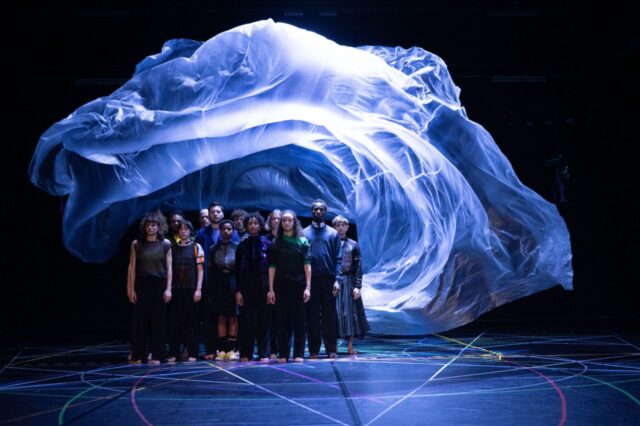
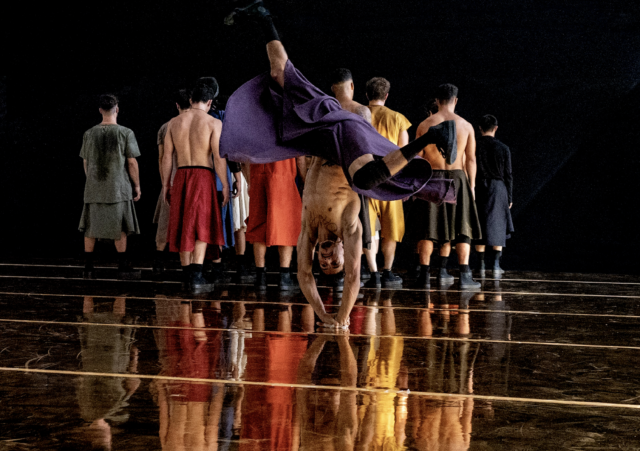
Who: Charlotte Aucella, Louise Heit, Will Pettigrew, Not a Dance Company, Josephine Brunner, Liiiam, Eleanor Crawford, Chisato Fujii What:Take Root: Digging In Group Artist Residency Where:Green Space, 37-24 24th St., Suite 211, Long Island City When: May 14-17, $22 in advance, $25-$27 at the door, 7:00/8:00 Why: Since October 2025, Green Space has been hosting “Digging In” mentored group artist residencies for eight dancer-choreographers. This week the public will be able to see what they’ve been up to as part of the “Take Root” series. On May 14 and 16, Charlotte Aucella, Louise Heit, Will Pettigrew, and Not a Dance Company will present their new works, while Josephine Brunner, Liiiam, Eleanor Crawford, and Chisato Fujii will share their pieces on May 15 and 17. The residency consists of eight work sessions, two personal and professional development workshops, and two full-production performances complete with marketing and publicity support, lighting, sound, a stipend, and a post-residency recap. Founded by Valerie Green of Dance Entropy in 2005, the venue is “a place for dancers, choreographers, teachers, and community members alike to gather and experience dance where it’s created.” Applications for the 2026–27 residency open in the fall.
[Mark Rifkin is a Brooklyn-born, Manhattan-based writer and editor; you can follow him on Substack here.]
Writer, director, choreographer, dancer, and actor Luke Murphy returns to St. Ann’s Warehouse, following 2024’s sci-fi gem Volcano, with the searing Scorched Earth.
I called the nearly four-hour Volcano “an eruption of ingenuity, a multimedia, multidisciplinary melding of past, present, and future bathed in mystery.” The same can be said of the ninety-minute Scorched Earth.
“What does it take to be from somewhere?” Detective Alison Kerr (Sarah Dowling) asks while discussing a questionable case, setting the stage for a play steeped in humans’ relationship with one another and the land.
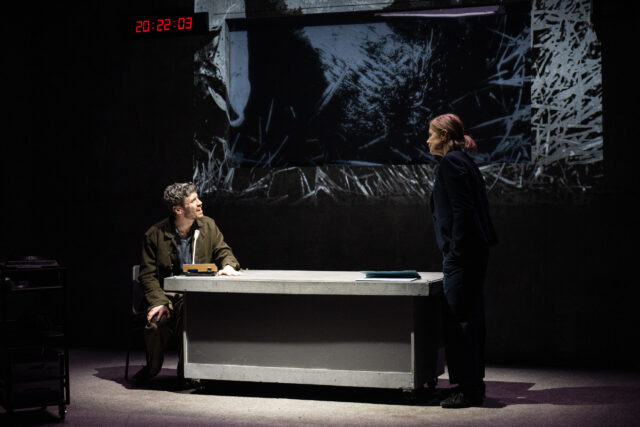
The show takes place in a small, tight-knit, unnamed Irish town where the body of a wealthy man, William Dean (Will Thompson), was found on a ten-acre plot of land he had just won at auction, outbidding John McKay (Murphy), a tenant farmer who had worked on the property for eight years. Ten years after the death, Kerr has reopened the case. She brings in McKay for twenty-four hours of interrogation, a digital clock on the wall counting down the time.
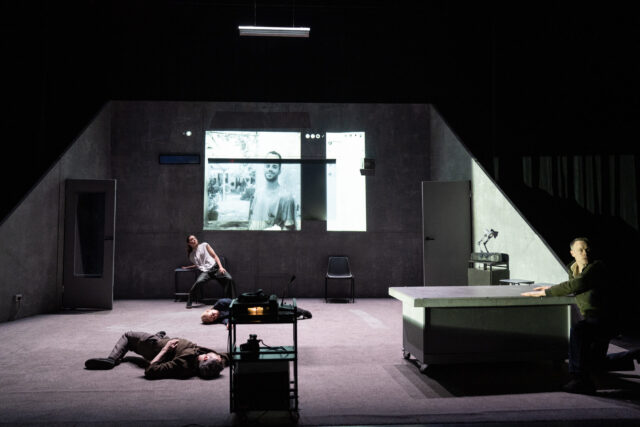
The fractured narrative shifts kaleidoscopically in time and space, between the interrogation, re-creations of past events, and a radio talk show where host Leanne Meany (Tyler Carney-Faleatua) speaks with Dean, both before and after his death. Alyson Cummins’s stark set is a bleak, gray, angled room in which the cast of five moves around tables and chairs, an open door morphs into a telephone booth where Sergeant Leahy (Ryan O’Neill) calls Kerr, and a rectangular section of the back wall slides open to reveal other elements. Patricio Cassinoni’s slide projections depict crime-scene photos, pages from official reports, and aerial views of the contested land while putting the murder in context of other similar disputes through Irish history.
Much of the story is told through captivating movement that takes the story in fascinating directions, brilliantly expanding the tense atmosphere as the police procedural unfolds. McKay dances with a grass body (Carney-Faleatua) that is less a green monster than a piece of the land. The deceased Dean writhes around on the floor, his body like a limp, boneless creature. There’s even a country line dance where, as Leahy announces, “no one has to touch each other,” a sly reference to the previously accepted claim that Dean died because of a fall, not at the hands of a murderer.
Meanwhile, the townsfolk seem far more concerned about John O’Donnell’s missing donkey than what happened to Dean, which they seek to remain buried in the cold earth.
Scorched Earth incorporates thrilling dance in police-procedural narrative (photo by Teddy Wolff)
Scorched Earth was inspired by John B. Keane’s 1965 play The Field, which was adapted into a 1990 film by Jim Sheridan that featured an Oscar-nominated Richard Harris as an elderly Irish tenant farmer who is fighting to own the land his family has worked on for generations, as well as by Mark O’Connell’s A Thread of Violence: A Story of Truth, Invention, and Murder, Myles Dungan’s Land Is All That Matters: The Struggle That Shaped Irish History, and Andrew Jarecki’s The Jinx, the Peabody-winning docuseries about real estate heir Robert Durst and a long-unsolved murder.
Cork-born Murphy (Sleep No More,Pass the Blutwurst, Bitte) is magnetic as McKay, a deeply conflicted man who firmly believes the land should have been his. Dowling, who portrays a bartender and a bank teller in addition to Kerr, is cool and calm as the determined detective. Thompson, who starred opposite Murphy in Volcano, brings nuance to Dean, a rich mogul who can afford to buy whatever he wants. (Perhaps the character was also based partly on William K. Dean, a doctor who retired to a New Hampshire farm where he was murdered in 1918; the case, investigated by a private detective named Wilhelm DeKerlor — oddly similar to “Kerr” — remains unsolved.) O’Neill and Carney-Faleatua provide expert support.
Scorched Earth is a scintillating success all the way around, including Cummins’s costumes, Stephen Dodd’s stark lighting, which beams in from the sides of the set, and composer Rob Moloney’s wide-ranging score. Everything merges beautifully for an exhilarating, powerful surprise Sisyphean conclusion where it all comes tumbling down, no matter who you are or where you’re from.
[Mark Rifkin is a Brooklyn-born, Manhattan-based writer; you can follow him on Substack here.]
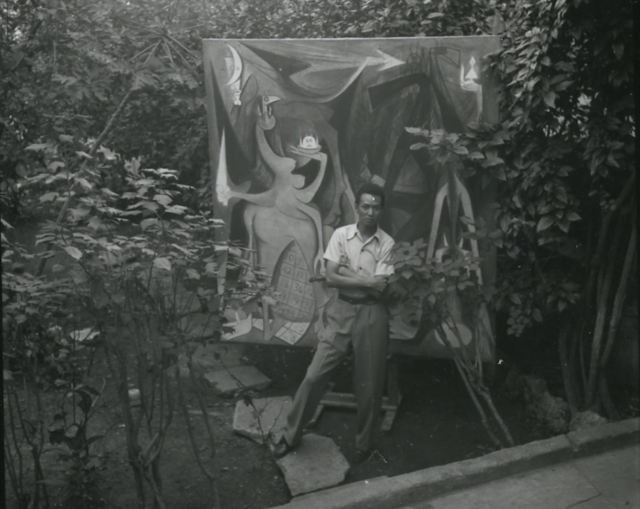
Who:Ballet Hispánico New York,Aruán Ortiz, Yaissa Jimenez What: A Special Evening Celebrating “Wifredo Lam: When I Don’t Sleep, I Dream” Where: Museum of Modern Art, 11 West Fifty-Third St. Between Fifth & Sixth Aves. When: Thursday, March 19, free with advance RSVP, 6:30 Why: “I knew I was running the risk of not being understood either by the man in the street or by the others,” Cuban-born artist Wifredo Óscar de la Concepción Lam y Castilla said, “but a true picture has the power to set the imagination to work, even if it takes time.” The wide-ranging MoMA retrospective “Wifredo Lam: When I Don’t Sleep, I Dream” paints a fascinating portrait of Lam, the son of a Chinese immigrant and the grandson of a Congolese former slave mother. It’s a marvelous collection of paintings, drawings, archival photographs, sketches, books, and ephemera tracing Lam’s career, which took him from Cuba, Spain, and France to Martinique, Haiti, and New York as his imagination turned to Spanish modernism, Surrealism, and Afro-Cuban tradition. Among the highlights of the exhibition, which runs through April 11, are the 1943 gouache on paper masterpiece The Jungle, a trio of dazzling abstracts, and a collection of plates.
On March 19 at 6:30, MoMA will be hosting “A Celebration of ‘Wifredo Lam: When I Don’t Sleep, I Dream,’” as Ballet Hispánico New York, Cuban-born, Brooklyn-based pianist, violist, and composer Aruán Ortiz, and Dominican writer and poet Yaissa Jimenez will perform specially commissioned new works in the exhibition galleries, paying tribute to Lam and his legacy. Admission is free with advance RSVP.
[Mark Rifkin is a Brooklyn-born, Manhattan-based writer; you can follow him on Substack here.]
“Oh no,” the person sitting next to me said at the start of Benjamin Millepied’s Romeo & Juliet Suite at Park Ave. Armory.
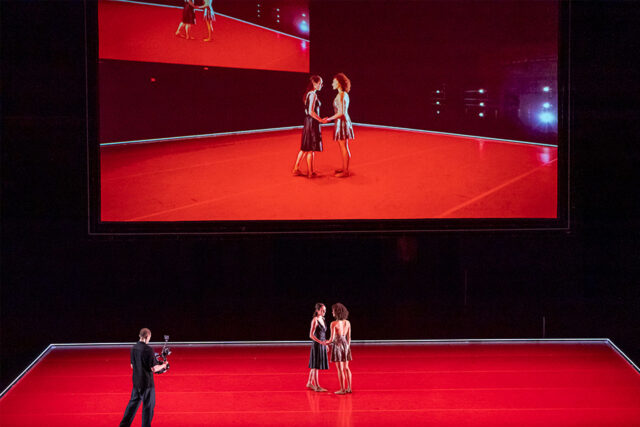
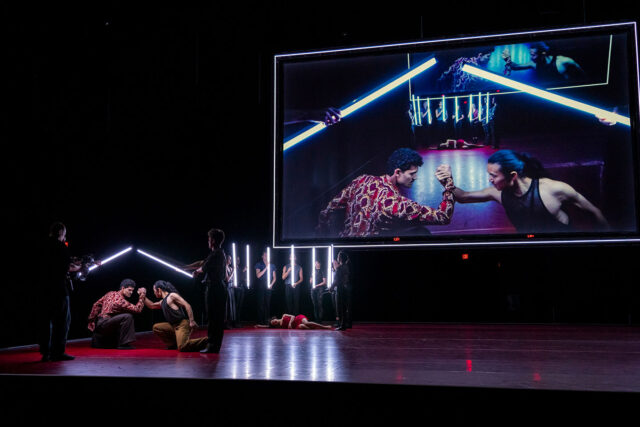
I couldn’t help but agree as we watched two dancers move a couch on a platform stage, followed by a cameraman in black who was documenting the action, the live video projected on a large screen. The men got onto the couch, which was facing away from the audience, but we could see what they were doing onscreen, since the cameraman was now in front of them. It was an odd way to begin the ballet, a multimedia adaptation of Sergei Prokofiev’s 1930s classic Romeo and Juliet, but it also signaled what was to come: ninety minutes of not knowing where to look as mostly unidentified characters — current and former members of Millepied’s LA Dance Project — performed on the stage, on the sides, and in various hallways and period rooms throughout the armory.
The score is bold and majestic. The choreography is often moving and beautiful. Camille Assaf’s naturalistic costumes, primarily blacks, brown, and grays, are set off by the usually heart-red platform and glow when the performers grab fluorescent light tubes and incorporate them in both inventive and curious ways. We get an inside look at various locations in the historic building, some not open to the public. A dark, mysterious masked ball with mirrors is held in a tight space. Romeo and Juliet (portrayed by three different pairs at each show: a man and a woman, two men, or two women) pose in silhouette against a white screen. A chase scene takes place under the rafters.
The problem is that we’re at a live performance and we spend much of the show’s eighty minutes essentially watching a movie, although it’s happening live. Even when the dancing is occurring on the stage, it is often being projected simultaneously, with cameraman Sebastien Marcovici, the company’s associate artistic director and rehearsal director, running about to capture it; it’s particularly intrusive during several duets between Tybalt (Renan Cerdeiro) and Mercutio (Shu Kinouchi) and Romeo (Daphne Fernberger) and Juliet (Rachel Hutsell). Many of the story’s most critical scenes can be seen only onscreen; in addition, no plot is ever described, so it helps if you know at least the basics of the Shakespeare play. There’s also a camera above the platform that offers a bird’s-eye view that is awe inspiring the first time but quickly becomes more like a scene from a Busby Berkeley movie starring Esther Williams. When the screen isn’t being used, it’s cast in shapes and colors that resemble a blurry Mark Rothko painting, as if hinting at the suicides to come.
And then there’s the balcony scene, which for me summed up the entire experience. (Just as an fyi, there was no balcony scene in the original play, which merely called for Juliet to be at a window.) Romeo and Juliet celebrate their newfound love by dancing in the glorious Veterans Room, then run upstairs and suddenly emerge on the upper ledge behind the screen. It’s a breathtaking moment — until Marcovici joins them, getting close to them so he can zoom in on their first kiss.
Mercutio (Shu Kinouchi) and Tybalt (Renan Cerdeiro) are at odds in multidisciplinary Romeo & Juliet Suite (photo by Stephanie Berger)
I’m sorry if I sound snarky; overall, I enjoyed the production, and there are numerous memorable moments that will stay with me. Fernberger and Hutsell are terrific, their movement packed with emotion, and the rest of the cast has a powerful energy. But it could have been so much more without all the bells and whistles; Millepied may have fared better had he incorporated the cinematic elements without getting camera happy, instead focusing more on the dance happening on the platform, in the room where the audience is sitting.
“Of all the places I’ve shown Romeo & Juliet Suite, the armory is by far the most fitting, as it provides the massive scale, flexibility, and grandeur needed to present this work at its fullest potential,” Millepied said about this iteration; previous versions have been presented at the Sydney Opera House, La Seine Musicale in Paris, and the Spoleto Festival in Charleston. He may have gotten a little carried away by the glorious armory, but there’s still a worthwhile dance to be found in his radically reimagined tale, if you know where to look.
[Mark Rifkin is a Brooklyn-born, Manhattan-based writer; you can follow him on Substack here.]
Ronald K. Brown/EVIDENCE returns to the Joyce for fortieth anniversary celebration
Ronald K. Brown/EVIDENCE, a Dance Company
Joyce Theater
175 Eighth Ave. at 19th St.
February 25 – March 1 (Curtain Chat February 25), $32-$82
212-645-2904 www.joyce.org evidencedance.com
Ronald K. Brown/EVIDENCE celebrates its past while looking toward the future in its annual winter season at the Joyce, running February 25 through March 1. Because of the blizzard, opening night, February 24, has been canceled, but a 7:00 show has just been added, and great seats are available if you hurry.
The Brooklyn-based company will be presenting two exciting programs as part of its fortieth anniversary. The first honors longtime collaborator Wunmi Olaiya, a composer, costume designer, dancer, and visual artist who has been working with Brown since 1992, while the second pays tribute to TU Dance cofounding artistic director Toni Pierce-Sands, who danced with Alvin Ailey and EVIDENCE and would begin every TU Dance production with the Ulysses Dove mantra “Nothing to prove, only to share”; Pierce-Sands passed away in November at the age of sixty-three.
“Celebrating Wunmi” — born in London and raised in Lagos, she goes by one name — begins with Ebony Magazine: To a Village, a 1996 piece for Cleo Parker Robinson Dance Ensemble that EVIDENCE debuted in March 1998, featuring music and costumes by Wunmi centered around the repeated phrase “do you see what I see.” Clear as Tear Water is a 2006 solo originally choreographed for Pierce-Sands; at the Joyce, six different dancers will perform the work, which will be set to Wunmi’s “Woman Child” in Program A and Meshell Ndegeocello’s “Heaven” in Program B. Next is 1999’s Gatekeepers, a piece originally for Philadanco that delves into Native American mythology and African traditions, with music and costumes by Wunmi. Following intermission, the evening concludes with the rousing, nonstop Upside Down, an exhilarating excerpt from Brown’s 1998 Destiny, in which the company cuts loose to music by Wunmi, which she will play live with two drummers.
“With the trust Ron affords me, I dare to dream and visualize what the work he is creating is speaking on,” Wunmi explains in a Joyce interview. “Ron tells stories of human beings making their way . . . and, in there, I create costumes to make them visible. Thankful, trust is alive and well.”
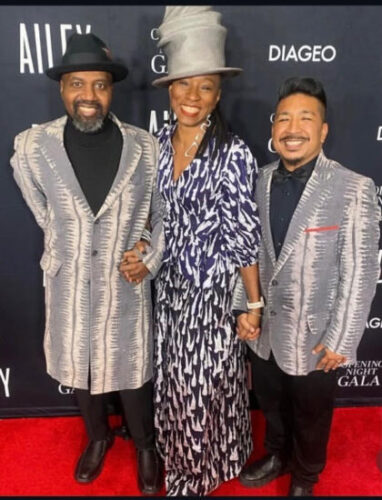
Ronald K. Brown, Wunmi Olaiya, and Arcell Cabuag at the 2024 Alvin Ailey American Dance Theater gala
Planned prior to Pierce-Sanders’s death from cancer, “A Celebration of the Life and Legacy of Toni Pierce-Sands” kicks off with 2012’s Torch, a touching tribute to former Brown student and dance enthusiast Beth Young, who passed away in January 2012, followed by Clear as Tear Water. The company premiere of 2017’s Where The Light Shines Through, originally commissioned for TU at the Ordway, is choreographed by Brown and his partner, Arcell Cabuag, and set to music by Ndegeocello, Susana Baca, Ballet Folklórico Cutumba de Santiago, and Black Motion. The finale is the spectacular 1999 favorite Grace, originally choreographed for Alvin Ailey, which features twelve dancers moving, in costumes by Wunmi, to a melding of modern dance and West African idioms as only Brown and Cabuag can do, with music by Duke Ellington, Roy Davis Jr., and Fela Aníkúlápó Kuti and live vocals by Gordon Chambers; the beats will stay with you long after the show is over.
“This celebration is long overdue and I am happy the time is now,” Brown says in a program note.
The time is always now to see this extraordinary company, still going strong after forty marvelous years.
[Mark Rifkin is a Brooklyn-born, Manhattan-based writer; you can follow him on Substack here.]
The second Dance Reflections by Van Cleef & Arpels Festival returns to New York City with sixteen performances and twenty-four workshops by some of the finest companies in the world, running February 19 through March 21.
The exciting series kicks off February 19-21 with the Lyon Opera Ballet presenting Merce Cunningham’s BIPED and Christos Papadopoulos’s Mycelium at City Center and the Ballet national de Marseille bringing (LA)HORDE’s Age of Content to BAM’s Howard Gilman Opera House from February 20 to 22. The lineup continues with such shows as Jan Martens’s The Dog Days Are Over 2.0 at NYU Skirball, Leïla Ka’s Maldonne at New York Live Arts, Noé Soulier’s The Waves at the Joyce, and Lucinda Childs’s Early Works for the Guggenheim’s Works & Process program.
Below is a look at five more of the highlights.
LA Dance Project’s On the Other Side is part of triptych at PAC NYC (photo by Jade Ellis)
BENJAMIN MILLEPIED AND THE L.A. DANCE PROJECT: REFLECTIONS: A TRIPTYCH
Perelman Performing Arts Center (PAC NYC)
251 Fulton St.
Saturday, February 21, 8:00, and Sunday, February 22, 3:00, $61-$157 www.dancereflections-vancleefarpels.com pacnyc.org
Benjamin Millepied merges dance, music, and visual art in the New York premiere of Reflections: A Triptych, three pieces inspired by precious stones. The thirty-minute Reflections (2013) boasts a score by David Lang and a bold scenic design by Barbara Kruger, with six dancers musing on longing and memory. The seventeen-minute Hearts and Arrows (2014) features a set by Liam Gillick, music by Philip Glass performed by Kronos Quartet, and fab costumes by Janie Taylor. Several Glass compositions and a set by Mark Bradford anchor the forty-five-minute On the Other Side (2016), which explores communal human experience. Audrey Sides will teach a “Hearts & Arrows Repertory” workshop at the New York Center for Creativity & Dance on March 12.
Trisha Brown and the Merce Cunningham Trust celebrate their extensive collaboration with Robert Rauschenberg, and the artist’s recent centennial, with two classic works for which Rauschenberg created the visual design and the costumes. Commissioned by BAM in 1983, Set and Reset is a postmodern masterpiece, with music by Laurie Anderson, that was recently reconceived as an art installation at the Tate. The vaudevillian pièce de résistance Travelogue (1977) is set to John Cage’s “Telephones and Birds,” which has been adapted for mobile devices, and is performed within Rauschenberg’s Tantric Geography environment. “I feel like this is the one time I can let the cat out of the bag and let you know just how dear this man is to me,” Brown once said about Rauschenberg. “Bob understands how I construct movement.” Bob returned the compliment: “Particularly with Trisha, it’s always a challenge because she remains so unpredictably fresh.” Cecily Campbell and Jamie Scott will lead a “Trisha Brown Discovery” workshop at the New York Center for Creativity & Dance on February 28.
Benjamin Millepied reconfigures his Romeo & Juliet Suite specifically for Park Ave. Armory
Benjamin Millepied follows up his PAC NYC Reflections tryptych with an eighty-minute multimedia adaptation of Sergei Prokofiev’s 1930s ballet Romeo and Juliet, combining dance, theater and film reconfigured specifically for the entire Park Ave. Armory building. The cast of eighteen dancers will rotate as Shakespeare’s doomed young couple, with the presentation spreading from the Wade Thompson Drill Hall to the historic period rooms and other spaces, so be sure to get there early. “Of all the places I’ve shown Romeo & Juliet Suite, the armory is by far the most fitting, as it provides the massive scale, flexibility, and grandeur needed to present this work at its fullest potential,” Millepied, who will participate in an artist talk with NYU professor André Lepecki on March 4, said in a statement. “I invite audiences to forget what you think you know about the story of these two star-crossed lovers — and how it should be told — and open your mind to experiencing a radically reimagined tale about love suited for modern day.”
Exciting Belgian choreographer Anne Teresa De Keersmaeker displays her principle of “My walking is my dancing” in Exit Above, in which thirteen dancers move to the sounds of Meskerem Meesre interpreting the blues of Robert Johnson in addition to music by TC Matic’s Jean-Marie Aerts and dancer-guitarist Carlos Garbin, with scenic design by Michel François, costumes by Aouatif Boulaich, and opening text taken from Walter Benjamin’s “On the Concept of History.” In a 2023 interview, De Keersmaeker explained, “Less is more, I increasingly think. For me that means going back to the source, to the real thing. Blues goes all the way back to that essence, also content wise: It is about sorrow and joy, my sorrow, my joy but also our sorrow, our joy. Both individual and collective: That tension is crucial to me. Blues the ultimate emotional alchemy: we sing about our sadness, but by singing about it with others we transform it into a strength, something joyful. Singing about sorrow immediately contains the consolation for that sorrow. Isn’t this ultimately why we make art? To mourn together and to celebrate joy together. Beauty and solace. I know that beauty is considered to be old-fashioned, but we need it more than ever: Our relationship with nature is disturbed, we are living on the edge of an ecological catastrophe. When you’re lost, it’s a good idea to retrace your footsteps.” Jacob Storer and Clinton Stringer will lead an Exit Above workshop at the New York Center for Creativity & Dance for professionals on March 6 and everyone on March 7.
Compagnie Hervé KOUBI will worship the sun again in Sol Invictus at the Joyce (photo by Nathalie Sternalski)
French choreographer Hervé Koubi studied dance and biology at the University of Aix-en-Provence, and he combines the two elements gorgeously in Sol Invictus as his company of eighteen performers pushes the limits of what the human body can do. Previously staged at the Joyce in 2023, Koubi calls the seventy-five-minute piece “a manifesto for life,” and he fills it with sections that explore ritual, worship, faith in a higher power — in this case, the sun — and life, death, and rebirth. “I want to talk about light, solidarity, and those bonds that unite us,” Koubi explains about the work, which features music and soundscapes by Mikael Karlsson, Maxime Bodson, Beethoven (the funeral procession from the Seventh Symphony), and Steve Reich and costumes by musical arranger Guilaume Gabriel. Several of the dancers will lead a “Sol Invictus Discovery” workshop at the New York Center for Creativity & Dance on March 13, and there will be a Curtain Chat following the March 11 show.
[Mark Rifkin is a Brooklyn-born, Manhattan-based writer; you can follow him on Substack here.]
There are no actors on hand but the Mabou Mines production of All That Fall boasts a magnificent set (photo by twi-ny/mdr)
“Space is the place,” Sun Ra sang on the title track of his 1973 album, Space Is the Place. “There’s no limit to the things that you can do. . . . And your life is worthwhile.”
The jazz legend might have been referring to the cosmos, but one of the (many) things that makes my life worthwhile is entering a theater with no idea what to expect visually. I’m not talking about standard setups where the proscenium stage is in front of rows of affixed seats but rooms that can be reshaped and reconfigured in multiple ways. For example, I am filled with anticipation every time I walk into Park Ave. Armory’s Wade Thompson Drill Hall, TFANA’s Polonsky Shakespeare Center, the Shed’s McCourt, BAM Fisher, and the Signature’s Romulus Linney Courtyard Theatre, all of which can be transformed into fascinating rearrangements.
Below are four recent shows I’ve seen that offered unique spatial experiences.
The cast of All That Fall does not appear in person at the 122 Community Center (photos by Jeri Coppola)
UNDER THE RADAR: ALL THAT FALL
Mabou Mines@122CC
150 1st Ave. at Ninth St.
January 8–25, $20-$50 www.maboumines.org utrfest.org
Since 1970, the experimental avant-garde Mabou Mines troupe has been challenging the boundaries of theater, and they do it again with their adaptation of Samuel Beckett’s 1957 radio play, All That Fall. When audience members get off the elevator at the 122 Community Center, they encounter a series of objects in the hallway and a side room that prepare them for the show: a photo of the Orangedale train station next to a radio playing a Big Band–era instrumental; a poster of a railway man’s “hand, flag and lamp signals” with an actual rusty lamp; a photo of the train station interior, with empty benches, which hints at what we’ll soon see; horse-racing information; and a piece of paper with the opening quote from Beckett’s 1938 novel, Murphy, “The sun shone, having no alternative, on the nothing new,” along with a drawing of a tree by Harry Bliss with the caption “A tree greeting the morning sun, because it has no choice.”
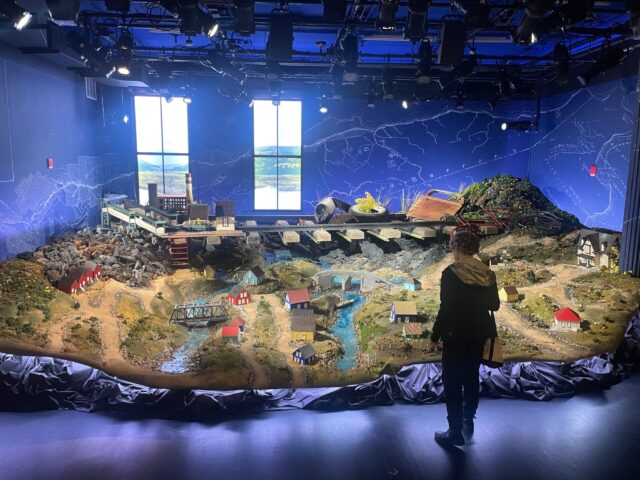
Inside the theater, the seats are arranged in a traditional manner, but the set is like an art installation, a large model of a miniature town with tiny houses, bumpy hills, rocky streets, a river, two bridges, hens near the tracks, and an elevated train station, all surrounded by a map on the walls; in the back are regular-size remnants, an abandoned bicycle and parts of some kind of moving vehicle. In front of the model, a man is projecting slides on an old carousel of costumed men and women — the characters the actors will be portraying. Shortly after the projections stop and the man leaves, we realize that there will be no actors for us to watch; in true radio-play fashion, they will only be heard, prerecorded, but we now know what they look like.
The narrative is fairly straightforward: Mrs Maddy Rooney (Randy Danson) is worried when her blind husband, Dan (Tony Torn), is late getting home. She finds out that the ever-dependable train has not arrived yet, and she is concerned why. Along her journey, she meets up with Christy the carter (Jesse Lenat), Mr Barrell the station master (Lenat), Mr Tyler the retired bill collector (Steven Rattazzi), Mr Slocum the racecourse manager (Torn), Tommy the railway porter (Tẹmídayọ Amay), the pious Miss Fitt (Wendy vanden Heuvel), the little girl Dolly (Lila Blue), and the little boy Jerry (Sylvan Schneiderman). They have absurdist conversations about dung, the Matterhorn, damnation, sex, bicycles and vans, the Titanic and the Lusitania, and “the horrors of home life.”
Mrs Rooney’s dialogue is filled with lovely snippets about human existence: “What kind of a country is this where a woman can’t weep her heart out on the highways and byways without being tormented by retired bill-brokers!” she complains to Mr Tyler. “Christ what a planet,” she declares to Miss Fitt. “I do not exist,” she says to Tommy. “I am not half alive nor anything approaching it,” she explains to Mr Tyler. “Have you no respect for misery?”
The breathtaking set is by Thomas Dunn, lit by Jennifer Tipton, with a bevy of sound effects by Bruce Odland, from animal noises to a storm that shakes your seat almost like Sensurround. Mabout Mines cofounder JoAnne Akalaitis directs with a wry sense of humor.
Wally Cardona and Molly Lieber revive David Gordon’s Times Four for its fiftieth anniversary (photo by Maria Baranova)
LIVE ARTERY: TIMES FOUR / DAVID GORDON: 1975/2025
New York Live Arts / Pick Up Performance Co. Studio
541 Broadway between Spring & Prince Sts.
January 11–13, $33.85 newyorklivearts.org
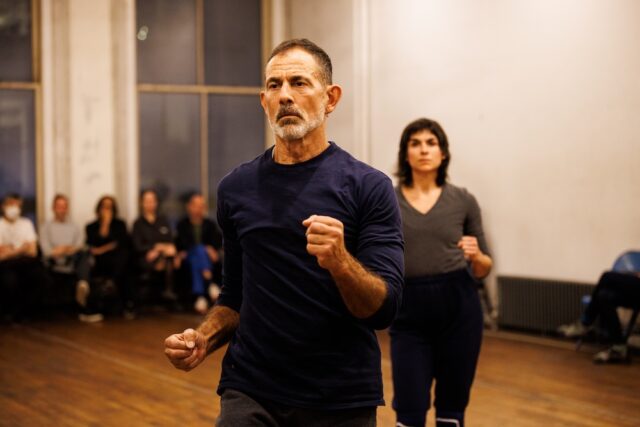
In May 1977, husband-and-wife dancers David Gordon and Valda Setterfield performed their 1975 piece, Times Four in the SoHo loft where they lived and worked. Their son-in-law, Wally Cardona, has brought their little-seen pas d’deux back for a fiftieth-anniversary tribute, teaming up with Molly Lieber to re-create it from a video rehearsal, Setterfield’s handwritten notes, photographs, and other ephemera, taking place in the same loft. It is like a 1960s happening: The limited seating is a single row of folding chairs around the periphery of the otherwise empty room; in addition, the night I attended, there were numerous familiar choreographers and dancers in the audience, all greeting one another. There is no score; the only sounds are Cardona’s (Interventions,The Set Up) and Lieber’s (Rude World,Gloria) breathing and their feet and other body parts touching the floor, sometimes landing softly, sometimes hard. They stare at the walls and windows, rarely making eye contact with the audience, as they glide primarily in unison to four beats, then deleting one move and replacing it with another.
Concentrating mostly on their legs and feet, they move forward, backward, sideways, lifting here, pounding there, almost always in unison. They fall to the ground, extend their bodies, come within inches of the audience. When slight differences occur, you can feel it in your bones. You never know which direction they are going to turn in, resulting in a thrilling suspense to it all.
They both exert remarkable strength as they perform difficult maneuvers, their muscles rippling, sweat forming. It’s a compelling feat of human endurance that last about sixty tense, exhilarating minutes. A poem associated with the dance explains, “well worn wood floor / smooth burnished brown / the kind of floor that begs to be danced on / that wants to seduce me out of my shoes and socks. . . . I face my back to the windows / I imagine 1975.”
Consider me seduced.
Paul Lazar and Annie-B Parson stage first revival of Richard Foreman’s What to wear at BAM (photo by Stephanie Berger)
PROTOTYPE: WHAT TO WEAR
Brooklyn Academy of Music
BAM Strong Harvey Theater
651 Fulton St. at Ashland Pl.
January 15-18 www.bam.org www.prototypefestival.org
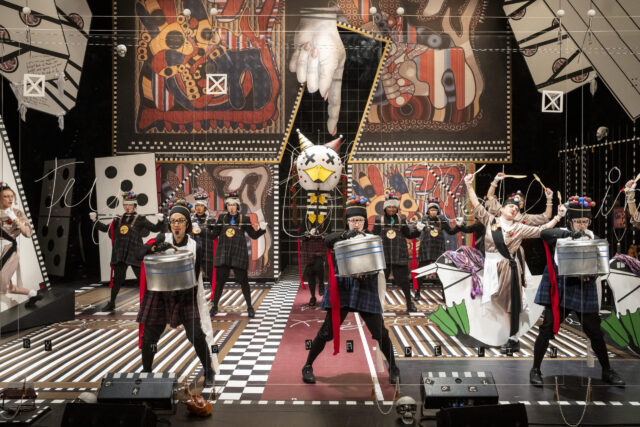
In September 2006, experimental avant-garde legend Richard Foreman and composer Michael Gordon debuted their surreal post-rock opera, What to wear, at the Redcat in LA. It took twenty years, but the show has finally made it to New York at the BAM Strong Harvey Theater as part of the Prototype festival, in its first-ever revival. To prepare everyone for what awaited inside the theater, in the lobby was Foreman’s detailed original concept design model for the complex, fabulously overstuffed stage, a kind of mind-blowing melding of Monty Python, Pablo Picasso, and Alice in Wonderland. It is thrilling to walk into the Harvey and see how that set has been painstakingly re-created at full size by Michael Darling, like magic; Darling also did the props, and the wild costumes are again by E. B. Brooks. Big Dance Theater’s Paul Lazar and Annie-B Parson direct, honoring the 2006 production, which you can watch online here.
The show begins with fancy lighting coming down from the ceiling as a giant cartoonish duck emerges from a doorway and the deep voice of Richard Foreman booms from the heavens: “As of this moment, this ugly duckling is now effectively banished from the realm of the oh so beautiful people.” The duck exits, and sopranos Sarah Frei and Sophie Delphis, mezzo Hai-Ting Chinn, and tenor Morgan Mastrangelo sing, “This is Mad’line X” eight times, then adding, “In a terrible world / One unpleasant world / Such a bad, bad world.” Over the next sixty-plus minutes, those four are joined by St. Vincent, an ensemble of more than a dozen vocalists and dancers, and the seven-piece Bang on a Can orchestra caged in one corner as the story goes through such chapters as “Mad’line X, who understands now,” “So sad but I reject you,” and “When a duck enters a fine restaurant.”
Marchers in kilts hold signs with a big X on them, a pointing finger drops down from above like the hand of G-d, skulls abound, headpieces feature little colored balls on top, a character walks around in a barrel, golf clubs become weapons, a head is locked in a box, and cool wizardry occurs just about everywhere. The unsatisfying ending does not diminish the triumph of this engaging revival. We are told that “Madeline X lives in this terrible world,” but any world that includes works by Foreman can’t be all bad.
AN ARK
The Griffin Theater at the Shed
The Bloomberg Building at Hudson Yards
545 West 30th St. at Eleventh Ave.
Tuesday – Sunday through March 1, $45 theshed.org
“Don’t panic. Don’t be scared. This must feel strange to you. It felt strange to me,” an unnamed character played by Sir Ian McKellen says at the beginning of British playwright Simon Stephens’s An Ark, continuing at the Shed through March 1.
Too late.
In the summer of 2021, Stephens’s Blindness was reimagined for the pandemic, presented at the Daryl Roth Theatre in Union Square, where a maximum of eighty-six masked and blindfolded people were seated in chairs in pods of two, either facing the same or opposite directions, each couple at least six feet away from other pairs. Everyone listened to the play, about a spreading virus that leads to chaos, through individual binaural headphones; the prerecorded narrative was performed by Juliet Stevenson.
In the summer of 2023, Tin Drum brought Kagami to the Shed’s Griffin Theater, which began with a historical multimedia installation that led to a mixed-reality concert in which everyone put on specially designed optically transparent devices that made it appear that the late pianist Ryuichi Sakamoto was playing live, enveloped in augmented reality art. In actuality, the room was completely empty except for a row of chairs along the perimeter where audience members could sit and watch, although it was much better to walk around and get up close and personal with Sakamoto — you could even go right through him.
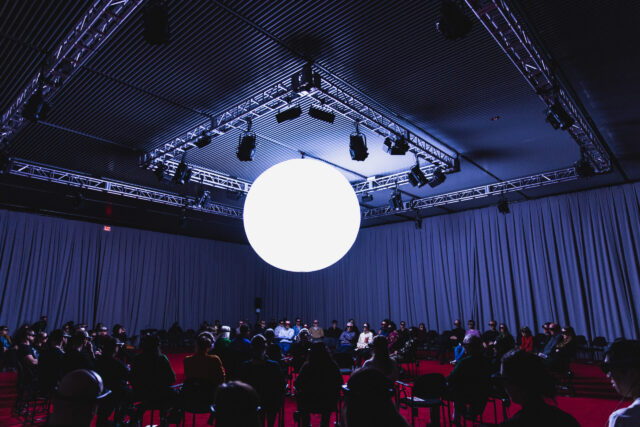
The prep for the show is mind-bogglingly annoying. The audience is encouraged to arrive at least fifteen or twenty minutes before showtime in order to check their coats and bags, which is mandatory; however, the line was so long when we go there that we were advised to just bring our stuff in with us. At the Griffin, a sign announced, “wipe your feet / check your glasses / store your shoes / enter through the curtain / find a seat / put on your headset / sit back / enjoy the ride.” There was no curtain; the open doorway revealed a large room with plush red carpeting, a giant glowing orb hanging in the center from the ceiling, and three circular rows of chairs with a pathway through the middle. While my guest waited for corrective lenses — glasses won’t work with the headset — I took off my shoes and jacket, placed them on the floor, and tried to grab a specific seat, then come back and store my garb in one of the small cubby-hole benches, but I was told by a guide that I couldn’t do that; first I had to put the shoes and coat away, then someone would guide me to a chair. The shoes fit in the little cubby, but I had to really force the coat into another slot, only to be told that I had placed them in the wrong bench and had to move them. By then, my guest was already seated — with her jacket, which she was allowed to keep on her lap, and bag, which she could put under her chair.
Mixed reality An Ark at the shed is a confusing jumble (photo by Marc J. Franklin)
Next, you put on the headsets, and four white holographic chairs appear in front of you; mine had to be adjusted by a guide because the chairs were enormous and floating in the ether. I was disappointed that I could also see everyone else in the room, which detracted from the personal nature of the show, even though theater is usually meant to be a communal experience. Then, guides wheeled the cubby benches straight through the middle of the theater and out the curtain on the other side of the room, further disturbing the alternate reality that was being created. As the play proper began, with the four characters, all barefoot and wearing white, entering the space and sitting down, it was hard not to wonder why the floor had to be carpeted and why we had had to take off our shoes; perhaps it was some kind of ASMR thing.
For forty-seven minutes, the actors perform just for you, making intense direct eye contact, reaching out with their hands, and using the second person as they recount multiple versions of a life, from birth, childhood, and adolescence to adulthood, the senior years, and death. For example: “At school you work hard but you never really feel like you belong,” “You’ll want to tell people about the things that have happened to you in here,” and “You get on first name terms with your pharmacist.” The dialogue is filled with detailed descriptions of objects and scenarios that involve all five senses; while poetic, they don’t propel the plot, which remains mysterious through the end.
Recorded in one take and directed by Sarah Frankcom (Our Town,Punk Rock) with sound by Ben and Max Ringham, set and costumes by Rosanna Vize, and lighting by Seth Reiser, An Ark has numerous beautiful moments, and the interaction between the characters and you can be utterly chilling (Sir Ian McKellen is only a few feet away!); when Sheehy reached a hand out to me, I reached back, attempting to grasp it.
But too much of it was confusing and unnecessary; I’m eager to see where the technology goes. Hopefully the kinks will be smoothed out and creators will have more faith in the story itself, without all the bells, whistles, and rules.
As McKellen says early on, “When this is over . . . things will have changed forever.” Well, hopefully not too much.
[Mark Rifkin is a Brooklyn-born, Manhattan-based writer and editor; you can follow him on Substack here.]