this week in broadway

GOLDEN BOY

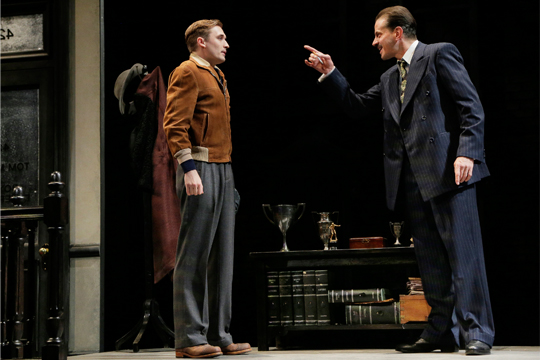
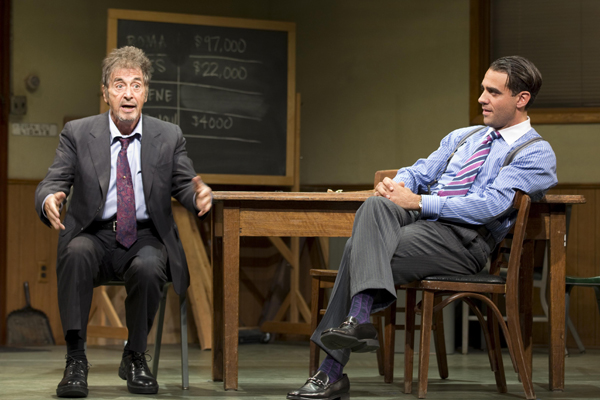
Tom Moody (Danny Mastrogiorgio) doesn’t like the way Joe Bonaparte (Seth Numrich) talks to him but likes the way he fights in GOLDEN BOY (photo by Paul Kolnik)

Belasco Theatre
111 West 44th St. between Sixth & Seventh Aves.
Through January 20, $37 – $122
www.lct.org

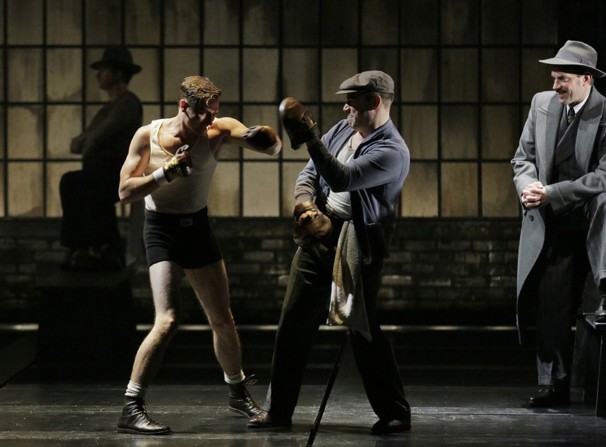
For its seventy-fifth anniversary, Clifford Odets’s Golden Boy has returned home, in a triumphant Lincoln Center production at the Belasco Theatre, where the show made its Broadway debut in November 1937. Seth Numrich (War Horse) comes on like a house on fire as Joe Bonaparte, a young classical violinist determined to make it in the fight game. He implores boxing promoter Tom Moody (Danny Mastrogiorgio) to put him in the ring against Chocolate Drop, sure that he has what it takes to become a champion. But in that first match, Joe is fearful of hurting his valuable hands, something that his trainer, Tokio (Boardwalk Empire’s Danny Burstein), has to cure him of if he is to become successful in the sweet science. The married Moody also involves his girlfriend, Lorna Moon (Dexter’s Yvonne Strahovski), a self-proclaimed floozy from Newark, in his plan to nurture Joe, but that strategy threatens to backfire when Joe and Lorna take a liking to each other. Meanwhile, Joe’s Italian immigrant father (Monk’s Tony Shalhoub) worries whether his son will ever play the violin again or make enough money as a fighter to support himself.

Joe risks a promising career as a violinist by putting on the gloves and getting in the ring in GOLDEN BOY (photo by Paul Kolnik)

Directed by Bartlett Sher, who also helmed Lincoln Center’s 2006 revival of Odets’s Awake and Sing!, Golden Boy still packs quite a wallop, performed by a talented ensemble, with creative period sets by Michael Yeargan (highlighted by vertical doors that come down from the ceiling). It tells the timeless story of the never-ending battle between artistic and financial success, as Joe understands he must give up the violin for good if he is to pursue a career in boxing. Odets was inspired to write Golden Boy after he headed to Hollywood and the company that he was part of, Lee Strasberg’s Group Theatre, disbanded, representing his own struggle between artistic integrity and wealth and fame. The original production of Golden Boy was directed by Harold Clurman and featured the legendary cast of Luther Adler (as Joe), Frances Farmer (as Lorna), Lee J. Cobb, Elia Kazan, Harry Morgan, Howard Da Silva, Karl Malden, and John Garfield. (Garfield, who played a troubled violinist in the 1946 film Humoresque, took on the role of Joe in a short-lived 1952 Broadway revival, while William Holden made his film debut in Rouben Mamoulian’s 1939 film.) The current cast also includes Ned Eisenberg as Roxy Gottlieb, Anthony Crivello as Eddie Fuseli, Jonathan Hadary as Mr. Carp, Michael Aronov as Joe’s brother-in-law, Siggie, and Dagmara Dominczyk as Joe’s sister, Anna. Golden Boy is like an old boxer getting back into the ring after a lengthy retirement but still showing there’s plenty of fight left in his game, ready to go twelve rounds with the best of them.

THE ANARCHIST

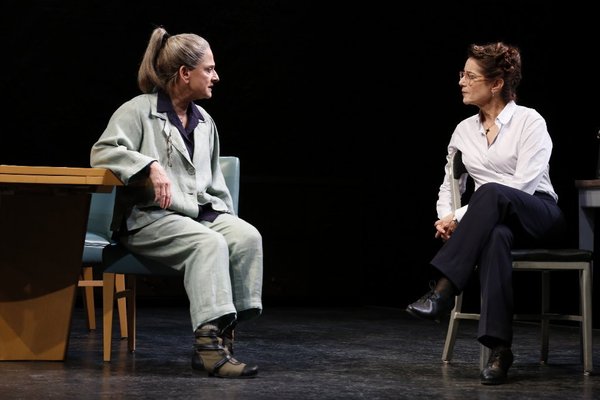
Cathy (Patti LuPone) and Ann (Debra Winger) play an intellectual game of cat-and-mouse in David Mamet’s THE ANARCHIST (photo by Joan Marcus)

Golden Theatre
252 West 45th St. between Broadway & Eighth Ave.
Through December 16, $70 – $134.50
www.theanarchistbroadway.com

Patti LuPone and Debra Winger might be extremely talented professionals, but it still has to be difficult to go on acting in a new Broadway play that announced, shortly after opening, that it would close early, after a mere twenty-three previews and seventeen regular performances. Written and directed by David Mamet (Race, Oleanna,) whose Glengarry Glen Ross is currently being revived down the street — and gives new meaning to its catchphrase, “Always be closing” — The Anarchist is essentially a seventy-minute intellectual debate between two very smart, edgy women. Mamet veteran LuPone (The Woods, State and Main) stars as Cathy, a former Weather Underground-type revolutionary who has converted to Christianity while serving a lengthy prison sentence and is now seeking to be released. Debra Winger (An Officer and a Gentleman, How I Learned to Drive), in her Broadway debut, plays Ann, a serious jailer who has thoroughly researched Cathy’s case and is not sure she is ready to be paroled. In a cold office setting, the convict and the bureaucrat battle it out in a war of words, discussing reason, revenge, religion, regret, revolution, and other topics as they play a tricky cat-and-mouse game that is overly clever for the Broadway stage. In addition, neither character is fully developed, and, more important, neither is very likable, making for a show that feels much longer than seventy minutes. Inspired by the post-9/11 world, the play has its fascinating moments, but it might have worked much better in a smaller theater without such a hefty ticket price ($70-$134.50), although it would still fail to be much of a story. “But the meaninglessness — let me be more precise — it was facing the meaninglessness which led me to faith,” Cathy says. “It led you to faith,” Ann responds. Cathy: “Because, do you see, they’re the same two choices.” Ann: “The same two as?” Cathy: “The bureaucrat and her make work files. To rebel. Or to submit. And each is unacceptable.” Ann: “Is there a third choice?” Cathy: “Thank you. And that is the essence of the book.” Ann: “That the third choice is Faith.” Cathy: “What else could it be? And to believe . . . in the possibility of another choice is to long for God. And to discover it is Faith.” Ann: “Faith without certainty.” Cathy: “If there were certainty, why would it be faith?” Mamet has a lot to say in The Anarchist, but far too much of it has to be taken on faith.

DEAD ACCOUNTS

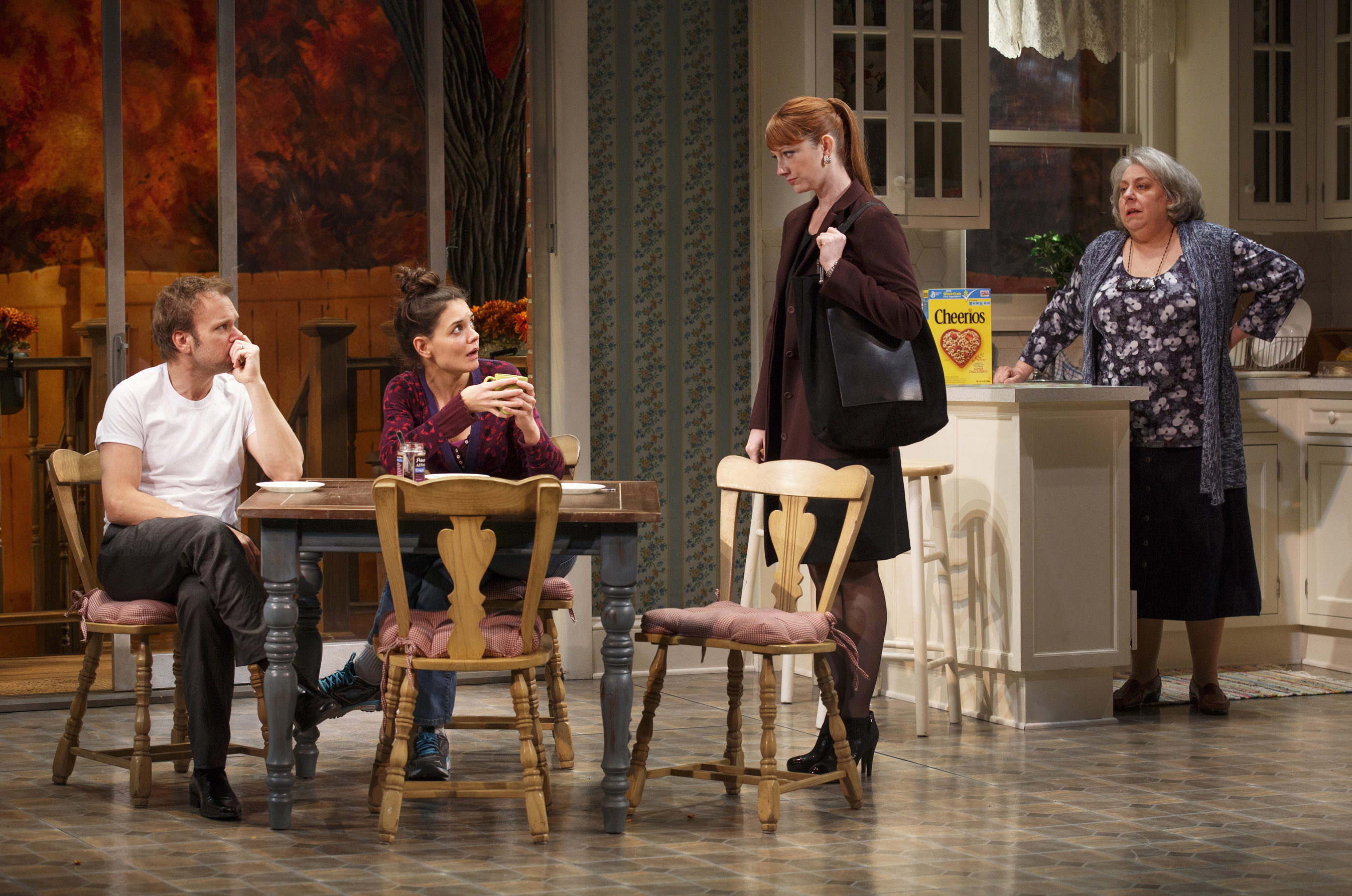
Playwright Theresa Rebeck ultimately bites off more than she can chew in DEAD ACCOUNTS (photo by Joan Marcus)

DEAD ACCOUNTS
Music Box Theatre
239 West 45th St. between Broadway & Eighth Aves.
Through September 2, $67 – $147
www.deadaccountsonbroadway.com

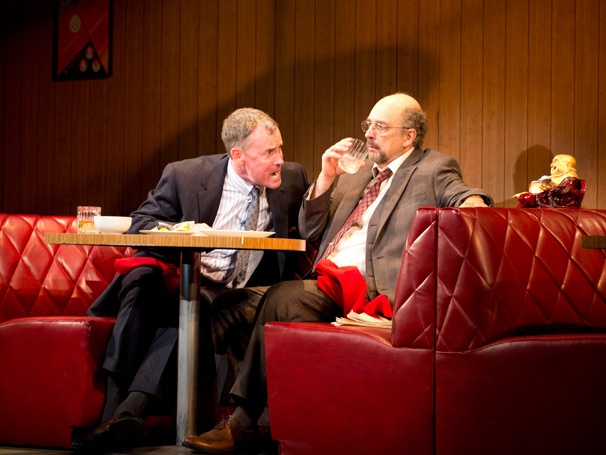
Ohio-born playwright Theresa Rebeck follows up her Broadway comedy Seminar and television series Smash with the slight, sitcomy Dead Accounts. The dysfunctional family tale is set in a kitchen in a house in Cincinnati, where prodigal son Jack (Tony winner Norbert Leo Butz) has suddenly and unexpectedly arrived from New York City, bringing with him numerous pints of Graeter’s ice cream. The charged-up Jack tells his younger sister, the cute Lorna (Katie Holmes), all about how he convinced the guy at the ice-cream shop to let him in, even though it was closed, and sell him a bunch of pints by paying him a thousand dollars. Lorna, who has sacrificed her social life in order to take care of her mother, Barbara (Jayne Houdyshell), and ailing, unseen father, is shocked by Jack’s disregard for the law (yeah, we didn’t get that one either), but she’s about to find out that Jack has done a lot worse and is on the run from both his job and his wife, Jenny (Judy Greer), whom he jokes about having killed. Meanwhile, Jack tries to reconnect to his hometown by hanging out with his childhood friend Phil (Josh Hamilton), who has had a longtime crush on Lorna, and devouring cheese Coneys. (The play features a whole lot of eating and drinking.) As various truths slowly emerge about Jack, things threaten to get even crazier in this small-town madhouse.

Butz gives a bravura performance as the manic-depressive Jack, who seems to live in a different reality from everyone else, but the play is weighed down by Rebeck’s inability to find its center; she sets the story in a kitchen, and she has essentially thrown in everything but the kitchen sink as she takes on religion, politics, Wall Street, environmentalism, love, aging, loneliness, drug addiction, and other topics in a swift two hours (with intermission). Holmes (All My Sons) is good as the shy Lorna, delivering a rousing soliloquy on the state of the nation that earns a well-deserved round of applause, and two-time Tony nominee Houdyshell (Follies, Well) is a joy to watch as always, but Greer, in her Broadway debut, speaks too softly, and Hamilton (The Coast of Utopia) isn’t given much to do with Phil, who seems to have stepped out of a middling sitcom. And continuing the play’s eating theme, the proceedings are dragged down by Rebeck repeatedly biting the hand that feeds her, tearing into big-city New York in favor of small-town Ohio in a mean-spirited way that falls outside the central story and seems to come with a gigantic chip on her shoulder. Fluidly directed by three-time Tony winner Jack O’Brien (The Coast of Utopia, Hairspray), Dead Accounts does have its share of tasty little morsels, especially in the person of Norbert Leo Butz, but it veers off in too many directions as it reaches its curious climax.

THE MYSTERY OF EDWIN DROOD

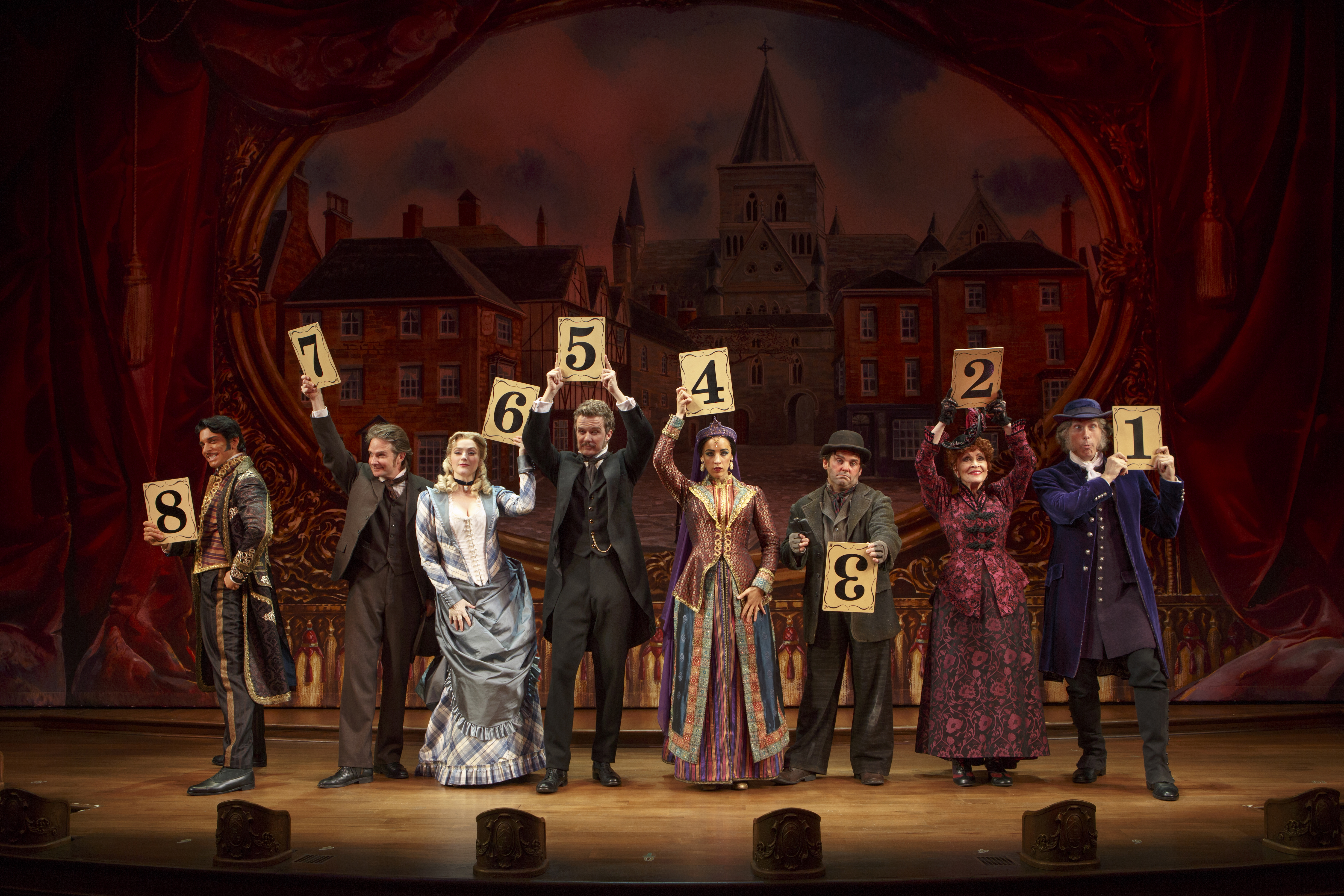
The audience gets to choose the ending and more in Roundabout revival of THE MYSTERY OF EDWIN DROOD (photo by Joan Marcus)

Studio 54
254 West 54th St.
Tuesday – Sunday through March 10, $42-$147
212-719-1300
www.roundabouttheatre.org

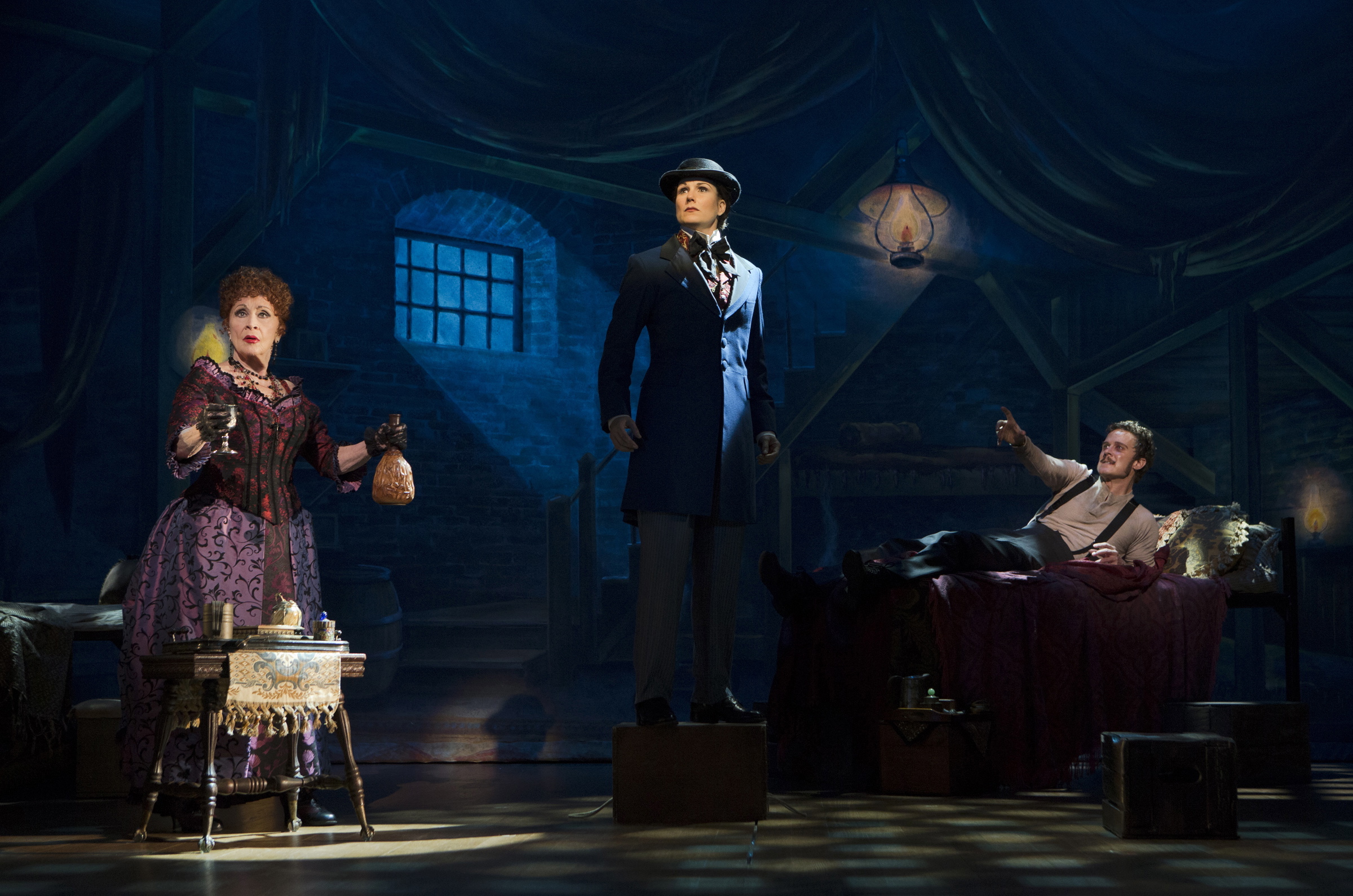
The Mystery of Edwin Drood is back on Broadway for the first time since the original production won five Tonys and nine Drama Desk Awards, and it’s as bawdylicious as ever. Featuring book, music, and lyrics by Rupert Holmes — yes, the man behind “Escape (The Piña Colada Song)” — Drood is a brilliantly imagined take on Charles Dickens’s final novel, half of which was serialized in 1870 before the British writer died at the age of fifty-eight. Dickens’s Victorian tale is set in a frame story, told as if it were being performed by a troupe in London’s Music Hall Royale in 1895. The Drood story itself is regularly interrupted by the master of ceremonies, Mr. William Cartwright (a wonderful Jim Norton), who tries to keep order while directing the wild shenanigans, introducing the characters and their actors and speaking directly to the audience. (Almost everyone interacts with the crowd; be sure to arrive before curtain time, as the actors walk around the theater in character and chat with theatergoers.) Will Chase (Smash) stars as music hall actor Mr. Clive Paget, who plays John Jasper, the mustachioed villain of the show-within-a-show. Church choirmaster Jasper is in love with his student, young buxom blonde Rosa Bud (Betsy Wolfe as Miss Deirdre Peregrine), who is engaged to marry Edwin Drood (Stephanie J. Block as “famous male impersonator” Miss Alice Nutting; Drood is always played by a woman, including, in the past, Betty Buckley and Donna Murphy). Intrigue abounds when a pair of adult orphan siblings from Ceylon, Neville and Helena Landless (Andy Karl and Jessie Mueller as Mr. Victor Grinstead and Miss Janet Conover), are brought to the town by the Reverend Mr. Crisparkle (Gregg Edelman as Mr. Cedric Moncrieffe); the local drunk, Durdles (Robert Creighton as Mr. Nick Cricker), finishes a tomb for the mayor’s dead wife; and Jasper spends the night in an opium den run by the haughty Princess Puffer (Chita Rivera as Miss Angela Prysock, the role originated by Cleo Laine).

Chita Rivera, Stephanie J. Block, and Will Chase star in DROOD revival at Studio 54 (photo by Joan Marcus)

The story unfolds through such terrific production numbers as “There You Are,” “A Man Could Go Quite Mad,” “No Good Can Come from Bad,” and the music-hall troupe’s classic, non-Drood song, “Off to the Races,” but the Drood plot comes to a screeching halt when they reach the part where Dickens died. At that point, it all becomes even more fun as the audience votes on various aspects of the tale, including the identity of the strange detective who has been seen around town and, even more important, the murderer of Edwin Drood, who has disappeared. The plot proceeds from there, potentially different every night. (Try to show some compassion for poor Phillip Bax, amiably played by Peter Benson, who has little to do as Bazzard in the Drood retelling.) Director Scott Ellis (Harvey) and choreographer Warren Carlyle (Chaplin) keep things appropriately light and frothy, filled with playful humor and plenty of double entendres, making for an extraordinarily delightful night of theater.

A CHRISTMAS STORY: THE MUSICAL

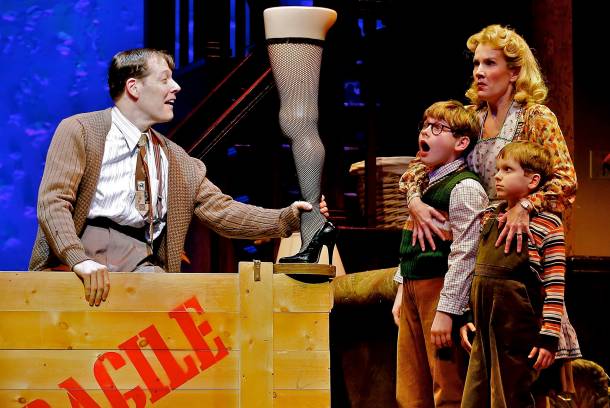
The Old Man (John Bolton) wins a major award in delightful Christmas musical (photo by Carol Rosegg)

Lunt-Fontanne Theatre
205 West 46th St. between Seventh & Eighth Aves.
Through December 30, $49-$159
www.achristmasstorythemusical.com

Bob Clark’s beloved holiday film, the 1983 family classic A Christmas Story, may now become a beloved classic Broadway musical as well with this sparkling Broadway adaptation. Joseph Robinette’s book and Benj Pasek and Justin Paul’s music and lyrics show deep respect for what makes Jean Shepherd’s tale about a young boy’s quest to find a highly coveted BB gun under the tree on December 25 so appealing. Under John Rando’s playful direction, the adult Shepherd (Dan Lauria) wanders the stage narrating his memories as nine-year-old Ralphie Parker (Johnny Rabe or Joe West), a generally good but occasional trouble-prone kid, dreams of receiving the best Christmas present ever. Meanwhile, his little brother, Randy (Zac Ballard), can’t move his arms in his winter coat; their mother (Erin Dilly) sweetly cares for Ralphie when she’s not washing his mouth out with soap for unleashing a dirty word; and their father (John Bolton, whose loose-limbed movement channels Dick Van Dyke), known as the Old Man, gripes and grumbles as he battles the neighbor’s dogs (played by real hounds), manhandles the furnace, and prepares to devour the Christmas turkey. As in Monty Python’s Spamalot, the vignettes in A Christmas Story: The Musical have become familiar favorites, and audiences will start smiling and laughing as many scenes open. The song titles alone let you know what you’re in for: “A Major Award,” “Sticky Situation,” “You’ll Shoot Your Eye Out,” and “Up on Santa’s Lap,” fancifully re-created by choreographer Warren Carlyle and set designer Walt Spangler.

Santa (Eddie Korbich) and his elves frighten young Ralphie (Johnny Rabe) in A CHRISTMAS STORY (photo by Carol Rosegg)

There are several bumps along the way — a few of the production numbers, including “Ralphie to the Rescue!,” are choppy and feel unfinished — but those minor quibbles can be forgiven, overshadowed by the sheer delight of “A Major Award,” in which the Old Man celebrates winning a lurid leg lamp in a crossword puzzle competition; the marvelous flat tire scene; and the splendid depiction of the fantasy/nightmare kids experience when visiting the local department-store Santa (Eddie Korbich). Lauria, who recently starred as legendary Green Bay Packers coach Vince Lombardi on Broadway and is most well known as the father in The Wonder Years — a character who shares much in common with the Old Man — is wonderful as Shepherd, reliving some of his seminal childhood remembrances in 1930s Indiana in a way that resonates with everyone. A Christmas Story: The Musical works because at its core, it’s a universal tale of growing up, of family, of being allowed to make mistakes while learning about the world around you, understanding that life is not as fra-gee-lay as so many other holiday books and movies would lead you to believe. Here’s hoping it shows up under the big Broadway Christmas tree for many a season to come.

SCANDALOUS: THE LIFE AND TRIALS OF AIMEE SEMPLE McPHERSON

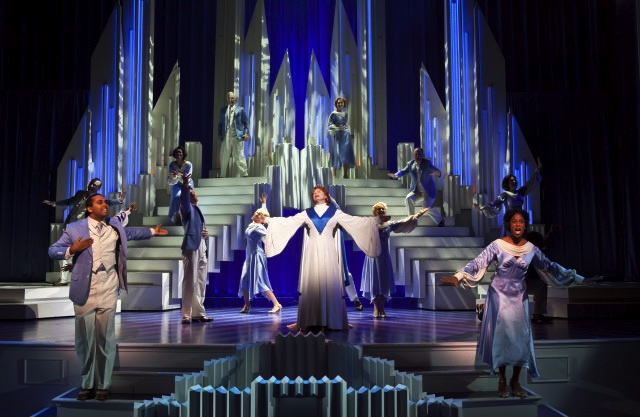
Carolee Carmello desperately tries to save new musical by Kathie Lee Gifford (photo by Jeremy Daniel)

Neil Simon Theater
250 West 52nd St. between Broadway & Eighth Ave.
Tuesday – Sunday through March 31 [new closing date: December 9], $35-$140
www.scandalousonbroadway.com

“Aimee Semple McPherson is a liar and a fake,” declares Asa Keyes (Benjamin Howes) at the beginning of the new Broadway musical Scandalous: The Life and Trials of Aimee Semple McPherson. In response, Emma Jo Schaeffer (Roz Ryan) proclaims, “Sister Aimee saved my life.” The two statements set up the unusual dichotomy that was McPherson, an enigmatic Pentecostal evangelist who was a female radio pioneer and the leader of the popular Angelus Temple in Los Angeles but might best be remembered for her mysterious disappearance at the height of her career. It took ten years for Kathie Lee Gifford — who wrote the book and lyrics, along with additional music — to bring Scandalous to Broadway, but now that it’s here, at the Neil Simon Theatre, it’s likely to follow in its subject’s footsteps and disappear, although not nearly as mysteriously. Two-time Tony nominee Carolee Carmello (Parade, Lestat) is very good as McPherson, spreading the word from high atop a blindingly white pulpit, but Gifford and composers David Pomeranz (who worked with Kathie Lee on her first show, Under the Bridge) and Disney veteran David Friedman make the proceedings feel more like an Up with People concert than a Broadway musical. David Armstrong’s direction is tiresome and repetitive, Lorin Latarro’s (American Idiot) choreography is nearly nonexistent (when it’s not head-scratchingly obvious), and two-time Tony winner George Hearn (Sunset Boulevard, La Cage aux Folles) is sadly, drastically underused. And it’s rarely a good sign when the Playbill includes a slipped-in loose sheet of the musical numbers that reveals that several songs in the second act have been axed. Today show cohost Gifford, whose husband, Frank, went to McPherson’s Foursquare Church when he was a child, spends too much time putting McPherson, and faith in general, up on a pedestal, essentially preaching herself, only without the edge that McPherson seemed to have. “Was she a true woman of God? Or just one helluva woman?” Louella Parsons (Elizabeth Ward Land) asks near the end of the show. Don’t expect to find out — or care — in the trivial Scandalous. [ed. note: On December 4, it was announced that the show would close on December 9, after thirty-one previews and twenty-nine regular performances.]

THE HEIRESS

Jessica Chastain and Dan Stevens make their Broadway debuts as Catherine and Morris in THE HEIRESS (photo by Joan Marcus)

Walter Kerr Theatre
219 West 48th St. between Broadway & Eighth Ave.
Through February 10, $50 – $225
www.theheiressonbroadway.com

A star vehicle onstage and on the silver screen, Ruth and Augustus Goetz’s The Heiress, an adaptation of Henry James’s slim 1880 novel Washington Square, is set in 1850 New York City, where prominent society member Dr. Austin Sloper lives with his daughter, Catherine, a shy, awkward plain Jane he blames for the death of his beloved wife, who died in childbirth. Dr. Sloper asks his wife’s sister, Lavinia, to help Catherine break out of her shell, but he worries when a poor suitor named Morris Townsend comes calling, concerned that he’s really after his daughter’s rather substantial financial future. Over the years, the potent period drama has been performed by several all-star casts, with Wendy Hiller, Jane Alexander, Tony winner Cherry Jones, and Oscar winner Olivia de Havilland as Catherine, Basil Rathbone, Richard Kiley, Philip Bosco, and Ralph Richardson as Dr. Sloper, Peter Cookson, David Selby, Jon Tenney, and Montgomery Clift as Morris, and Patricia Collinge, Jan Miner, Tony winner Frances Sternhagen, and Miriam Hopkins as Aunt Lavinia.

Judith Ivey (right) steals the show in new production of THE HEIRESS starring Jessica Chastain (photo by Joan Marcus)

The latest incarnation, directed by Moisés Kaufman (The Laramie Project, 33 Variations), ends up being a mixed bag, with another big-time cast led by Oscar nominee Jessica Chastain (The Tree of Life, The Help) making her Broadway debut as Catherine, Oscar nominee David Strathairn (Goodnight, and Good Luck.) as her father, Dan Stevens (Downton Abbey) in his Broadway debut as Morris, and multiple Tony winner Judith Ivey stealing the show as Lavinia. Taking place on a lush, elegant set by Derek McLane, the play is overly long at two hours and forty-five minutes with intermission, and Chastain’s portrayal of the mousey Catherine, who prefers to embroider rather than go out on the town, is somewhat dry and flat until it finally picks up steam late in the second act, when she finally decides to take action for herself. Strathairn is excellent as Dr. Sloper, a straightforward man who speaks candidly of his disappointment in Catherine, continually crushing her spirit. Stevens is solid as Morris, who professes his love for Catherine even after walking out on her, although the chemistry between Chastain and him never quite ignites. The play is most alive when Ivey is onstage, chattering away as Lavinia, her every movement and vocal twist a work of art, wearing fabulous black dresses that complement her niece’s more colorful gowns. All these years later, The Heiress is showing its age, but this new version still contains just enough memorable moments to make it worth revisiting.