this week in broadway

KINKY BOOTS

(© Matthew Murphy)

Down-in-the-dumps shoe factory gets new life in flashy Broadway musical (© Matthew Murphy)

Al Hirschfeld Theatre
302 West 45th St. between Eighth & Ninth Aves.
Tuesday – Sunday through September 1, $57 – $137
www.kinkybootsthemusical.com

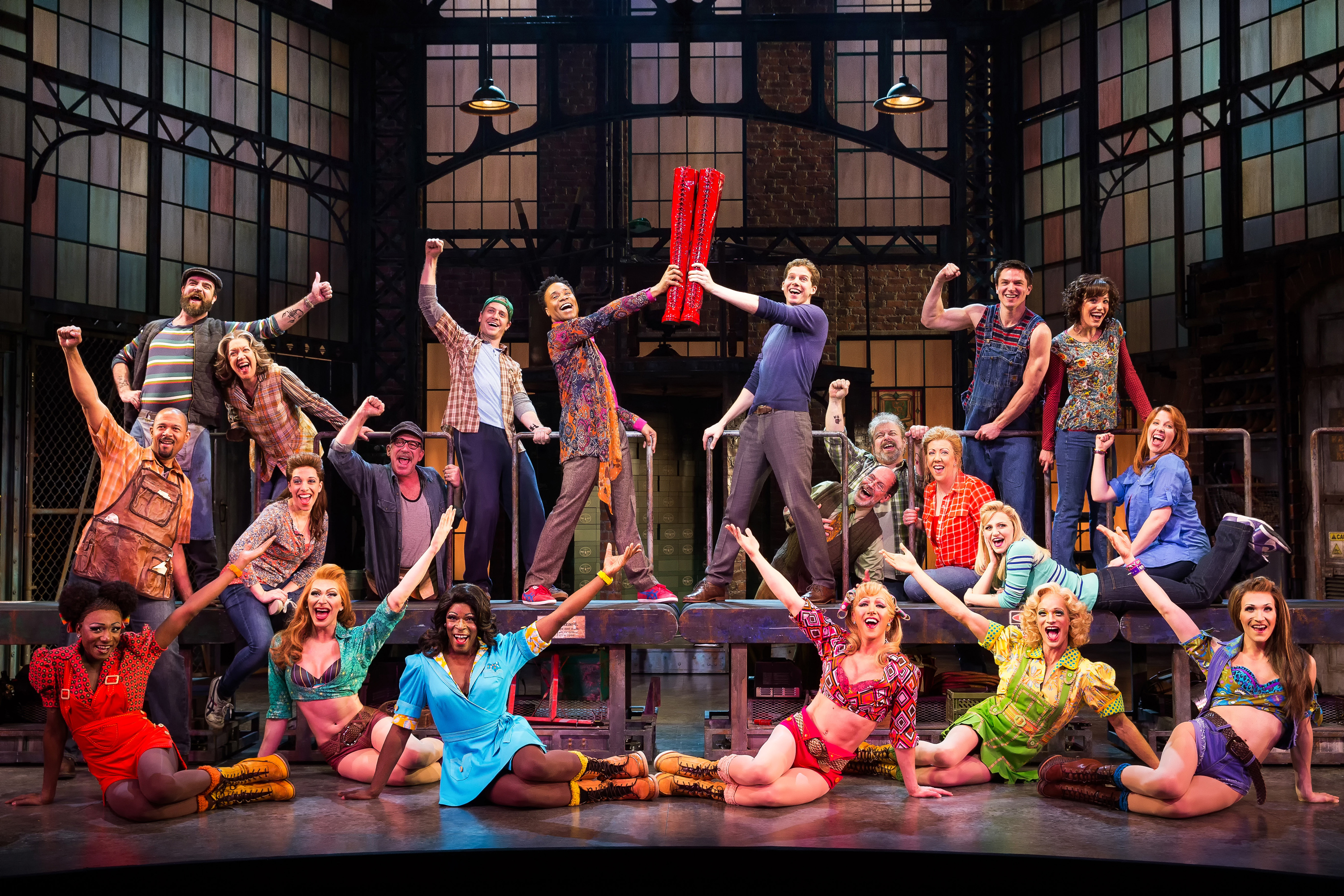
Adapted from the 2005 film that itself was inspired by a true story, Kinky Boots has marched onto Broadway looking fabulous while trying its best to balance itself on a pair of shaky, uneven, extremely high heels. It arrives with behind-the-scenes star power: Harvey Fierstein wrote the book, pop star Cyndi Lauper composed the music and lyrics, David Rockwell designed the set, and Jerry Mitchell, who will be awarded the “Mr. Abbott” Award for Lifetime Achievement in the American Theatre next month, directs and choreographs the splashy musical. Unfortunately, the problems start at the top, with underwhelming performances from Stark Sands (American Idiot, Journey’s End) as Charlie Price, who has been born into a shoemaking Northampton family but has bigger dreams than going into the family business, and Billy Porter (Miss Saigon, Grease, Dreamgirls) as Simon/Lola, a transvestite entertainer who teams up with Charlie to try to save the factory by designing sexy boots for men who dress up as women, exemplified by Lola’s sparkly — and, yes, definitely male — angels, played with plenty of panache by Paul Canaan, Kevin Smith Kirkwood, Kyle Taylor Parker, Kyle Post, Charlie Sutton, and Joey Taranto. But while Charlie plans to unveil the new line at a Milan fashion show, his fiancée, Nicola (Celina Carvajal), wants him to close the factory and move with her to London to start their new life together. Meanwhile, the factory workers, many of whom have followed in their parents’ footsteps, are caught in between, with tough, rugged Don (Daniel Stewart Sherman) representing the traditional, old-fashioned side of things and Lauren (Annaleigh Ashford) willing to do whatever it takes to keep Price & Son running.
(© Matthew Murphy)

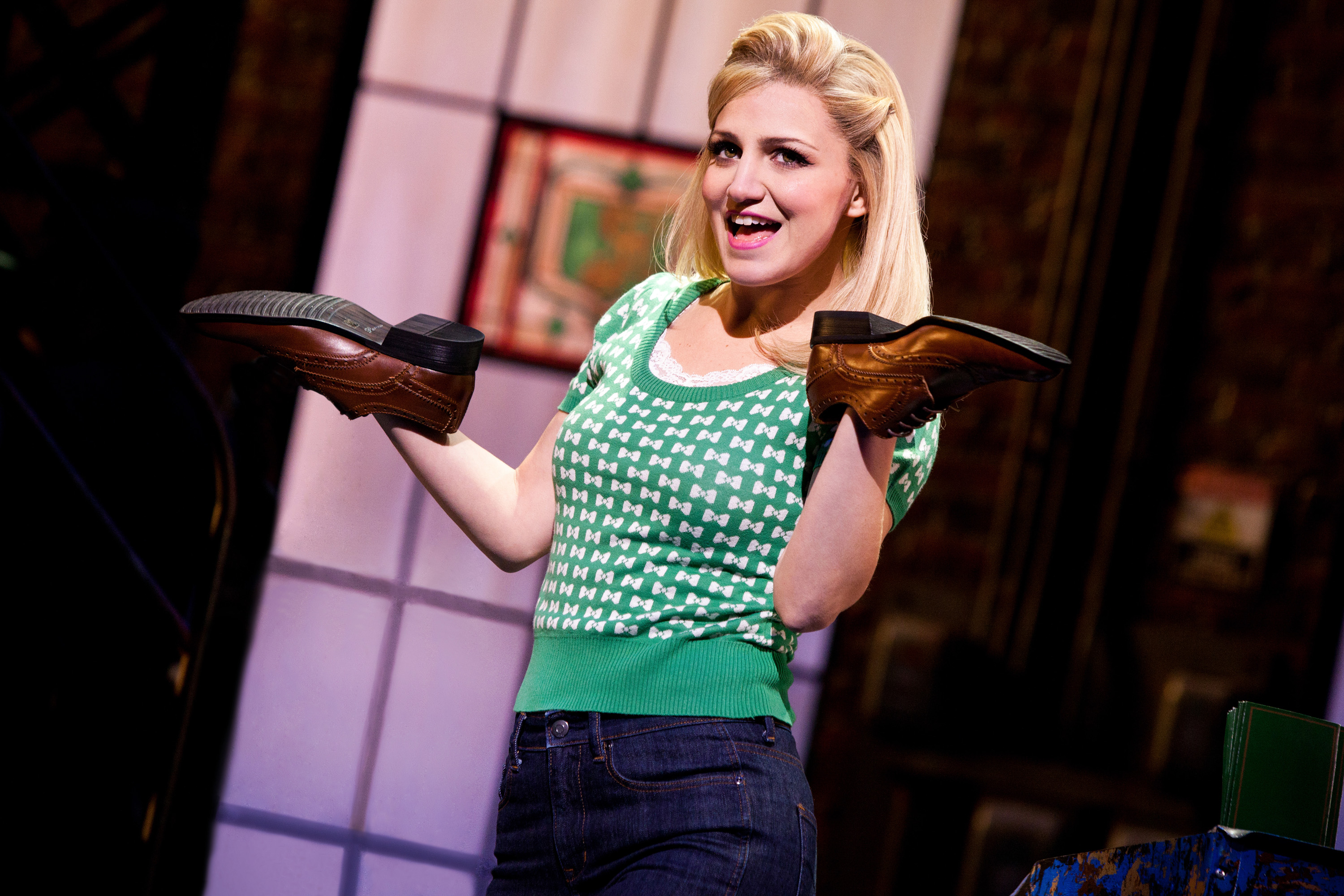
Annaleigh Ashford steals the show as factory worker with her own dreams (© Matthew Murphy)

Sands is rather vanilla as Charlie, never really inhabiting the role, and Porter, taking on the part that earned Chiwetel Ojiofor a much-deserved Golden Globe nomination, stumbles over some line deliveries and doesn’t quite hit the necessary high notes, but Rockwell’s exciting movable set and a dazzling turn by Ashford (Hair, Wicked, Legally Blonde), who virtually steals the show with her knockout solo “The History of Wrong Guys,” help keep things on track, along with Gregg Barnes’s appropriately glitzy/trashy costumes. The second act is stronger than the first, although a boxing match between Don and Simon goes too far as Fierstein begins to fall into the same trap Jarrold did with the film, trying too hard to make its point about individuality and acceptance. Lauper’s score, which often references 1980s hits, featuring such songs as “Sex Is in the Heel,” “I’m Not My Father’s Son,” and the first-act ender “Everybody Say Yeah,” is strong if not quite as Broadway redefining as one might hope. Even with its bumpy, sometimes lumbering gait, Kinky Boots is a glittery, sparkly extravaganza, loaded with fun for divas of all shapes and sizes.
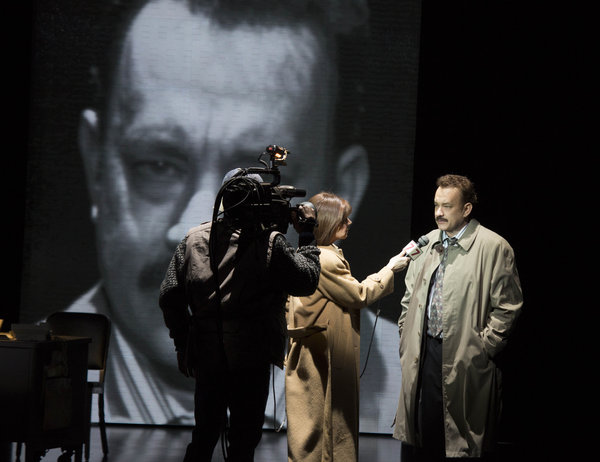
LUCKY GUY

(photo by Joan Marcus)

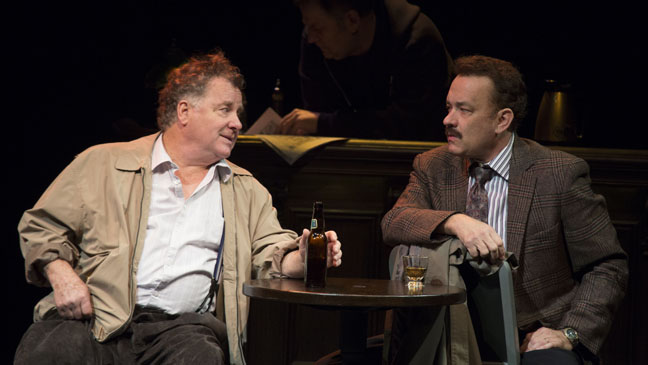
John Cotter (Peter Gerety) mentors Mike McAlary (Tom Hanks) on New York City journalism in LUCKY GUY (photo by Joan Marcus)

Broadhurst Theatre
235 West 44th St. between Broadway & Eighth Ave.
Tuesday – Sunday through June 16, $87-$152
www.luckyguyplay.com

Tom Hanks makes a terrific Broadway debut as New York City journalist Mike McAlary in Nora Ephron’s consistently entertaining Lucky Guy. Hanks, who won back-to-back Oscars in 1993-94 for Philadelphia and Forrest Gump and starred in Ephron’s Sleepless in Seattle and You’ve Got Mail, uses his general likability to endear the audience to McAlary, a fiercely ambitious reporter who shifted between New York Newsday, the Daily News, and the Post from 1985 to 1998, breaking some of the most important stories of that time, including the 77th Precinct corruption scandal, which made his career. The show is set up as a kind of Irish wake, with a group of McAlary’s colleagues drinking and telling stories about the Pulitzer Prize winner’s life and dedication to his chosen field. Among them are Courtney B. Vance as his longtime editor, Hap Hairston; Hanks’s former Bosom Buddies costar Peter Scolari as Daily News scribe Michael Daly; Peter Gerety as mentor John Cotter; Michael Gaston as subway columnist Jim Dwyer; Richard Masur as bombastic newspaper editors Jerry Nachman and Stanley Joyce; and Danny Mastrogiorgio as journalist Bob Drury. Maura Tierney, in her Great White Way debut as well, plays McAlary’s wife, Alice, who spent many a night worrying about his safety as he investigated dangerous stories, while Christopher McDonald is his fast-talking lawyer, Eddie Hayes. David Rockwell’s scenic design evokes the look and feel of a city newsroom, with lots of smoking, cursing (much of it courtesy of Deirdre Lovejoy as reporter Louise Imerman), drinking, and fighting for “the wood” — the story that is teased at the top of the front page, while a big logo at the rear of the stage announces which paper McAlary is writing for at that time.

Journalist Mike McAlary (Tom Hanks) becomes part of the story in LUCKY GUY (photo by Joan Marcus)

Journalist Mike McAlary (Tom Hanks) becomes part of the story in LUCKY GUY (photo by Joan Marcus)

Ephron, who spent part of her early career as a journalist, did plenty of research in writing Lucky Guy, and she pulls no punches in portraying McAlary — whose battle with cancer while still trying to do his job was an inspiration to Ephron, who was fighting myelodysplastic syndrome while finishing this play — warts and all, exploring his jealousy of Jimmy Breslin, his lack of loyalty to his employers, his near-fatal drunk-driving accident, and his famous failure when he refuses to back off of a story that implodes in his face. Ephron also avoids overplaying the sympathy card as the cancer begins to eat away at him. Director George C. Wolfe keeps things moving smoothly even as the characters go from reenacting the various tales to addressing the audience directly, sharing personal insights into McAlary and New York City journalism. Despite being about a man who tragically died too young, at the age of forty-one, written by a woman who also died tragically, at the age of seventy-one, both of whom still had a lot to give to this world, Lucky Guy manages to be a funny, irreverent, and, ultimately, uplifting two hours, led by an immensely talented actor who has seamlessly made the transition from Hollywood to Broadway.

ANN

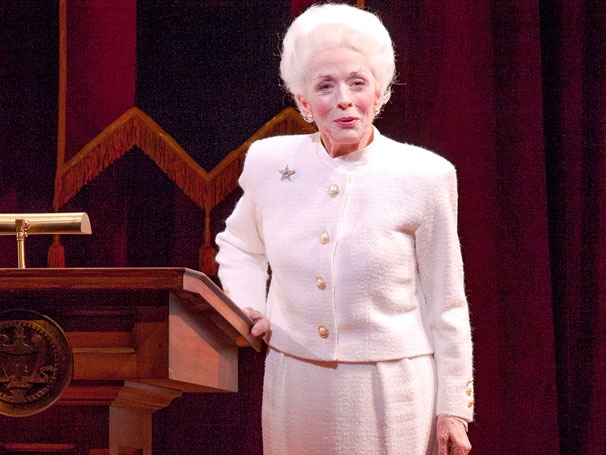
Ann Richards

Holland Taylor stars as Ann Richards in one-woman show she also wrote

Vivian Beaumont Theater at Lincoln Center Theater
150 West 65th St. between Broadway & Amsterdam Ave.
Tuesday – Saturday through June 9, $75-$125
212-362-7600
www.lct.org
www.theannrichardsplay.com

Fiery politician Ann Richards was a true star, giving a memorable keynote address at the 1988 Democratic National Convention and later serving as governor of Texas. Emmy-winning actress Holland Taylor (The Practice, Two and a Half Men) embodies the dedicated reformer in the one-woman show Ann, which she also wrote. Based on six years of intensive research, Ann opens with Taylor, wearing an eye-catching white suit and Richards’s trademark white coiffure, as Ann delivering an address at a fictional college, the audience standing in for the student body. She depicts Richards as an engaging, entertaining, very smart, and open and honest woman not afraid to speak her mind about her professional and personal life, including discussing her severe alcoholism and painful divorce. The play, directed by Benjamin Endsley Klein (resident director of War Horse), slows down considerably when Richards is in her gubernatorial office, answering multiple phone calls, yelling for her assistant, and shuffling through papers. Although it’s meant to show her as a bold and brash administrator fighting for the little person, it’s repetitive and not nearly as interesting as when she’s reflecting on her life and career directly with the audience. The play comes alive again when she returns to the podium, discussing her battle with cancer and hope for the future of America. Taylor is dazzling as Richards, capturing the spirit and dedication of a sharp, brave woman who was determined to make a difference and did. In an author’s note, Taylor writes that Richards is “someone I do think of now as a friend I know pretty well, and love”; after two hours, the audience is bound to feel the same.

CAT ON A HOT TIN ROOF

(photo by Joan Marcus)

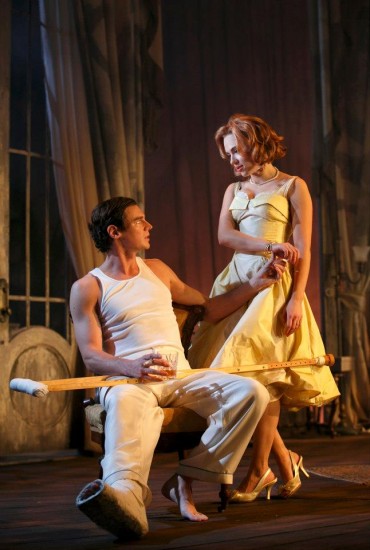
Brick (Benjamin Walker) and Maggie (Scarlett Johansson) smell the odor of mendacity in Broadway revival of CAT ON A HOT TIN ROOF (photo by Joan Marcus)

Richard Rodgers Theatre
226 West 46th St. between Seventh & Eighth Aves.
Through March 30, $27-$132
877-250-2929
www.catonahottinroofbroadway.com

Over the last two years, there has been a plethora of Tennessee Williams revivals on and off Broadway in celebration of the centennial of the Mississippi-born playwright’s birth in 1911, including In Masks Outrageous and Austere, In the Bar of a Tokyo Hotel, Vieux Carré, and A Streetcar Named Desire. The latest is a new Broadway production of Cat on a Hot Tin Roof, which initially debuted on the Great White Way in 1955 and was last seen on Broadway in an all-black version in 2008. The problems with this current revival, directed by Rob Ashford (How to Succeed in Business Without Really Trying), are evident from the very start, as the audience applauds over the opening lines spoken by Scarlett Johansson as Maggie the Cat and continues with Ciarán Hinds’s understated Big Daddy, Debra Monk’s goofy Big Mama, and Benjamin Walker’s barely there Brick. Cat on a Hot Tin Roof demands big, over-the-top performances to hide its relatively basic story line of a family hunkering for a big inheritance when they believe their patriarch to be seriously ill, in addition to a classic Williams subplot of a character having trouble facing his possible homosexuality. It’s not so much that the actors have to deal with the memories of such previous Cat stage and film superstars as Burl Ives, George Grizzard, Charles Durning, and James Earl Jones as Big Daddy, Ben Gazzara, Paul Newman, and Terrence Howard as Brick, and Elizabeth Taylor, Kathleen Turner, and Barbara Bel Geddes as Maggie. Instead, Ashford presents the play as a subdued tale lacking nuance; the audience keeps waiting for electricity and explosions that never happen. Christopher Oram’s set, a large, wide-open bedroom, turns into Grand Central Terminal as characters keep traipsing through, denying Maggie and Brick any privacy as the odor of mendacity increases. This production of Williams’s second Pulitzer Prize winner — Streetcar also garnered the honor — would have been better served in a smaller off-Broadway house than under the glaring lights of the Great White Way.

PICNIC

(photo by Joan Marcus)

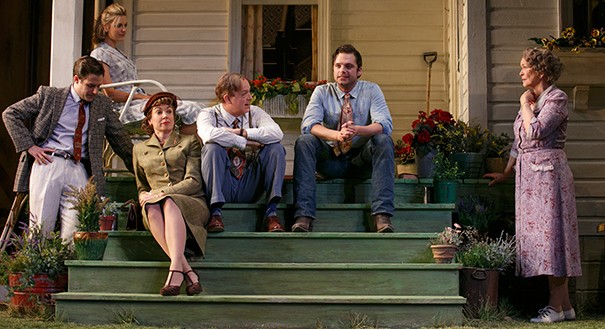
Pulitzer Prize–winning PICNIC looks at a day in the life of small-town America (photo by Joan Marcus)

American Airlines Theatre
227 West 42nd St. between Broadway & Eighth Ave.
Through February 24, $42-$127
212-719-1300
www.roundabouttheatre.org

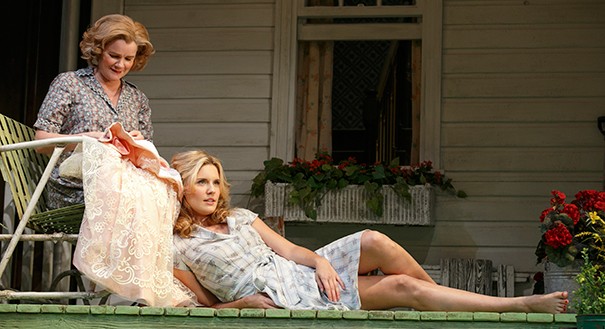
It’s been nearly sixty years since William Inge’s Pulitzer Prize–winning Picnic debuted on Broadway, with Ralph Meeker’s Hal and Paul Newman’s Alan battling over Janice Rule’s Madge; in the 1955 film, it was William Holden and Cliff Robertson with more than just their eyes on Kim Novak. So while the Roundabout’s current revival of Picnic at the American Airlines Theatre doesn’t boast quite the star power of those versions, it is still a charming and fun frolic through a bygone era. The two-hour play takes place in a small Kansas town in 1950s America that is preparing for the annual Labor Day picnic. Local beauty queen Madge Owens (Lost’s Maggie Grace) assumes she’ll be going to the picnic with Alan Seymour (Ben Rappaport), a relatively boring and self-satisfied college student from a wealthy family, along with her younger sister, the tomboy Millie (Californication’s Madeleine Martin), and their somewhat dowdy mother, Flo (Emmy winner Mare Winningham), whose husband walked out on her many years before, leaving her to raise her children on her own. The Owens family lives next door to Helen Potts (Oscar, Emmy, and Tony winner Ellen Burstyn), an older woman who has given up whatever life she could have had in order to care for her ailing mother. To get a cheap thrill, Helen hires a stranger, Hal Carter (Gossip Girl’s Sebastian Stan), to do some yard work for her, barely able to control herself when the Adonis-like man rips off his shirt, revealing his taut, sweaty chest. All of the other women notice as well, including spinster schoolteacher Rosemary Sydney (four-time Obie winner Elizabeth Marvel), who has been dating dull but reliable businessman Howard Bevans (two-time Obie winner Reed Birney). It turns out that Hal is a down-on-his-luck former fraternity brother of Alan’s who has come to town to get back on his feet, but after he is instantly attracted to Madge — and perhaps vice versa — things don’t exactly end up as planned.

(photo by Joan Marcus)

Madge (Maggie Grace) shares her hopes and dreams with her mother, Flo (Mare Winningham), in Roundabout revival of William Inge’s PICNIC (photo by Joan Marcus)

In Picnic, Inge, who also wrote such plays as Bus Stop and Come Back, Little Sheba and won an Oscar for his screenplay for Splendor in the Grass, cleverly deals with people’s hopes, dreams, and expectations in this funny, tender, and tense drama that explores the soft underbelly lying beneath the old-fashioned values of small-town America. Surprisingly, the acting is a mixed bag, with Marvel overplaying her part, Winningham underplaying hers, and Burstyn at times seeming to be lost while Grace, Birney, and Martin are more effective. Director Sam Gold (Look Back in Anger, Seminar) makes excellent use of Andrew Lieberman’s charming set, a shared backyard that firmly sets the action in America’s heartland. When Madge is up in her room, applying her makeup in front of a window that looks out on the backyard, the audience is sneaking a peek at her just as several characters are doing, everyone dreaming of the possibilities life holds for us all. In a season dominated by revivals of long-ago Broadway classics, including Golden Boy, The Heiress, Who’s Afraid of Virginia Woolf? and Cat on a Hot Tin Roof, Picnic is a fine addition.

THE OTHER PLACE

(photo by Joan Marcus)

Real-life mother and daughter Laurie Metcalf and Zoe Perry star in Sharr White’s fascinating THE OTHER PLACE (photo by Joan Marcus)

Manhattan Theatre Club at the Samuel J. Friedman Theatre
261 West 47th St. between Broadway & Eighth Aves.
Tuesday – Sunday through March 3, $67-$120
www.theotherplacebroadway.com

Three-time Emmy winner Laurie Metcalf won both an Obie and a Lucille Lortel Award for her 2011 off-Broadway portrayal of neurologist Juliana Smithson in Sharr White’s The Other Place, and now she has a strong shot at a Tony as the play moves to Broadway in the gripping MTC production at the Samuel J. Friedman. Metcalf stars as Juliana, a pharmaceutical pitch-woman who suffers an “episode” while on the road touting a new wonder drug. Long estranged from her daughter (Zoe Perry, Metcalf’s real-life daughter, in her Broadway debut) and accusing her doctor-husband, Ian (Daniel Stern), of having an affair with her much-younger doctor (Perry again), Juliana is trying to hold herself together even as she believes she has brain cancer. But as the complex, highly cinematic play continues, it becomes evident that she is suffering from something very different, and in many ways far more frightening.

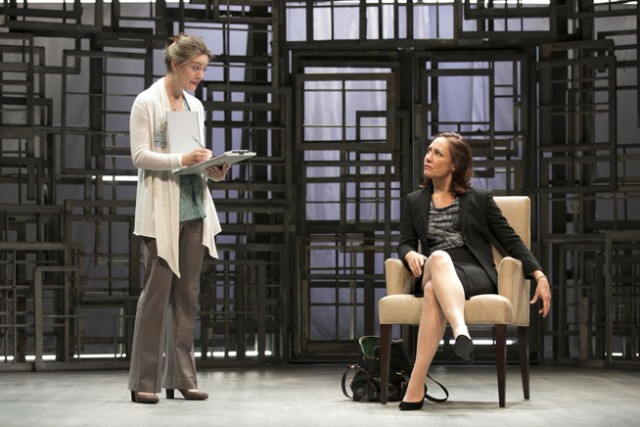
White and Tony-winning director Joe Mantello (Other Desert Cities, Wicked, Love! Valour! Compassion!) tell Juliana’s harrowing story by going back and forth between the past and the present, as Justin Townsend’s lighting signals the time shifts. The action takes place within set designers Eugene Lee and Edward Pierce’s semicircular web of bleak gray frames (hiding lights and speakers) that serve as doors, windows, and mirrors while also evoking the misfiring synapses of Juliana’s brain. Metcalf (Rosanne, November) gives a dazzling performance as Juliana, an intelligent, scientific woman who doesn’t understand — and is unwilling to accept — what is happening to her. As the audience filters into the theater, she is already onstage, sitting in a chair, fiddling with her cell phone, helping the incoming crowd instantly identify with her. But soon it’s Ian, strongly portrayed by Stern, who is standing in for the audience as the truth is slowly revealed. Despite a few missteps — primarily a somewhat baffling finale that takes things much too far — The Other Place is an involving eighty minutes of fascinating theater, expertly told and brilliantly acted.

BROADWAY WEEK 2013

broadway week

January 22 – February 7
www.nycgo.com/broadwayweek

Ticket prices on the Great White Way getting you down? During Broadway Week, which is actually seventeen days long (January 22 to February 7), you can get two-for-one tickets to nineteen shows, from such long-running musicals as Jersey Boys, Chicago, The Phantom of the Opera, and Wicked to such outstanding plays as Picnic, The Other Place, and Who’s Afraid of Virginia Woolf? and such newer musicals as The Mystery of Edwin Drood, Once, and Newsies. And for an extra twenty bucks, you can upgrade your seats. The only Broadway Week participant that is currently sold out is The Lion King, but you better act fast if you want to score some tickets to any of the other eighteen productions, which also include Spider-Man: Turn Off the Dark, Rock of Ages, and The Heiress, starring Oscar nominee Jessica Chastain.