this week in broadway

WHO’S AFRAID OF VIRGINIA WOOLF?

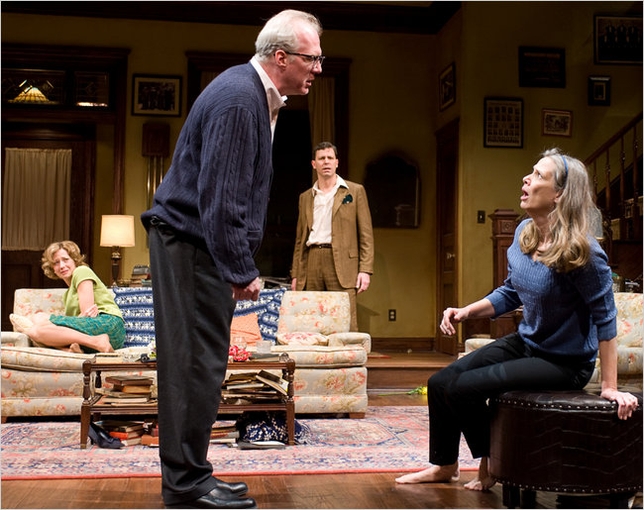
Tracey Letts and Amy Morton go at it in Steppenwolf production of Edward Albee classic (photo by Michael Brosilow)

Booth Theatre
222 West 45th St. between Broadway & Eighth Ave.
Tuesday – Sunday through February 24, $67 – $132
www.virginiawoolfbroadway.com

George and Martha might be “sad, sad, sad,” as half of the characters lament in Edward Albee’s Who’s Afraid of Virginia Woolf?, but it’s still electrifying to spend three hours with the supremely dysfunctional First (Fictional) Couple of American Theater. In the magnificent Steppenwolf production that opened at the Booth on October 13, exactly fifty years after Albee’s iconic work made its Broadway debut at the Billy Rose, Pulitzer Prize–winning playwright Tracy Letts is a marvel onstage as George, an intensely cynical, beat-down history professor at a small, prestigious New England college. George is married to the deliciously wicked Martha (a terrific Amy Morton), whose father is the college president; six years older than her husband, she never misses an opportunity to shred him. One very late night after a campus party, new biology teacher Nick (a wonderfully smug and smirking Madison Dirks) and his wife, the ditzy Honey (a splendidly quirky Carrie Coon), are invited for a nightcap at George and Martha’s home, where things go from bad to worse as George lights into Martha and Nick, Martha lights into George and lights up to Nick, and Honey has trouble holding her liquor, plenty of which flows throughout. As Honey and Nick are caught up in George and Martha’s extremely nasty games — actually, they are given no choice — secrets both big and small come out, creating an intoxicating tension that threatens to explode at any moment, and finally does.

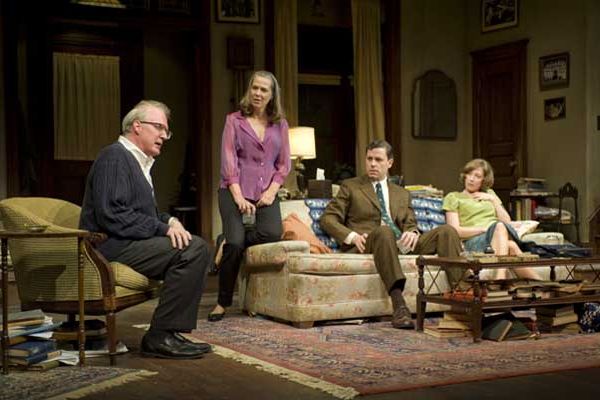
WHO’S AFRAID OF VIRGINIA WOOLF? is as alive as ever after fifty years (photo by Michael Brosilow)

Director Pam MacKinnon (Clybourne Park) gives every marvelous word the prominence it deserves as the four characters make their way around Todd Rosenthal’s appropriately messy set, as much in disarray as the lives of the protagonists. (There’s even a working clock in one corner that keeps time within the show.) Playing roles that have previously been performed by such pairs as Arthur Hill and Uta Hagen in the original Broadway production, Ben Gazzara and Colleen Dewhurst in 1977, Bill Irwin and Kathleen Turner in the 2005 revival, and, most famously, Richard Burton and Elizabeth Taylor in Mike Nichols’s 1966 film, Letts and Morton give the dueling couple a unique resonance all their own, perhaps because they have been working opposite each other very often at Steppenwolf since 1999. They are a justly celebrated pair: Letts earned a Pulitzer for writing August: Osage County, while Amy was nominated for a Tony for her performance in the play. In his Broadway acting debut, Letts is a revelation, dominating the stage with his eyes as well as his razor-sharp barbs, although Morton manages to go toe-to-toe with him. Who’s Afraid of Virginia Woolf? is an intricately woven web of love and hate, of marriage and infidelity, of loyalty and betrayal, as past, present, and future collide over way too much bourbon and brandy. It is no mere accident that George is a history professor, stuck in the past, and Nick is in the biology department, where science is delving into genetic research. Albee’s play holds up remarkably well; it might be fifty years old, but it feels as fresh as ever, cementing its place in the past, present, and future of American theater.

CHAPLIN

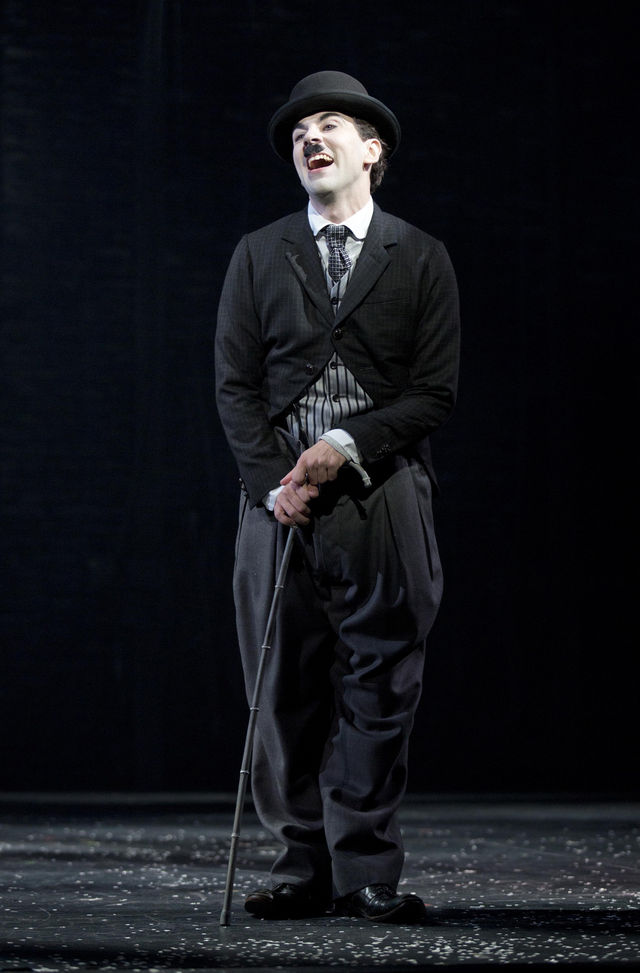
Rob McClure embodies the Little Tramp in new Broadway musical about Charlie Chaplin (photo by Joan Marcus)

Ethel Barrymore Theatre
243 West 47th St. between Broadway & Eighth Ave.
Through February 3, $49.50 – $135.50
www.chaplinbroadway.com

From his Dickensian upbringing to Hollywood stardom to his penchant for underage women and his long exile overseas, followed by a final redemption, Charles Spencer Chaplin lived quite a life, something book writers Christopher Curtis and Thomas Meehan are only partially successful in bringing to the big stage with Chaplin. The new musical, directed and choreographed by Warren Carlyle, glories, perhaps a bit too much, in Rob McClure’s dazzling performance as Chaplin, embodying the multitalented actor, writer, director, musician, composer, political rebel, and womanizer whose socially relevant silent comedies brightened up hard times in America during the 1920s and 1930s. The show starts in London, as young Charlie (a charming Zachary Unger) grows up in the seedy alleys and burlesque clubs with his mother, Hannah (an outstanding Christiane Noll), a bawdy performer whose husband has essentially abandoned the family. An older Charlie soon catches a break and is working for Mack Sennett (a strong Michael McCormick) in Hollywood; the scene in which Charlie is ordered to be funny and transforms into the Little Tramp is splendidly done, adding a deft touch of magic to the invention of this seminal character. Hiring his brother, Sydney (Wayne Alan Wilcox), as his business manager, Charlie finds massive success with such films as The Kid, The Gold Rush, and The Circus, but the musical oddly chooses which to focus on; while Carlyle does a good job equating The Kid with Chaplin’s real-life experiences as a child (clever casting has Unger also playing Jackie Coogan), shorter (or stranger) shrift is given to such critical works as City Lights and Modern Times, and later films such as Monsieur Verdoux and Limelight warrant nary a mention, despite their many inside references to his personal situations.

The musical does, however, devote a major sequence to The Great Dictator that reveals the development of his public political persona. But in the second act, Chaplin spends way too much time concentrating on Hedda Hopper’s (Jenn Colella) mission to destroy Chaplin by labeling him a communist in order to get even for his refusal to be interviewed by her. And the musical deals with Chaplin’s ultimately disastrous marriages to Mildred Harris (Hayley Podschun), Lita Grey, and Paulette Goddard in a baffling boxing scene that sideswipes the show, while his relationship with Oona O’Neill (Erin Mackey) swoops in from nowhere and then essentially disappears. Beowulf Boritt’s sets, Amy Clark and Martin Pakledinaz’s costumes, and Ken Billington’s lighting, along with Jon Driscoll’s inventive video projections, give Chaplin the look and feel of a black-and-white movie, but few of the songs stand out, aside from Noll’s “Look at All the People” and the ensemble piece “Just Another Day in Hollywood.” Much like Chaplin’s career, Chaplin kicks off with quite a bang but eventually dissipates into the disappointment of what could have been.

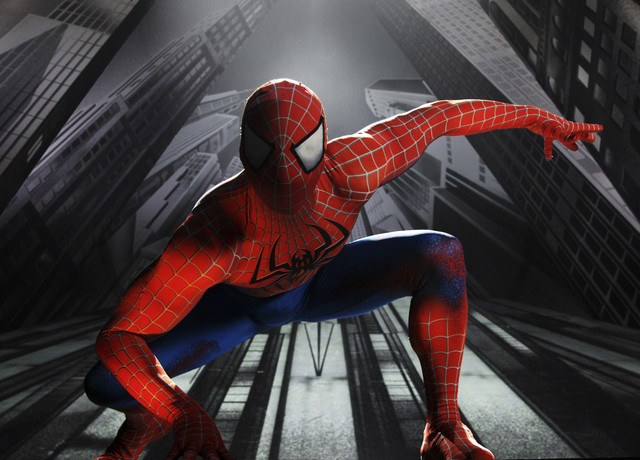
SPIDER-MAN: TURN OFF THE DARK

SPIDER-MAN flies both high and low on Broadway

Foxwoods Theatre
213 West 42nd St. between Broadway & Eighth Ave.
Tuesday – Sunday through January 4, $77.50 – $157.50
spidermanonbroadway.marvel.com

Forget about all the controversy, the delayed official openings, the injuries to performers from equipment problems, the departure of original director Julie Taymor, and all of the other bizarre elements that made Spider-Man: Turn Off the Dark the talk of Broadway for months and months on end. What it all really comes down to is this: Is it any good? And the answer is a resounding: No, it’s not really very good at all. The big-budget musical about a teenage science geek who suddenly becomes a superhero is an overblown spectacle with forgettable music and lyrics by Bono and the Edge, a meandering book by Taymor, Glen Berger, and Roberto Aguirre-Sacasa, and an uncomfortable mix of low-budget DIY staging and high-tech gadgetry. Reeve Carney stars as Peter Parker, a nerdy kid who is bitten by a spider while on a school trip to the lab of cutting-edge scientist Norman Osborn (Drama Desk-nominated Patrick Page). Peter quickly develops special powers that soon find him soaring over the Big Apple, protecting New York City from evil. Like every superhero, he needs an arch villain, who arrives in the form of the Green Goblin (Page), the result of one of Osborn’s experiments gone terribly wrong. As the Green Goblin and his Sinister Six ― Swarm (Drew Heflin), the Lizard (Julius C. Carter), Electro (Maxx Reed), Kraven the Hunter (Emmanuel Brown), Carnage (Adam Roberts), and Swiss Miss (Reed Kelly) ― terrorize the city, Spider-Man must choose between fighting crime or settling down with the love of his life, Mary Jane Watson (Rebecca Faulkenberry).

There are some dazzling moments ― director Philip Wm. McKinley and choreographers Daniel Ezralow and Chase Brock do a wonderful job introducing Arachne (Christina Sajous) and her small contingent, who magically descend from above on fabulously flapping fabric inspired by weaving techniques, and an unfolding Chrysler Building is breathtaking ― but most of the scenes are flat and uninspired. Even the justly celebrated flying gets played out and repetitive, and the supposed showstopping act two opener, “A Freak Like Me Needs Company,” in which the Green Goblin introduces his crew of baddies, insultingly breaks down the barrier between performer and audience, a mistake from which it never recovers. Nominated for two Tonys (for Best Scenic Design and Best Costume Design of a Musical), Spider-Man: Turn Off the Dark, which recently welcomed its one millionth visitor, is unable to break free from a tangled web of its own making. (In honor of the show’s two Tony nominations, the first one hundred people with the name Anthony, Tony, Antoinette, Toni, Antonia, or Antonio who come to the Foxwoods Theatre box office on June 4 at 10:00 am will receive a coupon for a pair of free tickets to the Sunday matinee on June 10.)

ONCE: A NEW MUSICAL

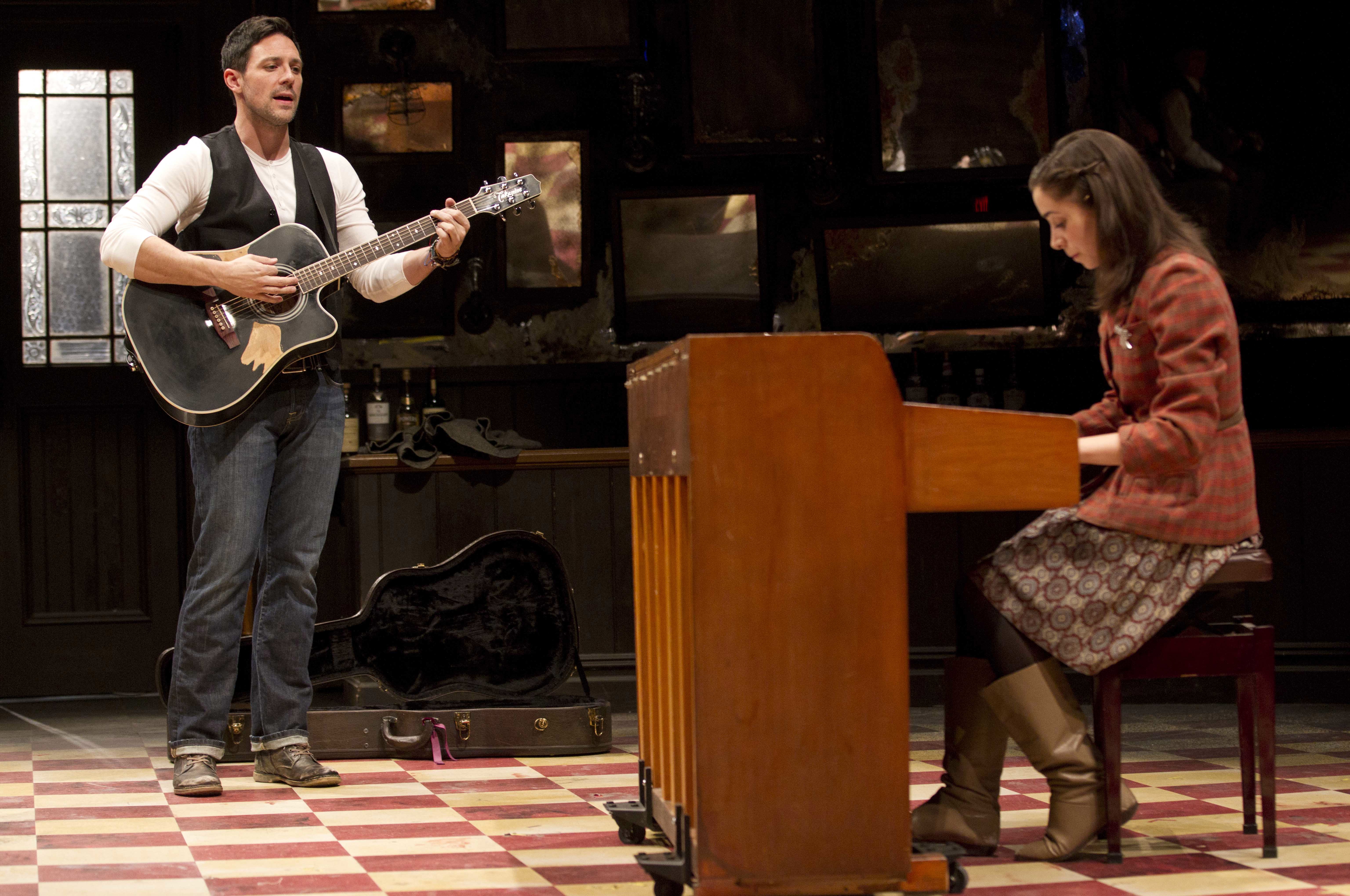
Steve Kazee and Cristin Milioti make beautiful music together in Broadway adapation of ONCE (photo © 2011 by Joan Marcus)

Bernard B. Jacobs Theatre
242 West 45th St. between Broadway & Eighth Ave.
Tickets: $59.50 – $186.50
oncemusical.com

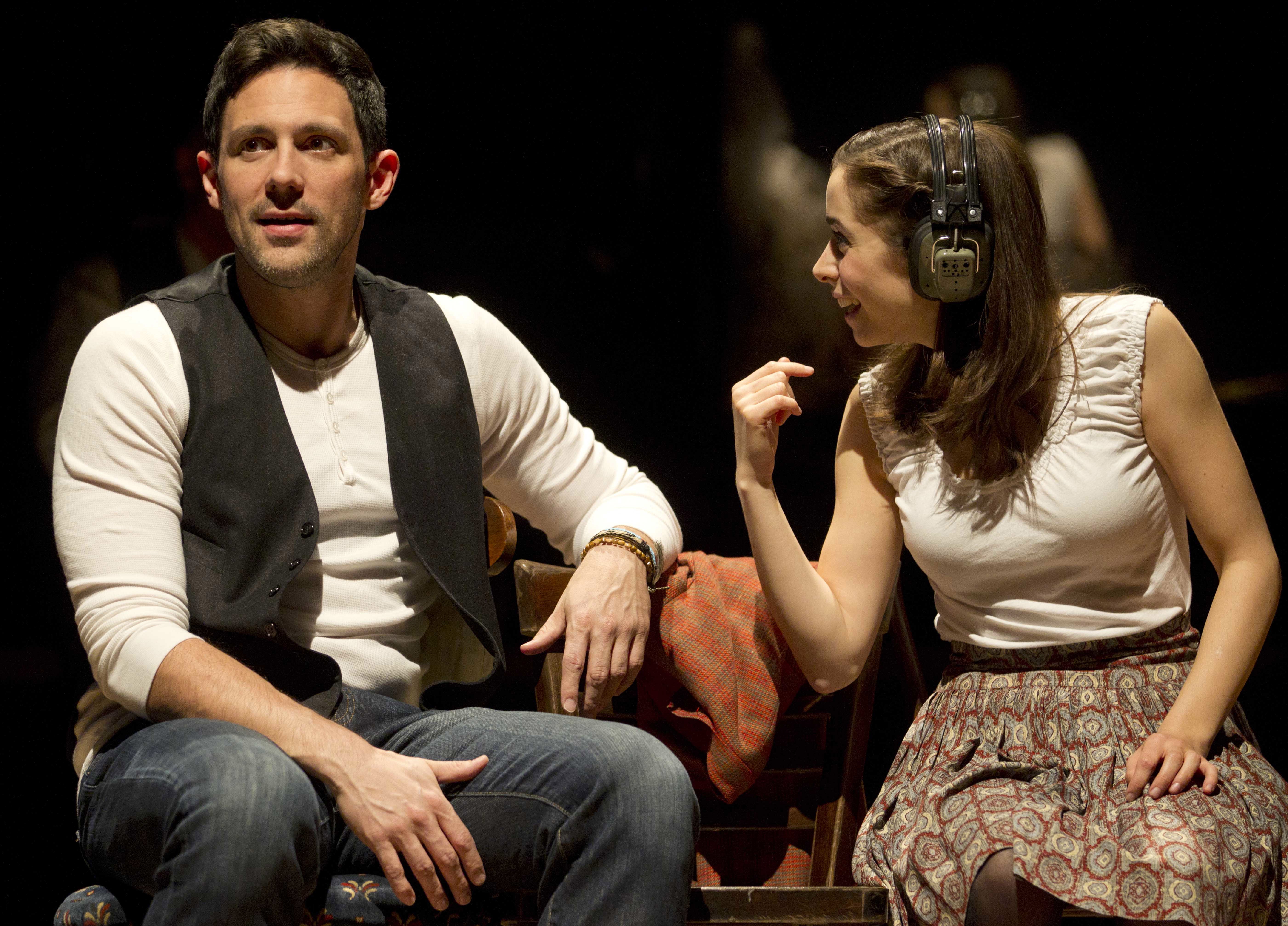
In 2006, writer-director John Carney had a surprise hit with his intimate low-budget drama Once, the touching story of an Irish vacuum repairman (musician Glen Hansard of the Frames) and a Czech flower seller (singer-songwriter Markéta Irglová) who meet in Dublin and make beautiful music together. Hansard and Irglová won the Oscar for Best Original Song for the ballad “Falling Slowly,” and the duo went on to form the band the Swell Season. The film has now been turned into a Broadway musical directed by John Tiffany (Black Watch) and with a book by playwright Enda Walsh (The Walworth Farce), but in expanding the eighty-five-minute movie into a two-and-a-half-hour show, they have stretched the story way too thin. Once actually begins twenty minutes before curtain time, when ticket holders are invited to buy a drink onstage as the house band plays traditional tunes amid Bob Crowley’s set, the interior of a pub shaped like a half-moon with more than seventy mirrors hanging on the walls, centered by a large rectangular one right in the middle. Steve Kazee (Spamalot) and Cristin Milioti (The Lieutenant of Inishmore) play the Guy and the Girl, two lonely souls, he a shy guitarist who works in his father’s shop, she a very direct pianist surrounded by family and friends but missing something in her life. Girl instantly becomes Guy’s muse, encouraging him to not give up on his music, which she thinks can make him a success in New York. As they spend more and more time together, their unrequited love begins to overwhelm them.

The Guy and the Girl dream about a better future in ONCE (photo © 2011 by Joan Marcus)

Kazee and Milioti are terrific in the lead roles, forming a believable team that audiences will pull for not only as a musical pair but hopefully as a romantic one as well. The staging is also excellent, with everything taking place on the same set with small furniture changes signaling such other locations as a piano shop, a recording studio, and Guy’s and Girl’s apartments. Whenever the Girl speaks in Czech, she actually says the words in English, with the Czech translation projected onto the top of the bar, which leads to a memorable moment when she discusses love with the Guy. The members of the house band double as the show’s minor characters, sitting on chairs on either side of the stage until their participation is required. But while some of these characters offer fine support, particularly David Patrick Kelly as the Guy’s father and Elizabeth A. Davis as the Girl’s sexy friend Réza, others drain the show of its subtle intimacy, , with silly, repetitive, over-the-top comic relief from Paul Whitty as the owner of the piano store and Andy Taylor as a bank manager. In addition, much of the second act feels added on and repetitive, including reprises of songs. The score features such familiar tunes from the film as “Falling Slowly,” “If You Want Me,” “Broken Hearted Hoover Fixer Sucker Guy,” “Gold,” and “The Hill” as well as several new ones; the production admirably doesn’t Broadway-fy the music or lapse into over-choreographed dance numbers, keeping things relatively simply for the most part. There’s a lot to like about Once, and fans of the film are likely to be charmed. But there’s also a lot that could have been trimmed, paying heed to the more personal warmth and honesty of the original.

IT’S A HARD ACT TO FOLLOW

Blair Underwood (in undershirt) will discuss taking on the role of Stanley Kowalski in Drama Desk panel at Sardi’s

A DRAMA DESK PANEL ON PLAYING ICONIC ROLES
Sardi’s
234 West 44th St.
Friday, March 30, $55 with RSVP, 11:45 am
www.dramadesk.org
www.sardis.com

On March 30, you can have lunch with four Broadway stars at Sardi’s as they talk about taking on iconic roles in hit shows in the special Drama Desk event “It’s a Hard Act to Follow.” As you enjoy your choice of salmon, chicken, pasta, or a vegetable basket, USA Today’s Elysa Gardner will moderate a panel discussion featuring Blair Underwood, who will play Stanley Kowalski, a role originated on stage and film by Marlon Brando, in the upcoming revival of A Streetcar Named Desire, which begins previews at the Broadhurst on April 3; Cynthia Nixon, currently earning raves as Dr. Vivian Bearing, a role that previously earned Kathleen Chalfant a slew of awards, in the Broadway debut of Margaret Edson’s Wit, joined by director Lynne Meadow; Hunter Parrish, starring as Jesus in the Godspell revival at Circle in the Square; and Michael McKean, who is playing Dick Jensen in an all-star production of Gore Vidal’s The Best Man, now in previews preparing for an April 1 opening at the Gerald Schoenfeld Theatre.

SEMINAR

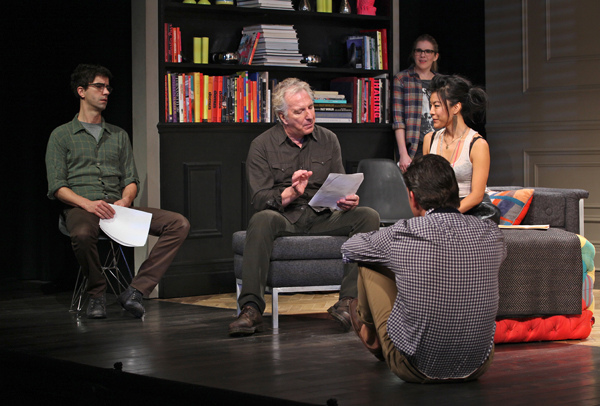
Wannabe writers get a whole lot more than they bargained for in SEMINAR

Golden Theatre
252 West 45th St. between Broadway & Eighth Ave.
Starring Alan Rickman through April 1, followed by Jeff Goldblum starting April 3, $51.50 – $121.50
www.seminaronbroadway.com

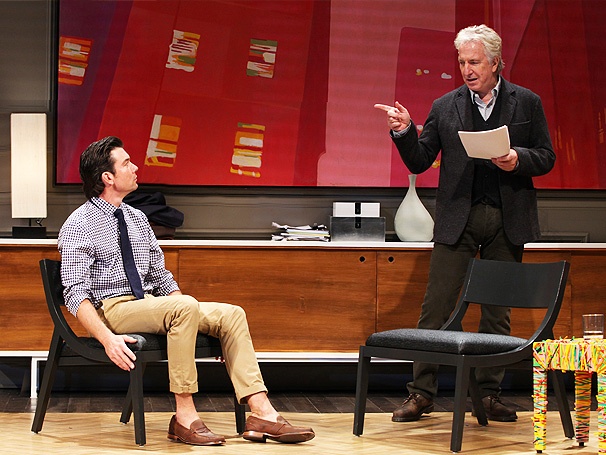
Inspired by her three years writing for David Milch on NYPD Blue, Theresa Rebeck’s Seminar is a solidly entertaining, very funny examination of competition and the creative process. Kate (Lily Rabe), Martin (Hamish Linklater), Douglas (Jerry O’Connell), and Izzy (Hettienne Park) are members of a private writing class led by the rather acerbic Leonard (Alan Rickman), a famous novelist and editor who charges the eager would-be writers five grand a piece for his services. Held in Kate’s family’s ritzy Upper West Side apartment, each class session consists of Leonard’s critique of a different student’s work. Desperate for his approval, they find out quickly that their story — as well as their life — is more likely to be shredded apart by the cynical Leonard, who rambles on about his travels to war-torn nations while debasing three of the writers; he has only kind things to say about Izzy, turned on by her erotically charged writing and sexy demeanor.

Alan Rickman will continue dishing out biting literary criticism on Broadway through April 1

Although the plot features few surprises, the dialogue by the prolific Park Slope-based Rebeck — she’s written numerous plays, several novels and screenplays, and is the creator and executive producer of the new television series Smash — is sharp and incisive, alternating between biting and laugh-out-loud funny. The part of Leonard seems tailor made for Rickman, who revels in the character’s love of language; just when it seems that Rickman is drifting off a bit, he charges back with a quiet fury that dominates the stage. The supporting cast, featuring O’Connell (Stand by Me, Jerry Maguire), Shakespearean regular Linklater (The New Adventures of Old Christine), and Park (The Intelligent Homosexual’s Guide to Capitalism and Socialism with a Key to the Scriptures) making their Broadway debuts alongside Tony nominee Rabe (The Merchant of Venice), is strong throughout, each actor adding just the right nuance to avoid becoming caricatures. Although most of Seminar takes place in a single room, director Sam Gold gives it a swift vitality, a strength he also displays in the current production of Look Back in Anger at the Roundabout. As a bonus, the night we saw Seminar, Jeff Goldblum, who replaces Rickman in the role of Leonard on April 3, was sitting nearby, apparently seeing the show for the first time. He leaned forward through most of the ninety-five minutes, his mouth hanging open, his eyes darting from character to character, following every movement with an extended hand, studying the play almost as if he were a student preparing for the most important class of his life.

OTHER DESERT CITIES

Secrets and lies unfold on Christmas Eve in Jon Robin Baitz’s exceptional Broadway drama OTHER DESERT CITIES (photo by Joan Marcus)

Booth Theatre
222 West 45th St. between Broadway & Eighth Ave.
Tuesday – Sunday, $61.50 – $126.50
www.lct.org

It’s Christmas Eve, 2004, and the Wyeth clan has gathered together to celebrate the holiday in Palm Springs, where WASPy parents Polly (Stockard Channing) and Lyman (Stacy Keach) raised their family, playing tennis and hanging out at the country club. Joining them is daughter Brooke (Rachel Griffiths), son Trip (Thomas Sadoski), and Polly’s sister, Silda Grauman (Judith Light). What transpires over the course of the next two hours is a classic tale of family dysfunction, filled with secrets and lies, masterfully told by playwright Jon Robin Baitz and director Joe Mantello. Other Desert Cities unfolds on John Lee Beatty’s wonderful set, a modern living room complete with working fireplace, tall windows that look out at the desert wasteland, and a long stone wall that seems to trap the family inside, combining California warmth with an icy coldness. After six years of writer’s block and months hospitalized for depression, Brooke has emerged with the follow-up to her successful debut novel, but it’s not fiction. This time she has written a tell-all memoir about the one thing the family never talks about and which brought them great public shame and embarrassment — eldest son Henry, a deeply troubled young man who joined an anarchist cult and participated in a terrorist attack that killed an innocent man, leading him to take his own life.

Former Hollywood players Polly and Lyman are true believers who have counted the Bushes and Reagans as close personal friends; in fact, Polly proudly declares that Nancy is her role model. While the parents are in favor of the Iraq war, Brooke and Silda, a recovering alcoholic, are vigilant lefties; Trip, a reality-TV producer, does his best to remain in the center, desperately trying to keep all conversations away from politics. But he has a lot more trouble attempting to be the voice of reason as long-held secrets emerge that threaten to tear the family apart. Other Desert Cities is everything a play should be: Sharp, incisive dialogue, nearly flawless acting, and seamless, flowing direction, with a laugh-out-loud first act and a much darker, far more serious second act. A Lincoln Center Theater production that originally ran at the Mitzi E. Newhouse this past January and February (and that also starred Channing, Keach, and Sandoski, with Linda Lavin as Silda and Elizabeth Marvel as Brooke), Other Desert Cities is an exceptional piece of work, an intelligent, thought-provoking drama that melds the political and the personal in thrilling ways.