this week in broadway

BRONX BOMBERS

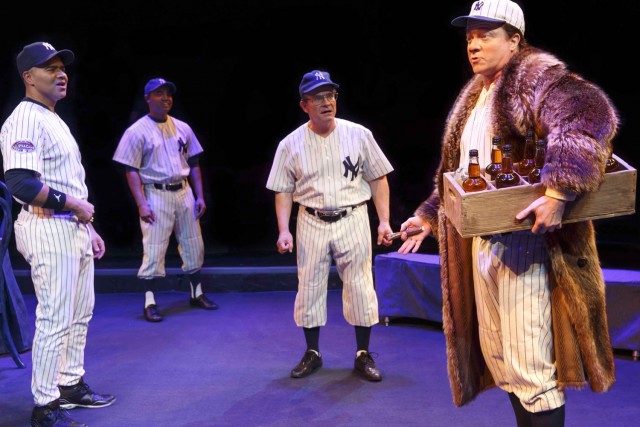
The Babe (C. J. Wilson) is better off packing up his things and going home in Broadway bomb about the Yankees (photo by Joan Marcus)

The Babe (C. J. Wilson) is better off packing up his things and going home in Broadway bomb about the Yankees (photo by Joan Marcus)

Circle in the Square Theatre
1633 Broadway at 50th St.
Tuesday – Sunday through March 2, $67 – $137
www.bronxbombersplay.com

Earlier this week, New York Yankees shortstop Derek Jeter announced over Facebook that he will be hanging up his cleats following the 2014 season. It’s a pity it wasn’t the new Broadway show Bronx Bombers — which features a fictional version of the pinstripes captain — calling it quits instead, immediately. Eric Simonson’s play, which transferred to Circle in the Square after fall training at the Duke on 42nd St., is nearly inconceivably dull and pointless, coming off more like an MLB-sponsored advertorial than an intuitive, intelligent look at baseball’s most storied franchise. The first act focuses on manager Billy Martin’s removal of Reggie Jackson from the outfield in the middle of an inning after Jackson loafed after a Jim Rice fly ball at Fenway Park on June 18, 1977. Yankees coach Yogi Berra (Peter Scolari) calls together captain Thurman Munson (Bill Dawes), Martin (Keith Nobbs), and Jackson (Francois Battiste) in a Boston hotel room to try to get the manager and the hot-dogging superstar to kiss and make up, but that’s not about to happen anytime soon. In the second act, Berra is caught up in a dreamlike fantasy in which he and his wife, Carmen (Tracy Shayne, who is married to Scolari in real life), host a dinner party with the greatest players in Yankees history, supposedly showing up to help Berra solve the Martin-Jackson dilemma and save the Yankees’ reputation and season. But not even the arrival of Lou Gehrig (John Wernke), Joe DiMaggio (Chris Henry Coffey), Elston Howard (Battiste), Babe Ruth (C. J. Wilson), Mickey Mantle (Bill Dawes), and Jeter (Christopher Jackson) can help playwright-director Simonson’s minor-league tale rise out of the cellar (as most of the sets do). Aside from Dawes, who captures the Mick’s wild personality, and Battiste, who nails Jackson’s braggadocio, none of the other actors turn in all-star performances, never embodying the famous, and familiar, athletes they are portraying. Simonson, the man behind such other sports-related Broadway productions as Lombardi and Magic/Bird, muddles the relationships among the players, with some dressed in uniform, others in suits, some in the prime of their careers, others nearing death, for no apparent dramaturgical reason. And in a 2008 coda, he includes no mention of Berra’s fourteen-year feud with owner George Steinbrenner, making Bronx Bombers feel even more like a promotional piece. Indeed, merchandise authorized by Major League Baseball is available for sale in the lobby, as are collectibles from an officially licensed memorabilia company. Unfortunately, the only souvenir worthy of this Broadway bomb is a Bronx cheer.

AFTER MIDNIGHT

(photo by Matthew Murphy)

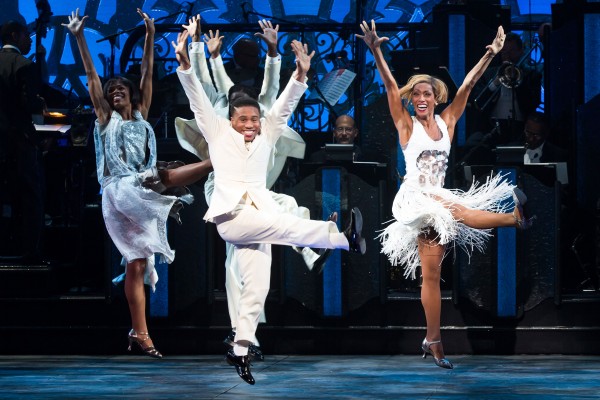
AFTER MIDNIGHT celebrates the music and movement of a thrilling Harlem evening (photo by Matthew Murphy)

Brooks Atkinson Theatre
256 West 47th St. between Broadway & Eighth Ave.
Through August 31, $60-$147
877-250-2929
www.aftermidnightbroadway.com

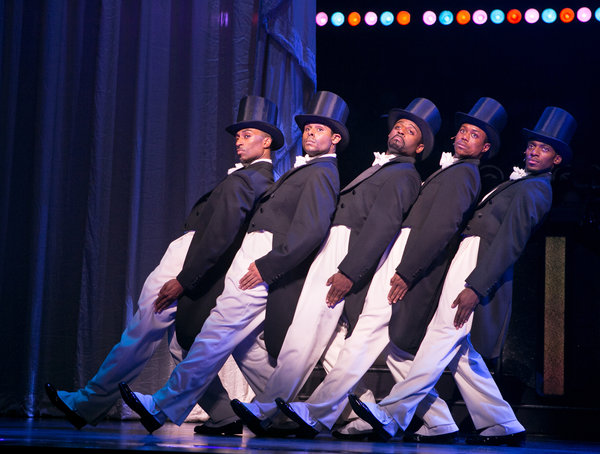
Initially conceived for New York City Center’s Encores! by series artistic director Jack Viertel, After Midnight is now lighting up Broadway, bringing Harlem to the Great White Way in a dazzling display of music and dance. The Brooks Atkinson Theatre has been transformed into the famed jazz clubs of the Golden Age, the Savoy, the Cotton Club, and the Sugar Cane, as a talented cast of more than two dozen singers and dancers shimmy the night away to the tunes of Duke Ellington. The show is hosted by Dulé Hill (Stick Fly, Psych), who is first seen in a too-cool white suit, leaning against a lamppost, poetically introducing the audience to a Harlem night to remember. Backed by the sixteen-piece Jazz at Lincoln Center All Stars, the performers strut their stuff for ninety glorious, uninterrupted minutes, playing directly to the audience as if in an intimate nightclub. Carmen Ruby Floyd, Rosena M. Hill Jackson, and Bryonha Marie Parham are caught “Between the Devil and the Deep Blue Sea,” Adriane Lenox warns that “Women Be Wise” and later declares “Go Back to Where You Stayed Last Night,” and Julius “iGlide” Chisolm and Virgil “Lil’ O” Gadson slide their way through “Hottentot Tot.” Hill carries a red balloon in “I’ve Got the World on a String,” while he joins Daye, Cedric Neal, Monroe Kent III, and T. Oliver Reid for “Ain’t It de Truth?” highlighted by playful vertical and horizontal group shuffles.

(photo by Matthew Murphy)

Flashy Broadway musical honors the legacy of Duke Ellington and the nightlife of Harlem (photo by Matthew Murphy)

Director and choreographer Warren Carlyle (Chaplin, Finian’s Rainbow) channels Alvin Ailey’s classic “Night Creature” throughout the evening, the moves and grooves often made bigger than life with Isabel Toledo’s stunning costumes. Among the standout dancers are Karine Plantadit (Come Fly Away), who solos on “Black and Tan Fantasy,” and Phillip Attmore and Daniel J. Watts, who have a heated tap-off. The show features several spots for a special guest; through February 9, Fantasia Barrino (American Idol, The Color Purple) makes a star turn singing such sultry numbers as “I Can’t Give You Anything But Love” and “Stormy Weather,” with k. d. lang taking over February 11 and Babyface and Toni Braxton on March 18. While other current Broadway jukebox musicals — Beautiful, Motown, and A Night with Janis Joplin — struggle when they focus on the narrative, the story of After Midnight is the grandeur of the music itself, resulting in a hot evening of jumping, jiving, and wailing, Harlem style.

A GENTLEMAN’S GUIDE TO LOVE AND MURDER

GENTLEMAN

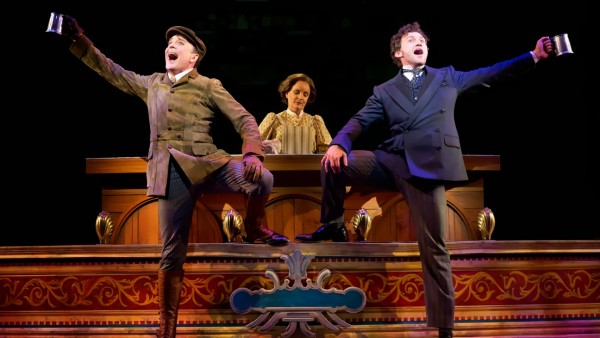
One of the D’Ysquiths (Jefferson Mays) celebrates with his potential murderer (Bryce Pinkham) in vengeful musical comedy

Walter Kerr Theatre
219 West 48th St. between Broadway & Eighth Ave.
Through September 7, $35-$137
www.agentlemansguidebroadway.com

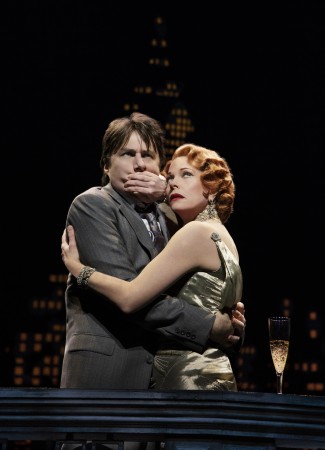
Not even a ridiculously loud family sitting behind us, crunching on candy and talking throughout the first act, could dampen our thorough enjoyment of the wonderful new Broadway musical A Gentleman’s Guide to Love & Murder. The show follows the trials and travails of one Monty Navarro (Bryce Pinkham), who is in prison, writing his memoirs. The story then turns back to Monty’s mother’s funeral, where chatty Miss Shingle (Jane Carr) tells him that his mother was disowned by the noble D’Ysquith family when she married a man her relatives disapproved of. When Monty discovers that he is eighth in the line of succession to become earl, those men and women in between him suddenly start dropping like flies, each one played with a hearty wink and a nod by Jefferson Mays (I Am My Own Wife, Blood and Gifts) in ever-more-clever set-ups, from various lords and ladies to a dentally challenged reverend. Meanwhile, Monty can’t let go of the woman he adores, the spectacularly beautiful, self-centered, and manipulative Sibella Hallward (Lisa O’Hare), who is engaged to marry the never-seen Lionel Holland. Social mores of Edwardian England come tumbling down as Monty nears his vengeful goal. (If any of this sounds familiar, it’s because Gentleman’s Guide is based on Roy Horniman’s 1907 novel, Israel Rank: The Autobiography of a Criminal, the inspiration for Robert Hamer’s classic 1949 British black comedy, Kind Hearts and Coronets, in which Alec Guinness plays eight members of the D’Ascoyne family.)

GENTLEMAN

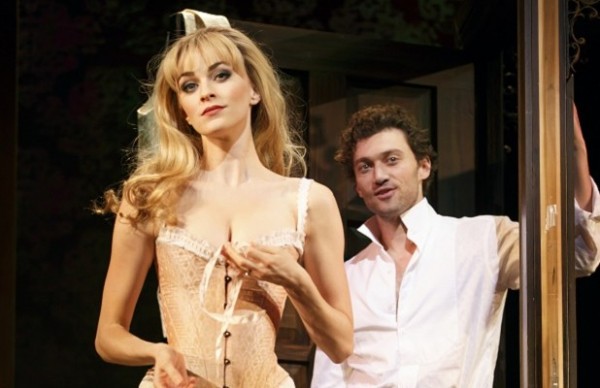
Sibella (Lisa O’Hare) and Monty (Bryce Pinkham) reevaluate their relationship in A GENTLEMAN’S GUIDE TO LOVE & MURDER

Robert L. Freedman (books and lyrics) and Steven Lutvak (music and lyrics), with director Darko Tresnjak and scenic designer Alexander Dodge, have created a lovely little tale, part The Mystery of Edwin Drood, part Gilbert & Sullivan operetta, with some Monty Python flourishes added for good measure. Pinkham (Ghost, Bloody Bloody Andrew Jackson) has devilish fun as Navarro, thinking up new ways to do away with his potential victims, while Mays — well, it’s often hard to figure out just how he changes from character to character so quickly, not only in wardrobe but in accent and style, a mind-boggling tour de force. Most of the action takes place on a stage within the stage, with red curtains and faces that occasionally come alive. Intentionally cheesy backdrops and playful video projection add to the fun of such numbers as “You’re a D’Ysquith,” “Poison in My Pocket,” and “The Last One You’d Expect,” while riotous slapstick propels a marvelous scene in which Monty is with Sibella but Phoebe D’Ysquith (Lauren Worsham) unexpectedly arrives, her sights also set on Monty, who does his best trying to keep each woman from finding out about the other. A Gentleman’s Guide to Love & Murder is a delicious mélange of music and mayhem, with plot twists that hold surprises even for those who adore Kind Hearts and Coronets.

OUTSIDE MULLINGAR

(photo by Joan Marcus)

Tony Reilly (Peter Maloney) shares his questionable plans with son Anthony (Brían F. O’Byrne) and neighbor Aoife Muldoon (Dearbhla Molloy) in OUTSIDE MULLINGAR (photo by Joan Marcus)

Manhattan Theatre Club at the Samuel J. Friedman Theatre
261 West 47th St. between Broadway & Eighth Aves.
Tuesday – Sunday through March 16, $67-$135
www.manhattantheatreclub.com
www.outsidemullingarbroadway.com

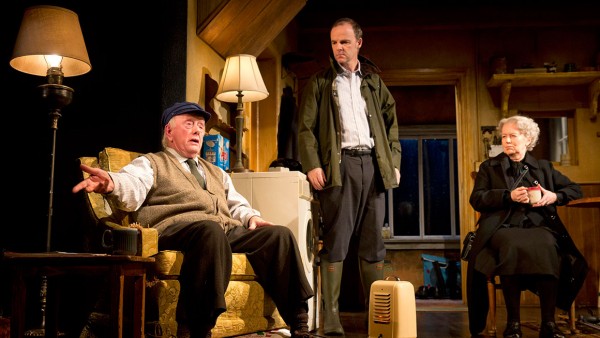
Ten years ago, Manhattan Theatre Club presented Bronx-born playwright John Patrick Shanley’s Doubt, starring Brían F. O’Byrne, directed by Doug Hughes, and with scenic design by John Lee Beatty. That group has teamed up again for the world premiere of Outside Mullinger, a charming little tale that opened last week at the Samuel J. Friedman Theatre. A dark romantic comedy, Outside Mullingar takes place in County Westmeath in the home of Tony Reilly (a wonderful Peter Maloney) and his ne’er-do-well son, Anthony (five-time Tony nominee O’Byrne). An elderly widower, Tony tells his neighbor, Aoife Muldoon (Dearbhla Molloy), that he is considering selling his farm to his nephew in America rather than leave it to Anthony. Aoife, who has just buried her husband, Christopher, can’t believe Tony would do that to his son, who is distressed when he is told of the possibility that he might not get the family land he has worked on his whole life. Discussion also turns to a forty-meter strip of land on the Reilly property that is actually owned by the Muldoons because of an old loan. The strip divides the front of the Reilly home so Tony and Anthony have to walk through a pair of gates to get from the road to their front door. Now that Christopher Muldoon has died, the Reillys believe they can get that narrow bit of land back, but Muldoon’s daughter, Rosemary (Debra Messing), is not about to hand it over, as it holds a very special memory for her. As the two families bicker both playfully and seriously, attention soon turns to Anthony and Rosemary, two lonely, difficult people who clearly don’t know what’s best for them.

(photo by Joan Marcus)

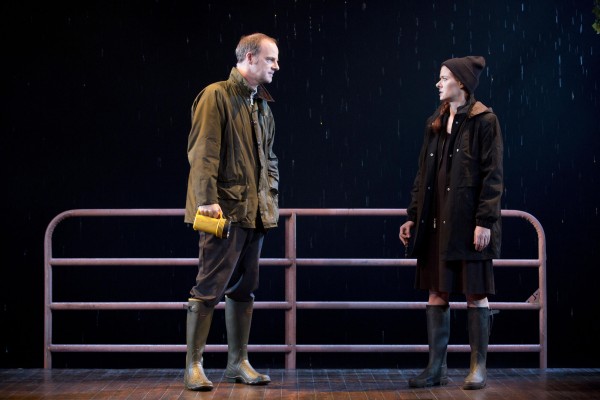
Anthony Reilly (Brían F. O’Byrne) and neighbor Rosemary Muldoon (Debra Messing) battle it out during a soft rainstorm in new John Patrick Shanley play (photo by Joan Marcus)

Shanley, who won a Tony and a Pulitzer for Doubt and an Oscar for his screenplay for Moonstruck, keeps things simple in Outside Mullingar, which works as a timeless character study, performed by an engaging cast. Maloney (To Be or Not to Be, Judgment at Nuremberg) nearly steals the show as the crotchety old man, while Molloy (Dancing at Lughnasa, The Cripple of Inishmaan) is stalwart as the widow dressed in black. One of the genuine treasures of the New York stage, O’Byrne (Frozen, The Beauty Queen of Leenane) plays the unpredictable Tony with just the right mix of ambiguity and crazy. And in her Broadway debut — although she has performed often off Broadway, including as Mary Louise Parker’s understudy in Shanley’s Four Dogs and a Bone — Emmy Award winner Messing (Will & Grace, Smash) is a delight, employing an Irish brogue as she battles with Tony both in his house and outdoors in a gentle rainstorm. Here’s hoping it’s not another ten years before this talented team works together again.

MACHINAL

MACHINAL (photo by Joan Marcus)

A young stenographer (Rebecca Hall) imagines a bleak future ahead in Sophie Treadwell’s MACHINAL (photo by Joan Marcus)

American Airlines Theatre
227 West 42nd St. between Broadway & Eighth Ave.
Tuesday – Sunday through March 2, $52-$127
212-719-1300
www.roundabouttheatre.org

Inspired by the true story of Ruth Snyder, journalist and playwright Sophie Treadwell’s Machinal is back on Broadway for the first time since it bowed at the Plymouth Theatre in 1928. The highly mannered, expressionist work sets the tense tone from the very start, as a young woman (Rebecca Hall) feels trapped on a crowded subway train, pushing her way through the mass of mostly male straphangers to get out and catch her breath. Es Devlin’s sensational four-sided set then rotates to an office, where a quartet of workers (Ashley Bell, Ryan Dinning, Edward James Hyland, and Henny Russell, who all play multiple roles) are performing their menial tasks and gossiping about the young woman, Miss A, and the boss, George H. Jones (Michael Cumpsty), in rhythmic, staccato language. Mr. J, a boring blowhard who speaks in clichés and tells the same stories over and over again, has proposed to Miss A, and after arriving at work late, she soon lets loose a machine-gun soliloquy of inner turmoil that begins, “Marry me – wants to marry me – George H Jones – George H Jones and Company – Mrs George H Jones – Mrs George H Jones. Dear Madame – marry – do you take this man to be your wedded husband – I do – to love honor and to love – kisses – no – I can’t – George H Jones – How would you like to marry me – What do you say – Why Mr Jones I – let me look at your little hands – you have such pretty little hands – let em hold your pretty little hands – George H Jones – Fat hands – flabby hands – don’t touch me – please – fat hands are never weary – please don’t – married – all girls – most girls – married – babies – a baby – curls – little curls all.” Upon returning home, she discusses the marriage proposal with her mother (Suzanne Bertish). While the young woman admits she doesn’t love Mr. J, her mother blurts out, “Love! — what does that amount to? Will it clothe you? Will it feed you? Will it pay the bills?” Their debate occasionally fades into the background as a series of brief interludes play out to their right and left in which neighborhood couples are immersed in their own issues of love, romance, and fidelity. Ultimately, Miss A decides to go ahead with the marriage, and it isn’t long before she feels trapped yet again, now with a child to raise as well, and she considers cavorting with a hunky adventurer (Morgan Spector), a decision that ultimately leads to tragedy.

MACHINAL (photo by Joan Marcus)

Miss A considers straying from her expected, straightforward path in Roundabout Revival (photo by Joan Marcus)

Machinal is told in nine episodes, which have such titles as “To Business,” “Home,” “Honeymoon,” “Prohibited,” and “Intimate,” essentially following the expected path of women in the 1920s, one that handcuffs Miss A. The play tries to contemporize the plight of women but, under the direction of Lindsey Turner (Chimera, Posh), it can’t break out of the overall feeling of being too dated and old-fashioned. In her long-awaited Broadway debut, Hall (The Town, As You Like It at BAM) plays the young woman with an elegiac tone, as if her life is already a lost cause simply because of her sex; born at the wrong time, she is likely to have thrived in the modern era. Cumpsty (The Winslow Boy, End of the Rainbow) gives the stuffed-shirt husband a sympathetic sadness, while Spector (Harvey, A View from the Bridge) is the polar opposite, bold and sexy as the potential lover, a role originated by Clark Gable. But the real star of the Roundabout revival is Devlin’s rotating set, which, as it turns, includes momentary interstitial scenes that immerse the audience in 1920s New York, along with costumes (by Michael Krass) and lighting (by Jane Cox) that bathe the production in black, white, and gray, illuminating Miss A’s drab, colorless life.

THE LINE KING’S LIBRARY: AL HIRSCHFELD AT THE NEW YORK PUBLIC LIBRARY

Al Hirschfeld’s long relationship with the New York Public Library is explored in exhibit at Lincoln Center

Al Hirschfeld’s long relationship with the New York Public Library and the arts is celebrated in exhibit at Lincoln Center

New York Public Library for the Performing Arts
40 Lincoln Center Plaza
Exhibition continues through January 4
Film screening: Bruno Walter Auditorium, 111 Amsterdam Ave., Monday, November 18, free, 6:00
212-642-0142
www.nypl.org/lpa

Twelve years ago, New York celebrated the life and eighty-plus-year career of legendary artist Al Hirschfeld with a major retrospective at the Museum of the City of New York and an exhibit of his celebrity caricatures at the New York Public Library’s main branch; in addition, Abrams released two books of his work, one focusing on New York, the other on Hollywood, and Hirschfeld made appearances to promote the publications. Nearly eleven years after his passing in January 2003 at the age of ninety-nine, the New York Public Library is honoring Hirschfeld again with a lovely exhibit at the Dorothy and Lewis B. Cullman Center, “The Line King’s Library: Al Hirschfeld at the New York Public Library.” Visitors can first stop by a re-creation of Hirschfeld’s work area, complete with his drawing table and barber chair, which is on permanent view at the library entrance. The exhibition is straight ahead, consisting of more than one hundred color and black-and-white drawings and lithographs, posters, books, letters, video, newspaper and magazine clippings, and various other ephemera, divided by the discipline of Hirschfeld’s subjects: theater, music, dance, and film, in addition to a section on those artists who influenced the man known as the Line King.

Oscar-winning documentary on Al Hirschfeld screens for free at NYPL on November 18

Oscar-winning documentary on Al Hirschfeld screens for free at NYPL on November 18

“My contribution is to take the character — created by the playwright and acted out by the actor — and reinvent it for the theater,” Hirschfeld once explained, and the evidence is on the walls, including works depicting Jack Lemmon in Tribute, Lee J. Cobb in Death of a Salesman, Christopher Plummer in Macbeth, Jessica Tandy and Marlon Brando in A Streetcar Named Desire, Rex Harrison and Julie Andrews in My Fair Lady, Alan Cumming in Cabaret, and Jackie Mason in The World According to Me, among so many more. There are also caricatures of Marcel Marceau, S. J. Perelman, George Bernard Shaw, Leonard Bernstein, Vladimir Horowitz, Dizzy Gillespie, Katharine Hepburn, and a dazzling, rarely shown 1969 print of Martha Graham. Another highlight is the original drawing for “Broadway First Nighters,” along with a key identifying the dozens of celebrities gathered in a packed room, and paraphernalia from Hirschfeld’s musical comedy Sweet Bye and Bye, a collaboration with Perelman, Vernon Duke, and Ogden Nash. And for those fans who have spent years trying to find all the inclusions of “Nina” in Hirschfeld’s drawings, “Nina’s Revenge” features his daughter holding a brush and smiling, the names “Al” and “Dolly” (for Dolly Haas, her mother and Hirschfeld’s second wife) in her long hair. In conjunction with the exhibition, there will be a free screening of the Oscar-winning 1996 documentary The Line King: The Al Hirschfeld Story, introduced by the director, Susan W. Dryfoos, on November 18 at 6:00 in the Bruno Walter Auditorium at the New York Public Library for the Performing Arts.

BETRAYAL

Robert (Daniel Craig) and wife Emma (Craig’s real-life wife, Rachel Weisz) don’t spend a lot of time together in bed in BETRAYAL (photo by Brigitte Lancombe)

Robert (Daniel Craig) and wife Emma (Craig’s real-life wife, Rachel Weisz) don’t spend a lot of time together in bed in BETRAYAL (photo by Brigitte Lancombe)

Ethel Barrymore Theatre
243 West 47th St. between Broadway & Eighth Ave.
Through January 5, $67 – $185
www.betrayalbroadway.com

Harold Pinter’s Betrayal has always been a star-driven vehicle. The reverse-chronology tale of marital infidelity opened on Broadway in 1980 with Raul Julia, Blythe Danner, and Roy Scheider and was revived in 2000 with Liev Schreiber, Juliette Binoche, and John Slattery; the 1983 film featured Jeremy Irons, Patricia Hodge, and Ben Kingsley. In its current incarnation on Broadway, directed by Mike Nichols, the husband-and-wife team of Daniel Craig and Rachel Weisz might be driving ticket sales through the roof, but it’s Rafe Spall who ends up stealing the show. Spall plays Jerry, an impulsive arts agent who has had a long affair with gallery owner Emma (Weisz), who is married to one of his closest friends, refined publisher Robert (Craig, who resembles Kirk Douglas here); Jerry was even best man at their wedding. The play begins in 1977, as Jerry, who is married to the never-seen Judith, and Emma meet in a bar so Emma can tell him that she had no choice but to finally confess their affair to Robert the previous night. But as Jerry finds out when he sees Robert later that day, Robert has actually known about their lengthy indiscretion for several years, which infuriates Jerry. The story continues in backward order, going from Jerry and Emma’s breakup in 1975 to the night he professes his love for her at a party in 1968. (However, multiple scenes within the same year move forward.)

BETRAYAL

Jerry (Rafe Spall) and Robert (Daniel Craig) reminisce over better times in second Broadway revival of Harold Pinter play (photo by Brigitte Lacombe)

Nichols, who helmed a marvelous revival of Death of a Salesman last year with Philip Seymour Hoffman, keeps things relatively simple in this even-keeled, somewhat subdued production. In his Broadway debut, Spall (Life of Pi, Prometheus) injects fiery life into the wildly unpredictable Jerry, while Craig (A Steady Rain, Bond, James Bond) and Weisz (The Constant Gardener, 2010 Olivier Award for A Streetcar Named Desire), in her Broadway debut as well, give their characters a dispassionate coldness that wavers a little too much in intensity, occasionally playing it too matter-of-factly. The staging matches the emotional temperature: As scenes fade out, somber piano music by former LCD Soundsystem head James Murphy tinkles over the loudspeaker, the actors glide offstage on Ian MacNeil’s rotating sets, and backdrops float in and out from above. Of course, Jerry is the meatier role; Emma and Robert’s marriage is cold and dispassionate from the start of the play, but Weisz’s and Craig’s performances still can feel a bit distant at critical moments. Based on his own affair with Joan Bakewell, Pinter’s thirty-five-year-old Olivier Award–winning drama retains a timeless quality, as Nichols focuses on the hearts and minds involved in a classic love triangle, avoiding the impulse to ground the play in any specific era by steering clear of overt references to the sociopolitical climate or even the clothing of the day. It might not be as stirring as it could have been, but this Betrayal offers an honest, penetrating examination of complex adult relationships.