this week in broadway

CASA VALENTINA

CASA VALENTINA

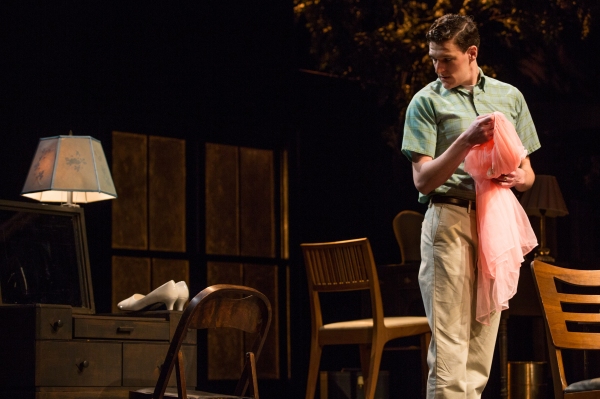
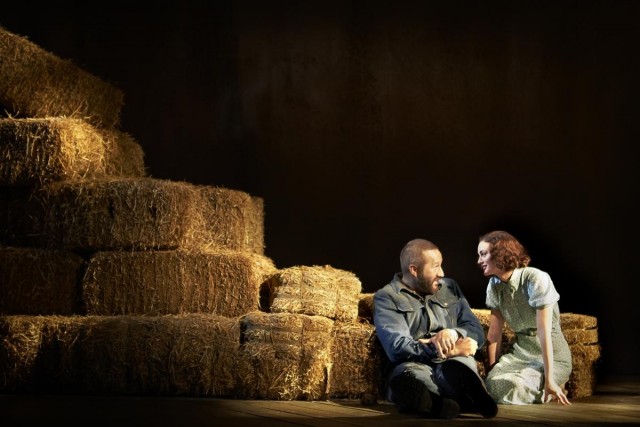
Jonathon (Gabriel Ebert) contemplates becoming Miranda in front of other people in CASA VALENTINA (photo by Matthew Murphy)

Manhattan Theatre Club at the Samuel J. Friedman Theatre
261 West 47th St. between Broadway & Eighth Aves.
Tuesday – Sunday through June 15, $67-$125
www.manhattantheatreclub.com
www.casavalentinabroadway.com

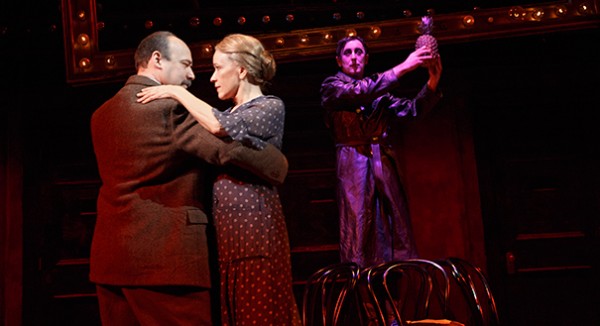
“Welcome to the Chevalier d’Eon Resort. Welcome to the world of self-made women,” Valentina (Patrick Page) announces in Harvey Fierstein’s sensitive and engaging, if occasionally didactic, new play, Casa Valentina. Fierstein’s first drama in more than a quarter century, following such hit musicals as Kinky Boots, Newsies, and La Cage aux Folles, Casa Valentina was inspired by the true story of a husband and wife who ran a Catskills bungalow in the 1960s where men would spends weekends cross-dressing and acting like women, a safe haven where they could celebrate their feminine side. The show takes place in June 1962 as Valentina, who spends her weekdays as George, and his wife, Rita (a wonderfully sensitive Mare Winningham), prepare for their latest arrivals. Among the attendees are Jonathon (Gabriel Ebert), a shy, nervous young man who will be making his first-ever appearance as Miranda; Bessie (Tom McGowan), a military veteran with a wife and kids who glories in the freedom Casa Valentina gives him; Gloria (Nick Westrate), a stylish woman who looks like she stepped out of an episode of Mad Men; Terry (John Cullum), a septuagenarian who tells Miranda, “You don’t get cleavage. You earn it”; and a respected judge (Larry Pine) who revels in becoming Amy away from his stressful regular life. The guest of honor for the weekend is Charlotte (Reed Birney), a radical cross-dresser who wants the others to join the Sorority, an organization that is attempting to change the public perception of and laws against transvestitism. “I firmly believe that once the world sees who we truly are, there will be no need for deception,” she says. However, membership includes signing an oath against homosexuality, something that makes the rest of the women more than a little uncomfortable.

CASA VALENTINA

Charlotte (Reed Birney) gets political at a Catskills bungalow in new Harvey Fierstein play (photo by Matthew Murphy)

Lovingly directed by two-time Tony winner Joe Mantello (Assassins, Take Me Out), Casa Valentina is at its best when it celebrates the joy these men experience by being accepted as women for a few treasured days. The show gets bogged down a bit when dealing with the oath, although it does bring up the critical point that the vast majority of cross-dressers — recent studies put the number around eighty percent — are heterosexual. Even with the growing acceptance of same-sex marriage in America, there are still gross misconceptions of homosexuality, transvestitism, and other so-called deviant or non-normative behavior, and Casa Valentina beautifully reveals how absurd it is for society to restrict and judge the predilections of others. The actors clearly have a blast in Rita Ryack’s lavish costumes and Jason P. Hayes’s glorious wigs and makeup (except for poor Winningham, allotted a frumpy pair of sensible pedal-pushers while the men get to wear fabulous dresses), while Scott Pask’s airy set immediately welcomes the audience into this little-known world. Cross-dressing might be somewhat de rigueur these days on Broadway (Kinky Boots, A Gentleman’s Guide to Love & Murder, Cabaret, Hedwig and the Angry Inch), but Fierstein, Mantello, and an extremely talented and beautiful cast offer a very different take on this misunderstood culture, treating it with humor, intelligence, honor, courage, and, perhaps most important, dignity.

THE REALISTIC JONESES

(photo by Joan Marcus)

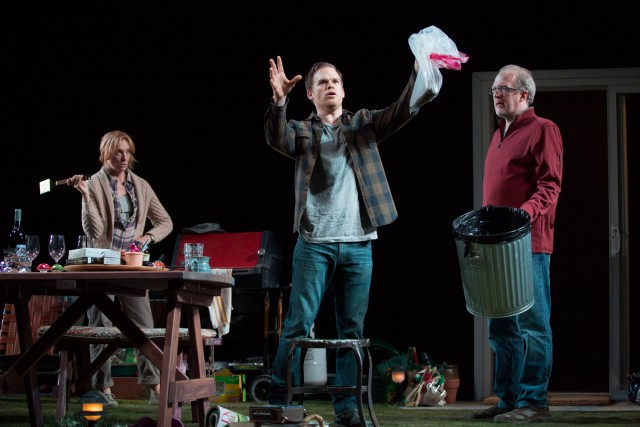
John Jones (Michael C. Hall) says farewell to a dead squirrel as Jennifer (Toni Collette) and Bob Jones (Tracy Letts) look on (photo by Joan Marcus)

Lyceum Theatre
149 West 45th St. between Sixth & Seventh Aves.
Through July 13, $29- $135
www.therealisticjoneses.com

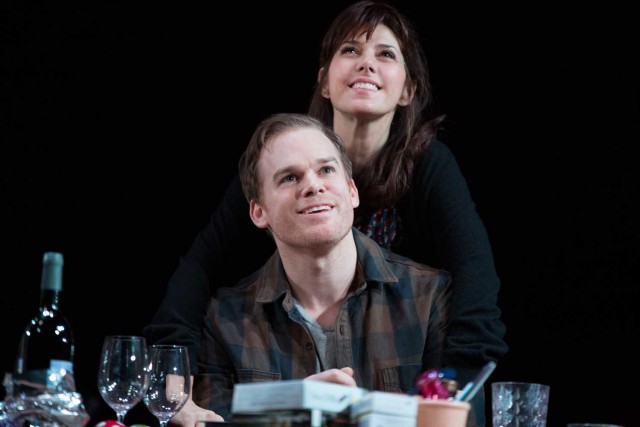
In his first Broadway play, The Realistic Joneses, Will Eno is as much choreographer as writer, his words twirling, spinning, lifting, throwing, bouncing, and ricocheting among the four characters, performing an intoxicating dance of language. As in his previous two works, Title and Deed and The Open House, a kind of existential absurdity hovers over the proceedings, which delve into the deeply psychological natures of home and family. The Joneses live a rather isolated life up in the mountains, Bob (Tracy Letts) a curmudgeon suffering from a mysterious disease, Jennifer (Toni Collette) taking care of him while trying to deal with his sudden mood shifts. Their peaceful tranquility is somewhat shattered when a cheerful, energetic couple also named the Joneses move into the house down the way, John (Michael C. Hall) a repairman, Pony (Marisa Tomei) a sort of ditzy ingénue. Over the course of a few days, the four characters interact in different groupings, sharing their views on love and marriage, home and health while debating the meaning of language and communication in general and certain words and phrases specifically. “Nature was definitely one of the big selling points of here. Plus, the school system’s supposed to be good,” Pony says. “Oh, do you have kids?” Jennifer asks. “No, it’s just that John hates stupid children,” Pony responds. “We communicate pretty well, even without words,” Jennifer says about Bob, then later tells John, “I think you have a nice way with words.”

(photo by Joan Marcus)

Pony (Marisa Tomei) and John Jones (Michael C. Hall) are looking forward to a new life in the mountains, but little do they know what awaits them (photo by Joan Marcus)

Eno, who was a Pulitzer Prize finalist for 2004’s Thom Pain (based on nothing), stealthily riffs on the old saw “keeping up with the Joneses” by equating the two couples in clever, understated ways, tantalizingly making one wonder whether they are actually different manifestations or younger and older versions of the same people. (Even though John and Pony appear more youthful than Bob and Jennifer, all four actors are in their forties, Tomei eight years older than Collette, Letts five years senior to Hall.) “We’re not so different, you and me,” John says to Bob, who responds, “I think we’re probably very different,” to which John adds, “Yeah, me too, actually.” And later, Pony tells John, “I don’t want to turn into those guys, next door.” Director Sam Gold (Fun Home, Seminar, Picnic) maintains a quick pace throughout the play’s fast-moving ninety minutes, another Eno specialty, with most scenes working well, although a meeting between John and Jennifer at the local market feels unsure of itself and falls flat. Otherwise, The Realistic Joneses is a smart, engaging comedy boasting an outstanding cast having a whole lot of deliciously infectious fun with the crazy English language.

A RAISIN IN THE SUN

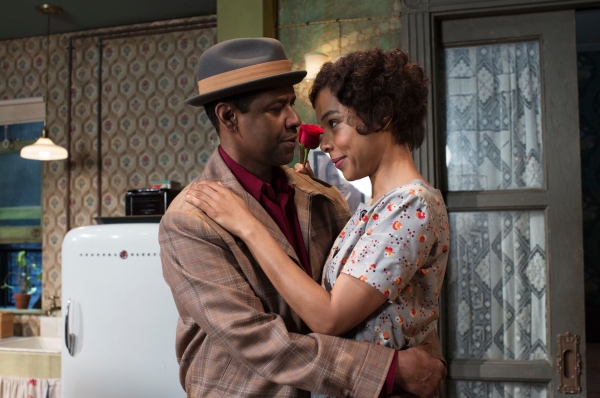
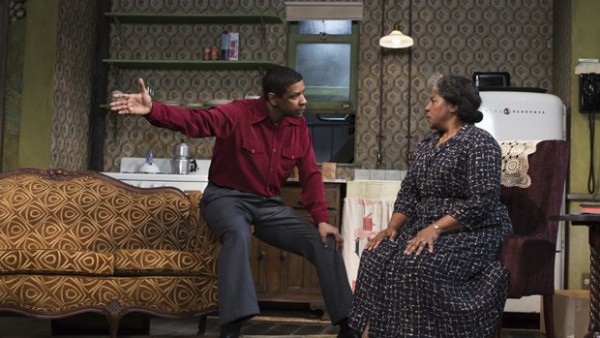
Walter Lee Younger (Denzel Washington) and Ruth (Sophie Okonedo) are just trying to survive day to day in stellar revival of A RAISIN IN THE SUN (photo by Brigitte Lacombe)

Walter Lee Younger (Denzel Washington) and Ruth (Sophie Okonedo) are just trying to survive day to day in stellar revival of A RAISIN IN THE SUN (photo by Brigitte Lacombe)

Ethel Barrymore Theatre
243 West 47th St. between Broadway & Eighth Ave.
Tuesday – Sunday through June 15, $67 – $149
www.raisinbroadway.com

Broadway revivals are often about star power, still-relevant socioeconomic or –political issues, or inventive staging of a familiar classic. But Kenny Leon’s new version of A Raisin in the Sun goes back to the very creation of this fifty-five-year-old American drama, celebrating its fascinating author, Lorraine Hansberry. As patrons enter the Ethel Barrymore Theatre, an interview with Hansberry, the first African American woman to have a work produced on Broadway, is being broadcast on the sound system. Each Playbill comes with an additional pamphlet that reprints “Sweet Lorraine,” James Baldwin’s 1969 Esquire remembrance of Hansberry — who died in 1965 at the age of thirty-four — in which he writes, “Black people ignored the theater because the theater had always ignored them. But, in Raisin, black people recognized that house and all the people in it — the mother, the son, the daughter, and the daughter-in-law — and supplied the play with an interpretative element which could not be present in the minds of white people: a kind of claustrophobic terror, created not only by their knowledge of the streets.” Leon’s production, and the extremely talented cast, honors every word of the play, which doesn’t feel old-fashioned in any way.

Walter Lee Younger (Denzel Washington) explains his questionable plans to his mother (LaTanya Richardson Jackson) in A RAISIN IN THE SUN (photo by Brigitte Lacombe)

Walter Lee Younger (Denzel Washington) explains his questionable plans to his mother (LaTanya Richardson Jackson) in A RAISIN IN THE SUN (photo by Brigitte Lacombe)

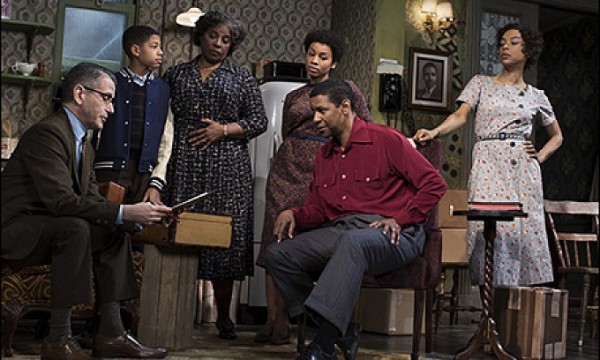
Oscar and Tony winner Denzel Washington stars as Walter Lee Younger, a dreamer trying to lift his family out of poverty in their cramped apartment on Chicago’s South Side. Every morning there’s a battle to get to the bathroom across the hall, shared by everyone on the floor. Walter’s mother, Lena (LaTanya Richardson Jackson), is expecting a $10,000 insurance check for her recently deceased husband. While Walter wants to invest it in a liquor store with his friends Bobo (Stephen McKinley Henderson) and the never-seen Willy Harris, Walter’s hardworking wife, Ruth (Sophie Okonedo), wants to put it to far more practical use. Also awaiting the money are Walter and Ruth’s son, Travis (Bryce Clyde Jenkins), who sleeps on the couch, and Walter’s sister, Beneatha (Anika Noni Rose), who lives with them as well and wants to become a doctor. As Beneatha spends time with two different men, the assimilating George Murchison (Jason Dirden) and Joseph Asagai (Sean Patrick Thomas), who introduces her to her African roots, Lena considers moving the family to all-white Clybourne Park, leading to a visit by neighborhood leader Karl Lindner (David Cromer), setting in motion a series of events that, with a delicate balance of humor and tragedy, intelligently capture the black experience in mid-twentieth-century America. (A Raisin in the Sun was a direct influence on Bruce Norris’s Pulitzer Prize-winning Clybourne Park.)

A representative from Clybourne Park (Karl Lindner) has some surprising news for the Younger family (photo by Brigitte Lacombe)

A representative from Clybourne Park (Karl Lindner) has some surprising news for the Younger family (photo by Brigitte Lacombe)

Washington (Fences, Julius Caesar), in a role created by Sidney Poitier first onstage and then in the 1961 film, is a whirlwind as Walter, practically dancing as he weaves his way through Mark Thompson’s apartment set, his gait displaying a slight jump, his leg often shaking in anticipation of making things better for him and his family. Okonedo embodies the sadness of the everyday drudgery her life encompasses, her eyes tired before their time, heavy with what could have been. Jackson is a fireball as the caring matriarch who wants to see her children and grandson succeed. Hansberry’s words flow like poetry as the Youngers’ path is continually blocked, evoking the Langston Hughes poem that gave the work its title, “A Dream Deferred”: “What happens to a dream deferred? Does it dry up / like a raisin in the sun? / Or fester like a sore — / And then run?” It was only ten years ago that Leon brought A Raisin in the Sun to the Royale, with a cast that included Sean Combs, Audra McDonald, Phylicia Rashad, and Sanaa Lathan, but this stellar current production makes the previous one but a distant memory, injecting fresh new life into one of Broadway’s most historically and socially important works.

OF MICE AND MEN

(photo by Richard Phibbs)

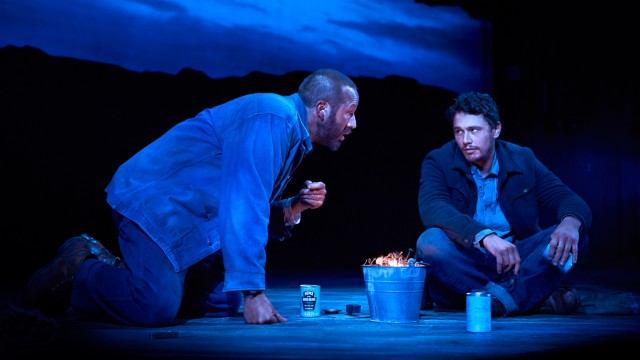
Chris O’Down and James Franco both make their Broadway debut in revival of John Steinbeck classic (photo by Richard Phibbs)

Longacre Theatre
220 West 48th St. between Broadway & Eighth Ave.
Tuesday – Sunday through July 27, $37 – $147
www.ofmiceandmenonbroadway.com

Chris O’Dowd steals the show as an endearing gentle giant who doesn’t know his own strength in Anna D. Shapiro’s riveting new production of John Steinbeck’s American classic Of Mice and Men, the first Broadway revival of the 1937 play in forty years. O’Dowd stars as Lennie Small, a large man with the mind of a child who has a penchant for petting nice things. He is out on the road with his best friend, George Milton (James Franco), a stand-up guy who takes care of him and finds work for them as migrant ranch hands. They had to leave their previous job in a hurry after Lennie caused trouble involving a young woman and her pretty dress, and they are now headed for another ranch, where they’re hoping to save up enough money bucking barley bags to get a little plot of land for themselves. George regularly makes Lennie tell them about their best-laid plans: “Some day we’re gonna get the jack together and we’re gonna have a little house, and a couple of acres and a cow and some pigs and . . .” George says before being interrupted by Lennie, who chimes in, “and live off the fat of the land! And have rabbits. Go on, George! Tell about what we’re gonna have in the garden. And about the rabbits.” Among the people they meet at the ranch are Candy (Jim Norton), an older man with a mangy dog; Slim (Jim Parrack), the jerk-line skinner who takes a liking to George and Lennie; Carlson (Joel Marsh Garland), a stout fellow who can’t wait to shoot Candy’s dog; Crooks (Ron Cephas Jones), a bitter black man whose color segregates him from the rest of the men; and the Boss (Jim Ortlieb), who just wants everyone to do their jobs with as few problems as possible. But the biggest danger is the Boss’s son, Curley (Alex Morf), a small, angry man with a chip on his shoulder, both about his size as well as how some of the guys look at his very attractive and flirty wife (Leighton Meester). However, despite trying so hard, Lennie finds himself in trouble yet again, leading to a tragic finale.

(photo by Richard Phibbs)

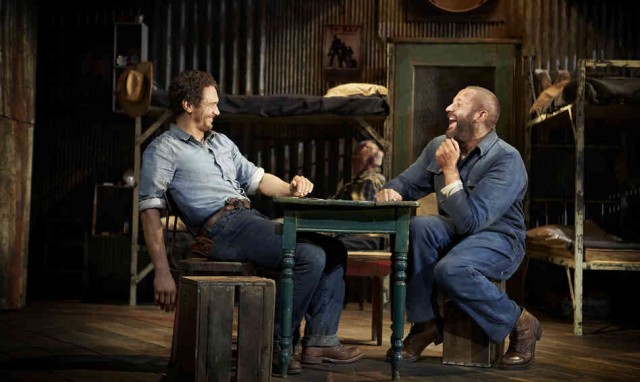
George (James Franco) and Lennie (Chris O’Dowd) share a rare laugh in OF MICE AND MEN revival (photo by Richard Phibbs)

Thoughtfully directed by Anna D. Shapiro (August: Osage County, Domesticated) with grace and tenderness, the show focuses on the concept of single-handedness, emphasizing the loneliness experienced by all of the characters. O’Dowd, as Lennie, uses his left hand almost like a conductor’s baton to help express himself and get his words out; while he remains by George’s side, he desperately wants something to pet and take care of, be it a mouse or a dog or other preferably living thing. Candy, played by the ever-dependable Norton, has only one hand, and he can’t imagine facing life alone if he allows Carlson to kill his dog. Crooks, so used to everyone steering clear of him because he’s black, is surprised when first Lennie, then others, suddenly come into his room, which is away from where the rest of the men stay. “You got no right to come in my room. This here’s my room. Nobody got any right in here but me,” he tells Lennie, who comes in anyway. When Curley attacks Lennie, it’s Curley’s hand, the one he keeps extra soft for his wife, that Lennie grabs. Even the “couples” in the play deal with the issue. Curley and his wife are never seen together, always looking for each other. And Slim makes a special note of Lennie and George’s relationship, which he alone seems to understand. “Hardly none of the guys ever travels around together. I hardly never seen two guys travel together,” he says to George. “You know how the hands are. They come in and go on alone. Never seem to give a damn about nobody. Jest seems kinda funny. A cuckoo like him and a smart guy like you traveling together.” Indeed, it’s no coincidence that the nearest town is Soledad, which means “loneliness” in Spanish and is where the men go to seek paid female accompaniment.

(photo by Richard Phibbs)

Lennie (Chris O’Dowd) and Curley’s wife (Leighton Meester) talk about their dreams in OF MICE AND MEN (photo by Richard Phibbs)

Film and television stars O’Dowd (Bridesmaids, Girls), Franco (127 Hours, Freaks and Geeks), and Meester (Country Strong, Gossip Girl) avail themselves well in their Broadway debuts; Meester adds a deep richness to Curley’s unnamed wife, who is often portrayed as more of a floozy, while Franco is smart and solid alongside O’Dowd’s mesmerizing performance, a pair previously played by such duos as Wallace Ford and Broderick Crawford, Kevin Conway and James Earl Jones, George Segal and Nicol Williamson, Robert Blake and Randy Quaid, Burgess Meredith and Lon Chaney Jr., and Gary Sinise and John Malkovich. The rest of the cast is stellar as well, with particularly fine turns by the ever-dependable Norton (The Mystery of Edwin Drood, The Seafarer) and the Texas-born Parrack (True Blood), Todd Rosenthal’s sets range from the bank of the Salinas River, where George and Lennie take a load off, to the bunkhouse, which looks more like a prison, representing the death of the American dream in the wake of the depression. Seventy-seven years after it first arrived on Broadway, Of Mice and Men is still a powerful, and relevant, examination of loneliness, friendship, and the struggle to survive in hard times.

LADY DAY AT EMERSON’S BAR AND GRILL

Audra McDonald channels Billie Holiday in  LADY DAY (photo by Evgenia Eliseeva)

Audra McDonald channels Billie Holiday in LADY DAY (photo by Evgenia Eliseeva)

Circle in the Square Theatre
1633 Broadway at 50th St.
Tuesday – Sunday through August 10, $97 – $252
www.ladydayonbroadway.com

Watching — nay, experiencing — the astonishing Audra MacDonald inhabit Billie Holiday in Lady Day at Emerson’s Bar & Grill, one might think that the show was created specifically for the five-time Tony winner. In fact, it’s been around since 1986, and earlier off-Broadway and out-of-town versions have featured such stars as Lonette McKee, Eartha Kitt, S. Epatha Merkerson, Loretta Divine, and Jackée Harry. Inspired by one of Holiday’s final performances, at a small club in South Philadelphia a few months before her death in 1959 at the age of forty-four, Lanie Robertson’s (Nasty Little Secrets) ninety-minute show focuses on a brittle but still immensely talented Holiday as she performs classic songs while sharing tales from her difficult life, which was riddled with physical and sexual abuse, failed marriages, rape, prostitution, and drug and alcohol addiction. Backed by Shelton Becton as pianist Jimmy Powers, George Farmer on bass, and Clayton Craddock on drums (get there early, as the trio starts performing well before curtain time), McDonald nails Holiday’s unique phrasing and thrilling voice on such numbers as “I Wonder Where Our Love Has Gone,” “Crazy He Calls Me,” and “Easy Living” as well as “God Bless the Child,” which she cowrote, “T’aint Nobody’s Business If I Do,” and “Strange Fruit,” giving them added emotional resonance in relation to Lady Day’s tragic downfall. The audience sits around the thrust stage on three sides, with a “Circle Club” section in the middle, where patrons sit at tables and drink during the show and Holiday occasionally stumbles through, slurring her words, needing help just to stay upright. Directed by Lonny Price, who previously worked with McDonald on 110 in the Shade, Lady Day is a poignant, passionate look at one of the greatest singers who ever lived, magnificently portrayed by one of Broadway’s very best.

BULLETS OVER BROADWAY: THE MUSICAL

Helen Sinclair (Marin Mazzie) tells David Shayne (Zach Braff) not to speak in BULLETS OVER BROADWAY (photo by Paul Kolnick)

Helen Sinclair (Marin Mazzie) tells David Shayne (Zach Braff) not to speak in BULLETS OVER BROADWAY (photo by Paul Kolnik)

St. James Theatre
246 West 44th St. between Broadway & Eighth Aves.
Tuesday – Sunday through September 28, $52 – $152
www.bulletsoverbroadway.com

In 2001, director-choreographer Susan Stroman struck gold collaborating with Mel Brooks on the musical adaptation of his 1968 comedy, The Producers, about a pair of schlemiels looking to finance a Broadway flop. The show itself was no flop, running for six years at the St. James Theatre and winning twelve Tonys. Unfortunately, Stroman’s current collaboration with another comedy genius, Woody Allen, also at the St. James and also about trying to get a show produced, ends up shooting mostly blanks. Allen wrote the book and Stroman serves as director and choreographer for Bullets over Broadway, the musical version of Allen’s hit 1994 film, which earned him and cowriter Douglas McGrath an Oscar nomination for best original screenplay. (The film earned seven Oscar nominations in all, with Dianne Weist winning for Best Supporting Actress.) The play is set in 1929, as serious playwright David Shayne (Zach Braff in his Broadway debut) is offered a chance to get his latest work produced on the Great White Way — but only if he casts mobster Nick Valenti’s (Vincent “Big Pussy” Pastore) girlfriend, Olive Neal (Heléne Yorke), in a major role. Shayne’s agent, Julian Marx (Lenny Wolpe), convinces him to take the deal, but when they quickly discover how talentless, annoying, and just plain dumb Olive is, they have their work cut out for them, especially after building an otherwise impressive cast that includes the dapper but always hungry Warner Purcell (Brooks Ashmanskas), the dependable Eden Brent (Karen Ziemba), and fading diva Helen Sinclair (Marin Mazzie). Valenti has assigned one of his goons, Cheech (Nick Cordero), to watch after Olive, but soon he is spending most of his time rewriting Shayne’s play — and making it much better, which excites, confuses, and terrifies Shayne as opening night approaches.

(photo by Paul Kolni

Opening night beckons in Woody Allen’s musical version of BULLETS OVER BROADWAY (photo by Paul Kolnik)

Cordero is excellent as Cheech, a role played in the film by Chazz Palminteri, but the rest of the cast never quite reaches the levels necessary to make this story of art and ethics, love and money, and the business of show rise above the mundane. Allen’s jokes, so potent in the film, continually fall flat onstage, and the songs, which primarily consist of old-time classics adapted and with additional lyrics by Glen Kelly, are often repetitive (how many brief reprises can one take?), unnecessary, and unmemorable, with a few exceptions: Cheech’s “Up a Lazy River,” is fun, and Warner and Olive have a ball with “Let’s Misbehave,” which was the theme song of Allen’s ”Everything You Always Wanted to Know About Sex* But Were Afraid to Ask.” In addition, the Atta-Girls, who sing and dance at Nick’s club and play various background roles, are always welcome, as are William Ivey Long’s glamorous period costumes. Ultimately, Bullets over Broadway is about how far a person will go for their art; in the case of this musical, the answer is not far enough.

WAITING FOR GODOT / NO MAN’S LAND

(photo by Joan Marcus)

Didi (Patrick Stewart) and Gogo (Ian McKellen) joke around while waiting for Godot in Samuel Beckett masterpiece (photo by Joan Marcus)

Cort Theatre
138 West 48th St. between Sixth & Seventh Aves.
Extended through March 30, $40 – $147
www.twoplaysinrep.com

For the past five months, British thespians Patrick Stewart and Ian McKellen have been having a blast in New York, as they perform two existential masterpieces in repertory on Broadway and travel all over the city in their bowler hats, posting fabulous pictures on their twitter sites. Sir Ian and Sir Pat are now entering the last week of two marvelous productions, Samuel Beckett’s Waiting for Godot and Harold Pinter’s No Man’s Land, running at the Cort Theatre through March 30. The two men, who have previously starred opposite each other as frenemies in the X-Men movies, first teamed up for Godot in London in 2009; they had such a good time, they decided to bring it to Broadway. It was director Sean Mathias’s idea to add Pinter’s 1975 drawing-room romp, and the two plays work extremely well together, like a pair of old friends enjoying each other’s company. In Waiting for Godot — the last word of which you will forever pronounce with the accent on the second syllable after seeing this show — McKellen is Estragon (Gogo) and Stewart is Vladimir (Didi), two homeless men who are expecting a man named Godot to arrive. In between Gogo’s concern for his boots and Didi’s frequent trips to relieve himself, the drifters engage in such surreal dialogue as E: “He should be here.” V: “He didn’t say for sure he’d come.” E: “And if he doesn’t come?” V: “We’ll come back tomorrow.” E: “And then the day after tomorrow.” V: “Possibly.” E: “And so on.” V: “The point is —” E: “Until he comes.” V: “You’re merciless.” E: “We came here yesterday.” V: “Ah no, there you’re mistaken.” E: “What did we do yesterday?” V: “What did we do yesterday?” E: “Yes.” V: “Why . . . Nothing is certain when you’re about.” Indeed, nothing is certain in the two-and-a-half-hour, two-act play, even when the pompous Pozzo (Shuler Hensley) arrives, led by his apparent human slave, Lucky (Billy Crudup). What’s it all about? That’s something that theatergoers and critics have been contemplating and arguing about for some fifty years, getting little help from Beckett himself. The beauty of Godot is that it is about everything and nothing, perhaps the most entertaining and perplexing Rorschach test ever conceived. It’s really about whatever you want it to be, including, very simply, exceptional theater.

(photo by Joan Marcus)

Spooner (Ian McKellen) and Hirst (Patrick Stewart) rehash the past in Harold Pinter classic (photo by Joan Marcus)

Much is left up to the audience to figure out in the absurdist black comedy No Man’s Land as well. After meeting in a pub, the wealthy, impeccably dressed Hirst (Stewart, wearing a wonderful pair of bright blue socks and a fashionable toupee) brings home the somewhat less erudite but scholarly Spooner (McKellen) for further conversation and top-shelf liquor. The two men discuss life and love, aging and infidelity, poetry and memory, occasionally joined by Foster (Crudup) and Briggs (Hensley), who may or may not be Hirst’s sons or servants. (The four characters are named after great cricketers — not that that lends insight into who they are or what they actually represent, other than that Pinter is playing yet more games with his story.) Stewart and McKellen, in roles originated by a pair of other sirs, Ralph Richardson and John Gielgud, respectively, are utterly delightful as the two gents. Are they old college friends? Romantic competitors? Two halves of the same person? As in Waiting for Godot, the significantly more acerbic No Man’s Land is open for vast interpretation as well, although it provides far more clues. Both plays are splendidly directed by Mathias (Bent), who honors the spirit of each play without getting overly fancy or dramatic, and feature exemplary sets and costumes designed by Stephen Brimson Lewis that evoke heaven, hell, and the way station in between. Over the past dozen years or so, McKellen (King Lear, Dance of Death) and Stewart (A Christmas Carol, Macbeth) have appeared on the New York stage separately, but there’s nothing quite like seeing them together on Broadway, in a pair of stellar productions that allow them to have just as much fun as the audience.