this week in broadway

THE LINE KING’S LIBRARY: AL HIRSCHFELD AT THE NEW YORK PUBLIC LIBRARY

Al Hirschfeld’s long relationship with the New York Public Library is explored in exhibit at Lincoln Center

Al Hirschfeld’s long relationship with the New York Public Library and the arts is celebrated in exhibit at Lincoln Center

New York Public Library for the Performing Arts
40 Lincoln Center Plaza
Exhibition continues through January 4
Film screening: Bruno Walter Auditorium, 111 Amsterdam Ave., Monday, November 18, free, 6:00
212-642-0142
www.nypl.org/lpa

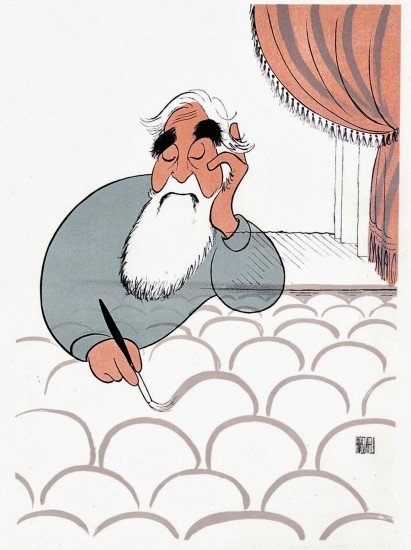
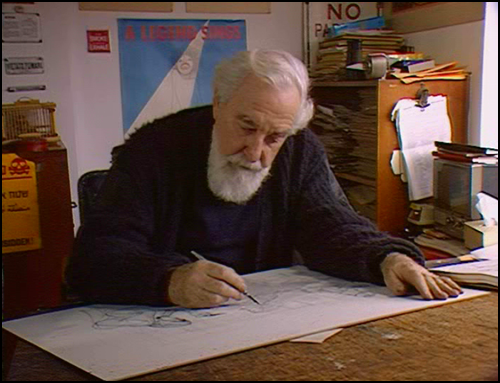
Twelve years ago, New York celebrated the life and eighty-plus-year career of legendary artist Al Hirschfeld with a major retrospective at the Museum of the City of New York and an exhibit of his celebrity caricatures at the New York Public Library’s main branch; in addition, Abrams released two books of his work, one focusing on New York, the other on Hollywood, and Hirschfeld made appearances to promote the publications. Nearly eleven years after his passing in January 2003 at the age of ninety-nine, the New York Public Library is honoring Hirschfeld again with a lovely exhibit at the Dorothy and Lewis B. Cullman Center, “The Line King’s Library: Al Hirschfeld at the New York Public Library.” Visitors can first stop by a re-creation of Hirschfeld’s work area, complete with his drawing table and barber chair, which is on permanent view at the library entrance. The exhibition is straight ahead, consisting of more than one hundred color and black-and-white drawings and lithographs, posters, books, letters, video, newspaper and magazine clippings, and various other ephemera, divided by the discipline of Hirschfeld’s subjects: theater, music, dance, and film, in addition to a section on those artists who influenced the man known as the Line King.

Oscar-winning documentary on Al Hirschfeld screens for free at NYPL on November 18

Oscar-winning documentary on Al Hirschfeld screens for free at NYPL on November 18

“My contribution is to take the character — created by the playwright and acted out by the actor — and reinvent it for the theater,” Hirschfeld once explained, and the evidence is on the walls, including works depicting Jack Lemmon in Tribute, Lee J. Cobb in Death of a Salesman, Christopher Plummer in Macbeth, Jessica Tandy and Marlon Brando in A Streetcar Named Desire, Rex Harrison and Julie Andrews in My Fair Lady, Alan Cumming in Cabaret, and Jackie Mason in The World According to Me, among so many more. There are also caricatures of Marcel Marceau, S. J. Perelman, George Bernard Shaw, Leonard Bernstein, Vladimir Horowitz, Dizzy Gillespie, Katharine Hepburn, and a dazzling, rarely shown 1969 print of Martha Graham. Another highlight is the original drawing for “Broadway First Nighters,” along with a key identifying the dozens of celebrities gathered in a packed room, and paraphernalia from Hirschfeld’s musical comedy Sweet Bye and Bye, a collaboration with Perelman, Vernon Duke, and Ogden Nash. And for those fans who have spent years trying to find all the inclusions of “Nina” in Hirschfeld’s drawings, “Nina’s Revenge” features his daughter holding a brush and smiling, the names “Al” and “Dolly” (for Dolly Haas, her mother and Hirschfeld’s second wife) in her long hair. In conjunction with the exhibition, there will be a free screening of the Oscar-winning 1996 documentary The Line King: The Al Hirschfeld Story, introduced by the director, Susan W. Dryfoos, on November 18 at 6:00 in the Bruno Walter Auditorium at the New York Public Library for the Performing Arts.

BETRAYAL

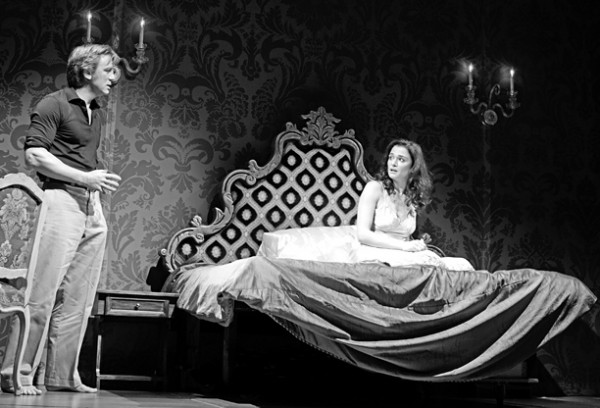
Robert (Daniel Craig) and wife Emma (Craig’s real-life wife, Rachel Weisz) don’t spend a lot of time together in bed in BETRAYAL (photo by Brigitte Lancombe)

Robert (Daniel Craig) and wife Emma (Craig’s real-life wife, Rachel Weisz) don’t spend a lot of time together in bed in BETRAYAL (photo by Brigitte Lancombe)

Ethel Barrymore Theatre
243 West 47th St. between Broadway & Eighth Ave.
Through January 5, $67 – $185
www.betrayalbroadway.com

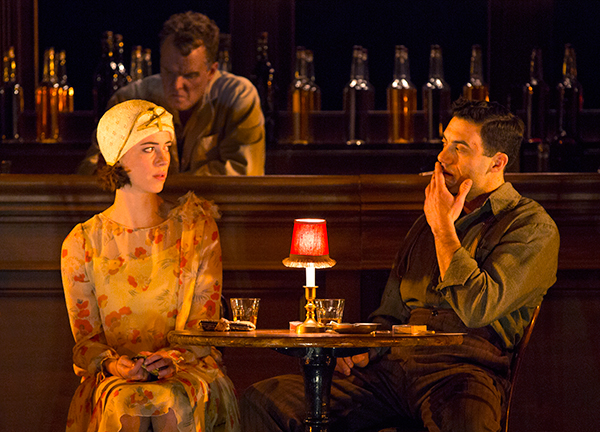
Harold Pinter’s Betrayal has always been a star-driven vehicle. The reverse-chronology tale of marital infidelity opened on Broadway in 1980 with Raul Julia, Blythe Danner, and Roy Scheider and was revived in 2000 with Liev Schreiber, Juliette Binoche, and John Slattery; the 1983 film featured Jeremy Irons, Patricia Hodge, and Ben Kingsley. In its current incarnation on Broadway, directed by Mike Nichols, the husband-and-wife team of Daniel Craig and Rachel Weisz might be driving ticket sales through the roof, but it’s Rafe Spall who ends up stealing the show. Spall plays Jerry, an impulsive arts agent who has had a long affair with gallery owner Emma (Weisz), who is married to one of his closest friends, refined publisher Robert (Craig, who resembles Kirk Douglas here); Jerry was even best man at their wedding. The play begins in 1977, as Jerry, who is married to the never-seen Judith, and Emma meet in a bar so Emma can tell him that she had no choice but to finally confess their affair to Robert the previous night. But as Jerry finds out when he sees Robert later that day, Robert has actually known about their lengthy indiscretion for several years, which infuriates Jerry. The story continues in backward order, going from Jerry and Emma’s breakup in 1975 to the night he professes his love for her at a party in 1968. (However, multiple scenes within the same year move forward.)

BETRAYAL

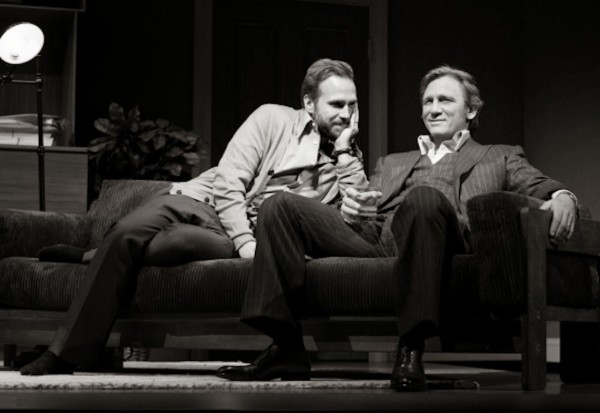
Jerry (Rafe Spall) and Robert (Daniel Craig) reminisce over better times in second Broadway revival of Harold Pinter play (photo by Brigitte Lacombe)

Nichols, who helmed a marvelous revival of Death of a Salesman last year with Philip Seymour Hoffman, keeps things relatively simple in this even-keeled, somewhat subdued production. In his Broadway debut, Spall (Life of Pi, Prometheus) injects fiery life into the wildly unpredictable Jerry, while Craig (A Steady Rain, Bond, James Bond) and Weisz (The Constant Gardener, 2010 Olivier Award for A Streetcar Named Desire), in her Broadway debut as well, give their characters a dispassionate coldness that wavers a little too much in intensity, occasionally playing it too matter-of-factly. The staging matches the emotional temperature: As scenes fade out, somber piano music by former LCD Soundsystem head James Murphy tinkles over the loudspeaker, the actors glide offstage on Ian MacNeil’s rotating sets, and backdrops float in and out from above. Of course, Jerry is the meatier role; Emma and Robert’s marriage is cold and dispassionate from the start of the play, but Weisz’s and Craig’s performances still can feel a bit distant at critical moments. Based on his own affair with Joan Bakewell, Pinter’s thirty-five-year-old Olivier Award–winning drama retains a timeless quality, as Nichols focuses on the hearts and minds involved in a classic love triangle, avoiding the impulse to ground the play in any specific era by steering clear of overt references to the sociopolitical climate or even the clothing of the day. It might not be as stirring as it could have been, but this Betrayal offers an honest, penetrating examination of complex adult relationships.

BIG FISH

(photo by Paul Kolnik)

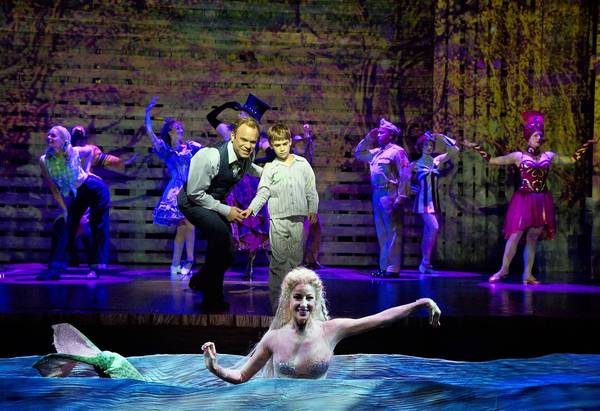
Father Edward (Norbert Leo Butz) introduces son Will (Zachary Unger) to a mermaid (Sarrah Strimel) in BIG FISH (photo by Paul Kolnik)

Neil Simon Theater
250 West 52nd St. between Broadway & Eighth Ave.
Through March 9, $49-$142
www.bigfishthemusical.com

Based on Daniel Wallace’s slim 1998 novel and Tim Burton’s overwrought 2003 film, Big Fish the musical has arrived on Broadway, but it doesn’t leave much of a splash. The story of fathers and sons and family legacies, Big Fish takes place in Alabama, opening with Will Bloom (Bobby Steggert) preparing to marry his sweetheart, Josephine (Krystal Joy Brown). Will asks his father, Edward (Norbert Leo Butz), not to tell any of his endless collection of stories at the wedding, but Edward can’t help himself, boldly spilling a secret that angers his son. The rest of the show goes back and forth between the present, in which Edward finds himself ill, and the past, as he fills his child’s (alternately played by Anthony Pierini and Zachary Unger) head with fantastical adventures that include witches, giants, mermaids, and dragons, all of which he claims to be true. Edward also details his romance with the love of his life, Will’s mother, Sandra (Kate Baldwin). Unfortunately, most of these tall tales come up short in the entertainment department.

Sandra (Kate Baldwin) and Edward (Norbert Leo Butz) fall in love in BIG FISH (photo by Paul Kolnik)

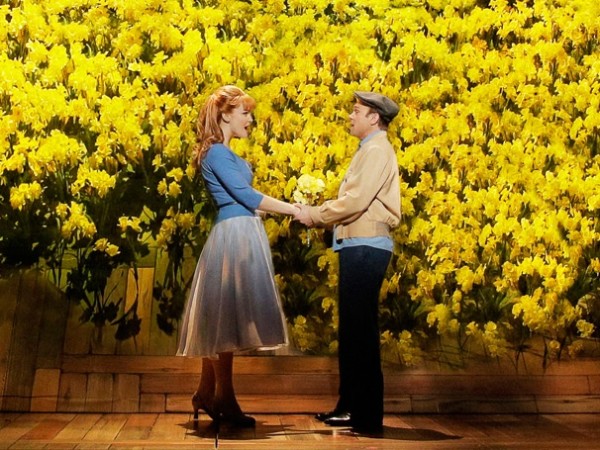
Sandra (Kate Baldwin) and Edward (Norbert Leo Butz) fall in love in BIG FISH (photo by Paul Kolnik)

From the opening number, Big Fish establishes itself as a completely standard Broadway musical, featuring a treacly, uninteresting score by Andrew Lippa (I Am Harvey Milk, The Addams Family), a book by August that confuses more than it intrigues, unnecessary video projections by Benjamin Pearcy, and flashy choreography by director Susan Stroman (The Scottsboro Boys, The Producers) that manages to be both tired and overdone. Like lesser Burton films, of which Big Fish is certainly one, style trumps substance; not even such Broadway favorites as Butz (Catch Me If You Can, Dirty Rotten Scoundrels), Baldwin (Finian’s Rainbow, Giant), and Brad Oscar (The Producers) as circus ringmaster Amos Calloway can save such drowning, hook-free numbers as “Be the Hero,” “Daffodils,” and “Start Over,” although Ciara Renée conducts herself well as the Witch in her Broadway debut and JC Montgomery is likable as Dr. Bennett. Despite its grand ambitions, this Big Fish ends up being all wet.

THE SNOW GEESE

(photo by Joan Marcus)

The Gaesling clan gathers at their upstate lodge for the start of hunting season (photo by Joan Marcus)

Manhattan Theatre Club at the Samuel J. Friedman Theatre
261 West 47th St. between Broadway & Eighth Aves.
Tuesday – Sunday through December 15, $67-$120
www.manhattantheatreclub.com
www.thesnowgeesebroadway.com

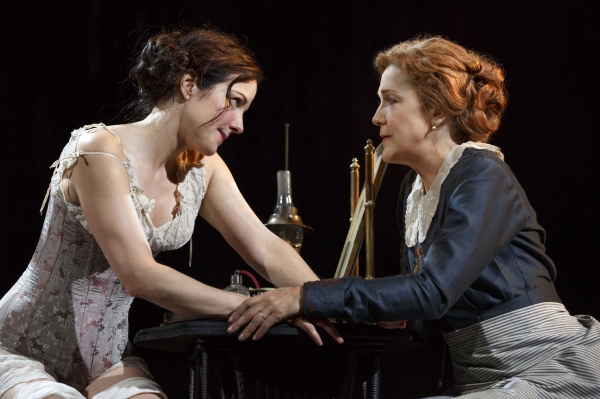
Late last year, Sharr White’s gripping The Other Place, a searing look inside the mind of a marketing executive lost in her own alternate reality, opened on Broadway after a 2011 run at MCC Theatre. White’s follow-up, The Snow Geese, another coproduction of Manhattan Theatre Club and MCC at the Samuel J. Friedman, is a dreary mashup of Alan Bridges’s 1985 film The Shooting Party and Chekhov’s The Cherry Orchard, a just-plain-dull WWI-era tale focusing on a woman having difficulty facing reality after the unexpected loss of her beloved husband. Despite the sudden death of Teddy, Elizabeth Gaesling (Mary-Louise Parker) thinks she is ready to go on with her life as the family comes together at their lodge in upstate New York for their traditional toast at the opening of snow goose season. Elizabeth is joined by her two sons: the patriotic, prodigal Duncan (Evan Jonigkeit), who goes to Princeton and has joined the war effort, and Arnold (Brian Cross), who has stayed home to take care of their mother and the family finances, which are not in very good shape.

(photo by Joan Marcus)

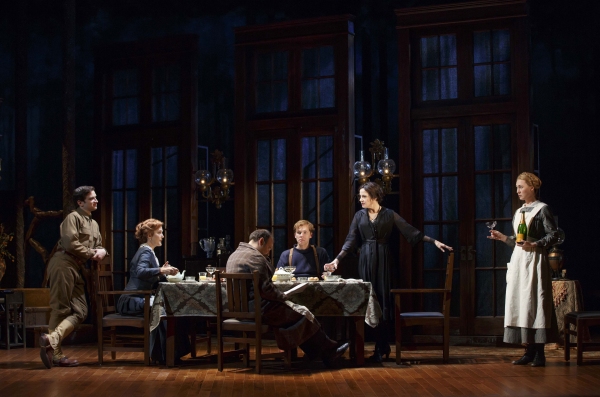
Two sisters (Mary-Louise Parker and Victoria Clark) try to get by in Sharr White’s new Broadway play (photo by Joan Marcus)

Also with them is Elizabeth’s sister, Clarissa (Victoria Clark), a very Christian woman who thinks that Elizabeth should still be in mourning, and her husband, Max (Danny Burstein), a German-born doctor with a thick accent who can no longer practice medicine because of anti-Axis sentiment, even though he has been an American for decades. Most of the meandering story plays out on John Lee Beatty’s stodgy dining-room set, with occasional boring scenes out in bare woods where Duncan and Arnold verbally spar while not shooting at snow geese, who fly by in a metaphorical gaggle of freedom. The most interesting figure in the play is the Gaeslings’ maid, Viktorya Gryaznoy (Jessica Love), a bright young woman from a wealthy family who escaped the Ukraine and has taken a job well below her; how she is treated by the others establishes not only her character but theirs as well. Director Daniel Sullivan (Proof, Orphans) is not able to do much with the material or the mediocre performances, surprising from such a talented cast. The Snow Geese takes aim at examining the human condition in a changing America during WWI but unfortunately ends up firing mostly blanks.

A TIME TO KILL

(photo by Carol Rosegg)

Rupert Holmes’s stage version of John Grisham novel gets off to an exciting start at Golden Theatre (photo by Carol Rosegg)

Golden Theatre
252 West 45th St. between Broadway & Eighth Ave.
Tuesday – Sunday through November 17, $49 – $132
www.atimetokillonbroadway.com

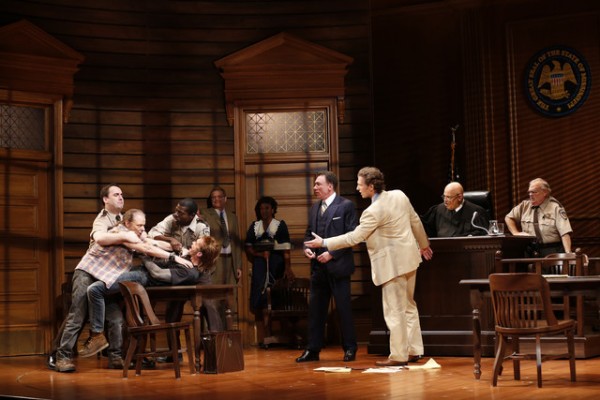
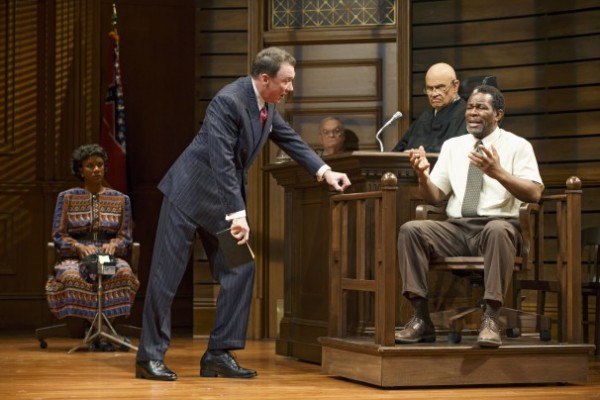
In A Time to Kill, Rupert Holmes’s adaptation of John Grisham’s 1989 debut novel, Tony winner Holmes (The Mystery of Edwin Drood) and director Ethan McSweeny set things up well in the first act, but it all falls apart very quickly in a second act that could have been called A Time to Overkill. In fictional Clanton, Mississippi, two white racists, Billy Ray Cobb (Lee Sellars) and Pete Willard (Dashiell Eaves), have just been arrested by Sheriff Ozzie Walls (Chiké Johnson) for raping and beating a ten-year-old black girl. After a bail hearing, the girl’s father, Carl Lee Hailey (John Douglas Thompson), shoots and kills both of them in the courthouse. Arrested for double homicide, Hailey hires local defense attorney Jake Brigance (Sebastian Arcelus) to represent him. With the help of law student Ellen Roark (Ashley Williams) and disbarred lawyer Lucien Wilbanks (Tom Skerritt), Brigance battles hotshot prosecutor and potential gubernatorial candidate Rufus R. Buckley (Patrick Page) to save Hailey from the death penalty. The first act flows smoothly, with short scenes and quick set changes that mimic the pace of a movie; in fact, A Time to Kill was a successful 1996 film directed by Joel Schumacher and starring Matthew McConaughey (Brigance), Samuel L. Jackson (Hailey), Sandra Bullock (Roark), Kevin Spacey (Buckley), Kiefer Sutherland (Cobb), Donald Sutherland (Wilbanks), and Charles S. Dutton (Walls).

(photo by Carol Rosegg)

Mississippi courtroom drama runs out of gas in overly zealous second act (photo by Carol Rosegg)

But in the second act, which focuses on the trial overseen by Judge Noose (a stumbling Fred Dalton Thompson), unnecessary video projections, manipulative emotional twists, and an annoying conceit in which Buckley and Brigance address the audience as if it’s the jury grow tiresome. The plot and characterizations get more, well, black and white as the lines become more heavily drawn between good and bad, and any sense of nuance vanishes. Skerritt, in his Broadway debut, isn’t given much to do, and none of the actors (the cast also includes Tonya Pinkins as Hailey’s wife and John Procaccino as a drunk insanity expert) deliver standout performances as the cardboard-cutout of a story continues. Grisham fans — who very likely are in the midst of reading his brand-new novel, Sycamore Row, which features the return of Brigance — will notice the deletion of certain characters, most prominently Ethel Twitty, Harry Rex Vonner, Stump Sisson, and Carla Brigance, making for a more streamlined version, but there are better ways to kill time than by seeing this overly zealous treatment of A Time to Kill. [ed note: On November 7, it was announced that the final performance will be held on November 17. In addition, John Grisham will host the November 14 performance, discussing the original novel, the play, and the sequel, Sycamore Row.]

A NIGHT WITH JANIS JOPLIN

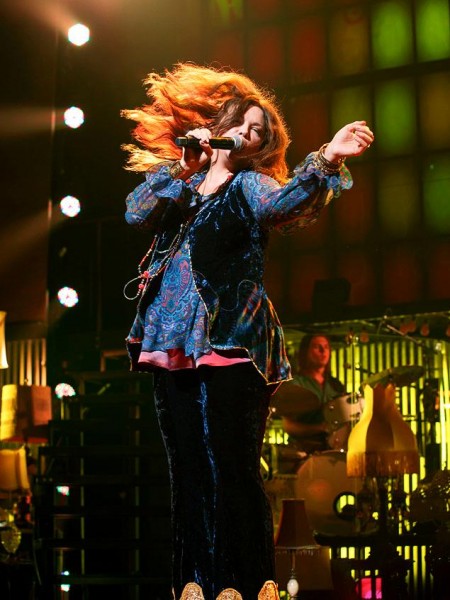
Mary Bridget Davies channels Janis Joplin in disappointing Broadway musical (photo by Joan Marcus)

Mary Bridget Davies channels Janis Joplin in disappointing Broadway musical (photo by Joan Marcus)

Lyceum Theatre
149 West 45th St. between Sixth & Seventh Aves.
Tuesday – Sunday through March 30, $28- $140
anightwithjanisjoplin.com

Mary Bridget Davies was seemingly born to play Janis Joplin. When she was a teenager in Cleveland, she dressed as Joplin for Halloween. Later, she toured as a singer with Joplin’s band, Big Brother and the Holding Company. And now she has the lead role in the Broadway musical A Night with Janis Joplin. Davies looks like Joplin, she moves like Joplin, and, most impressive, she sounds like Joplin. Unfortunately, writer-director Randy Johnson barely glosses over the personal aspects of Joplin’s life, never really delving into necessary details, instead concentrating ad nauseam on her love of the blues and her musical influences. The show is arranged as a one-night concert in which Joplin, backed by a trio of singers and a live band, blasts out classic songs, with in-between patter that quickly grows repetitive. As she talks about her heroes, they take the stage and perform, including Bessie Smith (Taprena Michelle Augustine), Nina Simone (De’Adre Aziza), Aretha Franklin (Allison Blackwell), Etta James (Nikki Kimbrough), and Odetta (Aziza again), but these numbers seem to be an excuse for Davies to rest her voice, as they add nothing to the Joplin legend. In fact, A Night with Janis Joplin occurs in a vacuum, set in no particular time period. There is no mention of the civil rights movement, sex, drugs, alcohol (Davies does take a single swig from a bottle, sans commentary), Monterey Pop, Woodstock, Jimi Hendrix, or Jim Morrison, although F. Scott and Zelda Fitzgerald show up twice, even once projected onto a screen in the back. The setlist is, of course, sensational, although too many songs are heard in incomplete versions: “Summertime,” “Down on Me,” “Piece of My Heart,” “Try (Just a Little Bit Harder),” “Cry Baby,” “Ball and Chain,” etc., in addition to the unfortunately prophetic “I’m Gonna Rock My Way to Heaven,” which Joplin was working on when she died and has never been previously performed or recorded. Set and lighting designer Justin Townsend fills the stage with dozens of lamps of all shapes and sizes, along with a row of vertical fluorescent lights in the back and yet more long, narrow fluorescent bulbs arranged askew around the front, but it’s not exactly clear why. But it does fit in with the general feel of the production, which ends up being a whole lot more style than substance. Johnson has claimed that this is not a tribute show, but it would fit in better at a venue such as B.B. King’s Blues Club, which hosts regular tributes to the Beatles, James Brown, Motown, Simon & Garfunkel, the Doors, Santana, Bruce Springsteen, and others, than at a Broadway theater, where a lot more depth is expected.

THE GLASS MENAGERIE

GLASS MENAGERIE

Cherry Jones and Zachary Quinto play mother and son in glorious revival of Tennessee Williams’s THE GLASS MENAGERIE (photo by Michael J. Lutch)

Booth Theatre
222 West 45th St. between Broadway & Eighth Ave.
Tuesday – Sunday through February 23, $42 – $147
theglassmenageriebroadway.com

In the past eighteen months, two of America’s greatest playwrights have experienced glorious Broadway revivals — Mike Nichols’s version of Arthur Miller’s Death of a Salesman, starring Philip Seymour Hoffman, and Pam MacKinnon’s Steppenwolf production of Edward Albee’s Who’s Afraid of Virginia Woolf?, with Tracy Letts and Amy Morton battling it out for three hours — but Tennessee Williams has not fared nearly so well. Until now. On the heels of disappointing adaptations of A Streetcar Named Desire and Cat on a Hot Tin Roof, John Tiffany’s The Glass Menagerie, which originated at Harvard’s American Repertory Theater earlier this year, is a spectacular celebration of one of Williams’s best plays, a haunting examination of a fragile family and the concept of memory. In depression-era St. Louis, Tom Wingfield (Zachary Quinto, of American Horror Story and the Star Trek reboot) and his sister, Laura (two-time Tony nominee Celia Keenan-Bolger), live in a small apartment with their caring yet domineering mother, Amanda (two-time Tony winner Cherry Jones). Tom works in a local warehouse but dreams of becoming a writer and traveling the world. Laura has a lame foot that has turned her into a shy, mousey girl who collects glass animal figurines and treats them like friends. Amanda, who has never quite gotten over the departure of her husband, is desperate for Laura to entertain “gentleman callers” and get married. So when Tom brings home a coworker, Jim (Stargate Universe’s Brian J. Smith), Amanda jumps all over the sudden opportunity to make sure things are just right for this potential suitor.

GLASS MENAGERIE

Amanda Wingfield (Cherry Jones) will do anything she can to find her daughter (Celia Keenan-Bolger) a suitor (photo by Michael J. Lutch)

The story unfolds on Bob Crowley’s relatively spare set, which includes a refrigerator and a small kitchen table on the left, a couch in the middle, and a Victrola and a fire escape on the right, the latter seemingly rising to the heavens. Front and center is a small table on which Laura keeps a single figurine that stands in for her larger collection, which is occasionally represented by glittering specs on a reflecting pool of water that surrounds the stage. Every so often the neon shape of a shark’s fin rises ominously above the surface, psychologically threatening the proceedings. Natasha Katz’s lighting demarcates the past (memory) from the present (reality), and Nico Muhly’s music adds texture between scenes. While Quinto, in his Broadway debut, and Smith are both exceptional, Jones and Keenan-Bolger virtually redefine these long-familiar characters, Jones delivering a performance for the ages as Amanda, words rolling off her tongue as if they were written just for her, Keenan-Bolger embodying Laura’s fears in subtle ways that offer a kind of catharsis for the audience. It’s heartbreaking when she kneels down in front of her figurine and its glow spreads across her face as if illuminating her soul. In his opening monologue, Tom explains that the “play is memory,” and that relates to both the story and Williams himself, as Laura is based on Williams’s sister, Rose (at one point, Laura remembers a high school boy calling her “Blue Roses” after mishearing her say that she has “pleurosis”), and Williams’s given name is Thomas. Tiffany’s version of this deeply personal play is indeed unforgettable, a sparkling example of the power of live theater and a mesmerizing examination of the conflicting emotions that complicate memory.