this week in art

AFTER DARKNESS: SOUTHEAST ASIAN ART IN THE WAKE OF HISTORY

(photo by twi-ny/mdr)

Htein Lin’s “A Show of Hands” documents the plight of hundreds of political prisoners in Myanmar (photo by twi-ny/mdr)

Asia Society Museum
725 Park Ave. at 70th St.
Tuesday – Sunday through January 21, $7-$12 (free Friday nights from 6:00 to 9:00)
212-288-6400
asiasociety.org

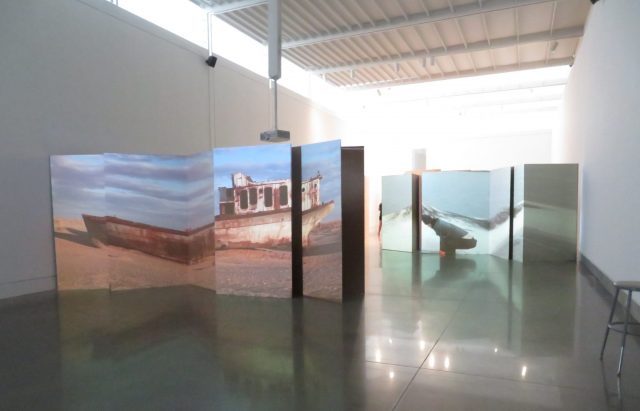
There is nothing subtle about “After Darkness: Southeast Asian Art in the Wake of History,” an intense exhibition continuing through January 21 at Asia Society. The seven artists and one collective in the show — who hail from Indonesia, Myanmar, and Vietnam, three nations that have undergone major sociopolitical transformations since WWII — are angry, and they want everyone to know it. “The featured artists have worked within challenging environments, which have included periods of violence and uncertainty, to create artworks that represent their most ardent aspirations for their home countries,” Asia Society president and CEO Josette Sheeran writes in her foreword to the expansive catalog. In “Destruction,” Indonesian artist FX Harsono turns himself into Ravana, the Demon King from the epic Indian poem Ramayana, and uses a chainsaw to cut up chairs to protest voter fraud, while in “Burned Victims” he sets fire to nine wooden torsos to raise awareness about nine innocent people who died in a mall fire during a riot; the charred remains are lined up along the floor of the gallery. Vietnamese artist Dinh Q. Lê evokes Chinese handscrolls in “WTC from Four Perspectives,” four long, stretched images of the fall of the Twin Towers, now turned into abstract colors and shapes. In “Relevancy of Restricted Things,” Myanmar’s Nge Lay wears a mask and dresses up as her father, who died when she was a teenager, and takes photographs of other families who have lost the patriarch, with Lay taking his place. She also stages her own death in “Observing of Self Being Dead.” Vietnamese artist Nguyen Thi Thanh Mai asked refugees in Cambodia and Vietnam to choose a stock background of an idyllic location, then had a traveling photographer take a picture of them as if they were there; the photos were then arranged on the walls of a hut made from coconut and eucalyptus leaves.

(photo by twi-ny/mdr)

FX Harsono’s “Burned Victims” leads to Dinh Q. Lê’s “WTC from Four Perspectives” (photo by twi-ny/mdr)

The Propeller Group, founded by Matt Lucero, Tuan Andrew Nguyen, and Phunam Thuc Ha, uses time-delay video to watch a motorcycle being stripped down by thieves in The Dream, while in the two-channel video The Guerrillas of Cu Chi, tourists pay a dollar to shoot M-16s and AK-47s from the Vietnam War where underground tunnels were used by the Viet Cong to kill American troops; across the way, a propaganda film promotes the Cu Chi Guerrillas. In Chinese Indonesian Tintin Wulia’s Everything’s OK, her camera moves across a Styrofoam city where money rains down and overcrowding takes over, while opportunity knocks in Ketok and fangs emerge from imported fruit in Violence Against Fruits, about the treatment of minority groups. Indonesian photographer Angki Purbandono spoofs fashion shoots in “Beyond Versace.” And Htein Lin gets his own room for “A Show of Hands,” multiple shelves of plaster of Paris casts of hands of political prisoners in Myanmar, creating an almost blindingly white effect, each hand tagged with a label detailing the person’s name and time spent in which jail. In addition, Harsono’s Writing in the Rain video, in which the artist continues writing his name in black ink on a window as water comes down and washes his identity away, is this month’s “Midnight Moment” selection, being projected on electronic billboards in Times Square throughout January from 11:57 pm to midnight. The exhibition is a kind-of follow-up to 1996’s “Contemporary Art in Asia: Traditions/Tensions,” which was held simultaneously at NYU’s Grey Art Gallery, the Queens Museum, and Asia Society and introduced artists from India, Indonesia, the Philippines, South Korea, and Thailand. But “After Darkness” takes it to the next level, focusing on artists’ reactions to dramatic changes in three nations. In his downstairs lobby installation, FX Harsono’s “Blank Spot on My TV” consists of twenty digital prints of news conferences in which the artist has placed a white circle on a politician’s face, primarily covering the speaker’s mouth, as if what is coming out is meaningless. Meanwhile, “After Darkness” celebrates artists who are not about to be silenced.

MISSION POSSIBLE: IN CONVERSATION WITH RONNY CHIENG

Comedian Ronny Chieng will discuss his life and career at Museum of Chinese in America on January 17

Comedian Ronny Chieng will discuss his life and career at Museum of Chinese in America on January 17

Who: Ronny Chieng, Nancy Yao Maasbach
What: “Mission Possible” conversation with comedian Ronny Chieng and MOCA president Nancy Yao Maasbach
Where: Museum of Chinese in America, 215 Centre St., 855-955-MOCA
When: Wednesday, January 17, $30 (includes museum admission and one drink), 6:00
Why: The Daily Show correspondent Ronny Chieng was born in Malaysia, raised in New Hampshire and Singapore, graduated from the University of Melbourne in Australia, and now is based in New York City. On Trevor Noah’s show, in his stand-up routines, and on his own series, Ronny Chieng: International Student, Chieng takes on stereotypes with straight-ahead humor and a touch of silliness, but always with a serious point. On January 17, the Chinese comedian will be at the Museum of Chinese in America to sit down with MOCA president Nancy Yao Maasbach to talk about comedy, his childhood, and Asian Americans in the arts. There will be an open mic with special guests at 6:00, followed by the discussion at 8:00. Tickets are $30 and include museum admission (and one drink), so get there early to check out the exhibitions “With a Single Step: Stories in the Making of America” and “FOLD: Golden Venture Paper Sculptures.” The program is part of MOCAFest 2018, a wide-ranging series of events welcoming in the Lunar New Year and the Year of the Dog. “Mission Possible” continues January 24 with Gish Jen and January 31 with Betty Wong Ortiz.

THE ’60s: THE YEARS THAT CHANGED AMERICA

You Say You Want a Revolution exhibition at NYPL is part of Carnegie Halls festival

“You Say You Want a Revolution: Remembering the Sixties” exhibition at NYPL is part of wide-ranging Carnegie Hall festival

Multiple locations
January 14 – March 24
www.carnegiehall.org

America came of age in the 1960s, from the assassinations of JFK, RFK, MLK, and Malcolm X to Vietnam and the Summer of Love. Carnegie Hall is paying tribute to the turbulent decade with the two-month series “The ’60s: The Years that Changed America,” inspired by Pulitzer Prize-winning journalist Robert A. Caro. The native New Yorker, who turned eighty-two this past October, is the author of such books as The Power Broker: Robert Moses and the Fall of New York and the four-part The Years of Lyndon Johnson, with a fifth tome on the way. “Luther King gave people ‘the feeling that they could be bigger and stronger and more courageous than they thought they could be,’ Bayard Rustin said — in part because of the powerful new weapon, non-violent resistance, that had been forged on the Montgomery battlefield,’” Caro wrote in Master of the Senate, a quote obviously apt for MLK Day. Running January 14 through March 24 all across the city, the festival features concerts, panel discussions, film screenings, dance, art exhibitions, and more. Below are only some of the many highlights; keep watching this space for more additions.

Sunday, January 14
through
Saturday, March 24

“Max’s Kansas City,” photos and writings, Mark Borghi Gallery, free

Friday, January 19
“You Say You Want a Revolution: Remembering the Sixties,” Library After Hours opening night program with experimental films, album-cover workshop, games and puzzles, curator tour led by Isaac Gewirtz, dance party with Felix Hernandez, and more, exhibit continues through September 1, the New York Public Library, Stephen A. Schwarzman Building, free, 7:00

Kronos Quartet, works by Stacy Garrop (world premiere inspired by “I Have a Dream” speech), Zachary J. Watkins (world premiere inspired by Studs Terkel), Terry Riley, John Cage, and Janis Joplin, Zankel Hall at Carnegie Hall, $62-$72, 9:00

Tuesday, January 23
through
Friday, May 18

“The Global Interconnections of 1968,” Kempner Exhibition Gallery, Butler Library (sixth floor), Columbia University, free

Thursday, January 25
Snarky Puppy with David Crosby and Friends, including Chris Thile and Laura Mvula, Stern/Perelman at Carnegie Hall, $26-$100, 8:00

Friday, January 26
Bernard and Irene Schwartz Classic Film Series: Coming Home (Hal Ashby, 1978), Justice in Film presentation introduced by Susan Lacy, New-York Historical Society, free with pay-what-you-wish museum admission, 7:00

Tuesday, February 6
through
Sunday, February 11

March, duet from Lessons inspired by civil rights movement, part of winter season program by Ronald K. Brown / Evidence, a Dance Company, the Joyce Theater, $26-$46

Friday, February 16
“Philip Glass Ensemble: Music with Changing Parts,” Stern/Perelman at Carnegie Hall, $14.50 – $95, 8:00

Wednesday, February 21
“The Summer of Law and Disorder: Harlem Riot of 1964,” panel discussion, the Schomburg Center for Research in Black Culture, free with advance registration beginning February 7, 6:30

Tuesday, March 13
Bernard and Irene Schwartz Distinguished Speakers Series: “The ’60s from Both Sides Now: An Evening with Judy Collins,” in conversation with historian Harold Holzer, New-York Historical Society, $38, 6:30

Saturday, March 24
“The Vietnam War: At Home and Abroad,” multimedia presentation with Friction Quartet performing George Crumb’s “Black Angels” and more groups to be announced, narrated by John Monsky, Zankel at Carnegie Hall, $35-$45, 2:00

MY ART

My Art

Ellie Shine (Laurie Simmons) takes a break at the new Whitney as the sun sets in My Art

MY ART (Laurie Simmons, 2016)
Quad Cinema
34 West 13th St. between Fifth & Sixth Aves.
Opens Friday, January 12
212-255-2243
quadcinema.com/film/my-art

Visual artist Laurie Simmons makes her feature-film debut as writer, director, and star of the self-indulgent, pretentious romance My Art, which opens at the Quad on January 12. Part of the Pictures Generation, Simmons, who was born in Queens in 1949, has been creating intriguing photographic series since the mid-1970s, often focusing on such inanimate objects as mannequins and dolls, offering a feminist viewpoint of domesticity. In My Art, she plays Ellie Shine, a sixty-five-year-old teacher and artist who decides to house-sit for an upstate friend in order to take advantage of her large studio and to work on a new project, bringing along her ailing dog, Bing, who is suffering from degenerative myelopathy (and is sometimes played by her real dog, Dean, who had the same illness). Although she is seeking privacy and seclusion, she is soon interacting with three men, local gardeners Frank (Robert Clohessy), a widower, and Tom (Josh Safdie), who is married to Angie (Parker Posey), and an oft-divorced lawyer, John (John Rothman). Instead of using dolls and mannequins, she and the three men dress up to re-create scenes from some of Ellie’s favorite films, including John Huston’s The Misfits, Stanley Kubrick’s A Clockwork Orange, Billy Wilder’s Some Like It Hot, and François Truffaut’s Jules and Jim, which involve issues of sex, femininity, age, and gender. Inspired by the work of Cindy Sherman and Gulley Jimson, the painter portrayed by Alec Guinness in Ronald Neame’s The Horse’s Mouth, Ellie reimagines herself as Marilyn Monroe, Kim Novak, Malcolm McDowell, Marlene Dietrich, and other characters as the scenes help drive the narrative of her evolving relationships with the three men as well as the upstate community as a whole. She did not come to the house looking for romance, instead wanting to concentrate on her art, but she can’t help but be beguiled by the three men, particularly Frank, while rediscovering her sexuality.

My Art

Ellie (Laurie Simmons) grabs a smoke while clutching Bing (Dean) in My Art

My Art is too cutesy for its own good, more of a Lifetime movie or gallery installation than a theatrical release for the general public. It’s often cloying, and clumsily edited, with a score that might rot your teeth. Simmons is a terrific visual artist — you can see some of her real work in the opening scene, when Ellie is walking through the 2015 Whitney exhibition “As Far as the Eye Can See” (the colorful painting she stops at is “Large Bather [quicksand],” by her husband, Carroll Dunham) — but perhaps feature films are just not her forte. Dunham and Simmons’s daughter, Lena Dunham, makes an early cameo as a student of Ellie’s; it’s not difficult to understand where Lena gets some of her artistic and political views from. There are also cameos by Simmons’s other daughter, writer and activist Grace Dunham, in addition to Marilyn Minter, Blair Brown, and Barbara Sukowa. Simmons, who appeared in Lena’s Tiny Furniture with Grace and in Girls and made the 2006 short The Music of Regrets, is a much better photographer than actress; while it’s refreshing to see a sixtysomething woman protagonist rediscovering life’s many pleasures, Simmons can’t carry the lead. In fact, the only actor who excels in the film is the amiable Clohessy, who is impeccable as Frank, riffing on his real life as a former boxer, son of a police officer, and actor who has primarily played cops in his career, including recurring roles on NYPD Blue, Oz, and Blue Bloods. Simmons will participate in several special events at the Quad: There will be Q&As with Simmons, Rothman, Clohessy, producer Andrew Fierberg, and Lena Dunham (via Skype) on January 12 and 13 at the 7:00 shows; the 4:50 screening on January 14 is dedicated to women artists, while the 7:00 screening the same day is a fundraiser for Planned Parenthood and will be followed by a Q&A with Simmons, moderated by Lynn Tillman.

NO PANTS SUBWAY RIDE

The seventeenth annual No Pants Subway Ride takes place on January 7 (photo courtesy ImprovEverywhere.com)

The seventeenth annual No Pants Subway Ride takes place on January 7 (photo courtesy ImprovEverywhere.com)

Multiple subway locations
Sunday, January 7, $2.75 (subway fare), 3:00-5:00
improveverywhere.com

On New Year’s Day, the Coney Island Polar Bear Club marched into the Atlantic Ocean, braving outside temperatures in the teens. On Sunday, January 7, for the seventeenth annual No Pants Subway Ride, participants will be removing their slacks in a similar climate as they enjoy the freedom of revealing their gams to the delight, consternation, and confusion of fellow passengers. Between 3:00 and 5:00, thousands of men and women will head underground and strip down to their boxers, panties, and tighty-whities (leaving shirts, shoes, and jackets on). Started as a prank by seven guys in 2002, the ride — staged by Improv Everywhere, the prank collective behind such other unusual stunts as Reverse Times Square, Car Alarm Symphony in Staten Island, and Carousel Horse Race in Bryant Park — hit a small bump in 2006, when 150 people participated and 8 were arrested and handcuffed, but the charges were shortly dismissed. As it turns out, it’s technically not illegal as long as the exposure doesn’t get too indecent. (Of course, it is also not against the law for men and women to be topless in Times Square.) Participants should gather, with their clothes on, at one of seven meeting points around the city (Hoyt Playground in Astoria, the Old Stone House in Brooklyn, Foley Square in Downtown Manhattan, Hudson Yards Park on West 34th St. in Midtown Manhattan, the Unisphere in Flushing Meadows Park, the Great Hill in Central Park, and Maria Hernandez Park in Bushwick) and will be assigned a train to ride on; the main rule is that you must be willing to take your pants off on the subway while keeping a straight face — and hopefully having someone around to document it for social media.

You should not document it yourself, and you need to act like you merely forgot to put your pants on or that you were feeling uncomfortable, pretending that it is a coincidence so many others did as well. Be natural about it, as if it’s no big deal; it’s important not to flaunt it or to wear undergarments that are too flashy or call attention to yourself. When it’s over at about five o’clock, there is a pants-less after-party at Bar 13 at 35 East 13th St., with a $15 cover (pants check is available); the festivities include music spun by DJs Dirtyfinger, Shakey, and Hamstaskin, live performances by the Flying Pants Brigade, art installations by Samantha Statin and others, performance art by Krauss Dañielle and Operative Slamdance, and more. And it should be comforting to know that the No Pants Subway Ride has spread to dozens of cities across the globe, including Adelaide, Berlin, Copenhagen, Dallas, Jerusalem, Lisbon, Los Angeles, London, Madrid, Prague, Stockholm, Vancouver, Warsaw, and Zurich.

NEW YEAR, NEW FUTURES

I Am Not Your Negro

Brooklyn Museum screening of I Am Not Your Negro will be followed by discussion of activism with James Baldwin’s niece

Brooklyn Museum
200 Eastern Parkway at Washington St.
Saturday, January 6, free, 5:00 – 11:00
212-864-5400
www.brooklynmuseum.org

The Brooklyn Museum looks to 2018 with its January First Saturday program, “New Year, New Futures.” There will be live music by Sinkane, BEARCAT, Zaven of Resonator Collective (an in-gallery soundscape for the terrific exhibition “Proof: Francisco Goya, Sergei Eisenstein, Robert Longo”), and New Kingston; a curator tour of “Rodin at the Brooklyn Museum: The Body in Bronze” with Lisa Small; a hands-on art workshop in which participants can make zines inspired by “Proof”; a community talk with Murad Awawdeh, the vice president of advocacy at the New York Immigration Coalition; a screening of the Oscar-nominated documentary about James Baldwin, I Am Not your Negro (Raoul Peck, 2017), followed by a discussion with activists Jessica Green and Aisha Karefa-Smart (Baldwin’s niece); a Feminist Book Club event focusing on the 1970 book Sisterhood Is Powerful: An Anthology of Writings from the Women’s Liberation Movement, edited by Robin Morgan, hosted by Glory Edim of Well-Read Black Girl based on selections by Judy Chicago; pop-up gallery talks on “Roots of ‘The Dinner Party’: History in the Making”; a Brooklyn Dance Festival movement workshop and live performances; pop-up poetry with DéLana R. A. Dameron (Weary Kingdom) and Rickey Laurentiis (Boy with Thorn), followed by a signing; and a NYLaughs comedy showcase with Negin Farsad, Nimesh Patel, and Jordan Carlos, hosted by Ophira Eisenberg and followed by a discussion on humor, activism, and crisis. In addition, the galleries will be open late so you can check out “Roots of ‘The Dinner Party’: History in the Making,” “Soulful Creatures: Animal Mummies in Ancient Egypt,” “Proof: Francisco Goya, Sergei Eisenstein, Robert Longo,” “Arts of Asia and the Middle East,” “Infinite Blue,” “Ahmed Mater: Mecca Journeys,” “Rodin at the Brooklyn Museum: The Body in Bronze,” “A Woman’s Afterlife: Gender Transformation in Ancient Egypt,” and more.

HIROSHI SUGIMOTO: GATES OF PARADISE

(photo by Richard Goodbody)

Hiroshi Sugimoto followed the journeys of the Tenshō Embassy through Italy for photographic series (photo by Richard Goodbody)

Japan Society
333 East 47th St. at First Ave.
Through January 7, $12
212-715-1258
www.japansociety.org

In his 2005-6 Japan Society exhibition “History of History,” Tokyo-born multidisciplinary artist Hiroshi Sugimoto explored time and spirituality by including his photographic works alongside artifacts from his personal collection dating from the prehistoric era to the fifteenth century. Throughout his career, he has constructed his own professional history by photographing dioramas at natural history museums (“Still Life”), capturing electrical discharges on photographic dry plates (“Lightning Fields”), focusing on the horizon line across the ocean (“Seascapes”), shooting wax figures to look like paintings (“Portraits”), using long exposures to reveal the blinding soul of movie palaces (“Theaters”), and turning one thousand gilded wooden Buddha statues at Sanjῡsangen-dō (Hall of Thirty-Three Bays) in Kyoto into a dizzying film (Sea of Buddha). His latest Japan Society show, “Hiroshi Sugimoto: Gates of Paradise,” on view through January 7 as part of the institution’s 110th anniversary celebration, returns to historical investigation, from a larger cultural perspective rather than a personal one.

Hiroshi Sugimoto, Pantheon, Rome, gelatin silver print, 2015 (© Hiroshi Sugimoto.)

Hiroshi Sugimoto, “Pantheon, Rome,” gelatin silver print, 2015 (© Hiroshi Sugimoto)

In 2015, while Sugimoto, who is based in Japan and New York City, was traveling through Italy photographing theaters, he learned of the fascinating story of Mancio Ito, Miguel Chijiwa, Juliao Nakaura, and Martinao Hara, four young Japanese men who were sent to Europe in 1582 to experience Western Christian culture. Known as the Tenshō Embassy, they returned eight years later with much information that influenced Japanese and nanban hybrid art, taught by Jesuit missionaries, which combined Eastern and Western subjects and techniques. Sugimoto decided to follow their journey, taking photographs of landmark structures and artworks the young men most likely saw, including the Pantheon in Rome, the Leaning Tower of Pisa, the Siena Duomo, the Duomo in Florence, the Villa Farnese, the Pietà by Michelangelo, and the Teatro Olimpico in Vicenza. Those works are displayed along with related historical objects that add intriguing context. “Pope Gregory XIII welcomed the four boys because he saw them as renewing the spirit of the three wise men coming from the East to pay homage to the newborn Christ,” Sugimoto explains in his artist statement. “That sense of mutual surprise from over four centuries ago still flows, not quite wholly absorbed, in my bloodstream.”

Hiroshi Sugimoto, The Last Supper: Acts of God, gelatin silver print, 1999–2012

Hiroshi Sugimoto, “The Last Supper: Acts of God,” gelatin silver print, 1999–2012 (© Hiroshi Sugimoto)

Sugimoto, who will turn seventy this year, produced silver gelatin prints of the places, casting the images in an austere, ghostlike darkness. The hole at the top of the inside of the Pantheon glows with light. The winding staircase at Villa Farnese unfolds in a captivating vertical triptych. The long hallway of the Teatro Olimpico beckons. In its own room, “The Last Supper: Acts of God” features Sugimoto’s more-than-twenty-two-foot-long horizontal photograph of Leonardo da Vinci’s iconic painting; the photo was significantly damaged when Sugimoto’s Chelsea studio was flooded by Hurricane Sandy. However, the destruction lends new meaning to the work, with some sections sharp and distinct, others looking melted and severely scratched — and adding what appears to be a halo around the head of Jesus. “I chose to interpret this as the invisible hand of God coming down to bring my monumental, but unfinished, ‘Last Supper’ to completion,” Sugimoto writes. “Leonardo completed his ‘Last Supper’ over five hundred years ago and it has deteriorated beautifully. I can only be grateful to the storm for putting my work through the same half millennium of stresses in so short a time.” Sugimoto’s photograph is accompanied by a fourteenth-century Japanese bust of Christ’s head that has been badly damaged.

A Portuguese Ship

Unidentified artist, “A Portuguese Trading Ship Arrives in Japan,” pair of six-panel folding screens, ink, color, gold, and gold-leaf on paper, early 17th century (Feinberg Collection)

Sugimoto has curated a collection of letters, portraits, scrolls, screens, and other objects that reveals the cross-cultural exchange between Japan and Europe that emerged during the “Christian Century” of the 1500s as missionaries came to the East and converted many Japanese. “A Portuguese Trading Ship Arrives in Japan,” consisting of a pair of early-seventeenth-century six-panel nanban folding screens, uses both European and Japanese techniques to relate the story of the West meeting the East. The details in the individual sections are worth examining at length to explore the architecture, manner of dress, and facial expressions. A bamboo vase, hanging scroll letter, and tea scoop belonging to tea master Sen no Rikyū refers to chanoyu, “the way of tea,” a ritual that was the focus of Sugimoto’s Rikyu-Enoura, an original theatrical production that ran in early November as part of Japan Society’s “NOH NOW” series.

Hiroshi Sugimoto

Hiroshi Sugimoto’s “Gates of Paradise” includes a photo of Ghiberti’s rendering of David slaying Goliath (© Hiroshi Sugimoto)

In the final room, Sugimoto debuts his latest series, “Gates of Paradise,” large-scale photographs of the bronze doors created by Lorenzo Ghiberti for the Baptistery of St. John in Florence from 1425 to 1452. Dubbed the “Gates of Paradise” by Michelangelo, the work underwent a major decades-long renovation and was moved to the Opera del Duomo Museum in 2012, where Sugimoto saw them. There are ten pieces from the black-and-white series, gelatin silver prints that give the bronze doors a different, haunting look. Among the subjects are Adam and Eve, Cain and Abel, Noah, Abraham, Jacob and Esau, Solomon, David, and Joshua, in biblical scenes that sometimes require a bit of entertaining deciphering. (And don’t miss Sugimoto’s “Red and White Plum Blossoms Under Moonlight,” a stunning platinum and palladium print on two screens that he produced in commemoration of the three hundredth anniversary of the birth of Japanese artist Ogata Kōrin.) It is an engaging and stimulating conclusion to the exhibit, for which Sugimoto also redesigned Japan Society’s lobby pond and upstairs corner garden, adding a stainless-steel sculpture to each. On January 6 from 6:00 to 9:00, in conjunction with the closing of the show, Japan Society is hosting “Escape East @ 333,” the next edition of its monthly mixer for art enthusiasts, with a viewing of the exhibition, live music from DJ Aki, and sake tastings; admission is free with advance registration.