this week in art

THE WORLD IS SOUND / SONIC ARCADE: SHAPING SPACE WITH SOUND

(photo by twi-ny/mdr)

Éliane Radigue, Laetitia Sonami, and Bob Bielecki’s “Le Corps Sonore (Sound Body)” winds its way sonically up the Rubin’s spiral staircase (photo by twi-ny/mdr)

THE WORLD IS SOUND
Rubin Museum of Art
150 West 17th St. at Seventh Ave.
Wednesday – Monday through January 8, $10-$15 (free Fridays 6:00 – 10:00)
212-620-5000
rubinmuseum.org

Listen up now: There are currently two excellent interactive exhibitions in New York City dedicated to the sound of art, and the art of sound, “The World Is Sound” at the Rubin Museum of Art through January 8 and “Sonic Arcade: Shaping Space with Sound” at the Museum of Arts & Design through February 25. “If you focus your attention, you can hear inside sound, you can hear that there’s more there than just what’s on the surface. I find that kind of listening very meditative. It’s centering,” Bob Bielecki says regarding his contribution to the show at the Rubin, “. . . from a distance,” an audio installation of environmental sounds recorded in India and Nepal. Meanwhile, composer Hildegard Westerkamp, who also uses field recordings from India in her piece, “Into India,” notes, “We respond differently when we begin to listen. It can become almost a revolutionary act.” The Rubin exhibition is divided into Body, Creation, Ritual, Listening, Death & Rebirth, and OM Lab, consisting of more than seventy-five works that also incorporate touch and sight while exploring aspects of Tibetan Buddhism relating to the cycle of samsara. Walking up the spiral staircase, you’ll encounter Éliane Radigue, Laetitia Sonami, and Bielecki’s “Le Corps Sonore (Sound Body),” a site-specific sonic labyrinth that rises from a resonant bowl on the floor and reaches up to the ceiling. If you take the elevator instead, you’ll hear fifteen of the artists discussing the first sounds they can remember and the last sound they expect to hear.

(photo by Filip Wolak)

Visitors can immerse themselves in multiple ways in sound exhibit at the Rubin Museum (photo by Filip Wolak)

You need to touch the wall to hear a series of mantras that are paired with related paintings and sculptures from the Rubin collection, including the Manjushri Mantra, the Heart Sutra Mantra, and the Vajrayogini Mantra, while other works are accompanied by chants from monasteries in Nepal and India and a retreat center in upstate New York. In the OM Lab, you can hear a collective OM recorded by museum visitors this past summer, who chanted the seed syllable in a special booth. Christine Sun Kim and John Giorno team up for “Voice” (through January 14), using video, silkscreened text, and abstract, coded poetry in such works as “Words Come from Sounds” and “The Sound of Relevance.” You can hear such instruments as the dung kar (ceremonial conch trumpet), dril bu (bell), dung chen (long horn), and gya ling (oboe) if you get close to them, while you are also invited to lie down on a bench to activate Tibetan funerary text recitations. There are also such videos as Resonant Universe, Daniel Neumann’s Intermediate States, and Robert Aiki Aubrey Lowe’s Harmonic Course, which challenge the senses, while you’ll need to put on headphones to check out audio works by Jules Gimbrone, MSHR, Samita Sinha, Nathan Wooley, C. Spencer Yeh, and others. As the wall text advises, “listen with your whole body” if you want to get the full effect of the exhibition, which was curated by Risha Lee to follow the path from creation to death to rebirth. Be adventurous and follow every passageway, as the exhibit is filled with surprises around every corner. And be sure to read the first issue of the Rubin’s Spiral magazine, which delves even further into the world of sound.

(photo by twi-ny/mdr)

Visitors activate MSHR’s “Knotted Gate Presence Weave” by walking under the arches and following the paths (photo by twi-ny/mdr)

SONIC ARCADE: SHAPING SPACE WITH SOUND
Museum of Arts & Design
2 Columbus Circle at 58th St. & Eighth Ave.
Tuesday – Sunday through February 25, $12-$16 (pay-what-you-wish Fridays 6:00 – 9:00)
212-299-7777
madmuseum.org

You can get even more involved at the Museum of Arts & Design’s “Sonic Arcade: Shaping Space with Sound,” which covers several floors as well as the stairwells and the lobby. The show focuses more on technological innovation and visceral pleasure as visitors make their way through a sonic wonderland where their touch and movement activates the works. “I was interested from an early age in the way our realities and surroundings are constructed, the way an experience is defined and placed,” Naama Tsabar says about “Propagation (Opus 3),” a large-scale wall installation that museumgoers can play by plucking vertical piano wires. She adds, “Sound and music were key players in blocking the outside world as well as in taking someone, and their surroundings, on a journey while inducing movements and interactions among humans specific to those places.” Foo/Skou’s “Format 3” takes people on a sonic journey through stairwell B, where they can perform their own score by touching sculptural squares, circles, and triangles that represent earth, water, and fire. MSHR’s “Knotted Gate Presence Weave” is a cybernetic musical composition consisting of futuristic digital-logic archways that are activated as you move through its mazelike structure, sound and light rattling through the purple space. Visitors are encouraged to remove their shoes and enjoy Studio PSK’s “Polyphonic Playground,” in which children and adults can climb ladderlike objects and ride on swings that respond to touch and movement by emitting musical sounds. One of the artists-in-residence, Stephanie Acosta, NIC Kay, or Steven Reker, is often there to perform and answer questions about the project; there will also be a guided “play time” most Thursdays at 5:00.

(photo by twi-ny/mdr)

Naama Tsabar’s “Propagation (Opus 3)” offers museumgoers the chance to form their own electronic string band (photo by twi-ny/mdr)

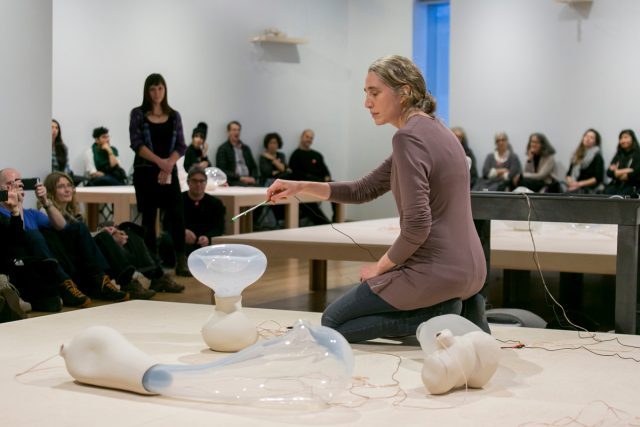
You’ll have to pick up a transistor radio and headphone at the front desk to experience Anna Friz’s “Echophone,” one of several works curated by Jeff Kolar and his experimental radio broadcast platform known as Radius. Curator Robert Aiki Aubrey Lowe’s “Subject to Gesture” brings together interactive hand-built analog synthesizers by Emily Counts, Make Noise, and others that people can play by twisting knobs, pushing objects, and filling out a card. Julianne Swartz was inspired by the Buddhist singing bowl in creating “Sine Body,” a table occupied by translucent abstract vessels made of acoustically reflective ceramic and glass that use electronic feedback and air to emit sound with a mallet. And Christie Wright and Arjen Noordeman’s “Audiowear” display features jewelry that acts like idiophone and aerophone instruments; the necklaces and bracelets are joined by videos showing the pieces being used in concerts. In addition, Deborah Stratman’s “Hearsay” and “Siege” can be heard in the Turnstyle Underground Market in the 59th St. – Columbus Circle subway station the first seven minutes of every hour on weekdays except 8:00 – 10:00 am and 5:00 – 7:00 pm. Together, “The World Is Sound” at the Rubin and “Sonic Arcade” at MAD offer visitors the opportunity to reevaluate the potential of sound both as inner healing and pure sensory pleasure.

HOLIDAY SUGAR SCULPTURE AT THE MET

(photo by twi-ny/mdr)

Annual display of the Met made of sugar is on display through January 6 (photo by twi-ny/mdr)

Metropolitan Museum of Art / Met Fifth Avenue
1000 Fifth Ave. at 82nd St.
Through January 6, $25 suggested admission to museum
212-535-7710
www.metmuseum.org

The Metropolitan Museum of Art’s annual Holiday Sugar Sculpture is on view in front of the downstairs cafeteria through January 6. The sweet, fully edible piece — except for the miniature bus and cab — was made seven years ago by executive pastry chef Randy Eastman and 6 assistants from the French Culinary Institute, using 60 pounds of rolled fondant and 30 pounds of gum paste over the course of 128 hours. Other seasonal displays at the Met Fifth Avenue include the Christmas Tree and Neapolitan Baroque Crèche, the Eastern European Silver Menorah, and a sculpture of Amsterdam outside the dining room.

GRAND CENTRAL HOLIDAY TRAIN SHOW 2017

(photo by twi-ny/mdr)

Transit Museum Holiday Train Show lights up Grand Central for the sixteenth year (photo by twi-ny/mdr)

GRAND CENTRAL HOLIDAY TRAIN SHOW
New York Transit Museum Gallery Annex
Shuttle Passage next to the Station Masters’ Office
Open daily through February 4, free, 8:00/10:00 am – 6:00/8:00 pm
www.mta.info
www.grandcentralterminal.com
holiday train show online album

The New YorkTransit Museum’s always delightful Holiday Train Show is back for the sixteenth year, continuing in Grand Central through February 4. A collaboration between Lionel and TW Design, the thirty-four-foot-long, two-level layout features plenty of old favorites with some new touches. As you walk inside the New York Transit Museum Gallery Annex, you are met by a model of Grand Central itself, in front of the MetLife building. Follow along as the Lionel “O” gauge trains motor past such city monuments as the Empire State Building (complete with King Kong) and Philip Johnson’s AT&T/Sony building, along with cozy smaller stops reminding everyone of a relatively simpler time. Complementing the display this year is a bright and cheery cityscape by Brooklyn-based artist Josh Cochran depicting multiple forms of travel.

DAVID SMITH: ORIGINS & INNOVATIONS

Installation view, 'David Smith. Origins & Innovations', 2017 ( © The Estate of David Smith / Courtesy The Estate of David Smith and Hauser & Wirth /  photo by Genevieve Hanson)

Installation view, “David Smith: Origins & Innovations,” 2017 (© The Estate of David Smith / Courtesy The Estate of David Smith and Hauser & Wirth / photo by Genevieve Hanson)

Hauser & Wirth
548 West 22nd St. between Tenth & Eleventh Aves.
Through December 23, free, 10:00 am – 6:00 pm
www.hauserwirth.com

Hauser & Wirth firmly entrenches itself in its new space in the old Dia building in Chelsea with the revelatory, museum-worthy show “David Smith: Origins & Innovations,” continuing through December 23. Smith, who was born in Indiana in 1906 and died in a car crash in Vermont in 1965, is most well known for his large-scale metal sculptures, but the exhibition features paintings, ink drawings, photographs, painted reliefs, miniatures, and other works that reveal Smith’s mastery of multiple media and styles, from the 1930s through to his death. The show is also beautifully curated, with pieces arranged in ways that they interact with one another to display similarities in line, shape, space, and form. The exhibit is accompanied by an extensive free brochure that digs further into Smith’s unique approach.

GILBERT & GEORGE: THE BEARD PICTURES

Gilbert & George, “Vote Beard,” from “The Beard Pictures,” mixed media, 2016 (© Gilbert & George. Courtesy the artists and Lehmann Maupin, New York and Hong Kong)

Gilbert & George, “Vote Beard,” from “The Beard Pictures,” mixed media, 2016 (© Gilbert & George. Courtesy the artists and Lehmann Maupin, New York and Hong Kong)

Lehmann Maupin
536 West 22nd St. & 201 Chrystie St.
Through December 22, free
www.lehmannmaupin.com
www.gilbertandgeorge.co.uk

Things have gotten a bit hairy at Lehmann Maupin’s Lower East Side and Chelsea galleries. Turner Prize winners Gilbert & George are celebrating their fiftieth anniversary — Gilbert Prousch and George Passmore met at Saint Martin’s School of Art in September 1967 — with their latest series, monumental pictures of the longtime partners in red with unique items hanging from their chins, from leaves and historical figures to an anchor and a gate, furthering their dedication to “living sculpture” and “Art for All.” In most of the large-scale works, Gilbert & George, now in their mid-seventies, are physically joined, either holding hands, standing shoulder to shoulder, or connected via their beards, often surrounded by chain-link fences and barbed wire. The pictures bear such titles as “Bless This Beard,” “Beardblood,” “Beard Wars,” “Beard Honor,” “Fuck Off Hipsters,” “Vote Beard,” and “Tits & Dicks,” combining humor with fear as they take on sociopolitical mores. In his exhibition essay, Michael Bracewell writes, “Like scenes from some bizarre animated cartoon, the ‘Beard Pictures’ dominate and confound the viewer’s experience, as though alive upon the gallery wall — in the way that sacred, ritual, and ceremonial art of ancient civilizations can feel alive. A sleepless energy within the image, semi-occult, which derives from the beliefs and convictions of the artist-workers who created them. These crazy pictures tell visionary stories, housing spirits, seemingly: portent, suffering, acceptance, journeying, anger, mockery, humiliation, mischief; disappearance into a world of absurdist pageantry.” It is quite an absurdist pageantry, one only Gilbert & George could stage.

YAYOI KUSAMA: FESTIVAL OF LIFE / INFINITY NETS

(photo by twi-ny/mdr)

Be prepared to wait hours to get ninety seconds inside Yayoi Kusama’s 2017 “Infinity Mirrored Room — Let’s Survive Forever” (photo by twi-ny/mdr)

David Zwirner
Festival of Life: 525 & 533 West 19th St. between Tenth & Eleventh Aves., through December 16
Infinity Nets: 34 East 69th St. between Park & Madison Aves., through December 22
Tuesday – Saturday, free, 10:00 am – 6:00 pm
www.davidzwirner.com

You probably should already be on line if you want to see Yayoi Kusama’s 2017 “Infinity Mirrored Room — Let’s Survive Forever,” part of her wide-ranging “Festival of Life” exhibition, which closes December 16 at David Zwirner’s Chelsea galleries. The wait times have been reaching upwards of six hours, and that will likely only increase as the end of the run approaches; you can stay updated about the line on Zwirner’s twitter feed. The approximately 12x20x20-foot carpeted room features stainless-steel balls hanging on monofilaments from the ceiling and arranged on the floor, with mirrored surfaces on all sides that seem to reflect into infinity. There is also a vertical box with three round viewing panes where visitors can look into a kaleidoscopic wonderland. Kusama, now eighty-eight, has been making the mirrored infinity rooms since 1963, when the Japanese artist was living and working in New York City. Five or six people at a time are allowed to enter the small space and spend ninety seconds there; be sure to actually experience the dazzling, brightly lit room and not just concentrate on taking selfies. In fact, each picture is a selfie because everyone inside is reflected again and again all over the room.

(photo by twi-ny/mdr)

Yayoi Kusama’s “Longing for Eternity” brings people together at David Zwirner (photo by twi-ny/mdr)

There are three other sections of the exhibit that don’t require standing on line. In a dark room, the new “Longing for Eternity” rises near the center, a vertical box with four viewing holes where visitors can stick their heads inside to see more endless, ever-changing kaleidoscopes of multiple colors made of LED lights; you can also see the other people sticking their heads in the box, at different heights. You cannot put your camera or iPhone through the holes to snap a picture; if you were to drop it inside, it would break and ruin the piece. So again, just let yourself get lost in the awe-inspiring visuals and don’t worry so much about perfect documentation.

Yayoi Kusama, “With All My Love for the Tulips, I Pray Forever,” installation view, “Yayoi Kusama Eternity of Eternal Eternity,” the National Museum of Art, Osaka, Japan, 2012 (image © Yayoi Kusama; courtesy of David Zwirner, New York; Ota Fine Arts, Tokyo/Singapore/Shanghai; Victoria Miro, London; YAYOI KUSAMA Inc.)

Yayoi Kusama, “With All My Love for the Tulips, I Pray Forever,” installation view, “Yayoi Kusama Eternity of Eternal Eternity,” the National Museum of Art, Osaka, Japan, 2012 (image © Yayoi Kusama; courtesy of David Zwirner, New York; Ota Fine Arts, Tokyo/Singapore/Shanghai; Victoria Miro, London; YAYOI KUSAMA Inc.)

You’ll next enter a captivating paradise known as “With All My Love for the Tulips, I Pray Forever,” a 2011 installation making its U.S. debut. The room is covered from floor to ceiling (including the hallway and the door) in big red polka dots on a white background; it also contains a trio of large-scale fiberglass tulips in planters that evoke the images you see when looking into Magic Eye stereograms. In fact, it can feel like you’re experiencing it through virtual reality glasses, but it’s actually right there, playing with your equilibrium in fun ways. But there’s more to it than just that; as Kusama, who combines Pop Art, Minimalism, and Abstract Expressionism and refers to herself as an Avant-Garde artist, writes in a “Message to the people of the world from Yayoi Kusama”: “Today’s world is marked by heightened anxiety connected to ever growing strife between nations and individuals, and to elusive prospects for peace. In the midst of such turmoil, we must, as human beings, be ever more vigilant and determined to build a better world through strengthened cooperation. . . . My greatest desire is that my vision of a future of eternal harmony among people be carried on.”

Yayoi Kusama’s “Festival of Life” combines “My Eternal Soul” paintings with “Flowers That Bloom Now” sculpture (photo by twi-ny/mdr)

Yayoi Kusama’s “Festival of Life” combines “My Eternal Soul” paintings with “Flowers That Bloom Now” sculpture (photo by twi-ny/mdr)

Finally, in the vast west gallery, Kusama, who works six days a week, nearly nonstop, has arranged sixty-six new paintings from her “My Eternal Soul” series, which she began in the late 2000s. Each canvas is 76.375 x 76.375 inches square, in two rows across all four walls. The works, which boast such titles as “When I Saw the Largest Dream in Life,” “Women in the Memories,” “Everyone Is Seeking Peace,” “The Far End of My Sorrow,” “A Soul Is Leaving the Body,” “Dear Death of Mine, Thou Shalt Welcome an Eternal Death,” and “Festival of Life,” contain repeated elements such as eyes, profiles, amoebalike organisms, aliens, faces, geometric patterns, and others in an endless array of colors. In the center of the room is a platform with a trio of forty-one-inch-high stainless-steel “Flowers That Bloom Now,” with long, snakelike green stems and polka-dotted petals and pistils, looking like a delightful ride in a children’s playground or amusement park (except it doesn’t rotate and you can’t go on it).

(photo by twi-ny/mdr)

“Yayoi Kusama: Infinity Nets” has been extended at David Zwirner’s uptown space through December 22 (photo by twi-ny/mdr)

There are no lines to see “Yayoi Kusama: Infinity Nets” at Zwirner’s new space on East 69th St., which will afford you plenty of time to breathe in Kusama’s stunning, iconic net paintings, inspired by hallucinations she has experienced since childhood; Kusama suffers from obsessive neurosis and has been voluntarily living at Tokyo’s Seiwa Hospital for the Mentally Ill since 1977. She first prepares the canvas in a solid color, then washes over it in a second color, her impasto brushwork evident, sometimes swirling, sometimes thick with clumps, as she makes hundreds of tiny arcs, like crescent moons or waves, in the background color. (She was influenced by a 1957 plane trip from Tokyo to Seattle, watching the ocean crests below her.) The works look different from every angle, at times offering optical illusions or what appear to be hidden figures, but that’s just your imagination getting in the flow. “My net paintings were very large canvases without compositions – without beginning, end, or center,” Kusama has said. “The entire canvas would be occupied by monochromatic nets. This endless repetition caused a kind of dizzy, empty, hypnotic feeling.” The ten works, which can be seen as traps or safety nets, include random letters in their titles that don’t actually mean anything (for example, WFCOT, BNDBS, and FWIPK), adding to the intrigue. “My desire was to predict and measure the infinity of the unbounded universe, from my own position in it, with dots — an accumulation of particles forming the negative spaces in the net. How deep was the mystery? Did infinities exist beyond our universe? In exploring these questions I wanted to examine the single dot that was my own life,” Kusama has explained. And in her unique universe, each single dot reveals the hand — and heart and mind — of the artist, a rare treat in a digital world.

WHO’S AFRAID OF THE NEW NOW? 40 ARTISTS IN DIALOGUE

Allen Ruppersberg, Who’s Afraid of the New Now?, from the series Preview Suite, 1988. Lithograph, image: 21 3/8 × 13 1/4 in (54.1 × 33.5 cm), sheet: 22 × 13 7/8 in (56 × 35.1 cm). Edition of thirty. Courtesy the artist and Greene Naftali, New York

Allen Ruppersberg, “Who’s Afraid of the New Now?” from the series Preview Suite, lithograph, 1988 (courtesy the artist and Greene Naftali, New York)

New Museum of Contemporary Art
235 Bowery at Prince St.
Saturday, December 2, and Sunday, December 3, $5 per conversation, 10:00 am – 8:00 pm
212-219-1222
www.newmuseum.org

The New Museum continues its fortieth anniversary celebration with “Who’s Afraid of the New Now? 40 Artists in Dialogue,” two days of free admission to the downtown institution and a fab series of five-dollar artist conversations that require advance purchase here. On Saturday beginning at ten o’clock, every hour on the hour (except for the two o’clock lunch break), you can catch Judith Bernstein and Linda Montano, Paweł Althamer and Cally Spooner, Ragnar Kjartansson and Carolee Schneemann, Hans Haacke and Carsten Höller, Donald Moffett and Nari Ward, George Condo and Jeff Koons, Paul Chan and Carroll Dunham, Thomas Bayrle and Kerstin Brätsch, Raymond Pettibon and Kaari Upson, and Simone Leigh and Lorraine O’Grady. Sunday’s lineup features Cheryl Donegan and Mary Heilmann, Jeremy Deller and Martha Rosler, Paul McCarthy and Andra Ursuta, Elizabeth Peyton and Allen Ruppersberg, Nicole Eisenman and Neil Jenney, Howardena Pindell and Dorothea Rockburne, Bouchra Khalili and Doris Salcedo, Camille Henrot and Anri Sala, Sharon Hayes and Faith Ringgold, and Carol Bove and Joan Jonas. It’s a crazy-good roster of artists who have shown at the museum, which was founded in 1976 by Marcia Tucker and opened at C Space in 1977 before moving to the New School and then 583 Broadway before its grand reopening at 235 Bowery on December 1, 2007. Currently on view are “Trigger: Gender as a Tool and a Weapon,” “Kahlil Joseph: Shadow Play,” “Petrit Halilaj: RU,” “Helen Johnson: Ends,” “Alex Da Corte: Harvest Moon,” and “Pursuing the Unpredictable: The New Museum 1977–2017” in addition to a special window reinstallation of Bruce Nauman’s 1987 video No, No, New Museum from his Clown Torture series.