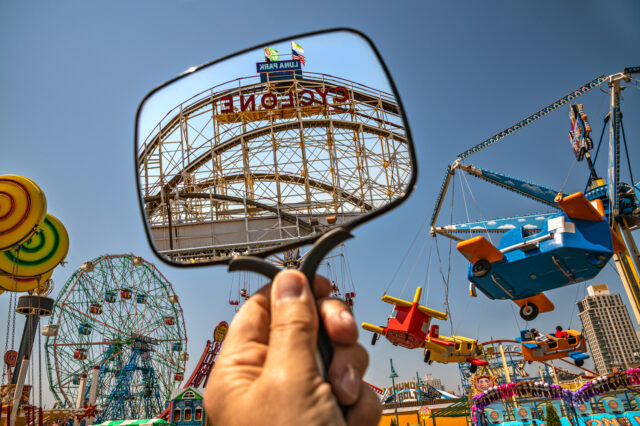
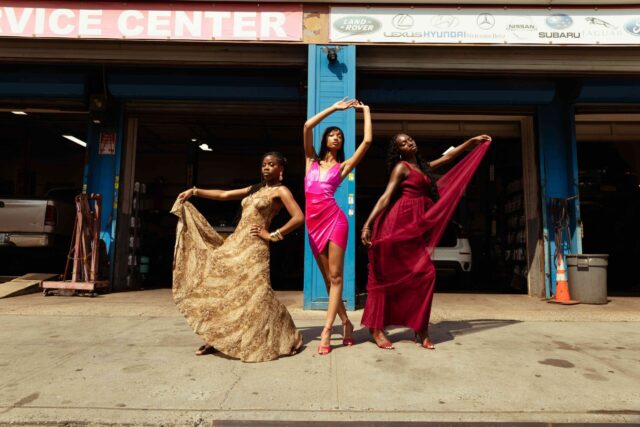
Who:Storm Cuff,Stefan Falke What:Photoville Summer Artist Walk: Hudson Yards Where:Bella Abzug Park at Hudson Yards, 533 West Thirty-Fourth St. When: Saturday, August 1, free with advance RSVP, 11:30 am Why: The Photoville Summer Artist Walk series continues August 1 at 11:30 am with two photographers who hold a mirror up to New York City — in one case, literally. The hourlong tour, which begins in Bella Abzug Park at Hudson Yards, features Brooklyn-born multidisciplinary artist Storm Cuff and NYC-based German-American photographer Stefan Falke. Both participated in Photoville this year, Storm Cuff with Vehicle. The Chosen Ones, Falke with Reflecting New York.
“You need a very low aperture and a corresponding amount of light in order to produce a sharp image. Even the smallest movement of the handheld mirror is magnified in the camera; that’s just a mathematical phenomenon,” Falke says in the published Reflecting New York book, consisting of photos of him holding up a mirror at such locations as the Chrysler Building, Coney Island, the Roosevelt Island Tram, the Unisphere in Flushing Meadows Park, the Empire State Building, and Hudson Yards.
“I hope it carries the weight of deliberateness. That nothing about it feels accidental. That even without my voice present, the work communicates that it was built with care, a responsibility to who it represents. I want it to retain clarity about who shaped it and why,” Storm Cuff told ColorBloc magazine about her photos of Black men and women around classic cars. “I hope it carries momentum. That it doesn’t feel static on a page and feels like part of something still moving. That someone younger might encounter it and feel permission, not just to admire it, but to build beyond it. When the work moves without me, it becomes a kind of ambassador. I want it to continue doing what it was built to do: propel and remind.”
Admission is free with advance RSVP to what should be a special event.
[Mark Rifkin is a Brooklyn-born, Manhattan-based writer; you can follow him on Substack here.]
Walking tour of Harlem is part of special exhibition programming at Poster House
POSTER HOUSE WALKING TOUR WITH HISTORIAN JOHN T. REDDICK
Poster House
119 West Twenty-Third St. (tour starting point given upon ticket purchase)
Saturday, July 18, $25, 11:00 am to 1:00 pm
Exhibition runs through September 6 posterhouse.org
In September 2024, longtime Harlem resident, preservationist, and Yale University School of Architecture graduate John T. Reddick gave me a tour of the exhibit “Illustrating Tin Pan Alley: From Ragtime to Jazz” at the Society of Illustrators, consisting of his remarkable collection of sheet music art from the Tin Pan Alley era, focusing on Black composers, musicians, and performers. He told me that while doing his research, “It was just shocking; as I bought sheet music or got to see the names, I realized they all lived in Harlem during the same time period.”
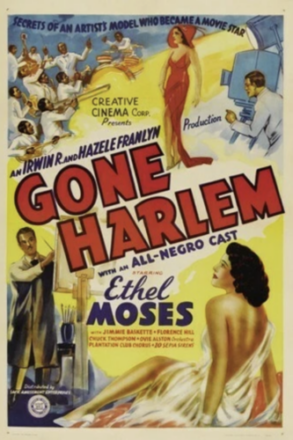
Reddick is now collaborating with Poster House on a walking tour of Harlem in conjunction with the institution’s “Act Black: Posters from Black American Stage & Screen,” comprising promotional posters for musical revues, theatrical presentations, and movies featuring Black performers from the 1870s to the 1940s (including from Cabin in the Sky,Zouzou, and Imitation of Life). The one-hour tour will visit Strivers’ Row, the Schomburg Center, and Harlem Hospital’s WPA murals, among other locations that played a role in the Harlem Renaissance.
Reddick, who is a member of the Board of Directors of the Tin Pan Alley American Popular Music Project, is an engaging storyteller and a font of knowledge, so this should be a special adventure; tickets are $25, and the starting point will be given upon purchase.
[Mark Rifkin is a Brooklyn-born, Manhattan-based writer; you can follow him on Substack here.]
“I’m ready to roll the end credits / Ready for the curtain call,” Jesse Hartman sings on a remastered version of “End Credits,” one of seven tracks on Laptop’s new EP from Hurricane Cove. The original was released in 1997 and appeared on the 2001 album, Opening Credits, but Hartman decided to revisit it after Doublespeak, consisting of Erasure’s Vince Clarke, Blancmange’s Neil Arthur, and producer and musician Benge, teamed up for a surprise cover that came out in May.
In addition to five versions of that track — “Remaster,” “Tower of Babel,” “Director’s Cut,” “The Sweet & Lowdown,” and “The Rise and Fall of a Phone Call” — the EP includes covers of Blancmange’s “Living on the Ceiling” and Erasure’s “Love to Hate You” as a kind of thank-you.
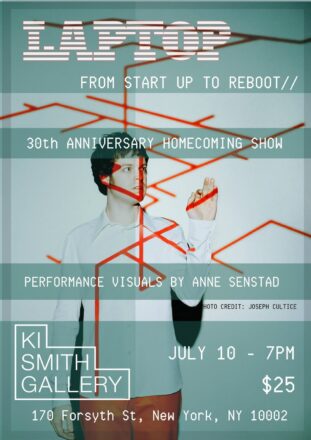
The curtain is not quite ready to close on Laptop and Hartman, who will be performing a rare live show on July 10 at Ki Smith Gallery on the Lower East Side, a thirtieth anniversary homecoming that will feature songs from their heyday, 1997–2003, accompanied by visuals from multidisciplinary artist Anne Senstad.
In addition, for the first time in more than twenty-three years, Laptop will be releasing a record of new material, On This Planet, in September, featuring such tracks as “Confused,” “Xanadu,” and “Squirrel-a-Bug.” It’s a very different kind of album from Laptop, with more pop elements, but they still capture the state of the world, and the band itself, starting with the opening track, in which Hartman explains, “It’s getting weirder and weirder / on this planet.”
Yes it is.
[Mark Rifkin is a Brooklyn-born, Manhattan-based writer; you can follow him on Substack here.]
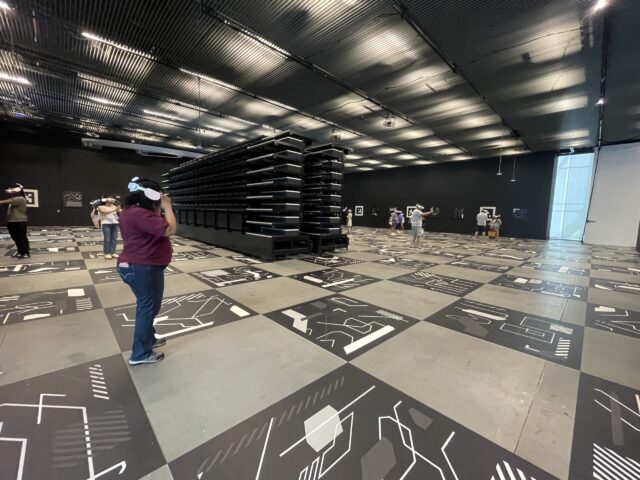
The Black Mirror Experience takes place on a special grid at the Shed (photo by twi-ny/mdr)
THE BLACK MIRROR EXPERIENCE
The Shed
545 West 30th St. at Eleventh Ave.
Tuesday – Sunday through September 6, $56.35-$79.35 (approx. 10% discount for groups of four to six; priority access for VIP) theshed.org nyc.theblackmirrorexperience.com
The Black Mirror Experience is an ultracool interactive, immersive, participatory, multimedia, AI-generated, virtual reality presentation at the Shed that puts you inside an episode of the hit streaming series.
Inspired by The Twilight Zone,Black Mirror is an Emmy-winning British anthology show created in 2011 by Charlie Brooker; there have been thirty-two episodes across seven seasons in addition to two specials, with a dedicated focus on how advancements in technology impact the future of humanity.
In The Black Mirror Experience, which earned a Special Mention at the 2026 Cannes Film Festival and is concurrently taking place in Montreal and Madrid as well as New York City, groups of up to six people at a time, wearing VR headsets, enter the mysterious world of Phaethon Labs. Each person has their biometrics scanned in order to create their own LifeAgent, a lifelike avatar, and then is thrust into an original story by Brooker that introduces the LifeAgent Integration Pathway, leading from a store, a life goals selection, and general orientation to a neural mapping facility, the LifeAgent Customization Centre, a testing playground, and final delivery. Its motto: “Do less. Live more.”
“At Phaethon, we believe in reversing time’s decline, because your LifeAgent exists to give you back what time has taken: space, clarity, energy, and self. Which is why our origin story imagines these ancient ages in reverse,” Phaethon Labs founder Dakota “Cody” Winters explains.
Phaethon is named after the Greek demigod who searched for his father, Helios, and traveled too close to the sun, an apt metaphor for the dangers of AI. A chart details Phaethon’s brief history from the Genesis Iron Age in 2025, the Breakthrough Age of Heroes in 2027, and the Revelation Bronze Age in 2028 to the Evolution Silver Age in 2029 and the Revolution Underway Golden Age in 2030 and beyond. Various items are on display, including a PhaethonVault, which stores thoughts and memories; PhaethonSync neural implants for communicating with your LifeAgent; and an Emotional Intelligence Filter.
“I wasn’t trying to create a new kind of AI. I was just trying to understand how my own brain worked,” Winters states.
The journey into the AI world is a VR marvel. I had two companions in my group; we boarded a shuttle that moved us into various fantastical realms, where we competed in a game show, formed a band, danced, painted, and spoke with Sigmund Freud. Through it all, we were accompanied by our LifeAgent, which gets pretty creepy, for reasons I won’t divulge here. Just when you think the credits are going to roll — without ever having kicked into overdrive — a spectacular twist sends you deep into a darkly threatening society from which escape will not come easily. It’s absolutely thrilling as you battle strange creatures, claustrophobic rooms, and yourself, desperately attempting to survive against ever-mounting odds.
Depending on your answers to several questions, some of the details of your adventure will be different from those of your friends, just like in real life. At one point, I was luxuriating in a gorgeous mountain mansion, a tiger by my side, while my wife was advising a small cult in Bhutan.
The narrative reaches its epic conclusion after about fifty minutes; when you return your headset, you get to see others in the midst of the odyssey, which is in itself a fun revelation.
“Is that we looked like?” I asked a member of the staff.
“Yup,” she responded with a smile.
I’m not a video-game player, but I had a blast. I am a big fan of Black Mirror, but you don’t have to know anything about it to get caught up in these proceedings. (However, you should watch the show, which casts a sharp reflection on who we are and where we are going; I suggest starting with “The National Anthem,” “San Junipero,” and “USS Callister.”)
On the way out, you are given a link to a video that re-creates your actions not the way you saw them but how the technology has re-created it.
Like most of us, I have severe suspicions about the future of AI, but when it is used for such astonishing, harmless exhilaration as The Black Mirror Experience, count me in as one of the converted.
[Mark Rifkin is a Brooklyn-born, Manhattan-based writer; you can follow him on Substack here.]
Lincoln Center’s Summer for the City features numerous events tied to the World Cup
SUMMER FOR THE CITY: TOGETHER, WE MOVE
Lincoln Center
June 10 – August 8, free or choose-what-you-pay www.lincolncenter.org
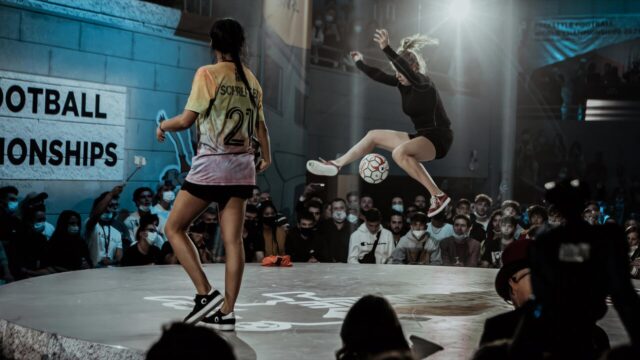
The fifth iteration of Lincoln Center’s Summer for the City features art, film, music, comedy, workshops, discussions, meditation, silent discos, and more, but its focus is on dance — along with World Cup–related soccer programs.
Describing the series, which features an outdoor installation by Clint Ramos, Chief Artistic Director Shanta Thake explains, “Lincoln Center becomes a celebration of bodies in motion — dancing, gathering, and connecting people from all walks of life.” There are hundreds of events, with performers from around the globe.
All presentations are free or choose-what-you-pay, and some require advance RSVP; below are twi-ny’s don’t-miss highlights.
Reg Bloor will conduct her late husband Glenn Branca’s symphony for one hundred guitars at Lincoln Center on June 12 (photo by Maria Jose Govia)
Glenn Branca’s Symphony No. 13 (Hallucination City) for 100 Guitars
Wu Tsai Theater, David Geffen Hall
Friday, June 12, choose-what-you-pay, 7:30 www.lincolncenter.org
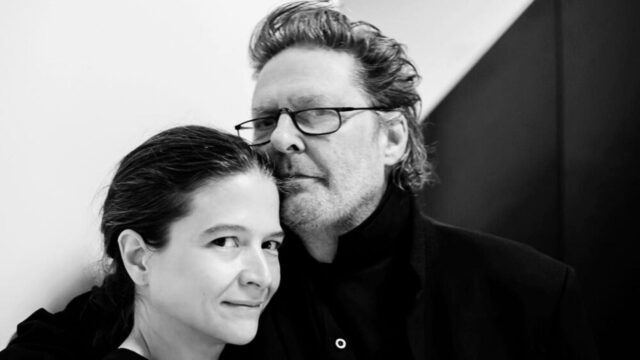
On June 13, 2001, avant-garde composer Glenn Branca premiered Symphony No. 13 (Hallucination City) for 100 Guitars on the plaza at the World Trade Center. Writing about the piece for Sound American, Reg Bloor, guitarist Reg Bloor, Branca’s wife, explained, “This is the first time Glenn had done anything like this with volunteers, so we had no idea if anyone was going to show up. I’ll never forget walking around the corner of the North Tower onto the World Trade Center Plaza for the first rehearsal and seeing people sitting there on their amps waiting for us. This was really going to work. . . . The piece was a swirling cauldron of consonance and dissonance, like a giant swarm of bees trapped in a cyclone, the single movement a long, gradual build of dynamics, pitch, and tempo to a crescendo bouncing off the towers and ringing through the plaza, spilling out onto the streets of Lower Manhattan. It’s a sound that stays with you for the rest of the day after the piece is over. You hear it coming out of the subway tunnel or in the air conditioning. You can’t get it out of your ear until whole world starts to sound like Glenn.” Bloor will conduct the symphony at David Geffen Hall on June 12 at 7:30, with one hundred guitarists along with drummer Greg Fox.
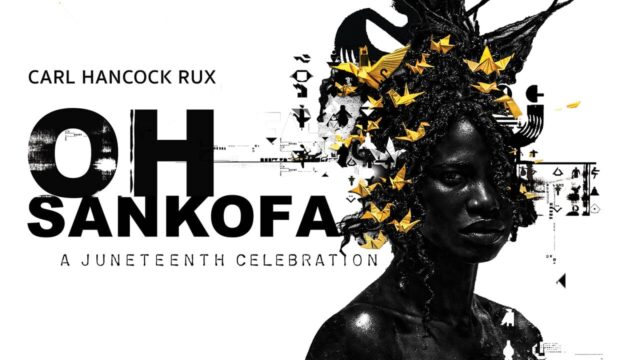
Lincoln Center honors Juneteenth with three special performances that, unfortunately, overlap one another: Carl Hancock Rux’s Oh Sankofa at Hearst Plaza at 7:00, boasting a talented cast exploring the importance of folklore during the Transatlantic Slave Trade; Jeremy Nedd’s from rock to rock . . . aka how magnolia was taken for granite at Alice Tully Hall at 7:30, which looks at the Milly Rock; and Pulitzer Prize winner Suzan-Lori Parks’s The Tune Up at the David Rubenstein Atrium at 7:30, directed by the Flea’s Niegel Smith.
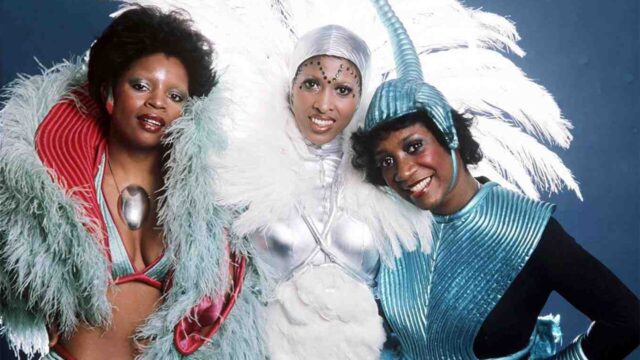
The music of Labelle is celebrated by original member Nona Hendryx at David Geffen Hall
Nightbirds, the Music of Labelle
Wu Tsai Theater, David Geffen Hall
Sunday, June 28, choose-what-you-pay, 7:30 www.lincolncenter.org
In 1974, Patti LaBelle, Nona Hendryx, and Sarah Dash, known as LaBelle, took the country by storm with the monster hit “Lady Marmalade.” The trio had been together in other forms since 1961, broke up in lurid circumstances in 1976, the re-formed from 2005 to 2009. On June 28, Dream Machine Studio is presenting “Nightbirds, the Music of Labelle” at David Geffen Hall, led by Hendryx, joined by the original Labelle backing trio of guitarist Eddie Martinez, bassist Carmine Rojas, and percussionist Jose Rossy, along with Tony winner Adrienne Warren, Kimberly Nichole, Ledisi, and Sandra St. Victor.
Shen Wei Dance Arts and Guangdong Modern Dance Company team up for site-specific MindScape on Hearst Plaza (photo by Gabe Palacio)
Shen Wei Dance Arts | Guangdong Modern Dance Company: MindScape
Hearst Plaza
July 1-3, free, 5:00 www.lincolncenter.org
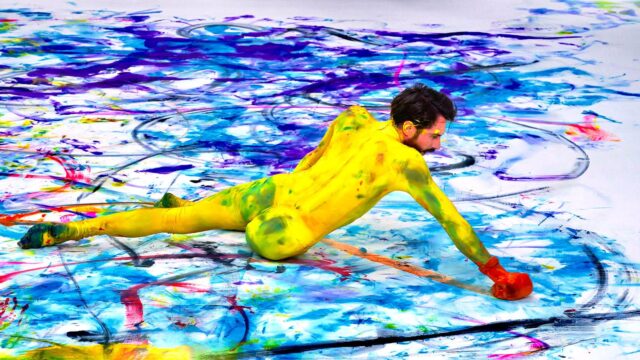
Chinese-born, NYC-based choreographer, director, and painter Shen Wei brings together Shen Wei Dance Arts (SWDA) and Guangdong Modern Dance Company for MindScape, a forty-five-minute piece that incorporates poetry, calligraphy, painting, and movement on Hearst Plaza. SWDA has presented dazzling dances in the Park Ave. Armory Drill Hall, at the Prospect Park Bandshell, in the Met’s Charles Engelhard Court, and other unique locations, so it should be fascinating to see what they’ll be doing outdoors at Lincoln Center. MindScape is part of Lincoln Center’s Dance Encounters series, which also has performances by Omari Wiles / Les Ballet Afrik (New York Is Burning), Ogemdi Ude (Major), Anna Sperber (Bow Echo), Benjamin Akio Kimitch (Tiger Hands), and Vangeline (Naiad Metal), which takes place in and around the Milstein Reflecting Pool, as well as Chinese Arts Week, which also includes Chinese-born, NYC-based Pulitzer Prize winner Du Yun’s family-friendly The Ocean Etched in the Forest.
Akram Khan’s Thikra is part of Summer for the City at Lincoln Center
Akram Khan Company: Thikra: Night of Remembering
Alice Tully Hall, 1941 Broadway
Thursday, July 2, 7:30; Friday, July 3, 7:30; Sunday, July 5, 2:00, choose-what-you-pay www.lincolncenter.org
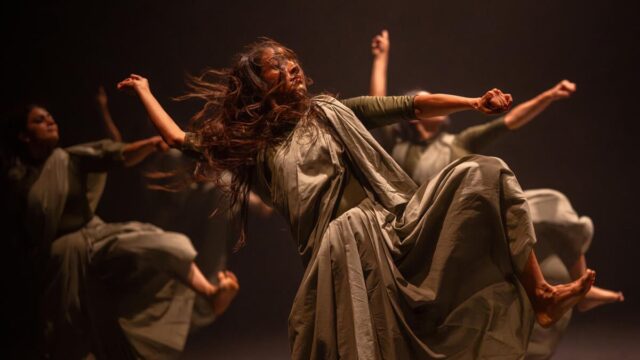
English choreographer Akram Khan, who melds the Indian kathak form with contemporary dance, collaborates with visual director Manal AlDowayan on Thikra: Night of Remembering, a piece for between nine and eleven women set to “Gyura Beli Belo Platno” by the London Bulgarian Choir and “The Elephant’s Funeral” by Sushma Soma with Aditya Prakash. “As I stand humbled within the vastness of this epic desert known as AlUla, I feel the urge to unearth the many cultures that have passed through here,” Khan says about the work, which explores the ancient Saudi Arabia desert civilization. Thikra: Night of Remembering is part of the Lincoln Center Contemporary Dance Festival, which also features Jeremy Nedd, Yinka Esi Graves, Sung Im Her / Her Project, Rachid Ouramdane / Compagnie de Chaillot, and others.
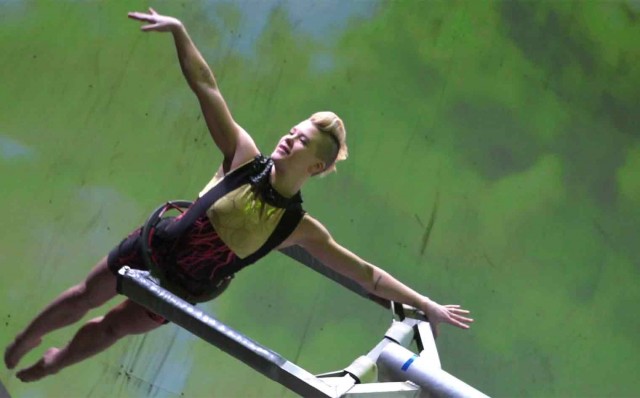
Documentary reveals how Elizabeth Streb and her Extreme Action Company (including Jackie Carlson, seen here) take dance to a whole new level
For more than fifteen years, New Yorkers have gotten the chance to see Elizabeth Streb’s Extreme Action Company perform such dazzling works as Ascension at Gansevoort Plaza, Kiss the Air! at the Park Avenue Armory, and Human Fountain at World Financial Center Plaza as her team of gymnast-dancer-acrobats risk their physical well-being in daring feats of strength, stamina, durability, and grace. In addition, Streb herself walked down the outside wall of the Whitney as part of a tribute to one of her mentors, Trisha Brown. Catherine Gund takes viewers behind the scenes in the exhilarating documentary Born to Fly: Elizabeth Streb vs. Gravity, going deep into the mind of the endlessly inventive and adventurous extreme action architect and the courage and fearlessness of her company. Gund follows Streb as she discusses her childhood, her dance studies, the formation of STREB in 1985, and her carefully thought out views on space, line, and movement as her work stretches the limits of what the human body can do. “I think my original belief and desire is to see a human being fly,” Streb says near the beginning of the film, which includes archival footage of early performances, family photos, and a warm scene in which the Rochester-born Streb and her partner, Laura Flanders, host a dinner party in their apartment, cooking for Bill T. Jones, Bjorn Amelan, Anne Bogart, Catharine Stimpson, and A. M. Homes. Gund also speaks with current and past members of the talented, ever-enthusiastic company — associate artistic director Fabio Tavares, Sarah Callan, Jackie Carlson, Leonardo Giron, Felix Hess, Samantha Jakus, Cassandre Joseph, John Kasten, and Daniel Rysak — who talk about their dedication to Streb’s vision while using such words as “challenge,” “velocity,” “endurance,” “magic,” “invincibility,” and “risk” to describe what they do and how they feel about it. The film is screening on Hearst Plaza on July 10 at 6:00 as part of Lincoln Center’s Dance Encounters series, which also includes “Movement on Film: Athletic Shorts” July 15–17.
Double Dutch Fusion Freestyle & Open Jump
The Dance Floor, Josie Robertson Plaza
Thursday, July 16, free, 5:00 www.lincolncenter.org
One of the most exciting events of every summer at Lincoln Center is the National Double Dutch League strutting its stuff with breathtaking displays of athleticism. It’s three hours of exhilarating movement, including an open jump where visitors are encouraged to participate.
Five troupes come together for annual BAAND Festival (Francesca Levita by Rachel Neville, Christopher R. Wilson by Andrew Eccles, Fangqi Li by Karolina Kuras, Taylor Stanley by Paul Kolnik, DTH Company Artist Kamala Saara by Nir Arieli)
BAAND Together Dance Festival
David H. Koch Theater
Tuesday, July 28, through Sunday, August 1, choose-what-you-pay www.lincolncenter.org
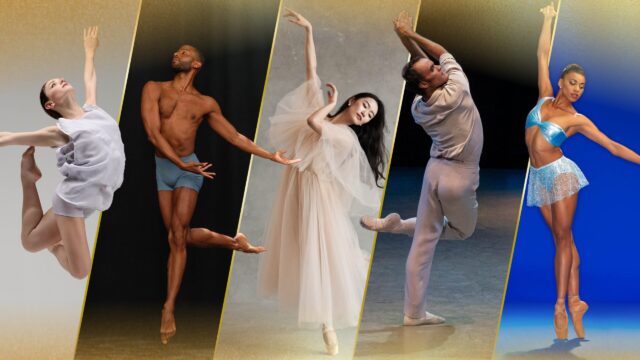
The sixth BAAND Together Dance Festival takes place July 28 thorugh August 1, with five exciting troupes performing in the David H. Koch Theater: Ballet Hispánico New York, Alvin Ailey American Dance Theater, American Ballet Theatre, New York City Ballet, and Dance Theatre of Harlem. It doesn’t get much better than that. Each company will also host a family-friendly dance workshop every day.
[Mark Rifkin is a Brooklyn-born, Manhattan-based writer; you can follow him on Substack here.]
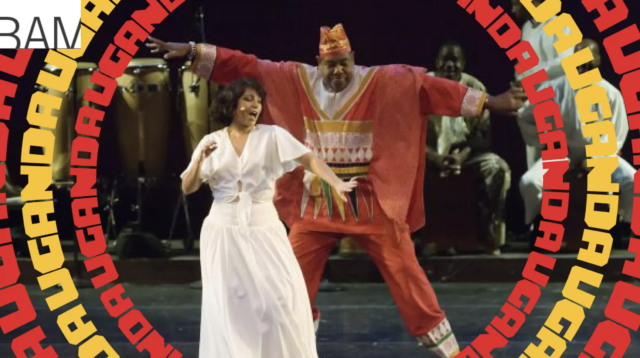
Who: Abdel R. Salaam, Ndere Troupe, Asase Yaa African American Dance Theater, the Billie’s Youth Arts Academy Dance Ensemble, DanceAfrica Spirit Walkers, DJ YB, more What:DanceAfrica Festival 2026 Where:BAM Howard Gilman Opera House, BAM Rose Cinemas, 30 Lafayette Ave. When: May 22-28, many events free, Gilman dances $21-$86, film screenings $17 Why: The coming of the summer season means the arrival of one of the best festivals of every year, BAM’s DanceAfrica. The forty-ninth annual iteration focuses on Uganda, with four companies performing “Umoja/Mirembe/Obulungi (Unity/Peace/Beauty)!” in BAM’s Howard Gilman Opera House: DanceAfrica Spirit Walkers, Asase Yaa African American Dance Theater, the Billie’s Youth Arts Academy Dance Ensemble, and Ndere Troupe, highlighting movement and music from the Pearl of Africa. Curated by artistic director Abdel R. Salaam, the festival also includes the DanceAfrica Bazaar with more than 150 vendors, dance workshops and master classes at the Mark Morris Dance Center, Sanaa Gateja’s “Voices of Peace” art installation, the Council of Elders Roundtable: Legacy & Preservation moderated by Dyane Harvey-Salaam, the Memorial Room, which offers a place to honor festival ancestors, and a late night dance party with DJ YB.
This year’s FilmAfrica screenings and cinema conversations, held in conjunction with the New York African Film Festival, are highlighted by Mohamed Ahmed’s A Tribe Called Love (2025), Maia Lekow and Chris King’s How to Build a Library (2025), Ossie Davis’s Black Girl (1972), Olive Nwosu’s Lady (2026), and Awam Amkpa’s The Man Died (2024) all followed by Q&As with the directors and/or others.
“Thousands of years of African cultural development were interrupted by centuries of colonialism, which gave rise to a sociopolitical movement that led to Uganda’s independence on October 9, 1962, and its formal nationhood in 1963. In the decades since, a powerful artistic movement has emerged to reclaim and celebrate Ugandan identity and intelligence through cultural expression, a force that continues to this day,” Salaam said in his mission statement. “Today, ancient Uganda is considered a cradle of human evolution and early civilization in the East African region of Lake Nalu Baale, the traditional name of what became Lake Victoria. In Luganda, a Bantu language, ‘Nalu Baale,’ translates to ‘Mother of the Ancestral/ Guardian Spirits.’ I am honored to share more of these ancient dances and songs, mixed with shades of contemporary visions of East Africa.”
[Mark Rifkin is a Brooklyn-born, Manhattan-based writer and editor; you can follow him on Substack here.]
Judith Bernstein, Joan Semmel, and Joyce Kozloff will take part in a Feminist Art Roundtable at the Jewish Museum
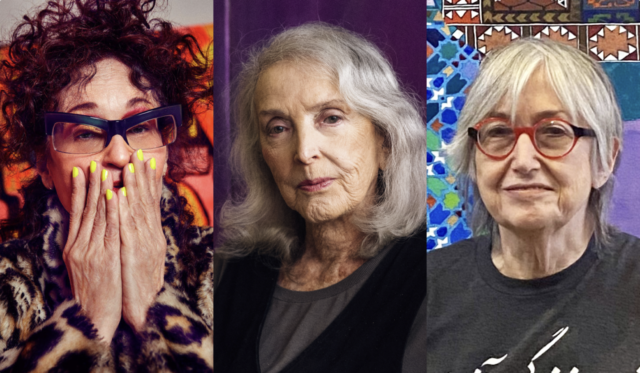
Who:Joan Semmel,Joyce Kozloff,Judith Bernstein,Rachel Corbett What:Feminist Art Roundtable Where:The Jewish Museum, Scheuer Auditorium, 1109 Fifth Ave. at 92nd St. When: Thursday, March 26, $14-$24, 6:30 Why: On New Year’s Eve, I attended a small dinner party in the West Village, where among the other invitees was painter extraordinaire Joan Semmel, whose brilliant exhibition “In the Flesh” is on view at the Jewish Museum through May 31, and the marvelous Joyce Kozloff, whose stunning cartographic works have been on display in such gallery shows as “Collateral Damage,” “Uncivil Wars,” and “Girlhood.” At the last minute, artist Judith Bernstein, whose provocative solo exhibitions include “Truth and Chaos,” “We Don’t Owe You a Tomorrow,” and “Money Shot,” was unable to make the gathering. But now everyone is invited to be in the presence of all three remarkable women — and longtime friends — when they convene at the Jewish Museum on March 26 for a “Feminist Art Roundtable” moderated by Rachel Corbett, author of You Must Change Your Life: The Story of Rainer Maria Rilke and Auguste Rodin and The Monsters We Make.
Semmel’s “In the Flesh” comprises sixteen lush, tender, and potent depictions of naked contorted figures and bodies in motion, dating from 1971 to 2023. “Their reflections are hidden, as is my face in most of my paintings,” Semmel has noted of her subjects. “For women who are always a sight to be seen, not being seen can be an act of defiance.” The show also features “Eye on the Collection,” consisting of forty-two museum works selected by Semmel, among them Bernstein’s 1966 Invest Your Sons (War Is Good Business) and Kozloff’s 2004 American History: 21st Century Crusades.
Don’t miss this rock-star lineup of extraordinary artists who have helped define and expand the concept of feminist art for six decades, demanding to be seen and heard.
[Mark Rifkin is a Brooklyn-born, Manhattan-based writer; you can follow him on Substack here.]