Who:Janet Biggs,Mary Lucier,Shaun Leonardo,Marka27,Pablo Helguera What: Public art campaign benefit for Art at a Time Like This Where:Cristin Tierney Gallery, 49 Walker St. When: Thursday, March 27, minimum donation $150 ($75 for artists), 6:00 – 9:00 Why: Only a few days into the pandemic lockdown in March 2020, independent curator and author Barbara Pollack and artist agent Anne Verhallen took action, starting the nonprofit Art at a Time Like This (ATLT), dedicated to the idea that “art can make a difference and that artists and curators can be thought-leaders, envisioning alternative futures for humanity.” Art at a Time Like This has presented two dozen online and in-person exhibitions and programs since then, including “Dangerous Art, Endangered Artists,” “Rupture: Interventions of Possibility,” and “Don’t Look Now: A Defense of Free Expression.”
On March 27, ATLT will be celebrating its sixth anniversary, at the Cristin Tierney Gallery on Walker St., with a three-hour evening of cocktails, conversation, and a call to action, featuring four impressive speakers: artists Janet Biggs, Mary Lucier, Shaun Leonardo, and Marka27, with Pablo Helguera serving as moderator. The event is hosted by Leonardo Bravo, Andy Cushman, Helina Metaferia, Marilyn Minter, Gina Nanni, Megan Noh, Eric Shiner, and Cristin Tierney.
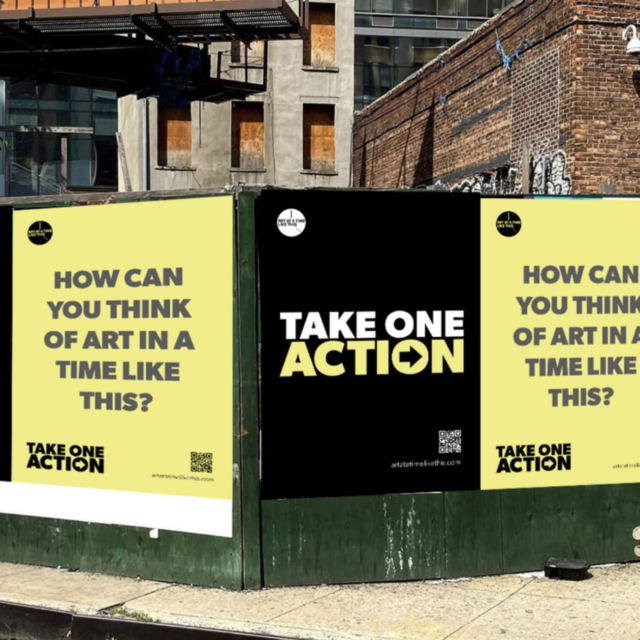
“At the very beginning of a worldwide pandemic, we asked a simple question: How can you think of art at a time like this?” Pollack tells twi-ny. “The question is now more relevant than ever, which presents both a tragedy and an opportunity for creative solutions.”
The next creative solution for ATLT is the exhibition “Take One Action,” which the organization considers “an antidote” for what is happening around the globe today. All artists are invited to submit one artwork, along with a suggested action to help protect and preserve our democracy — with an eye toward the midterm elections. Select contributions will be printed and wheatpasted across the city and/or appear in an ever-growing digital exhibit.
“Barbara and Anne responded to the pandemic with amazing speed, care, and inclusiveness by asking a question: ‘How can you think of art at a time like this?’ The overwhelming response was: ‘How can you not?’” explains Biggs, a research-based interdisciplinary artist known for her immersive work in video, film, and performance. “They have continued to ask that question in the face of ongoing trauma, injustice, and upheaval, and artists have continued to answer with work that is engaged, compassionate, and necessary. That is why Art at a Time Like This — and its programming — is so essential.”
Admission is a minimum donation of $150 ($75 for artists) for what should be a fascinating gathering of thought-leaders who will not just be honoring the success of ATLT but continuing the fight to use art to make a difference.
[Mark Rifkin is a Brooklyn-born, Manhattan-based writer; you can follow him on Substack here.]
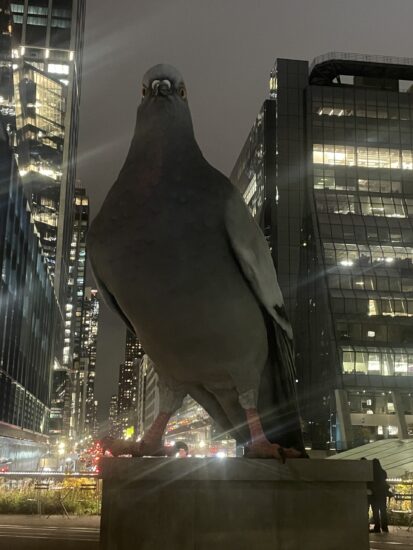
Iván Argote’s Dinosaur will be flying off from the High Line soon (photo by twi-ny/mdr)
FAREWELL, DINOSAUR
High Line Plinth on the High Line Spur
Thirtieth St. at Tenth Ave.
Friday, March 21, free, noon – 4:00 www.thehighline.org
It promises to be the biggest send-off for a New York City pigeon ever.
On June 14, 2025, the High Line welcomed Iván Argote’s High Line Plinth commission, Dinosaur, with “Pigeon Fest,” a festival celebrating pigeons, urban ecology, and public art on National Pigeon Appreciation Day. The High Line is now saying goodbye to the seventeen-foot-tall, one-ton aluminum pigeon sculpture on March 21 with another party, “Farewell, Dinosaur,” consisting of games, photo ops, and more, with Argote, DJ Tommy Sparks, and Miriam Abrahams, the British multidisciplinary artist who won the Pigeon Impersonation Pageant at the opening. Visitors are encouraged to again come in feather-brained costumes as they play bingo and have Argote sign limited-edition posters.
“The name Dinosaur makes reference to the sculpture’s scale and to the pigeon’s ancestors who millions of years ago dominated the globe, as we humans do today,” the Colombia-born, Paris-based Argote said in a statement. “The name also serves as a reference to the dinosaur’s extinction. Like them, one day we won’t be around anymore, but perhaps a remnant of humanity will live on — as pigeons do — in the dark corners and gaps of future worlds. I feel this sculpture could generate an uncanny feeling of attraction, seduction, and fear among the inhabitants of New York.”
The attraction, seduction, and fear will continue through early April, when Dinosaur will go extinct on the High Line, replaced by Tuan Andrew Nguyen’s The Light That Shines Through the Universe.
[Mark Rifkin is a Brooklyn-born, Manhattan-based writer; you can follow him on Substack here.]
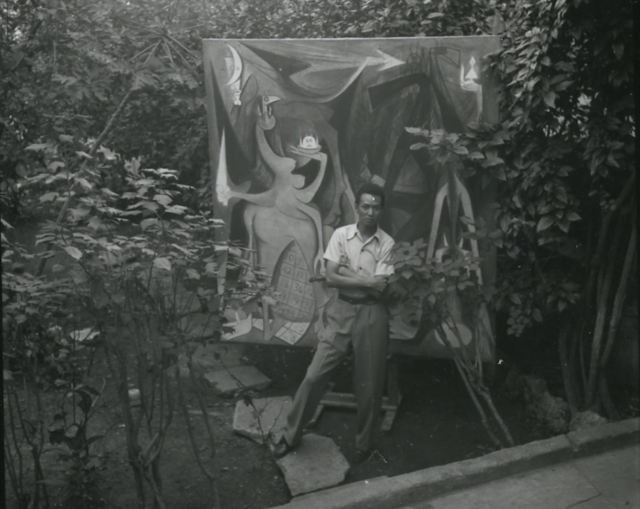
Who:Ballet Hispánico New York,Aruán Ortiz, Yaissa Jimenez What: A Special Evening Celebrating “Wifredo Lam: When I Don’t Sleep, I Dream” Where: Museum of Modern Art, 11 West Fifty-Third St. Between Fifth & Sixth Aves. When: Thursday, March 19, free with advance RSVP, 6:30 Why: “I knew I was running the risk of not being understood either by the man in the street or by the others,” Cuban-born artist Wifredo Óscar de la Concepción Lam y Castilla said, “but a true picture has the power to set the imagination to work, even if it takes time.” The wide-ranging MoMA retrospective “Wifredo Lam: When I Don’t Sleep, I Dream” paints a fascinating portrait of Lam, the son of a Chinese immigrant and the grandson of a Congolese former slave mother. It’s a marvelous collection of paintings, drawings, archival photographs, sketches, books, and ephemera tracing Lam’s career, which took him from Cuba, Spain, and France to Martinique, Haiti, and New York as his imagination turned to Spanish modernism, Surrealism, and Afro-Cuban tradition. Among the highlights of the exhibition, which runs through April 11, are the 1943 gouache on paper masterpiece The Jungle, a trio of dazzling abstracts, and a collection of plates.
On March 19 at 6:30, MoMA will be hosting “A Celebration of ‘Wifredo Lam: When I Don’t Sleep, I Dream,’” as Ballet Hispánico New York, Cuban-born, Brooklyn-based pianist, violist, and composer Aruán Ortiz, and Dominican writer and poet Yaissa Jimenez will perform specially commissioned new works in the exhibition galleries, paying tribute to Lam and his legacy. Admission is free with advance RSVP.
[Mark Rifkin is a Brooklyn-born, Manhattan-based writer; you can follow him on Substack here.]
In the fall of 2023, Rob Pruitt presented “The Golden Hour” at 303 Gallery in Chelsea, a show in which the DC-born artist faced his approaching sixtieth birthday with one of his “Flea Markets,” in this case a collection of personal objects that visitors could pore over and take one home; as I write this, one of Pruitt’s cigar boxes is right next to me.
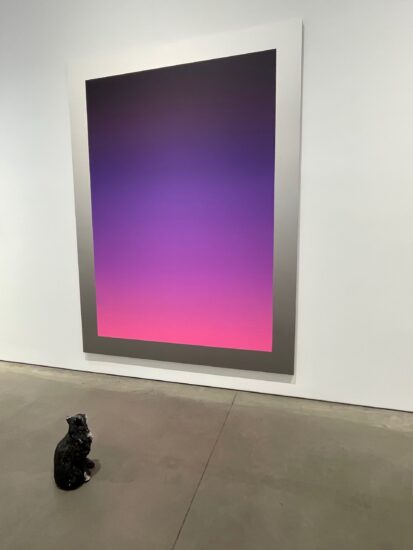
His latest exhibition at 303, today titled “Watching the Sun Set and Drinking Beer with Friends Is the Highest Form of Art” — the name changes every day; it began on January 15 as “Skyscapes” — is another deeply personal show, focusing on the loss of his sister, Gina, who died on December 7, 2025, following a stroke. The works on view include his monthly 2025 “Sunrises” watercolor and silkscreen ink calendar series, ceramic fruit bowls, selections from his “Bright Light” acrylic on linen series, two of his “Suicide Paintings,” and the concrete sculpture Karen, a cat on the floor looking up at Bright Light — Purple.
In the back room are two works by his partner, Jonathan Horowitz: the video Father land: Wilhelm Reich, Jacques Morali, et al., about gay culture and authoritarian political ideology, and the gold-plated bronze Crucifix for Two.
There is a warm radiance to the gallery as Pruitt explores time. The show is accompanied by a heart-wrenching artist statement that places everything in context and is worth adding here in full:
Tragedy, like joy, can fall out of the sky.
When I was working on this show, my sister Gina suffered multiple strokes and was rendered paralyzed from the neck down, unable to speak. She made the decision to stop treatment and end her life on her own terms. This changed the show for me and I changed the show.
As I sat with Gina and recounted memories from our childhood, I thought about what she might be experiencing. She liked the room filled with light and liked to face the sun, even with her eyes closed. I imagined that she might be seeing bright, vivid colors.
The suicide paintings started for me as an expression of my own social anxiety. They were about punching a hole through a wall to make an escape, leaving one space and entering another space. With the paintings I made for Gina, the metaphor became literal. But not suicide from a place of darkness and depression. Just a choice.
Also, while the show was coming together, I could hear my partner Jonathan Horowitz from the room next door, working day after day on a video project. He never told me what the video was about, but I would occasionally hear familiar fragments – a Village People song, clips from the movies Cruising with Al Pacino and Saturday Night Fever, chanting political rioters. When Jonathan was finished and showed me the work, I was blown away. It’s called Father land: Wilhelm Reich, Jacques Morali, et al. and it’s about hyper masculinity and gay history and the political nightmare that we’re all living through today. Somehow, the particularity of his work seemed like a perfect counterpoint to the generality of mine. I asked him if I could put his video in the project room of the gallery, coming through the wall like at our house.
These were my days when I made the show. They are embedded within the work.
Raven Halfmoon will discuss High Line commission West Side Warrior on March 3 (photo by twi-ny/mdr)
Who:Raven Halfmoon,Cecilia Alemani What: Artist talk about West Side Warrior Where: Friends of the High Line Headquarters, 820 Washington St., fourth floor When: Tuesday, March 3, free with RSVP, 12:30 Why: In a July 2023 interview with Forbes, artist Raven Halfmoon (Caddo Nation) explained, “When I was in those anthropology classes [at the University of Arkansas], not only was I learning about my own tribe and our histories, but also about the Olmec heads in Mexico and the Easter Island heads and then not only that, but the earthworks that are in America: Spiro Mounds in Oklahoma, Moundville in Alabama, Serpent Mound in Ohio. A lot of those earthworks my ancestors made, Caddo ancestors, especially in the Mississippi region, so I was always interested in large scale works and being a part of that, the idea of community being in those works.”
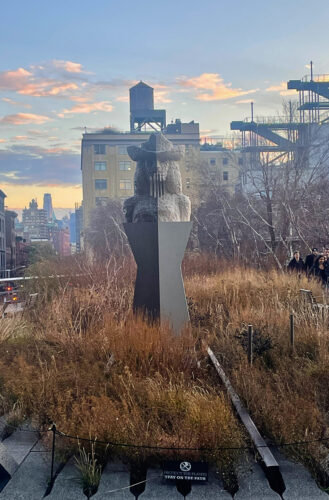
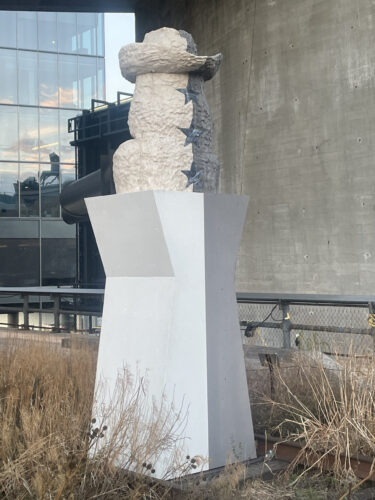
That description fits well with her latest piece, the High Line commission West Side Warrior, in which Halfmoon employs the ancient coiling method as she honors tradition and her heritage while exploring gender and personal experience. Located on the old railway at Little West Twelfth St., the bust, sitting on a plinth, depicts a Native American female horse rider in a cowboy hat, her left side white, her right side black; there are four vertical tattoos on her face and three stars on the back of her head, representing the Red River. In addition, the hand of the artist is present in the clay, which is not smooth. The piece refers not only to the American West, where she is from, but also to the West Side Cowboys, who protected pedestrians and carriages on Death Avenue by guiding New York Central freight trains down the street beginning in the 1850s.
Raven Halfmoon’s West Side Warrior explores indigenous culture, the Old West, gender, and High Line history (photo by twi-ny/mdr)
On March 3 at 12:30, Halfmoon, who is based in her hometown of Norman, Oklahoma, will discuss West Side Warrior with High Line Art chief curator Cecilia Alemani inside the Friends of the High Line Headquarters on Washington St.; admission is free with advance RSVP. The next scheduled talk takes place March 12 at 6:30, when Saba Khan will discuss her three videos, Leaking Ocean,Water Lords, and The Dolphin, with High Line associate curator Taylor Zakarin.
[Mark Rifkin is a Brooklyn-born, Manhattan-based writer; you can follow him on Substack here.]
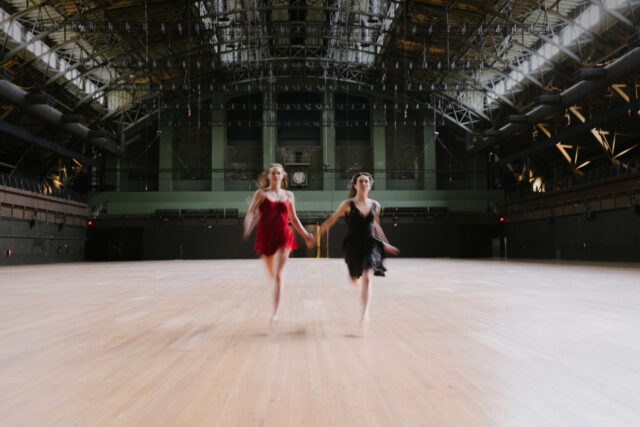
The second Dance Reflections by Van Cleef & Arpels Festival returns to New York City with sixteen performances and twenty-four workshops by some of the finest companies in the world, running February 19 through March 21.
The exciting series kicks off February 19-21 with the Lyon Opera Ballet presenting Merce Cunningham’s BIPED and Christos Papadopoulos’s Mycelium at City Center and the Ballet national de Marseille bringing (LA)HORDE’s Age of Content to BAM’s Howard Gilman Opera House from February 20 to 22. The lineup continues with such shows as Jan Martens’s The Dog Days Are Over 2.0 at NYU Skirball, Leïla Ka’s Maldonne at New York Live Arts, Noé Soulier’s The Waves at the Joyce, and Lucinda Childs’s Early Works for the Guggenheim’s Works & Process program.
Below is a look at five more of the highlights.
LA Dance Project’s On the Other Side is part of triptych at PAC NYC (photo by Jade Ellis)
BENJAMIN MILLEPIED AND THE L.A. DANCE PROJECT: REFLECTIONS: A TRIPTYCH
Perelman Performing Arts Center (PAC NYC)
251 Fulton St.
Saturday, February 21, 8:00, and Sunday, February 22, 3:00, $61-$157 www.dancereflections-vancleefarpels.com pacnyc.org
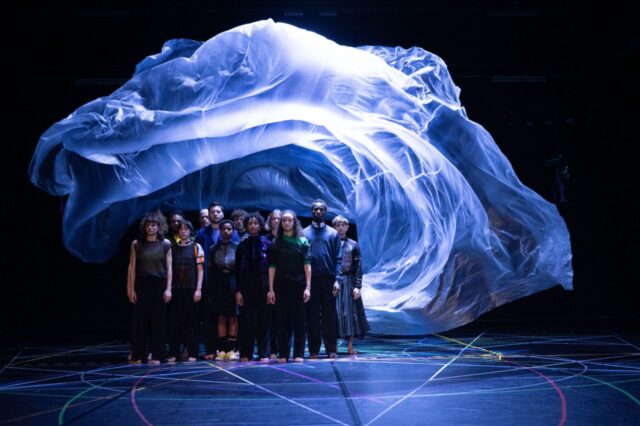
Benjamin Millepied merges dance, music, and visual art in the New York premiere of Reflections: A Triptych, three pieces inspired by precious stones. The thirty-minute Reflections (2013) boasts a score by David Lang and a bold scenic design by Barbara Kruger, with six dancers musing on longing and memory. The seventeen-minute Hearts and Arrows (2014) features a set by Liam Gillick, music by Philip Glass performed by Kronos Quartet, and fab costumes by Janie Taylor. Several Glass compositions and a set by Mark Bradford anchor the forty-five-minute On the Other Side (2016), which explores communal human experience. Audrey Sides will teach a “Hearts & Arrows Repertory” workshop at the New York Center for Creativity & Dance on March 12.
Trisha Brown and the Merce Cunningham Trust celebrate their extensive collaboration with Robert Rauschenberg, and the artist’s recent centennial, with two classic works for which Rauschenberg created the visual design and the costumes. Commissioned by BAM in 1983, Set and Reset is a postmodern masterpiece, with music by Laurie Anderson, that was recently reconceived as an art installation at the Tate. The vaudevillian pièce de résistance Travelogue (1977) is set to John Cage’s “Telephones and Birds,” which has been adapted for mobile devices, and is performed within Rauschenberg’s Tantric Geography environment. “I feel like this is the one time I can let the cat out of the bag and let you know just how dear this man is to me,” Brown once said about Rauschenberg. “Bob understands how I construct movement.” Bob returned the compliment: “Particularly with Trisha, it’s always a challenge because she remains so unpredictably fresh.” Cecily Campbell and Jamie Scott will lead a “Trisha Brown Discovery” workshop at the New York Center for Creativity & Dance on February 28.
Benjamin Millepied reconfigures his Romeo & Juliet Suite specifically for Park Ave. Armory
Benjamin Millepied follows up his PAC NYC Reflections tryptych with an eighty-minute multimedia adaptation of Sergei Prokofiev’s 1930s ballet Romeo and Juliet, combining dance, theater and film reconfigured specifically for the entire Park Ave. Armory building. The cast of eighteen dancers will rotate as Shakespeare’s doomed young couple, with the presentation spreading from the Wade Thompson Drill Hall to the historic period rooms and other spaces, so be sure to get there early. “Of all the places I’ve shown Romeo & Juliet Suite, the armory is by far the most fitting, as it provides the massive scale, flexibility, and grandeur needed to present this work at its fullest potential,” Millepied, who will participate in an artist talk with NYU professor André Lepecki on March 4, said in a statement. “I invite audiences to forget what you think you know about the story of these two star-crossed lovers — and how it should be told — and open your mind to experiencing a radically reimagined tale about love suited for modern day.”
Exciting Belgian choreographer Anne Teresa De Keersmaeker displays her principle of “My walking is my dancing” in Exit Above, in which thirteen dancers move to the sounds of Meskerem Meesre interpreting the blues of Robert Johnson in addition to music by TC Matic’s Jean-Marie Aerts and dancer-guitarist Carlos Garbin, with scenic design by Michel François, costumes by Aouatif Boulaich, and opening text taken from Walter Benjamin’s “On the Concept of History.” In a 2023 interview, De Keersmaeker explained, “Less is more, I increasingly think. For me that means going back to the source, to the real thing. Blues goes all the way back to that essence, also content wise: It is about sorrow and joy, my sorrow, my joy but also our sorrow, our joy. Both individual and collective: That tension is crucial to me. Blues the ultimate emotional alchemy: we sing about our sadness, but by singing about it with others we transform it into a strength, something joyful. Singing about sorrow immediately contains the consolation for that sorrow. Isn’t this ultimately why we make art? To mourn together and to celebrate joy together. Beauty and solace. I know that beauty is considered to be old-fashioned, but we need it more than ever: Our relationship with nature is disturbed, we are living on the edge of an ecological catastrophe. When you’re lost, it’s a good idea to retrace your footsteps.” Jacob Storer and Clinton Stringer will lead an Exit Above workshop at the New York Center for Creativity & Dance for professionals on March 6 and everyone on March 7.
Compagnie Hervé KOUBI will worship the sun again in Sol Invictus at the Joyce (photo by Nathalie Sternalski)
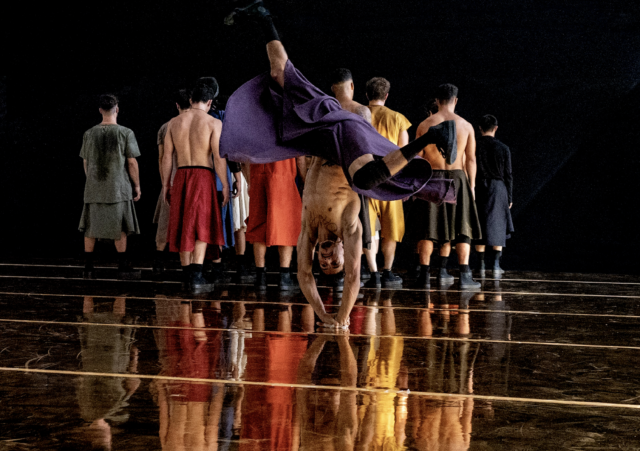
French choreographer Hervé Koubi studied dance and biology at the University of Aix-en-Provence, and he combines the two elements gorgeously in Sol Invictus as his company of eighteen performers pushes the limits of what the human body can do. Previously staged at the Joyce in 2023, Koubi calls the seventy-five-minute piece “a manifesto for life,” and he fills it with sections that explore ritual, worship, faith in a higher power — in this case, the sun — and life, death, and rebirth. “I want to talk about light, solidarity, and those bonds that unite us,” Koubi explains about the work, which features music and soundscapes by Mikael Karlsson, Maxime Bodson, Beethoven (the funeral procession from the Seventh Symphony), and Steve Reich and costumes by musical arranger Guilaume Gabriel. Several of the dancers will lead a “Sol Invictus Discovery” workshop at the New York Center for Creativity & Dance on March 13, and there will be a Curtain Chat following the March 11 show.
[Mark Rifkin is a Brooklyn-born, Manhattan-based writer; you can follow him on Substack here.]
RUTH ASAWA: A RETROSPECTIVE
Museum of Modern Art
The Steven and Alexandra Cohen Center for Special Exhibitions
11 West 53rd St. between Fifth & Sixth Aves.
Through February 7, $17-$30 www.moma.org ruthasawa.com
“To watch you at work on a wire sculpture is to see how a single line is transformed into a network of interconnectedness. It’s an expression of the Heart Sutra: form is emptiness, and emptiness is form,” author, filmmaker, and Zen Buddhist priest Ruth Ozeki writes in a letter to the late Ruth Asawa in the catalog of the outstanding MoMA exhibition “Ruth Asawa: A Retrospective.” She continues, “It’s a performance of eternal and infinite nonduality, in which inside is out, and outside is in, and there is no start, no finish, and no separation between these continuous and continually related moments of being.”
“Let the medium express itself.”
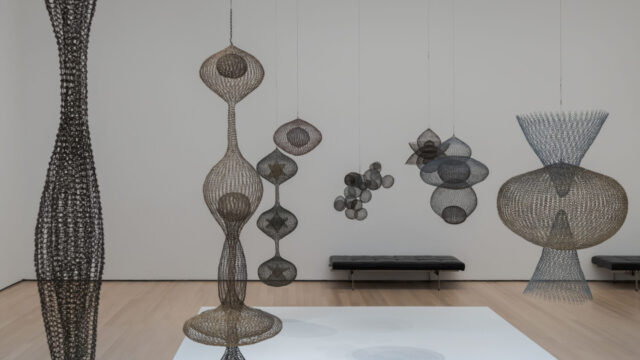
On view through February 7, the show features approximately three hundred wire sculptures, bronze casts, drawings, paintings, prints, class notes, a Guggenheim fellowship application, a letter of patent, and public projects. Asawa was born in California in 1926, was sent to an internment camp in Arkansas in 1942 (her parents were Japanese immigrants), studied at Black Mountain College in North Carolina with Josef Albers, Jacob Lawrence, John Cage, Merce Cunningham, Willem de Kooning, and Buckminster Fuller, and helped create the San Francisco School of the Arts, which was renamed the Ruth Asawa San Francisco School of the Arts in 2010. That background led to a career making wide-ranging works that combine movement, architecture, color, and music into something wholly new. She died in 2013 at the age of eighty-seven.
“I hold no hostilities for what happened; I blame no one. Sometimes good comes through adversity. I would not be who I am today had it not been for the internment, and I like who I am.”
Among the pieces to watch out for are the oil on masonite We Five and Fourteen, the ink and crayon on paper Untitled (MI.121, Chair with Straw Bottom), the ink on paper Untitled (PT.128, Plane Tree), clay life masks, a glazed ceramic plate and persimmon, gentle watercolors, carved doors, lithographs of children, the ceramic Untitled (S.806d, Everyone’s Favorite City: The Golden Gate Bridge, the Cable Car, and the San Francisco Victorian House), bronze body parts, a series of flower lithographs from 1965, index cards, sketchbooks, archival photographs, and a wedding ring made for Asawa by Fuller. There are also works by Albers, Hazel Larsen Archer, Elizabeth Jennerjahn, Imogen Cunningham, Ray Johnson, Merry Renk, and Marguerite Wildenhain.
“I am able to take a wire line and go into the air and define the air without stealing it from anyone. A line can enclose and define space while letting the air remain air.”
But mostly there are Asawa’s dazzling wire sculptures, mounted on bases and walls and hanging from above, intricate constructions of interlocking spheres and continuous organic forms within forms based on nature. They cast shadows as you walk around them, and some spin ever so slowly, but they all nimbly dance between positive and negative space.
“An artist is not special. An artist is an ordinary person who can take ordinary things and make them special.”
[Mark Rifkin is a Brooklyn-born, Manhattan-based writer and editor; you can follow him on Substack here.]