this week in art

NEW AGORA: JULY — ART, MUSIC, YOGA, AND MORE AT SOCRATES SCULPTURE PARK

The art in Socrates Sculpture Park will be activated with special programs on July 9 (photo by twi-ny/mdr)

Who: Woomin Kim, Greg Hammontree, Douglas Paulson and Nicole Brancato, Rudy Walker Ensemble, Cooper-Moore, Ununu, Elliott Sharp, Duology, more
What: Jazz Foundation of America presentation for Second Saturdays
Where: Socrates Sculpture Park, 32-01 Vernon Blvd. at Broadway, Long Island City
When: Saturday, July 9, free, 9:30 am – 8:00 pm
Why: Socrates Sculpture Park and the Jazz Foundation of America have teamed up for a special day of live music, workshops, and more on July 9, activating the historic park and its current art installations. There will be yoga at 9:30 and 11:00 in the morning; from 10:00 to 2:00, the Hellgate Farm Stand will be open, and the Astoria Food Pantry will distribute free clothes, books, and essential items and collect nonperishables and clean clothing; at 11:00, Field Guide: Wildlife Among Us — Finding Shelter will take preregistered participants on a tour of the park, focusing on where animals and insects make their home; and at noon, artist Woomin Kim, whose “Shijang Project” quilts are at Susan Inglett Gallery in Chelsea until July 29, will lead a collage workshop with Noguchi Museum educators. In addition, Greg Hammontree’s ambient soundworld Trumpet Echoes will ring out all day in the Grove of Trees, where you can walk through the adaptive sonic space.

The afternoon will include live thirty-to-forty-five-minute concerts, featuring part I of .soundfullness by Douglas Paulson and pianist Nicole Brancato at the front gate BBQ area at 2:00, the Rudy Walker Ensemble at the Cobblestone Stage at 3:00, pianist Cooper-Moore inside Hélio Oiticica’s Subterranean Tropicália Projects PN15 at 4:00, improv trio Ununu at the North Gate Stage and part II of .soundfullness at the front gate BBQ area at 5:00, the legendary Elliott Sharp playing “Monkulations” on acoustic guitar in Oiticica’s installation at 6:00, and Michael Marcus’s Duology at the Main Stage at 7:00.

As you enter the park, you encounter the Broadway Billboard The Marooned Picturesque Series (Socrates) by New York City native Joiri Minaya, which was selected by the Socrateens. On view through August 14, Oiticica’s Subterranean Tropicália Projects PN15 is an immersive circular environment of an unrealized work by the late Brazilian artist and activist Oiticica, who was honored with a terrific exhibition at the Whitney in 2017, “To Organize Delirium.” Originally conceived for Central Park, the piece is now centered at Socrates, where visitors can follow narrow, winding paths to surprise places; facing the front of the park is a small platform and screen behind mesh, where live performances and screenings are held. Sharp and Cooper-Moore will play inside on July 9; on August 14, the closing reception is highlighted by “We are one only heart, one only earth, one only soul,” an invitation to the public by Brazilian Yanomami shaman Davi Kopenawa to learn about the violence the Yanomami people are facing at the hands of the Brazilian government.

In the Grove of Trees, where you can hear Trumpet Echoes, you will find Maren Hassinger’s Two Bushes, a new pair of sculptures made of iron wire hiding in plain sight among the natural elements of the park, harkening back to Hassinger’s Three Bushes, which were part of the 1988 group exhibition “Sculptors Working” at Socrates. The New York–based artist has also installed “Steel Bodies” throughout the park, consisting of ten steel sculptures inspired by different types of vessels throughout history; some of them resemble open cages, which you can walk into, offering a unique perspective on your relationship to the people and nature around you, while their placement, and the shadows they create, interacts dramatically with the surrounding trees, skyscape, and outdoor studio of Socrates cofounder Mark di Suvero. [To see all the artwork in the park, go here.]

KENZO DIGITAL’S AIR AT THE SUMMIT

Kenzo Digital’s Air offers a new perspective on making connections in the city (photo by twi-ny/mdr)

AIR
SUMMIT One Vanderbilt
45 East Forty-Second St. at Vanderbilt Pl.
Admission: $39-$73
summitov.com
kenzodigital.com
online slideshow

“I wanted New Yorkers to come and watch their home come back to life, to reengage with their friends and family they hadn’t seen for a long time and create ritual and ceremony around human connection, which is actually the antithesis of New York, which is a highly transactional city where people are just trying to survive,” Kenzo Digital said on a private walkthrough of his multipart permanent installation, Air, near the top of the SUMMIT One Vanderbilt skyscraper. “So I want to have a place where people can forget about that aspect of their survival identity in New York and connect through a primal curiosity on a basic, authentic level.”

Kenzo, a graffiti artist, DJ, and film and video director who has worked with Kanye West and Beyoncé, had lofty goals when designing Air; he didn’t want the project to just be an Instagram-friendly tourist attraction but to generate other, more meaningful conversations, especially among New Yorkers.

“In a nutshell, what I wanted to do was essentially create an experience of physical space that was capable of having a deep emotional and psychological relationship with a human being over the course of their entire life. The idea is you walk into this space and it will feel different every time,” he explained. “I wanted to create something that specifically challenges and defies language, both the written word and the image. It’s impossible to describe what this is, even though you can break it down by its components and you’d be correct, but it’s impossible to describe the effect of the experience and the emotional impact. Everyone is wrong and right in different ways, and it will be a different wrong and right every time you come.”

Air consists of several floors of fantastical views of New York City and dramatic reflections, reaching high into the sky and way down below, of the humans occupying the space on the ninety-first floor and above. “We built the entire thing during the pandemic. It was like making art in a science fiction film. It was . . . fucking crazy,” Kenzo notes. Glass windows and mirrors are arranged in geometric patterns that result in awe-inspiring repeated imagery that forces visitors to try to find their body in the space as well as their position in the city and the world. Kenzo, whose previous installations include Social Galaxy, which featured chambers where visitors were barraged by their social media history, and the immersive haunted house Nocturnal Awakening, considers the work to be “the story of your relationship to time, your relationship to New York City, your relationship to weather, and also your relationship to yourself.

“It’s about the relationship between the natural world and the physical world,” he points out. “If there is an approaching storm from New Jersey, you will see the city as an organism react to that storm — cars, traffic, people move differently, with rain on the street, fewer people, umbrellas pop up. You can see the city as an expression of nature. People always talk about the life force of New York; Air is an organ within that life force, the heart of it that contains its spirit. This is expressing the infinite power of chaos that is the collision of uncontrollable variables: nature, time, the world, your emotions, your place in all of this.”

Visitors first take an elevator that recalls one of Yayoi Kusama’s Infinity rooms, with lights flashing on and off and mirrors that reflect the passengers into an endless oblivion. You get out at “Transcendence,” a large rectangular space with tall windows that offer stunning views of the city on three sides and glass floors that reflect the inside and the outside. It will take you a while to orient yourself, especially as you look down at what appear to be multiple levels of people either upright or upside down as buildings, blue sky, and clouds merge with the interior space.

“There are so many avenues, it almost looks like they’re delivering you to the front doorstep of One Vanderbilt,” says Kenzo, who speaks quickly and excitedly, like a child with a new toy. “And because it’s positioned so symmetrically, you can almost see the city like an organized system of neighborhoods; you understand it spatially, you understand the grid, and that grid is magnified and deconstructed within the grid of reflection that exists in here.” The gridlike structure recalls the multimedia installations of the father of digital art, Nam June Paik, who arranged television sets into wholly new, living environments; Kenzo is the late Nam June’s great-nephew and the creative director of his great-uncle’s estate.

Much of the eye contact in Air is made via the reflections, so you can connect with individuals who are not in your immediate physical space, if you can find them. It’s a far cry from being on the subway, for example, where many straphangers go out of their way to avoid eye contact with anyone.

When I mention to Kenzo that it’s hard to tell who is actually on the mezzanine and what are reflections, he replies slyly, “They are asking themselves the same question about you.”

In the mezzanine, you can look down and see how the next batch of people initially react to the area. Kenzo explains, “The idea behind Transcendence II is this concept of folding time in the sense of that when you’re up here, you’re essentially watching people exposed to the concept for the first time, and so the idea of connective language through primal curiosity is in effect because you see people, just where you were a few minutes ago, processing the information at a base level for the first time. So as we were just down there, observing that there’s a physical mezzanine up here and making eye contact, everyone up here has already established equilibrium and has the foundation of knowledge and information, and everyone down there is still figuring out what’s going on.” Kenzo envisions Air as encompassing human development: “crawl, walk, run, fly.”

Kenzo Digital stands next to the Empire State Building in his permanent installation at Summit One (photo by twi-ny/mdr)

The idea for Air emerged from Kenzo’s subconscious.

“This is all based on a recurring dream I’ve had for twenty-five years; it’s a strangely, deeply personal thing,” Kenzo reveals. “In the dreams there’s a fictitious skyscraper, residential; so I’ve had these dreams that took place in the top two floors, the penthouse of the skyscraper, which is circular in shape, which is why I have the two circles on the east and west side as a nod to that dream. So it’s the ability to project my dream and then put it inside of other people’s mind and then for that to be a shared dream. And oftentimes I find people dream about it after the experience.”

Affinity is a room of silver balls, reminiscent of Andy Warhol’s helium Silver Clouds, that visitors can run through, kicking the balls in the air and against mirrors and windows, each ball reflecting themselves, those around them, the view, and other balls as dozens of orbs seem to multiply into thousands in a fun deluge. “It’s constantly engaging with the city; it’s always an inside-outside experience,” Kenzo says. In another room, the inside-outside connection involves a projection of sky and clouds on the wall and the floor as scanned images of your face are added to a large screen.

Levitation puts you in a space where you are seemingly floating above the skyline, standing on a transparent floor facing a window so clear that it makes you feel like it’s not there, that you are on a ledge, midtown Manhattan right below you. Cameras are set up to take a picture and/or video of you in the space that you can pick up at the exit. As wondrous as it is to look at, it also makes you feel the interdependence between nature, technology, and humanity as well as the impermanence of life. “It’s the story of your relationship to time, your relationship to New York City, your relationship to weather, and also your relationship to yourself,” Kenzo explains. You can further those relationships by taking the outside glass elevator, Ascent.

Levitation offers a chance to seemingly float above New York City (photo courtesy Summit One)

Kenzo honors Japanese artist Kusama with her 2019 work Clouds, a collection of amorphous stainless-steel and wax floor sculptures that also reflect visitors and the sky; it is the first of a rotating series of exhibitions Kenzo will curate by other artists in the space.

Kenzo sees Air as an ever-changing, always-evolving experience that changes from day to day, hour to hour, depending on the crowd and the weather, and he wants it to be more than just a photo opportunity that’s over when you leave.

“There’s a part of you that stays in here,” he says thoughtfully.

SigSpace: EMANCIPATED STORIES

Who: Quiara Alegría Hudes, Sean Ortiz, Sean Carvajal, Dominic Colón, Kenyatta Emmanuel, Suave Gonzales, Renee Goust, David Zayas, Kenyatta Emmanuel, Renee Goust, Jamie Maleszka, more
What: Installation and pop-up events
Where: Signature Theatre, the Pershing Square Signature Center Lobby, 480 West Forty-Second St. at Tenth Ave.
When: June 29 – July 24, Tuesday – Sunday, noon – 5:00, free
Why: Last summer, the Signature Theatre reopened with the immersive installation The Watering Hole, which included Vanessa German and Haruna Lee’s “This Room Is a Broken Heart,” part of which involved choosing a postcard designed by an incarcerated individual and sending a note to someone living behind bars. This summer the Signature has taken that a step further by teaming with the Fortune Society and Emancipated Stories to present an installation focusing on words and art by incarcerated people. Founded in 1967, the Fortune Society’s mission is “to support successful reentry from incarceration and promote alternatives to incarceration, thus strengthening the fabric of our communities . . . through believing, building lives, and changing minds.” Emancipated Stories was started by prison reform activist and playwright Quiara Alegría Hudes and her cousin Sean Ortiz, who spent ten years behind bars, as a way for incarcerated people to have their voices heard through handwritten letters that are shared on Instagram and in special installations.

Hudes, the Signature’s premiere writer-in-residence and author of such works as In the Heights, Water by the Spoonful, Daphne’s Dive, and Miss You Like Hell, explained in a statement, “The thing that’s fun and safe about theater is that the basic rule of engagement is one of listening. The fundamental contract is: I’m going to listen, I’m going to pay attention. Similarly, what we’re seeking to create is a communal space of sharing and openness. Within this installation and the events we’ve planned, the lines between audience and performer are more porous; it’s more of a gathering, and there’s no fourth wall, and we put the original letters in people’s hands. When you hold someone’s piece of paper and it’s handwritten — and you feel the grooves — it’s like holding someone’s hand. It’s an instant connection that’s part of the liveness of it. Surprising heart doors come open in these moments.”

“The Fortune Society is thrilled to be in community and collaboration with Signature Theatre and Quiara Alegría Hudes to help bring this insightful and moving project to life,” Fortune Society director of creative arts Jamie Maleszka added. “The goal of Emancipated Stories is to center and celebrate the full humanity of community members who are currently and formerly incarcerated and to grow meaningful connections through storytelling. The project perfectly aligns with our mission to build people, not prisons, and invest in more just collective futures.”

“SigSpace: Emancipated Stories” will be open in the theater lobby Tuesday through Sunday from June 29 through July 24, from noon to 5:00; admission is free. In addition, there will be four pop-up events, free with advance RSVP, featuring actors, artists, activists, musicians, writers, and members of the Fortune Society activating the installation, which was designed by Yazmany Arboleda with Emmanuel Oni, through music, discussions, readings, and writing letters in response to those from incarcerated individuals.

Wednesday, June 29
Kick-off, with actors David Zayas and Sean Carvajal, artist and activist Suave Gonzales, and Felix Guzman and Daniel Kelly of the Fortune Society, hosted by playwright Quiara Alegría Hudes, free with RSVP, 5:00 – 7:00

Wednesday, July 13
Music Night, with composer Kenyatta Emmanuel, singer-songwriter Renee Goust, writer and actor Dominic Colón, and others, hosted by Quiara Alegría Hudes, free with RSVP, 5:00 – 7:00

Sunday, July 17
Family Day, with Fortune Society community members and actor Sean Carvajal, moderated by Fortune Society director of creative arts Jamie Maleszka and Quiara Alegría Hudes, free with RSVP, noon – 2:00

Wednesday, July 20
Quiet Writing Time, free with RSVP, 5:00 – 7:00

PAUL MAHEKE: A FIRE CIRCLE FOR A PUBLIC HEARING

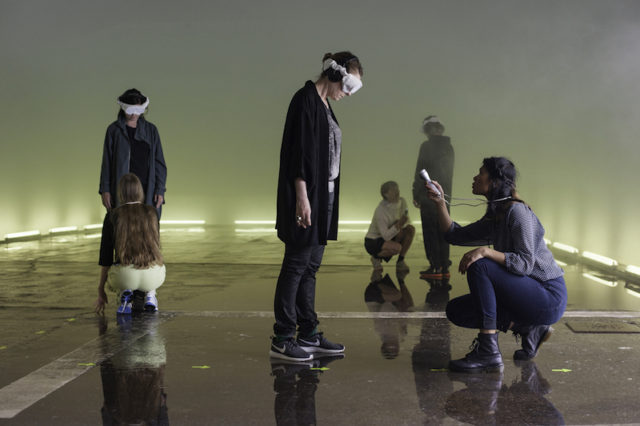
Paul Maheke rehearses A fire circle for a public hearing before US debut on the High Line this week (photo by twi-ny/mdr)

Who: Paul Maheke, Morgan “Emme” Bryant, Lucy Hollier, Rafaelle Kennibol-Cox
What: High Line Art live performance
Where: The High Line at Fourteenth St.
When: June 28-30, free (advance RSVP recommended), 7:00
Why: “My work is always in reaction or in response to a certain space, a certain context,” multidisciplinary French artist Paul Maheke said in a 2018 discussion about his installation A fire circle for a public hearing at Chisenhale Gallery in London. “Often in my exhibitions, there is this notion of welcoming people in the space, whether they are collaborators or members of the audience.” Maheke is reimagining A fire circle for a public hearing for its US debut, taking place in the Fourteenth St. tunnel passage on the High Line June 28-30 at 7:00. He will be joined by dancers Morgan “Emme” Bryant and Rafaelle Kennibol-Cox and trombonist Lucy Hollier. The piece combines music, movement, and spoken word as Maheke explores marginalization, hypervisibility, erasure, and identity.

Paul Maheke’s A fire circle for a public hearing premiered at Chisenhale Gallery in London in 2018 (photo by Mark Blower)

“Paul’s work asks important questions about what it means to be a body onstage, and how a single person is able to hold many shared and overlapping histories in a single gesture. He encourages us to think about what is seen and what is not seen, both in the performance of a single person, but also in our wider cultures and histories at large,” High Line Art associate curator Melanie Kress said in a statement. Judging from a rehearsal I saw a few days ago, this is a powerful work with a lot to say about where we are at this moment in history.

RIVER TO RIVER 2022

Beth Gill’s Nail Biter is part of twenty-first annual River to River Festival

RIVER TO RIVER FESTIVAL
Multiple locations
June 12-26, free (advance RSVP recommended for some events)
lmcc.net/river-to-river-festival

One of New York City’s best and most wide-ranging summer festivals is underway. Sponsored by the Lower Manhattan Cultural Council (LMCC), River to River offers free theater, music, art, dance, and more, from the East River to the Hudson. The twenty-first consecutive iteration begins with Okwui Okpokwasili and Peter Born’s repose without rest without end, a video installation in which the real-life partners (on the way, undone; Poor People’s TV Room) adapt their 2019 interdisciplinary performance piece, Adaku’s Revolt, which investigates ideas of beauty through nature and slavery. The installation is on view at Fosun Concourse Amphitheater at 28 Liberty St. daily through June 26 from 7:00 am to 11:00 pm; in addition, the space will be activated by live performances on June 13 and 20 at 8:00.

On June 17 at 7:00, Jonathan González will be at La Plaza at the Clemente Soto Vélez Cultural & Educational Center at 114 Norfolk St. for the world premiere of Practice, an immersive event focusing on Afro-diasporic idioms featuring Ali Rosa-Salas, Marguerite Angelica Monique Hemmings, Dani Criss, Jordan Lloyd, and Fana Fraser, with music by William “DJ Embe” Catanzaro. On June 18 at 3:00, Amy Khoshbin and Jennifer Khoshbin team up for The Sun Seekers on Governors Island, a participatory induction ceremony in which everyone is encouraged to disconnect from technology and reconnect with the natural world, involving sight, smell, touch, and hearing. On June 18 at 7:00, the opening will be held for Rose DeSiano’s Lenticular Histories: South Street Seaport, an immersive installation on Front St. of large-scale lenticular photographs on sculptural mirrored prisms that will remain on view through June 30.

Skave by keyon gaskin promises to be one of the hottest shows at River to River

Dancer and choreographer Beth Gill delves into psychodrama and sci-fi in the site-responsive Nail Biter, taking place in Federal Hall on June 22 and 23 at 5:30, with Jordan Demetrius Lloyd, Walter Dundervill, Jennifer Lafferty, Jennifer Nugent, and Marilyn Maywald Yahel moving to a score by Jon Moniaci. On June 23 and 25 at 7:30 at La Plaza, keyon gaskin will present Skave, continuing his journey into oppression, imperialism, colonization, communication, and escape. On June 25 at 4:00, trombonist Craig Harris will lead a large ensemble in Rockefeller Park for Breathe, helping the community fight racial injustice.

Downtown favorite Heather Kravas returns June 25-26 at 8:00 with duet/duet, a piece set at dusk on Governors Island — inside and outside — for opal ingle, Joey Kipp, and Jennifer Kjos, whose movement, to an electroacoustic score by Zeena Parkins, references line drawings and the shapes our bodies can make. The festival was actually supposed to open on June 12 in Teardrop and Rockefeller Parks with Gregory Corbino’s participatory puppet performance Murmurations, but it was canceled because of the weather; watch this space for a rescheduled date. And just a reminder that all events are free, and walk-ups are accepted for sold-out events, as at least a few tickets usually become available around showtime.

BLACK DOLLS

Topsy-turvy doll, mixed fabrics, paint, 1890-1905 (photo by Glenn Castellano)

BLACK DOLLS
New-York Historical Society
170 Central Park West at Seventy-Seventh St.
Wednesday – Sunday through June 5, $6-$22
www.nyhistory.org

The New-York Historical Society explores the sociocultural history of black dolls, particularly in regard to slavery and racism, in the revelatory exhibit “Black Dolls,” on view through June 5. The show features more than two hundred items, including more than a hundred handmade dolls dating back to the 1840s. Cynthia Walker Hill’s “Doll representing an enslaved man” depicts a fugitive slave with a slave collar still around his neck. There are several dolls crafted by Harriet Jacobs, author of Incidents in the Life of a Slave Girl: Written by Herself, for the children of white author Nathaniel Parker Willis. There are several topsy-turvy dolls, a Black figure on one side, a white figure on the other; an old advertisement makes a clear distinction between the two.

A row of Black dolls forming a family are lined up in front of photographs of girls with dolls of a different color. Disturbed at seeing two Black girls playing with a white doll, Sara Lee Creech worked with Eleanor Roosevelt and Zora Neale Hurston on a line of Black dolls with positive images, not stereotypes, but they didn’t sell well. In 1908, Richard Henry Boyd and his National Negro Doll Company began manufacturing “Negro Dolls for Negro Children.” In the 1990s, American Girl introduced Addy Walker, a Black doll with her own, smaller Black doll.

“While the names of the women who created these dolls are largely unknown, every stitch that they sewed into place is invaluable evidence of their lived experience, as well as a reflection of the larger historical forces of slavery and its legacy,” New-York Historical Society president and CEO Dr. Louise Mirrer said in a statement. There’s a folk-art quality to the dolls, reminiscent of story quilts, each one forming its own narrative.

In its landmark 1954 decision Brown v. Board of Education of Topeka, the Supreme Court cited Dr. Kenneth Clark’s doll tests, in which he asked questions of Black and white children between the ages of three and seven to find out which doll they felt represented them and which were the good ones. The results were a window into how kids viewed racial stereotypes and their own self-esteem; most of the children preferred the white dolls. “To separate [Black children] from others of similar age and qualifications solely because of their race generates a feeling of inferiority as to their status in the community that may affect their hearts and minds in a way unlikely ever to be undone,” Chief Justice Earl Warren wrote in the opinion. The exhibit demonstrates more than a century and a half of quiet efforts to resist that damage and the resilience of the Black community and a few allies in the ongoing fight to represent themselves.

There will be guided gallery tours on May 29 and June 1 at 1:00. While at the museum, be sure to check out such other exhibits as “Title IX: Activism On and Off the Field,” “Picture the Dream: The Story of the Civil Rights Movement Through Children’s Books,” and “Scenes of New York City: The Elie and Sarah Hirschfeld Collection.”

LOWER EAST SIDE FESTIVAL OF THE ARTS: ARTISTS EMBRACE LIBERTY AND JUSTICE FOR ALL

Who: Nearly two hundred performers
What: Lower East Side Festival of the Arts
Where: Theater for the New City, 155 First Ave. at Tenth St.
When: May 27-29, free (donations accepted)
Why: The twenty-seventh annual Lower East Side Festival of the Arts, a wide-ranging, indoor and outdoor celebration of the vast creativity of the neighborhood over the decades, will feature nearly two hundred performers, at Theater for the New City and on Tenth St. Taking place May 27-29, the festival, with the theme “Artists Embrace Liberty and Justice for All,” includes dance, spoken word, theater, music, visual art, and more from such familiar faves as David Amram, the Thunderbird American Indian Dancers, Shakespeare in the Parking Lot, James Rado, La MaMa, Akiko, Folksbiene National Yiddish Theater, Malachy McCourt, KT Sullivan, Eduardo Machado, Austin Pendleton, the Rod Rodgers Dance Company, Melanie Maria Goodreaux, Chinese Theater Works, New Yiddish Rep, Eve Packer, 13th Street Rep, and Metropolitan Playhouse.

The event will be emceed at the various locations by Crystal Field, Robert Gonzales Jr., Danielle Aziza, Sabura Rashid, David F. Slone Esq., and Joe John Battista. There will also be vendors and food booths and special programs for children curated by Donna Mejia and hosted by John Grimaldi, film screenings curated by Eva Dorrepaal, a “poetry jam with prose on the side” curated by Lissa Moira, and an art show curated by Carolyn Ratcliffe. Select performances will be livestreamed here.