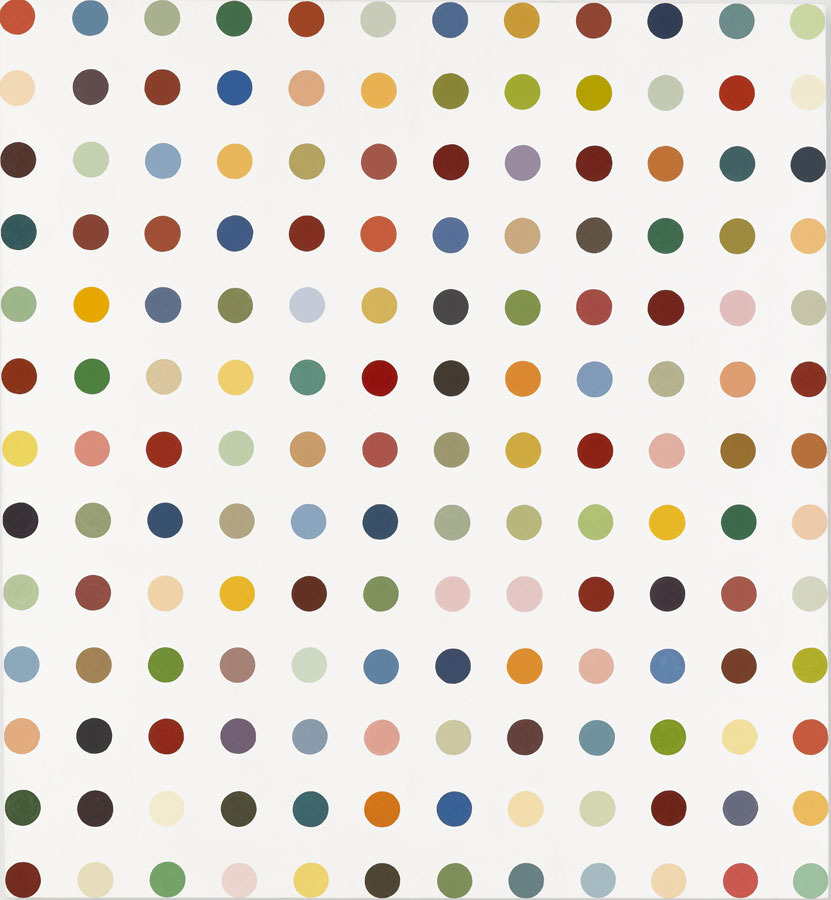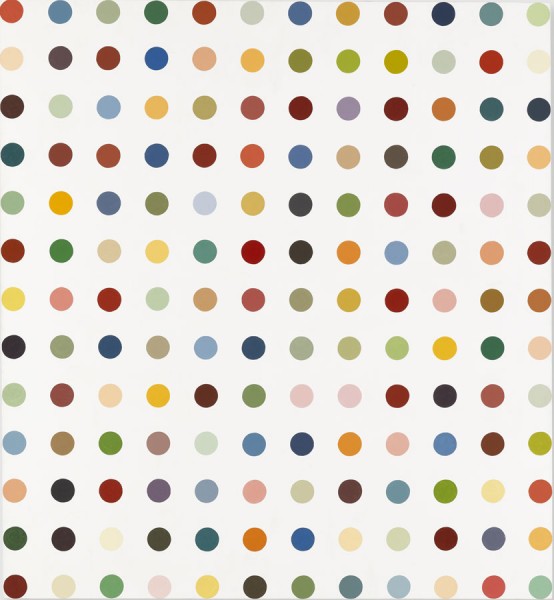
Damien Hirst, “Methoxyverapamil,” household gloss on canvas, two-inch spot, 75 x 69 inches, 1991
Gagosian Gallery
980 Madison Ave., 555 West 24th St., 522 West 21st St.
Through February 18, free
www.gagosian.com
In the 1945 Warner Bros. short Hare Tonic, Bugs Bunny tricks Elmer Fudd into believing that the hilarious hare is infected with Rabbititus. “How do you know I’m contaminated? I haven’t got any symptoms. You don’t see no spots before my eyes, do ya?” Bugs asks as a group of colorful spots swirls in front of his face. Right now at all eleven Gagosian locations around the world — from Hong Kong, Geneva, Beverly Hills, and London to Paris, Rome, Athens, and all three galleries in New York City — people are seeing spots before their eyes, but it has nothing to do with Rabbititus. Instead, the outbreak is the result of Damien Hirst’s “The Complete Spot Paintings 1986-2011,” comprising more than three hundred of the British bad boy’s household gloss on canvas works. Each painting features multiple dots of a single size, hand-painted by a single member of Hirst’s team, with no color repeated. In New York, the spots range from one millimeter to slightly more than one yard each, with most falling in the one-to-six-inch range, in circular patterns or straight up-and-down grids, creating a dizzying array as you make your way through room after room after room. The majority of the works are named after pharmaceutical and chemical products, referencing Hirst’s familiar cabinets filled with pills and other medical paraphernalia; among the titles are “Cefatrizine Propylene,” “Minoxidil,” “Benzoic Anhydride,” “Aminobenzaldehyde,” and “Hexadecanedioic Acid.” Hirst adds extra playfulness to the fifth floor of 980 Madison, with several canvases featuring spots that are barely visible or cut in half, as well as a “Controlled Substance Key Painting” that might or might not offer a way to decipher hidden meanings in the works.
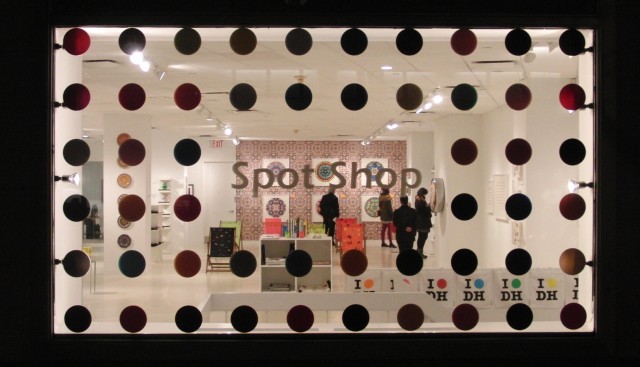
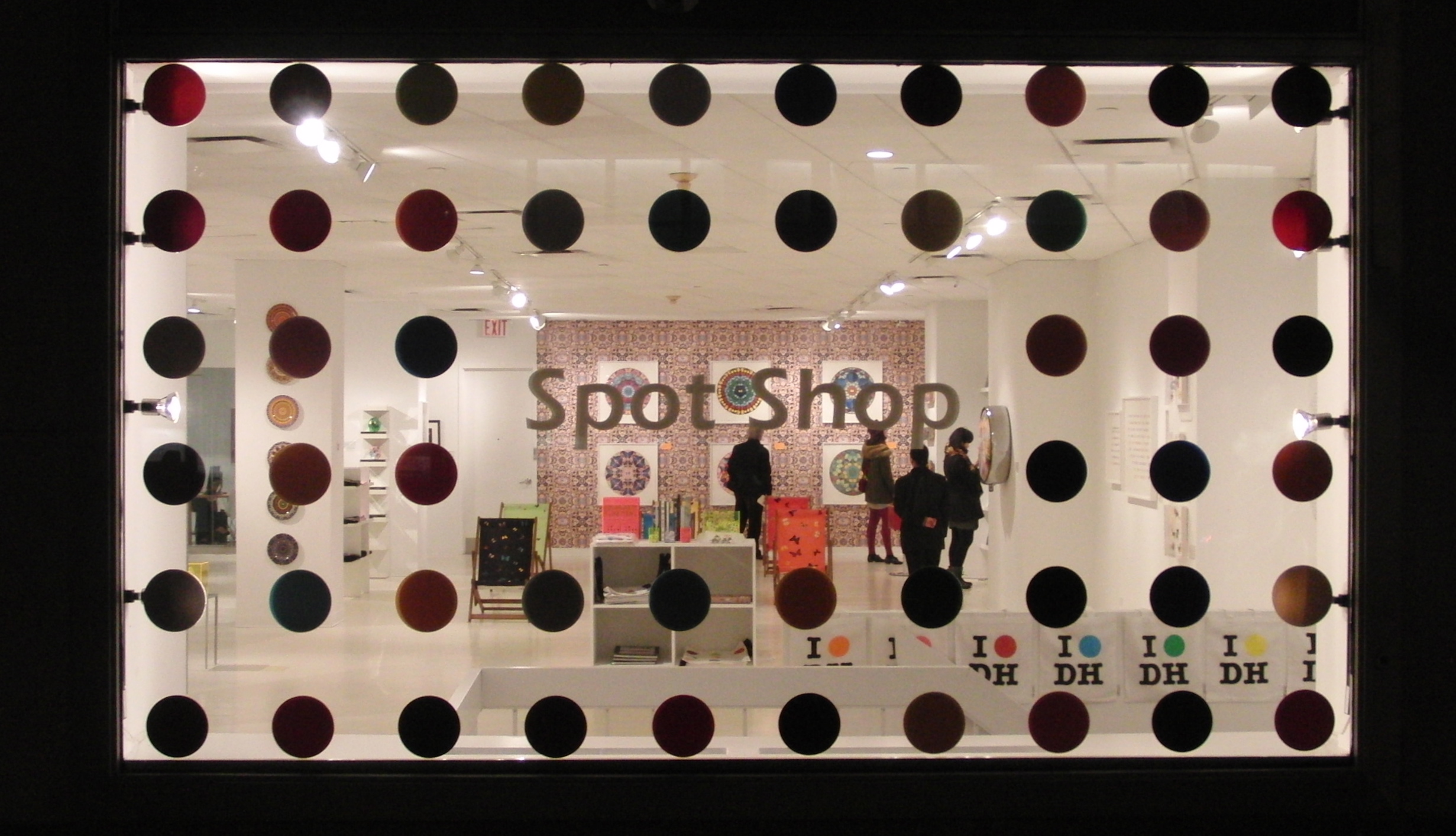
Damien Hirst exhibit comes with its own dedicated store (photo by twi-ny/mdr)
If you look closely, it is easy to see that the arrangements are not perfect, indeed made by humans and not machines. You’ll also notice that just about everyone else in the gallery is smiling, getting a kick out of the seemingly endless display of colorful canvases, which can be cheerful and friendly, warm and welcoming. We are not a bit ashamed to admit that we thoroughly enjoyed our three-gallery jaunt through Hirst’s “Spot Paintings.” Perhaps it was our OCD working overtime, but we were drawn into the aesthetically pleasing, colorful works, excited by the repetition and consistency. So why are so many people unhappy with Hirst and decrying the exhibition as a self-centered display of artistic pomposity and conglomerate excess? Of course, it is impossible to look at the spot paintings and not think about Hirst, Inc. Hirst is big business, and his manipulation of the market for his works has made him a lot of enemies. Yes, there is a small concession in the 24th St. space as well a much bigger Spot Shop up on Madison Ave., where you can buy Hirst tote bags, clocks, stickers, skulls, pins, prints, and various other ephemera. So maybe the spots in front of Hirst’s eyes are made of giant dollar signs — you can practically hear the “ca-ching” as you meander through the galleries — but does the meta surrounding Hirst & Company take away from the sheer pleasure that most people derive from seeing these works? “It was just a way of pinning down the joy of color,” Hirst has said about the spot paintings. We found a whole lot of joy in this show, even if it is a way to make Hirst that much richer as he prepares for his first major museum career survey (beginning in April at the Tate Modern). And as far as Rabbititus goes? Well, you can consider the spots to be little more than hundreds of thousands of rabbit pellets deposited by an egotistical British Easter Bunny. You can think of them as the result of a Warholian cadre of assistants metaphorically screwing like rabbits. Or you can just get a huge kick at the nearly endless joy of color. It’s your choice.

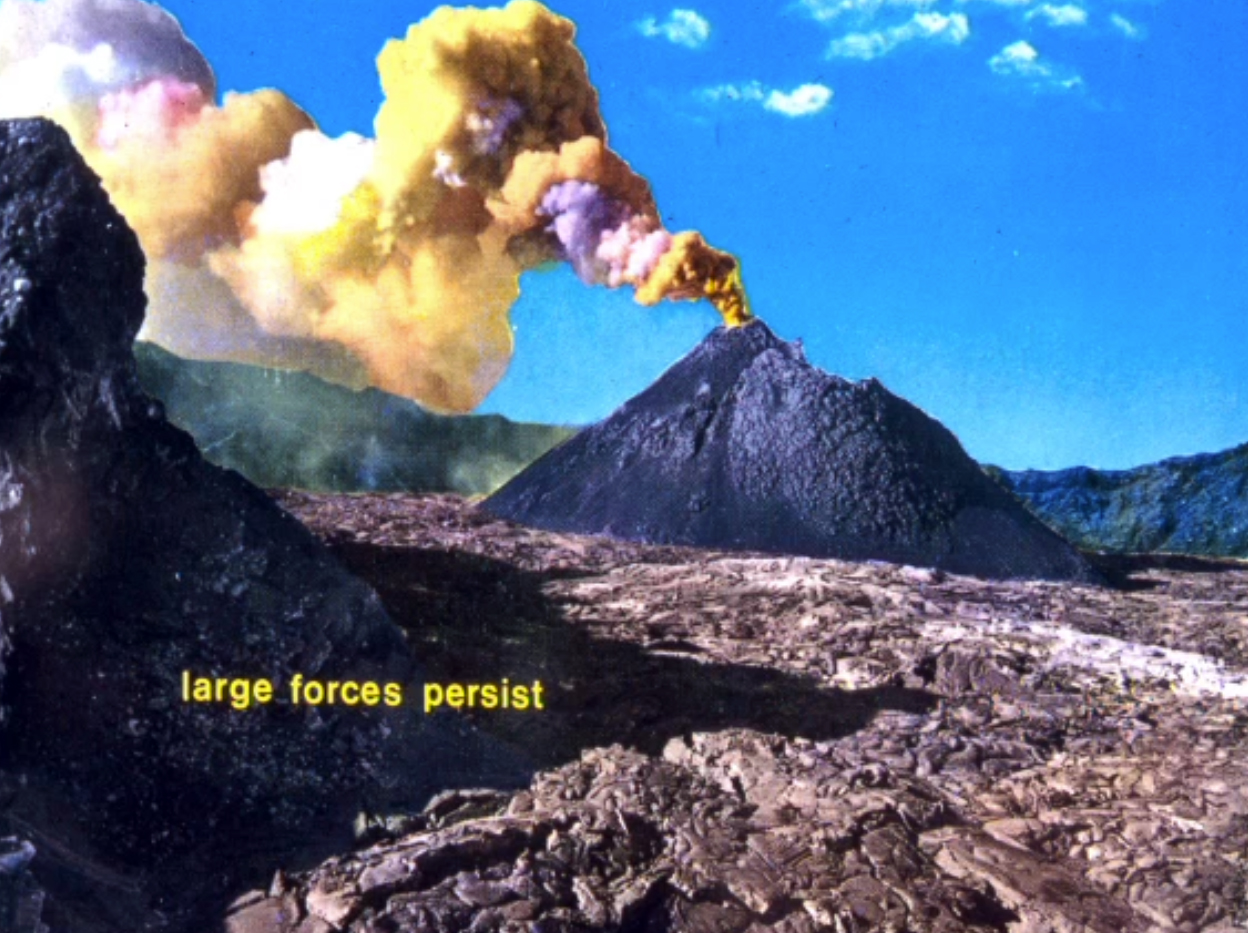
 In the late 1970s, Andrea Callard helped found a collective of artists that would come to be known as Colab, or Collaborative Projects, Inc. Among her fellow officers in the group were Coleen Fitzgibbons, Tom Otterness, and Ulli Rimkus. “Through a juicy and conflicted multi-year period of identity and structural definition,” she explains on her website, “there was experimentation in and rich discussion of accessible content, political forces, technology, equity, corporate versus union models, and material resources.” From February 13 to 19, the Maysles Institute will look back at Callard’s career by presenting the world premiere of her first feature-length film, Talking Landscape: Early Media Work, 1974-1984, which examines all those things and more in its eighty minutes. More a greatest-hits package than a narrative nonfiction film, Talking Landscape consists of several of Callard’s low-budget, low-tech Super 8 shorts, narrated in her steady deadpan, beginning with 11 thru 12, in which Callard humorously discusses “inspiration, information, transportation, the National Geographic, the Yellow Pages, and taxi cabs” while standing at an ironing board, trying to hail a cab out on the street, and walking on her hands in the ocean. In Notes on Ailanthus, she details the history of the tree that “grows abundantly in all the empty spaces around New York.” In Sound Windows, she has fun with her apartment windows. In Walking Outside, she sings a blues song while walking through green fields. Talking Landscape also includes a trio of slide shows of site-specific installations Callard was involved in. Commuting from Point to Point combines images shot in Paris, Italy, and New York with phrases lifted from books; for example a shot of cigarettes put out in a bowl of dirt on a newspaper is accompanied by the words “only time gets lost,” while a photo of the Spanish Steps features the phrase “worn by millions of feet.” The Customs House is a document of the 1979 Creative Time group show “Custom and Culture 2,” held inside the dilapidated Customs House by Bowling Green, now home to the National Museum of the American Indian. And finally, The Times Square Show takes viewers on a tour of the seminal art show held in June 1980, which sought to investigate “the need to communicate in a larger world”; the Colab exhibition comprised works by Keith Haring, Lee Quinones, Jean-Michel Basquiat, Jenny Holzer, Kenny Scharf, John Ahearn, Kiki Smith, Otterness, Callard, and others held in the then-still-seedy neighborhood. Throughout the film, Callard displays a wry sense of humor in these brief experimental works that were part of a major shift in the New York City art scene. Talking Landscape is being screened as part of the Maysles Institute’s continuing “Documentary in Bloom” series, curated by Livia Bloom, who will moderate Q&As with Callard following the February 16 and 19 showings.