this week in art

MICHAEL SNOW: IN THE WAY

Michael Snow, “The Viewing of Six New Works,” installation view, seven looped video projections, silent, touch design recording technology by Greg Hermanovic, 2012

Jack Shainman Gallery
513 West 20th St. between Tenth & Eleventh Aves.
Tuesday – Saturday through February 11, free, 10:00 am – 6:00 pm
212-645-1701
www.jackshainman.com

Canadian conceptual artist Michael Snow has been creating cutting-edge multimedia works for more than fifty years, including such seminal experimental films as Wavelength and Corpus Collosum and such site-specific projects as “Flightstop” and “The Audience.” In his latest gallery show, the eighty-two-year-old Guggenheim Fellow and chevalier de l’ordre des arts et des lettres explores the creation and perception of visual art itself in the four-part installation “In the Way.” Visitors first encounter “La Ferme,” in which Snow takes 16mm footage of grazing cows, then arranges eleven successive frames horizontally, the way it was actually seen as the film was made, instead of vertically, the way the frames would appear in the developed film itself; the 1998 work announces that you are in for a unique experience that is going to examine ways of seeing while laying bare the process behind it all. In a room off to the left, “In the Way” (2011) features a twenty-three-minute video loop projected onto the floor; you have to stand right on it in order to get the full impact of the panning shots taken from a truck, making you feel like you’re moving over green fields, dirt, asphalt, and rocks, each surface giving you a different visceral experience. Experience is at the heart of “The Viewing of Six New Works” (2012), as Snow projects seven changing geometric shapes, in varying bright colors, onto the walls of a large room, each image shifting based on how the eye reads a rectangular work of art on the wall, following ocular patterns of perception and forcing viewers to see these images in the same way. “When attention is not being paid to it,” Snow explains in the press release, “the object/rectangle is not there.” The fourth piece, 1985’s “Exchange,” involves a holographic set-up in a daring red that falls short of expectations, with little happening as you move around it. Continuing at Jack Shainman in Chelsea through February 11, “In the Way” is another engaging example of how we look at art, from one of the masters of the genre.

AI WEIWEI: SUNFLOWER SEEDS

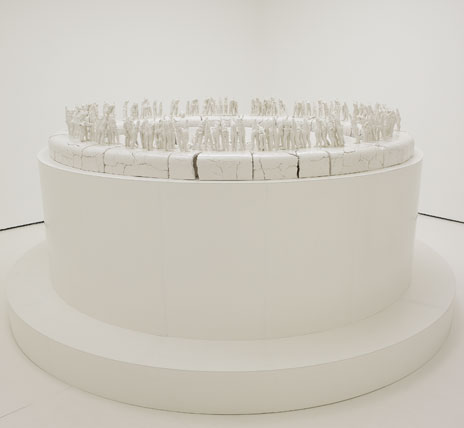
Ai Weiwei, “Sunflower Seeds,” detail, hand-painted porcelain (photo by twi-ny/mdr)

Mary Boone Gallery
541 West 24th St. between Tenth & Eleventh Aves.
Tuesday – Saturday through February 4, free
212-752-2929
www.maryboonegallery.com
www.aiweiwei.com
sunflower seeds slideshow

In October 2010, Chinese artist and activist Ai Weiwei installed 100 million porcelain sunflower seeds in the Tate Modern’s Turbine Hall. The individual husks were made by hand by 1,600 workers over a period of two and a half years in Jingdezhen, long famous for its porcelain production, dating back to the Song Dynasty (960-1279). Three million of the hand-painted seeds are now on view at Mary Boone in Chelsea, where they form a rather neat rectangular field in the middle of the spacious gallery. You can walk around the field and take pictures, but if you get too close, a security guard will warn you to back off. When the work opened at the Tate, visitors were encouraged to actually walk and lie on the seeds, stepping right on and crunching the seemingly endless black-and-white pieces, but that interaction created a dust that was determined to be a health hazard, so from then on visitors could only look and not touch. “Sunflower Seeds” is loaded with references, from the historical and political to the economic and the governmental; in fact, near the end of its run at the Tate, Ai was arrested and disappeared for nearly three months. Approaching the piece now, it is difficult not to imagine Ai himself lost in it, his disappearance, which led to outcry from human rights and arts organizations around the world, like a needle in the haystack of the Chinese people. The installation raises questions of mass production and exploitive labor, the Cultural Revolution (Mao badges often included yellow sunflowers), cheap “Made in China” global exports, world hunger, the lack of individuality in an overpopulated Communist Chinese society, and the value of art itself. (Last February, a 100-kilogram collection of the seeds sold for more than half a million dollars at Sotheby’s.) Even the dust-up at the Tate, though not intentional, calls to mind the numerous health hazards that have recently arisen in Chinese food products. Ai also honors his father, the poet Ai Qing, an enemy of the revolution who was banished to a province where the exiles ate many sunflower seeds. The installation at Mary Boone is a far cry from the Tate original, a commission for the museum’s Unilever Series. It feels too neat, and the security guard adds a tension to the viewing that was clearly not the artist’s initial intent. Still, if you just let yourself get lost in the piece, putting away the camera and just allowing your eyes to roll over its abundance, “Sunflower Seeds” is a compelling work that can be as deep as you want it to be.

OUTSIDER ART FAIR

7W New York
7 West 34th St. between Fifth & Sixth Aves.
Thursday, January 26 preview, $35, 6:30 – 9:00
January 27-29, $20 (includes catalog and admissions to programs)
www.sanfordsmith.com

The twentieth annual Outsider Art Fair takes place January 26-29 at 7W New York, featuring more than thirty galleries exhibiting painting, sculpture, and photography by self-taught, primitive, and naive artists, including Galerie Bonheur, Pavel Zoubok, La Galerie les Singuliers, Margaret Bodell Arts, Galerie Bourbon-Lally, Stephen Romano, and the Creative Growth Art Center. Among the special lectures and programs are Charles Russell’s “Groundwaters” talk and book signing, screenings of Is It Art? and The Films of Everything with the Museum of Everything’s James Brett, the conversation “The Roots of the Spirit: American Folk Art Museum at the 2011 Venice Biennale” with Martha Henry and Kevin Sampson, the panel discussions “Dubuffet’s Legacy” with Sarah Lombardi, Harmony Murphy, and Barbara Safarova and “Voices from Inside: Pano Drawings by Mexican-American Inmates” with Henry, Dr. Peter David Joralemon, Barbara E. Mundy, and Deborah Cullen, a look into “Creativity and Madness” with Bruno Decharme, Mieke Bal, and Safarova, and the symposium “Uncommon Artists XX” with Stacy C. Hollander, Carol Crown, Jane Kallir, and Russell, held at the American Museum of Folk Art.

LUMINOUS MODERNISM 1912 / 2012

Edvard Munch, “Badende gutter (Bathing Boys),” oil on canvas, 1904-1905 (private collection)

Scandinavia House
58 Park Ave. at 38th St.
Thursday, January 26, $10, 6:30
Saturday, February 11, $40, 9:30 am – 6:00 pm
Exhibition continues through February 11 (Tuesday-Saturday, $5, 12 noon – 6:00 pm)
212-847-9740
www.scandinaviahouse.org

One hundred years ago, the American-Scandinavian Foundation put together a survey of modernist art from Denmark, Norway, and Sweden that visited several cities in the United States, introducing America to Nordic art and the region’s vast, diverse landscape and culture. Scandinavia House is celebrating the centennial of that important, influential show with “Luminous Modernism: Scandinavian Art Comes to America, 1912,” on view through February 11. The show includes twenty artists and eight of the paintings from the original exhibition, divided into sections devoted to Denmark, Norway, and Sweden as well as Iceland and Finland, with works by such artists as Prince Eugen, Anna Boberg, Harald Sohlberg, Vilhelm Hammershøi, Thorvald Erichsen, Thórarinn Thorláksson, Karl Norstrom, Pekka Halonen, Anders Zorn, Ásgrímur Jónsson, and Edvard Munch. As part of the centennial celebration, Scandinavia House will present “Universal Truths and Local Fictions: Nordic Art on the Edge,” a lecture by curator Dr. Patricia Berman, on January 26 ($10, 6:30), and the all-day symposium “Regional Modernism: New Art in Scandinavia, 1880-1912” on February 11 ($40, 9:30 am – 6:00 pm).

CULTUREMART 2012

YOU ARE DEAD. YOU ARE HERE. opens Culturemart 2012 with an intimate look at the Iraq war (photo © Jared Mezzocchi)

HERE Arts Center
145 Sixth Ave. at Dominick St.
January 24 – February 11, $15
212-647-0202
www.here.org

The January parade of experimental theater festivals, which has already included Coil, Under the Radar, American Realness, and the Times Square International Theater Festival, continues with HERE’s annual Culturemart. Referring to itself as a “vital testing ground,” Culturemart will present a dozen works in progress from January 24 through February 11 in a variety of disciplines, beginning with Christine Evans, Joseph Megel, and Jared Mezzochi’s You Are Dead. You Are Here., an interactive multimedia examination of the relationship between an American soldier and an Iraqi blogger during the Iraq war. Among the other productions are Aaron Landsman’s participatory City Council Meeting, Jake Margolin and Nick Vaughan’s A Marriage: 1, involving a couple who watches Fox News in a motel room for twenty-four consecutive hours (and is supplemented by an exhibition at HERE), Bora Yoon’s audiovisual one-woman show Weights and Balances, Betty Shamieh’s The Strangest, which imagines the story of the Arab killed in Albert Camus’s The Stranger, and Alexandra Beller/Dances’ other stories, which delves into narrative itself. Tickets to all events are only fifteen bucks, so it’s always worth checking out something different and unusual at one of the city’s best spots to see cutting-edge productions.

SHERRIE LEVINE: MAYHEM

Sherrie Levine, “La Fortune” (After Man Ray: 4), felt and mahogany, 1990 (Whitney Museum of American Art, © 1990 Sherrie Levine)

Whitney Museum of American Art
945 Madison Ave. at 75th St.
Wednesday – Sunday through January 29, $18 (pay-what-you-wish Fridays 6:00 – 9:00)
212-570-3600
www.whitney.org

Walking through Sherrie Levine’s expansive “Mayhem” at the Whitney, one is overcome by a warm feeling of familiarity that is enhanced upon further examination of the unique conceptual world the American artist has created. For more than thirty years, the Pennsylvania-born Levine has been exploring ideas of ownership, gender, class, authenticity, and the creative process itself through painting, sculpture, photography, and installation. By reappropriating, repurposing, and recontextualizing existing imagery, often through dramatic acts of repetition, Levine brings up questions of artistic reproduction, art history, and how time and place influence perception. Taking works by Edgar Degas, Alfred Stieglitz, Piet Mondrian, Walker Evans, Marcel Duchamp, Gustave Courbet, Constantin Brancusi, and many others, Levine breathes new life into them, bringing them into the modern age and offering new ways to see them while wholly making them her own. For “After Walker Evans 1-22,” Levine photographed seminal WPA pictures taken by Evans and arranged them in a grid on the wall. For “Fountain (Madonna),” she cast a bronze urinal, combining Duchamp with Brancusi, and placed it in a vitrine to emphasize its artistic value. For the “Melt Down” series, Levine used a computer program to reproduce works by Mondrian, Monet, and Ernst Ludwig Kirchner, turned each into a monochromatic color field, and then filled canvases with that new color. In “La Fortune (After Man Ray),” she took a billiard table out of Man Ray’s “La Fortune” surrealist painting, creating four life-size replicas and placing them in a room, turning the Whitney into a pool hall. And in “Newborns,” Levine re-created a pair of Brancusi’s “Newborn” sculptures, one in black, one in white, and placed each on a grand piano, based on how she saw a Brancusi sculpture displayed in a photograph of a British collector’s home, bringing the private sphere into the public. “Mayhem” is not arranged as a chronological retrospective; instead, it forms a fascinating journey through the mind of an artist who lays bare the process behind her conceptual work, creating a very different kind of “group show” by a single artist.

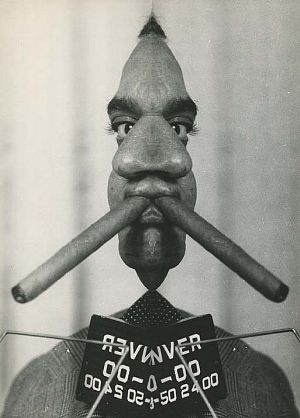
Man Ray, “La Fortune,” oil on canvas, 1938 (© 2009 Man Ray Trust / Artists Rights Society (ARS), NY / ADAGP, Paris)

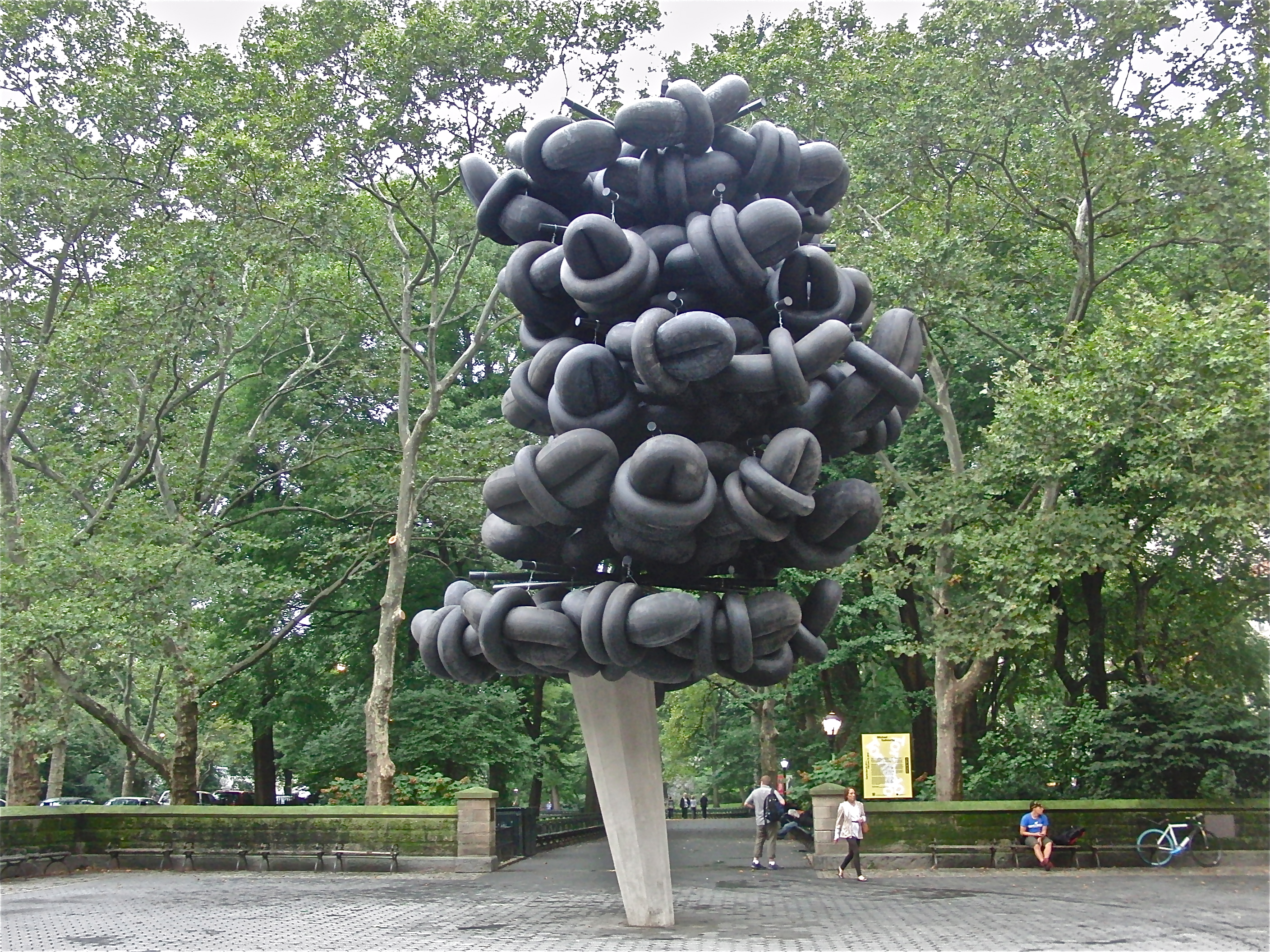
As a bonus, you can find Man Ray’s original 1938 “La Fortune” painting in the current “Real/Surreal” exhibit (through February 12), the second in the Whitney’s ongoing reexamination of its permanent collection as it prepares for its eventual move downtown. The exhibition also features works by Edward Hopper, Marsden Hartley, George Tooker, George C. Ault, Louis Guglielmi, Rockwell Kent, Charles Sheeler, Yves Tanguy, and others depicting scenes that are not quite as realistic as they might initially appear. Also at the Whitney right now are “Three Landscapes: A Film Installation by Roy Lichtenstein” (through February 12) and “Aleksandr Mir: The Seduction of Galileo Galilei” (February 19), in which the Polish-born Swedish and American artist attempts to reconstruct Galileo’s gravity experiments by building a tower with tires.

PAULA HAYES: LAND MIND

Paula Hayes’s “Land Mind” provides a beautiful oasis in Midtown Manhattan (photo by twi-ny/mdr)

Lever House
390 Park Ave. at 54th St.
Through January 27
Admission: free
www.leverhouseartcollection.com
www.paulahayes.com
land mind slideshow

Last winter, New York-based environmental artist and landscape designer Paula Hayes installed “Nocturne of the Limax maximus” in MoMA’s lobby, a pair of terrariums — the horizontal, biomorphic “Slug” and the vertical “Egg” — that brought colorful life to the space. This winter the Massachusetts-born Hayes, who was raised on a farm in upstate New York, has done the same in the Lever House lobby gallery just a few blocks east of MoMA with “Land Mind.” On view through January 27 in the large, glassed-in lobby, “Land Mind” consists of cast silicone and EPDM rubber planters, some in the shape of dumplings, that hold tropical trees and plants; “Slug,” which is filled with succulents; and “Aquarium,” a gorgeous 240-gallon, nearly six-foot-high cast acrylic saltwater tank that is home to such fish as Bartlett’s Anthias, Black Ocellaris Clownfish, Green Chromis, Sixline Wrasse, and Yellow Coris Wrasse, such invertebrates as Blood Red Shrimp, Cleaner Shrimp, Blue Linchia Starfish, and Banded Serpent Starfish, and such corals as Neon Green Toadstool Leather Coral, Yellow Leather Coral, and Rose Bubble Tip Anemone, surrounded by a beaded “Garden Necklace” and with a “Lighting Hood” dangling above it. Hayes has installed the ecosystem so that the working parts that keep pumping clean, fresh water and shining lights into the aquarium are visible, emphasizing the living aspects of the piece while making clear how its survival requires mechanical intervention, a delicate balance between nature and humans. “Land Mind” is an oasis in Midtown Manhattan, a charming, beautiful respite that will make you forget about the concrete and asphalt madness around you. And Lever House is the perfect place for it, as the glass building is somewhat of a terrarium itself, just filled with people instead of plants and aquatic creatures.