this week in art

ART SEEN / LOCAL COLOR: CUTIE AND THE BOXER

CUTIE AND THE BOXER

Documentary tells the engaging story of a pair of Japanese artists and the life they have made for themselves in Brooklyn

CUTIE AND THE BOXER (Zachary Heinzerling, 2013)
Nitehawk Cinema
136 Metropolitan Ave. between Berry St. & Wythe Ave.
Thursday, September 19, 7:30
718-384-3980
www.nitehawkcinema.com
www.facebook.com/cutieandtheboxer

Zachary Heinzerling’s Cutie and the Boxer is a beautifully told story of love and art and the many sacrifices one must make to try to succeed in both. In 1969, controversial Japanese Neo Dada action painter and sculptor Ushio Shinohara came to New York City, looking to expand his career. According to the catalog for the recent MoMA show “Tokyo 1955-1970: A New Avant-Garde,” which featured four works by Ushio, “American art had seemed to him to be ‘marching toward the glorious prairie of the rainbow and oasis of the future, carrying all the world’s expectations of modern painting.’” Four years later, he met nineteen-year-old Noriko, who had left Japan to become an artist in New York as well. The two fell in love and have been together ever since, immersed in a fascinating relationship that Heinzerling explores over a five-year period in his splendid feature-length theatrical debut. Ushio and Noriko live in a cramped apartment and studio in DUMBO, where he puts on boxing gloves, dips them in paint, and pounds away at large, rectangular canvases and builds oversized motorcycle sculptures out of found materials. Meanwhile, Noriko, who has spent most of the last forty years taking care of her often childlike husband and staying with him through some rowdy times and battles with the bottle, is finally creating her own work, an R. Crumb-like series of drawings detailing the life of her alter ego, Cutie, and her often cruel husband, Bullie. (“Ushi” means “bull” in Japanese.) While Ushio is more forthcoming verbally in the film, mugging for the camera and speaking his mind, the pig-tailed Noriko is far more tentative, so director and cinematographer Heinzerling brings her tale to life by animating her work, her characters jumping off the page to show Cutie’s constant frustration with Bullie.

Ushio Shinohara creates one of his action paintings in CUTIE AND THE BOXER

Ushio Shinohara creates one of his action paintings in CUTIE AND THE BOXER

During the course of the too-short eighty-two-minute film — it would have been great to spend even more time with these unique and compelling figures — the audience is introduced to the couple’s forty-year-old son, who has some issues of his own; Guggenheim senior curator of Asian Art Alexandra Munroe, who stops by the studio to consider purchasing one of Ushio’s boxing paintings for the museum; and Chelsea gallery owner Ethan Cohen, who represents Ushio. But things never quite take off for Ushio, who seems to always be right on the cusp of making it. Instead, the couple struggles to pay their rent. One of the funniest, yet somehow tragic, scenes in the film involves Ushio packing up some of his sculptures — forcing them into a suitcase like clothing — and heading back to Japan to try to sell some pieces. Cutie and the Boxer is a special documentary that gets to the heart of the creative process as it applies both to art and love, focusing on two disparate people who have made a strange yet thoroughly charming life for themselves. Cutie and the Boxer is screening September 19 at 7:30 as part of two Nitehawk Cinema monthly series, “Art Seen” and “Local Color,” and will be followed by a Q&A with the director. “Art Seen” continues September 21-22 with Chris Marker’s La Jetée and Ben Rivers’s Slow Action, while “Local Color” returns October 30 with Amy Nicholson’s Zipper.

FIAF FALL FSTVL: CROSSING THE LINE

Eliane Radigue and Xavier Veilhan’s SYSTEMA OCCAM kicks off FIAF’s seventh annual Crossing the Line festival

Eliane Radigue and Xavier Veilhan’s SYSTEMA OCCAM kicks off FIAF’s seventh annual Crossing the Line festival

French Institute Alliance Française and other locations
Florence Gould Hall, 55 East 59th St. between Madison & Park Aves.
Le Skyroom and FIAF Gallery, 22 East 60th St. between Madison & Park Aves.
September 19 – October 13, free – $30
212-355-6160
www.fiaf.org

Curators Lili Chopra, Simon Dove, and Gideon Lester have once again put together an impressive, wide-ranging program for the Crossing the Line festival, now in its seventh year. Sponsored by the French Institute Alliance Française and taking place there as well as at other venues around the city, CTL features cutting-edge art, dance, music, theater, discussion, and more from an international collection of multidisciplinary performers, with many events free and nothing costing more than $30. The twenty-five-day festival begins September 19 with electronic music composer Eliane Radigue and artist Xavier Veilhan collaborating on Systema Occam (Florence Gould Hall, $30), a multimedia performance installation that is part of CTL’s “New Settings” series, a joint venture with Hermès; the fashion company will be hosting Martine Fougeron’s “Teen Tribe” photo exhibition at the Gallery at Hermès from September 20 to November 8. In Capitalism Works for Me! True/False (September 20, October 6-9, free), Steve Lambert will keep score in Times Square as people vote on whether capitalism indeed works for them. The award-winning Nature Theater of Oklahoma presents episodes 4.5 and 5 at FIAF of their massive undertaking, Life and Times (September 20-21, $30), accompanied by the FIAF Gallery show “10fps,” consisting of 1,343 hand-colored drawings (September 21 – November 2, free). For “The Library,” Fanny de Chaillé invites people to FIAF’s Haskell Library on September 24 and 26 and the NYPL’s Jefferson Market Branch on September 27 (free), where they can choose books that are actually men and women who will share their stories verbally one on one.

Boyzie Cekwana and Panaibra Canda look at postcolonial Africa in THE INKOMATI (DIS)CORD

Boyzie Cekwana and Panaibra Canda look at postcolonial Africa in THE INKOMATI (DIS)CORD

In The Inkomati (dis)cord (September 25-26, New York Live Arts, $20), Boyzie Cekwana and Panaibra Canda use contemporary dance to examine postcolonial Africa. De Chaillé teams up with Philippe Ramette for Passage à l’acte / Acting Out (September 26-28, Invisible Dog, $30), using absurdist human sculpture to “rationalize the irrational.” Dancer and choreographer Nora Chipaumire will perform the CTL-commissioned solo piece rite riot (October 3-5, Le Skyroom, $30), exploring African stereotypes, collaborating with writer Teju Cole and visual artist Wangechi Mutu. Pascal Rembert’s large-scale A (micro) history of world economics, danced (October 11-13, La MaMa, $20) features New Yorkers discussing how the financial crisis impacted their lives. The festival also includes works by Annie Dorsen, Ernesto Pujol and Carol Becker, Bouchra Ouizguen, Tim Etchells, and Kyle deCamp and Joshua Thorson, in addition to a series of talks and conversations.

DAYLIFE

DayLife festival returns to Lower East Side for summer finale on September 15

DayLife festival returns to Lower East Side for summer finale on September 15

Orchard St. between East Houston and Delancey Sts.
Sunday, September 15, free, 12 noon – 5:00 pm
www.lowereastsideny.com

The Lower East Side BID says goodbye to summer with DayLife, a block party featuring food, fashion, live music, food, sports, and other activities. (The LES welcomed the season with a DayLife party back on June 2.) Held on Sunday, September 15, from 12 noon to 5:00, the three-block festival will cover Orchard St. in AstroTurf between Houston & Delancey Sts. The music lineup, sponsored by the Living Room on the Tammany Hall Stage, begins at noon with DJ Twin T and continues with Catey Shaw, DJ Kai Song, Miwa Gemini, Michael Hunter, Norman Vlardimir, and Deja; the Hits, Lewis Lazar, Chances with Wolves, and Swaai Boys will play on Lost Weekend’s Leadbelly Stage. There will also be fitness challenges, badminton, urban croquet, yoga demonstrations, an art fair, face painting, and other family-friendly activities. Food will be supplied by more than two dozen local restaurants, including Antibes Bistro, Georgia’s BBQ, Goodfellas Brick Oven Pizza, the Meatball Shop, Melt Bakery, Mission Chinese, Pop Karma, Souvlaki GR, and Sweet Buttons Desserts.

BECOMING-CORPUS

LEIMAY’s BECOMING-CORPUS explores the nature of the human body (photo by Yara Travies)

LEIMAY’s BECOMING-CORPUS explores the nature of the human body (photo by Yara Travies)

BAM Fisher, Fishman Space
321 Ashland Pl.
Through September 15, $20
718-636-4100
www.bam.org
www.leimaymain.cavearts.org

Becoming-Corpus is another mesmerizing, meditative multimedia production from director and choreographer Ximena Garnica and video and installation artist Shige Moriya, the principals behind the Brooklyn-based LEIMAY company (Floating Point Waves, Furnace). The seventy-minute piece opens with a breathtaking scene in which seven dancers (Masanori Asahara, Andrew Braddock, Andrea Jones, Liz McAuliffe, Denisa Musilova, Eija Ranta, and Savina Theodoru) stand still onstage, louvered black-and-white shadows projected across their bodies. Slowly they begin swaying, giving the impression that they are gently rocking on the sea. Meanwhile, Tommy Schell walks imperceptibly slowly across the back, a trip that will last all seventy minutes. Soon the dancers, five of whom are topless, start exploring their bodies as if they’ve just been born, in intricate ensemble movements that feature solos created by picking out individual dancers with spotlights. At one point they balance with their shoulders on the floor, their backs facing the audience, making them appear headless, arms and legs emerging as if they are hatching out of an egg. Birth is one of the subjects of the piece, as the dancers learn what their bodies are capable of by learning and experimenting with their limbs. The piece features an electronic score by Roland Ventura Toldeo, Christopher Loar, and Laddio Bolocko, with light projections by Moriya that create fascinating meshlike and shadowy elements directly on the dancers’ bodies and futuristic computer visuals on the floor and backdrop. A beautiful, elegant piece expertly performed with a playful dose of humor, Becoming-Corpus continues through September 15 at BAM Fisher’s Fishman Space, supplemented by an art installation in the Peter Jay Sharp Lobby that includes mixed-media representations of the creators’ and dancers’ faces, heads, and bodies as well as casts of Garnica and Moriya dangling from the ceiling, in addition to a specially designed “artifact” publication that details the development and process of the work. (There will be a post-show audience roundtable on September 13, the preshow “Tracing the Art” talk with Garnica and Moriya on September 14, and a closing night toast on September 15. To see our 2012 interview with Garnica and Moriya, please go here.)

LEIMAY: BECOMING-CORPUS

BAM Fisher, Fishman Space
321 Ashland Pl.
September 12-15, $20-$50
718-636-4100
www.bam.org
www.leimaymain.cavearts.org

In such previous performances as Furnace and A Timeless Kaidan, the Brooklyn-based LEIMAY company have combined striking lighting and visuals with Butoh-inspired movement and electronic music to create mesmerizing works that often employ nudity as they test the capacity of the human body. For its latest avant-garde piece, LEIMAY — Colombian-born dancer and choreographer Ximena Garnica and Japan-born video artist Shige Moriya, the duo behind CAVE, the New York Butoh Festival, and the Williamsburg SOAK festival — has created the immersive multimedia performance installation Becoming – Corpus, running at BAM Fisher September 12-15. Part of BAM’s Professional Development Program, Becoming – Corpus consists of a visual art installation in BAM Fisher’s Peter Jay Sharp Lobby that includes molds of Garnica’s and Moriya’s bodies and investigates their creative process, along with four dance presentations in the Fishman Space featuring Masanori Asahara, Andrew Braddock, Andrea Jones, Liz McAuliffe, Denisa Musilova, Eija Ranta, Tommy Schell, and Savina Theodoru. The show incorporates a real-time six-channel video designed by Moriya and a live electronic score by Roland Toledo and Christopher Loar with meditative movement choreographed by Garnica. The September 12 show is a benefit performance that will be followed by an opening party and a silent auction; there will also be a post-show audience roundtable on September 13, the preshow “Tracing the Art” talk with Garnica and Moriya on September 14, and a closing night toast on September 15. To see our 2012 interview with Garnica and Moriya, please go here.

PUBLIC ART FUND TALKS — IRAN DO ESPIRITO SANTO: PLAYGROUND

Iran do Espírito Santo’s “Playground” alters perception of light and space at entrance to Central Park (photo by twi-ny/mdr)

Iran do Espírito Santo’s “Playground” alters perception of light and space at entrance to Central Park (photo by twi-ny/mdr)

The New School, Tishman Auditorium
66 West 12th St. between University Pl. & Sixth Ave.
Wednesday, September 11, $10, 6:30
“Playground” continues through February 16 at Doris C. Freedman Plaza
212-223-7805
www.publicartfund.org
playground slideshow

For his first public installation in the United States, São Paulo-based artist Iran do Espírito Santo has created “Playground” at Doris C. Freedman Plaza at the entrance to Central Park on 60th St. & Fifth Ave. Resembling a gray Lego or Tetris construction, “Playground” also evokes such previous Public Art Fund projects as Sarah Sze’s “Corner Plot,” Sol Lewitt’s “Structures,” and Ryan Gander’s “The Happy Prince.” Appearing unfinished, the cubelike, thirteen-foot-square “Playground,” which do Espírito Santo refers to as an “idealized ruin,” has missing concrete blocks that form geometric shapes of their own and allow visitors to walk inside, offering uniquely framed views of the surrounding area, which includes trees, the Plaza Hotel, and passing taxis and horse carriages, in a seemingly changing relationship with light and space that plays with perception. Although its name brings to mind the many playgrounds in Central Park, people are not allowed to climb on it, although taking a seat on one of the blocks is encouraged. The largest piece in the Brazilian artist’s “Destroços” (“Remains”) series of architectural fragments, “Playground” will be on view through mid-February. On September 11 at 6:30, do Espírito Santo will be at the New School giving his first New York lecture, discussing the work, which is part of the Public Art Fund project “Square Pegs, Round Holes: From White Cube to Public Sphere” and continues October 2 with Mark Manders and November 13 with Allora & Calzadilla.

ABBY ALDRICH ROCKEFELLER SCULPTURE GARDEN: THE MODERN MONUMENT

Katharina Fritsch’s “Group of Figures” is back in MoMA’s Abby Aldrich Rockefeller Sculpture Garden, which is now open for free every morning from 9:00 to 10:30 (photo by twi-ny/mdr)

Katharina Fritsch’s “Group of Figures” is back in MoMA’s Abby Aldrich Rockefeller Sculpture Garden, which is now open for free every morning from 9:00 to 10:30 (photo by twi-ny/mdr)

Museum of Modern Art
The Abby Aldrich Rockefeller Sculpture Garden
West 54th St. between Fifth & Sixth Aves.
Early hours: open daily 9:00 – 10:30 am, free
www.moma.org

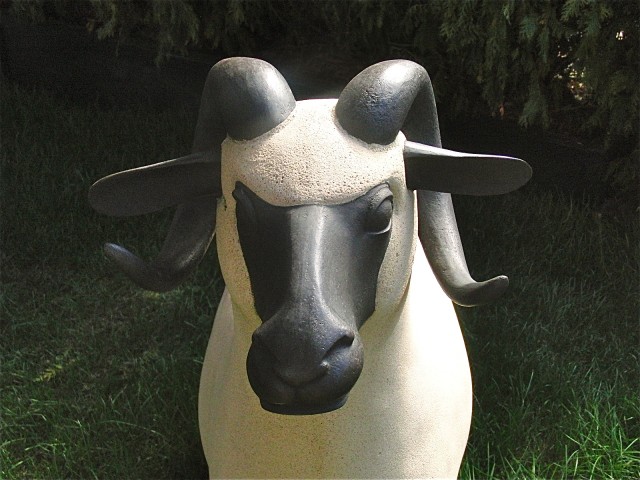
Designed in 1953 by architect Philip Johnson, the Abby Aldrich Rockefeller Sculpture Garden resides on the site that was once the town-house home of Abby Aldrich Rockefeller, one of the founders of the Museum of Modern Art. A socialite and philanthropist who married John D. Rockefeller Jr. in 1901, Aldrich was the mother of Abby, John III, Nelson, Laurance, Winthrop, and David Rockefeller. The garden has been one of the great, peaceful respites of New York City for sixty years, its multiple levels and reflecting pools, which Johnson called “canals,” along with its birches and beeches, offering visitors a beautiful space to commune with both art and nature en plein air. Beginning September 9, the sculpture garden will be open for free starting at 9:00 each morning, ninety minutes before the rest of the museum opens to paying customers. Early risers can buy coffee and other drinks and enjoy the garden’s current arrangement of sculptures, “The Modern Monument,” which consists of old favorites as well as newer delights. Walking around the garden, one will encounter Alberto Giacometti’s “Tall Figure, III,” Jenny Holzer’s “Granite Bench,” Joan Miró’s “Moonbird,” Barnett Newman’s “Broken Obelisk,” and Pablo Picasso’s “She-Goat.” Aristide Maillol’s “The River” still dangles over one of the pools, while Hector Guimard’s “Entrance Gate to Paris Subway (Métropolitain) Station, Paris, France” stands in its longtime space at the far east end and Henri Matisse’s stunning quartet, “The Back,” lines its usual wall, celebrating the human body. Also on view are Mark di Suvero’s “For Roebling,” Tony Smith’s “Die,” Claes Oldenburg’s “Geometric Mouse, Scale A,” Picasso’s “Monument,” and Katharina Fritsch’s colorful “Group of Figures.” The most recent addition to the garden is Stephen Vitiello’s audiovisual installation “A Bell for Every Minute,” which was created for the High Line and now resides outside at MoMA, a collection of different bells from around the city chiming minute after minute. In 2004, when the museum returned to Midtown after a major renovation and expansion (and temporary move to Queens), architect Yoshio Taniguchi restored the garden to its original dimensions, explaining that it is “perhaps the most distinctive single element of the museum today.” And now entrance to this most distinctive element is free every morning from 9:00 to 10:30.