this week in art

DANTE FERRETTI: DESIGNING FOR THE BIG SCREEN — SWEENEY TODD, THE DEMON BARBER OF FLEET STREET

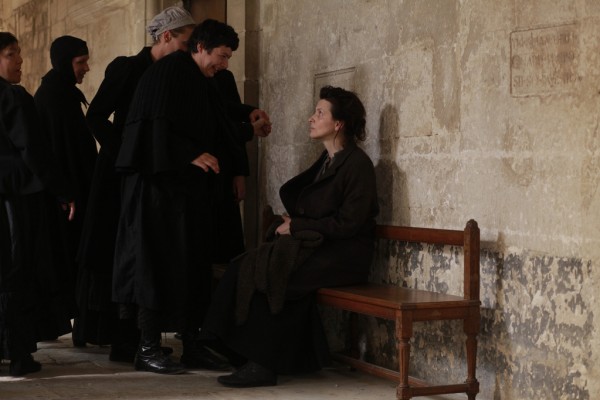
Johnny Depp and Helena Bonham Carter hide a dark secret in SWEENEY TODD

Johnny Depp and Helena Bonham Carter hide a dark secret in SWEENEY TODD

SWEENEY TODD, THE DEMON BARBER OF FLEET STREET (Tim Burton, 2007)
MoMA Film, Museum of Modern Art
11 West 53rd St. between Fifth & Sixth Aves.
Monday, September 30, 4:00
Tickets: $12, in person only, may be applied to museum admission within thirty days, same-day screenings free with museum admission, available at Film and Media Desk
212-708-9400
www.moma.org
www.sweeneytoddmovie.com

Oh yes, there will be blood. Tim Burton’s adaptation of the hit Broadway musical Sweeney Todd is bloody good fun. After being sent to prison for fifteen years by Judge Turpin (Alan Rickman), who had designs on his wife (Laura Michelle Kelly), innocent barber Benjamin Barker (Johnny Depp) returns to nineteenth-century London, reborn as Sweeney Todd, now a dark, ominous figure dead set on gaining his dastardly revenge. He gets back his coveted silver razors, which he considers an extension of his arm, and sets up shop in his old place, above the store where Mrs. Lovett (Helena Bonham Carter) sells meat pies crawling with cockroaches. When Todd begins slicing throats with expert precision, Lovett has a novel way of doing away with the bodies — while increasing business. Burton and screenwriter John Logan (The Aviator, The Last Samurai) terrifically translate the show onto the big screen, as Depp, Bonham Carter, and the rest of the cast — including Sacha Baron Cohen as a magical elixir salesman, Timothy Spall as the judge’s wingman, and Jayne Wisener as Todd’s daughter, who is doomed to marry the judge — do a wonderful job with such Stephen Sondheim songs as “No Place Like London,” “Poor Thing,” “My Friends,” “Pretty Women,” and “Not While I’m Around.” Depp is marvelous as the demon barber of Fleet Street, wearing a fright wig with a shocking streak of white, singing most of his dialogue with a gentle devilishness, enhanced by his haunting, penetrating eyes. The goth opera not only sounds good but looks even better, courtesy of cinematographer Dariusz Wolski, Oscar-winning production designer Dante Ferretti, and costume designer Colleen Atwood. Burton and Depp, who previously collaborated on Edward Scissorhands, Ed Wood, Sleepy Hollow, Charlie and the Chocolate Factory, and Corpse Bride, have another winner on their hands. Sweeney Todd is screening September 30 at 4:00 as part of the MoMA series “Dante Ferretti: Designing for the Big Screen,” being held in conjunction with the exhibit “Dante Ferretti: Design and Construction for the Cinema” and continues through February 9 with such other fab-looking works as Pier Paolo Pasolini’s Medea, Federico Fellini’s City of Women, and Julie Taymor’s Titus.

DUMBO ARTS FESTIVAL 2013

Micah Stansell’s “Inversion (with Water)” combines sound and image in the Manhattan Bridge Archway & Anchorage

Micah Stansell’s “Inversion (with Water)” combines sound and image in the Manhattan Bridge Archway & Anchorage

Multiple venues in DUMBO
September 27-29, free
www.dumboartsfestival.com

More than two hundred thousand visitors are expected to take part in the seventeenth annual Dumbo Arts Festival this weekend, running Friday night, Saturday, and Sunday. The streets and galleries will be home to three days of art, music, site-specific installation, workshops, open studios, and live performances, with everything free. The New York Photo Festival will be hosting the New York Photo Awards at 37 Main St., Gleason’s Gym is sponsoring “The Art of Boxing” at 77 Front St., “DADA’s Playground” will include family-friendly sculptures in the Kidlot, Mighty Tanaka welcomes people to the work of street artist Skewville in “Welcome to Skewville,” United Photo Industries’ “Photoville” continues on Brooklyn Bridge Park’s Pier 5, Anthony Heinz May’s “Appropriation of Nature” can be found on the park’s John St. Path, Ilya and Emilia Kabakov’s “Ship of Tolerance” sails into East River Cove, Abhaya Yoga will hold “Live Beats & Yoga Flow” at 10 Jay St., Clifford Ross & Taikoza’s “Immersive Harmonium Video and Japanese Drums” and Micah Stansell’s “Inversion (with Water)” take advantage of the Manhattan Bridge Archway & Anchorage, Andrey Bartenev and Mei Ann Teo’s “Bubbles of Hope” will roam all around the area, Amelia Marzec’s “New American Sweatshop” repurposes electronic waste into communication devices at 85 Washington St., dancers Jake Bone, Lynda Senisi, Damani Pompey, Ellyn Sjoquist and Alessandra Delle Grotti will perform Kensaku Shinohara’s “Math Time” on Main St., and CAM, DALeast, Eltono, Shepard Fairey, Faith47, MOMO, Stefan Sagmeister, and Yuko Shimizu will decorate DUMBO Walls in Bridge Park Two.

Andrey Bartenev and Mei Ann Teo’s “Bubbles of Hope” will roam around DUMBO on Saturday afternoon

Andrey Bartenev and Mei Ann Teo’s “Bubbles of Hope” will roam around DUMBO on Saturday afternoon

There are lots of interactive installations, including the Heather Hart Experience’s “Bartertown (Trading Post Xi: The Magic Feathers),” in which participants can exchange objects, ideas, and just about anything else; Daina Taimina’s “Hyperbolic Hyperbolic Hyperbolic,” involving crocheting and paper cut-outs; Samuel Jablon and the Underpass Poets’ “Poet Sculpture” will feature readings on movable crates (by Steve Dalachinsky, Yuko Otomo, Vito Acconci, and many others, as well as an open mic); Rev. Lainie Love Dalby will bless festivalgoers as part of “HUMBO (Hope Under the Manhattan Bridge Underpass): A Blessing Performance to Burst Open Your He(art)”; the South Asian Women’s Creative Collective will present “Sublime,” interactive performance art pieces by Monica Jahan Bose, Ruby Chishti, Anjali Deshmukh, Swati Khurana, and Sunita S. Mukhi; and Kaloyan Ivanov’s “Void Simulacrum” invites the audience to work on a fifty-foot-long piece of fabric by Jane’s Carousel.

MUSEUM DAY LIVE! 2013

museum day live

Multiple venues
Saturday, September 28
Admission: free for two people with printed ticket
www.smithsonianmag.com/museumday

The ninth annual free museum day, sponsored by Smithsonian magazine, takes place on Saturday, September 28, with institutions all over the country opening their doors to people who have downloaded a free ticket for two from the above website. There’s only one ticket allowed per household/e-mail address, so be careful before filling out the online form; some of the museums are free anyway, either all the time or on Saturdays, while others might be between exhibits so there won’t be all that much to see. The participating venues in the five boroughs include the Asia Society Museum (“Iran Modern”), the Bartow-Pell Mansion Museum, the Cathedral Church of Saint John the Divine (“Dog Bless You: The Photography of Mary Bloom”), the Children’s Museum of Manhattan (“Red Grooms’ New York City”), El Museo del Barrio (“La Bienal: Here Is Where We Jump!”), the Fraunces Tavern Museum (“Rating the Attic: A Crowdsourced Exhibit”), the Hispanic Society, Historic Richmond Town, the Jewish Museum (“Chagall: Love, War, and Exile”), the Morgan Library (“Tiepolo, Guardi, and Their World: Eighteenth-Century Venetian Drawings”), the Mount Vernon Hotel Museum & Garden, the Museum of American Finance (“The Fed at 100”), the Museum of Arts & Design (“Body & Soul: New International Ceramics”), the Museum of Chinese in America (“Shanghai Glamour: New Women 1910s-40s”), the New York City Fire Museum, the Noble Maritime Collection (“Tides of 100 Years”), the Rubin Museum of Art (“Flip Side”), the Skyscraper Museum, the Smithsonian National Museum of the American Indian (“Before and After the Horizon: Anishinaabe Artists of the Great Lakes”), the Staten Island Museum (“They’re Baaack! Return of the Seventeen-Year Cicadas”), the Ukrainian Museum (“Out of Tradition: Contemporary Decorative and Applied Art”), the U.S. Lighthouse Tender LILAC (“Industrial Waters”), the Van Cortlandt House Museum, the Vilcek Foundation (“Brian Doan: hôme hôme home”), and the Waterfront Museum (“Pollywogs and Shellbacks: Marine Paintings by Frank Hanavan”). Of course, if you pair up with friends and relatives, you can get more tickets for different places.

LAST CHANCE: BILL TRAYLOR

Bill Traylor, “Untitled (Man with Cane on Construction, with Dog),” poster paint, pencil, and colored pencil on cardboard, 1939-42 (Louis-Dreyfus Family Collection)

Bill Traylor, “Untitled (Man with Cane on Construction, with Dog),” poster paint, pencil, and colored pencil on cardboard, 1939-42 (Louis-Dreyfus Family Collection)

American Folk Art Museum
2 Lincoln Square, Columbus Ave. at 66th St.
Sunday, September 22, suggested donation $5, 12 noon – 6:00 pm
212-595-9533
www.folkartmuseum.org

Today is the last day to see a pair of splendid exhibitions on self-taught superstar Bill Traylor at the American Folk Art Museum. “Bill Traylor: Drawings from the Collections of the High Museum of Art and the Montgomery Museum of Fine Arts” and “Traylor in Motion: Wonders from New York Collections” together feature more than one hundred works by Traylor, who was born into slavery on an Alabama plantation in the mid-1850s, where he continued to work after being freed. The drawings date from 1939 to 1942, when he began looking back at his life after moving to Montgomery. He developed a unique visual style involving dark silhouetted figures on cardboard, with occasional blues and reds, that form a kind of memory dance of the black experience in America. They are both charming and frightening, evoking today a kind of mix of Jacob Lawrence and Kara Walker. Seeing so many of Traylor’s works filling the walls at the museum immerses you in his fascinating artistic world, which included between 1,200 and 1,500 drawings made in that whirlwind three-year period. Traylor died in 1949, but his reputation as a fine artist continues to grow, as ably shown by these two exemplary exhibitions.

WHO IS JACK GOLDSTEIN?

Jack Goldstein, A Ballet Shoe, 16mm film, color, silent, 1975 (Courtesy Galerie Daniel Buchholz, Berlin/Cologne and the Estate of Jack Goldstein)

Jack Goldstein, A BALLET SHOE, 16mm film, color, silent, 1975 (Courtesy Galerie Daniel Buchholz, Berlin/Cologne and the Estate of Jack Goldstein)

The Jewish Museum
1109 Fifth Ave. at 92nd St.
Sunday, September 22, $12, 12:30 – 4:30
Exhibition continues Thursday – Tuesday through September 29, $15 (free admission Saturday 11:00 am – 5:45 pm, pay-what-you-wish Thursday 5:00 – 8:00)
212-423-3200
www.thejewishmuseum.org
www.jackgoldstein-artist.com

In 1973, multimedia artist Jack Goldstein made the short film Jack, in which he, as cameraman, backs away from a man in a desolate landscape who repeatedly calls out, “Jack,” over and over and over again as he fades into the distance. It’s a critical piece in the first American museum retrospective of Goldstein’s work, “Jack Goldstein x 10,000,” which continues through September 29 at the Jewish Museum. The self-destructive Goldstein was known for disappearing during the course of his career, both in his art and in his life, and the Jewish Museum has been examining the iconoclastic figure in a series of programs that have included the exhibition walk-through “What Is Jack Goldstein?” and the panel discussions “Where Is Jack Goldstein?” and “How Is Jack Goldstein?” The museum has saved the best for last, as the final program takes place on September 22, the afternoon symposium “Who Is Jack Goldstein?,” which features a prestigious collection of artists and historians talking about Goldstein’s influence and legacy: Morgan Fisher, Robert Longo, Matt Mullican, Troy Brauntuch, Kathryn Andrews, and Paul Pfeiffer, moderated by Julia Robinson and Claire Bishop. The exhibition itself comprises many of Goldstein’s films in addition to sculpture, sound installations, paintings, and writings. The works display Goldstein’s unique mix of wit and anxiety: In the eight-minute video A Spotlight, Goldstein runs around a room trying to avoid a spotlight, while in the “Burning Window” installation, flickering candles make it seem like a fire is raging behind a window, and there’s nothing anyone can do to stop it.

Jack Goldstein, “Untitled,” acrylic on canvas, 1981 (collection Melva Bucksbaum and Raymond J. Learsy)

Jack Goldstein, “Untitled,” acrylic on canvas, 1981 (collection Melva Bucksbaum and Raymond J. Learsy)

Goldstein strips things down to their bare elements in such shorts as Shane, in which a German shepherd barks for three minutes, and A Ballet Shoe, in which two hands tie a ballet shoe on a ballerina’s foot. A series of instructions explains how others can stage some of Goldstein’s performances and installations, once again adding to his theme of the artist’s disappearance. In the mid-to-late-1980s, Goldstein, a heroin addict who was born in Canada in 1945 and spent time in New York before moving to California, where he studied with John Baldessari and became associated with the Pictures Generation, created colorful abstract canvases using appropriated images, the works melding science, computer technology, and psychedelia. The exhibit ends with extracts from Goldstein’s writing — influenced by his penchant for reading philosophy books backward — in which he experimented with new word-processing techniques and repurposed words from other writers in order to form his own personal narrative. In a 1985 interview with the Tate’s Chris Dercon, Goldstein, who hanged himself in his backyard in 2003 at the age of fifty-eight, said, “You wake up in the morning and look at yourself and go, ‘Who is that?’ and ‘What is that?’ and ‘What do you call it?’ and ‘What’s my name?,’” later adding, “My name, it’s the name of a name. It’s not my name. . . . Imagine, if you look in the telephone book, there must be ten thousand Jack Goldsteins.” This revealing survey goes a long way toward establishing just who this Jack Goldstein is, although all of the mysteries are likely never to be solved.

JAMES TURRELL

James Turrell

James Turrell’s “Aten Reign” bathes the Guggenheim in meditative colored light display (photo by David Heald / © Solomon R. Guggenheim Foundation, New York)

Solomon R. Guggenheim Museum
1071 Fifth Ave. at 89th St.
Friday – Wednesday through September 25, $18-$22 (pay-what-you-wish Saturday 5:45-7:45)
212-423-3587
www.guggenheim.org

During the last few years, the Guggenheim has staged several exhibitions in which the bays that line the winding interior have remained empty. In 2010, Tino Sehgal had trained men and women speak with visitors making their way to the top, with no physical art present at all. In 2011, Maurizio Cattelan’s career retrospective, “All,” consisted of an amalgamation of his works hung from the ceiling like a massive mobile, with nothing in the bays. Now James Turrell has created the site-specific “Aten Reign,” a dazzling, meditative spectacle in which five rings of light that echo the museum’s shape, beginning at the oculus at the top of the rotunda, slowly change colors in mystifying and intoxicating ways. Visitors have access only to the main floor and the first section of the spiraling ramp, with special arched benches at the bottom for more comfortable viewing, but make sure to walk around, as the display, which explores light, space, and perception, seemingly shifts form ever so slightly when seen from different positions and angles, affected by the natural daylight as well. Constructed with interlocking cones and LED fixtures, “Aten Reign” is like one of Turrell’s Skyscapes (such as his open-air “Meeting” at MoMA PS1) mixed with more subdued elements of the psychedelic Joshua Light Show while incorporating the Gazfeld effect. “I really felt to be using light as a material [is] to work or affect the medium of perception,” the L.A.-born Turrell explains in a promotional video. “For me, it’s trying to orient toward what the perception really is, rather than the object of perception, to actually, sort of, remove that. I have an art that has no image. It has no object. And even very little a place of focus, or one place to look. So, without image, without object, without specific focus, what do you have left? Well, a lot of it is this idea of seeing yourself see, understanding how we perceive.” The overall individual, hallucinatory experience grows the more you immerse yourself in its splendor, allowing it to take you to other places in your mind, body, and spirit. Take your time and let it envelop you, not worrying about anything else anywhere in the world.

James Turrell, “Afrum I (White),” projected light, 1967 (photo by David Heald / © Solomon R. Guggenheim Foundation, New York)

James Turrell, “Afrum I (White),” projected light, 1967 (photo by David Heald / © Solomon R. Guggenheim Foundation, New York)

The show is supplemented with several rooms of other works, including a series of white-light pieces from the late 1960s that play with physical space and altered reality; “Prado (White)” appears to be a rectangular hole in the wall, “Afrum I (White)” looks like a floating cube, and the vertical “Ronin” has a special trick to it. Expect a ridiculously long line to see 1976’s “Iltar,” a mysterious wall piece that you’re not allowed to get too close to; don’t ask the guard what it actually is, because he’s not allowed to tell you. The Guggenheim is also screening a pair of short exhibition-related films, David Howe’s James Turrell, Second Meeting Art21 Exclusive and Peter Vogt and Erin Wright’s James Turrell’s Roden Crater, which examine other works by the artist; on September 20 they will be joined by Carine Asscher’s Passageways: James Turrell. Also on September 20, the afternoon symposium “James Turrell: Sensing Space” will feature presentations by Thomas Crow, Miwon Kwon, and Mark Taylor and a panel discussion moderated by exhibition co-curator Nat Trotman. Expect extended wait times for the last week of the much-talked-about show, which closes September 25, but it’s well worth it.

A DIFFERENT KIND OF ORDER: THE ICP TRIENNIAL

Gideon Mendel, “Shopkeeper Suparat Taddee, Chumchon Ruamjai Community, Bangkok, Thailand,” chromogenic print, November 2011 (photo courtesy the artist)

Gideon Mendel, “Shopkeeper Suparat Taddee, Chumchon Ruamjai Community, Bangkok, Thailand,” chromogenic print, November 2011 (photo courtesy the artist)

International Center of Photography
1133 Sixth Ave. at 43rd St.
Tuesday – Sunday through September 22, $10-$14 (pay what you wish Fridays 5:00 – 8:00)
www.icp.org

For the International Center of Photography’s fourth triennial, curators Kristen Lubben, Christopher Phillips, Carol Squiers, and Joanna Lehan have organized “A Different Kind of Order,” a powerful survey of sociopolitical and environmentally conscious work from around the world with a focus on digital technology and manipulation and the widespread reuse of internet images. In “Touch Parade,” A. K. Burns re-creates five odd fetish videos she found on YouTube. Mishka Henner’s “Dutch Landscapes” series at first appear to be aerial shots of the countryside overlaid with abstract splotches but turn out to be actual Google images that the Dutch government has censored. Thomas Hirschhorn’s “Touching Reality” video depicts a hand scrolling through photos of victims of war, from bloody corpses to bodies missing limbs, occasionally stopping to pinch the shot into close-up, not usually the kind of images people look at on their phones. Gideon Mendel’s “Drowning World” photos and video (in the gallery as well as in a window display) show people in communities that have been devastated by massive flooding, as men, women, and children, each of whom she specifically identifies, wade through environmental calamities in England, India, Nigeria, Thailand, and other locations.

Mishka Henner, “Unknown Site, Noordwijk aan Zee, South Holland,” from the series “Dutch Landscapes,” archival inkjet print, 2011 (photo courtesy the artist)

Mishka Henner, “Unknown Site, Noordwijk aan Zee, South Holland,” from the series “Dutch Landscapes,” archival inkjet print, 2011 (photo courtesy the artist)

For his “Blow Up” project, Rabih Mroué narrates frightening scenes of Syrians risking their lives taking camera-phone pictures of the military firing on its citizens, and them, found images that might or might not be real. Mikhael Subotzky captures contemporary Johannesburg in a trio of lightboxes (“Windows,” “Doors,” “Televisions”) that examines the psyche of the city that reveal what is going on in each room of the fifty-four-floor Ponte City building, which Subotzky and collaborator Patrick Waterhouse explain “has always been a place of myth, illusion, and aspiration. Sohei Nishino creates maps of New York and Jerusalem by combining thousands of photographs he takes while making his way through those cities. Meanwhile, Lucas Foglia’s photographs of people living off the land harken back to a time pre-internet. The exhibition also includes intriguing works by Luis Molina-Pantin, Andrea Longacre-White, Oliver Laric, Elliott Hundley, Jim Goldberg, Wangechi Mutu, Trevor Paglen, Walid Raad, and others that explore the nature of images — both how they are made and how they are viewed — in a technology-obsessed world.