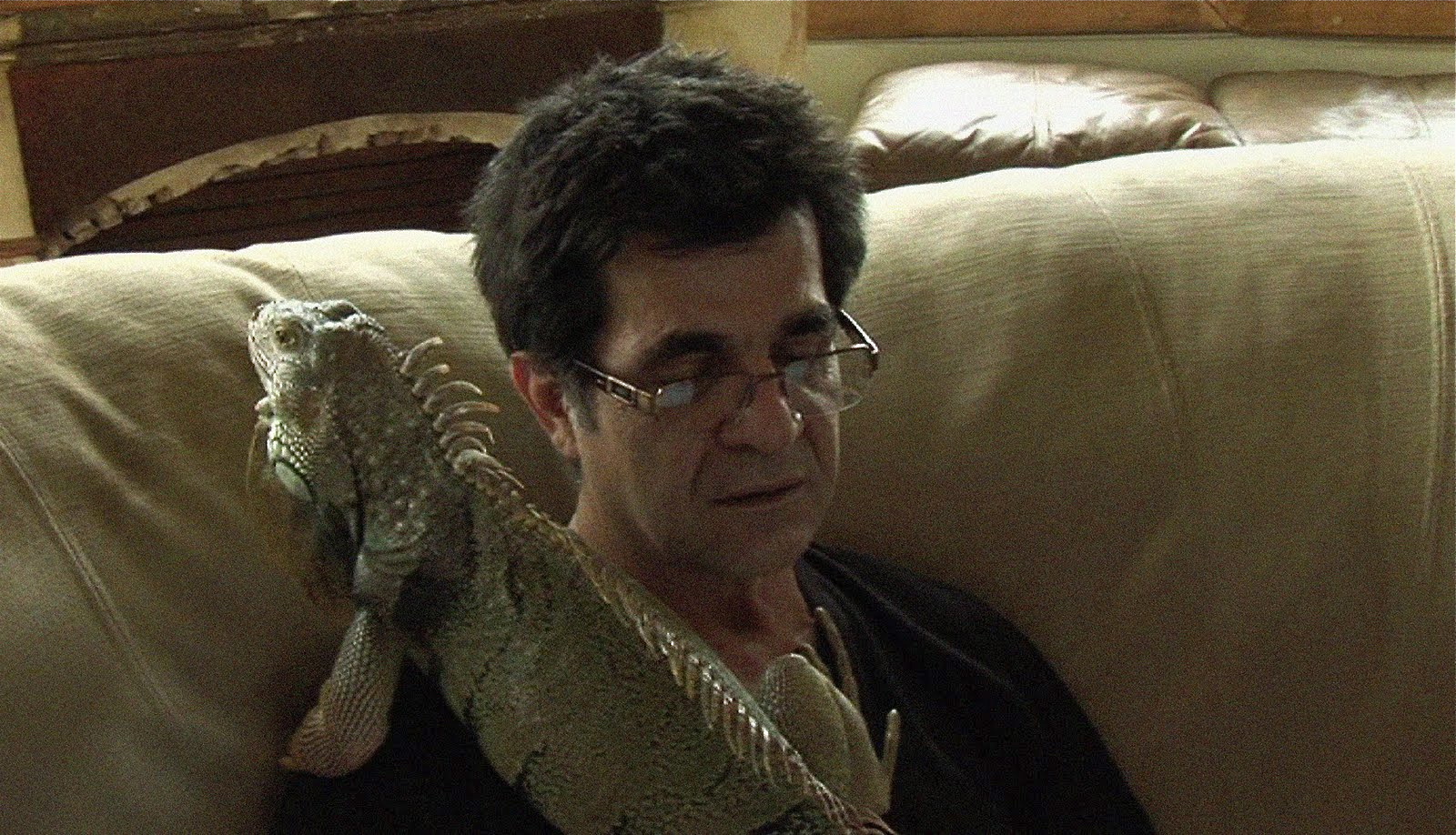
Ai Weiwei lets the camera follow him everywhere in revealing documentary about art and activism
AI WEIWEI: NEVER SORRY (Alison Klayman, 2011)
Maysles Cinema
343 Malcolm X Blvd. between 127th & 128th Sts.
January 21-22, $10, 7:30
212-582-6050
www.mayslesinstitute.org
aiweiweineversorry.com
 “I consider myself more of a chess player,” Ai Weiwei says at the beginning of Never Sorry, Alison Klayman’s revealing documentary about the larger-than-life Chinese artist and dissident. “My opponent makes a move, I make a move. Now I’m waiting for my opponent to make the next move.” Over the last several years, Ai has become perhaps the most famous and controversial artist in the world, primarily since he participated in the design of Beijing National Stadium, known as the Bird’s Nest, for the 2008 Summer Olympics, then denounced the Games on political grounds. Ai gives director, producer, and cinematographer Klayman, making her first full-length film, remarkable access to his personal and professional life as he gets physically abused by Chinese police, prepares to open major exhibits in Munich and London, and visits with his young son, Ai Lao, the result of a tryst with Wang Fen, an editor on his underground films. Klayman speaks with Ai Weiwei’s devoted wife, Lu Qing, an artist who publicly fought for his freedom when he disappeared in 2011; his mother, Gao Ying, who spent time in a labor camp with her dissident-poet husband, the late Ai Quing; and such fellow Chinese artists and critics as Chen Danqing, Feng Boyi, Hsieh Tehching, and Gu Changwei, who speak admiringly of Ai’s dedication to his art and his fearless search for the truth. A round man with a long, graying bear, Ai is a fascinating, complicated character, a gentle bull who openly criticizes his country because he loves it so much. He is a social media giant, making documentaries that are available for free on the internet and revolutionizing the way Twitter and the blogosphere are used. Ai risks his own freedom by demanding freedom for all, calling for government transparency before and after he is secretly arrested, not afraid of the potential repercussions. And he is also a proud cat lover — more than forty felines regularly roam around his studio — eagerly showing off one talented kitty that has a unique way of opening a door. Ai Weiwei: Never Sorry shows Ai to be an honorable, supremely principled human being who has deep respect for the history of China and a fierce determination to improve its future, no matter the personal cost. Although it was not nominated for an Academy Award — it made the short list — Ai Weiwei: Never Sorry will be screening at the Maysles Cinema on January 21 and 22 as part of the institute’s “Oscar Buzz” series, with Klayman participating in a Q&A following Monday’s night screening.

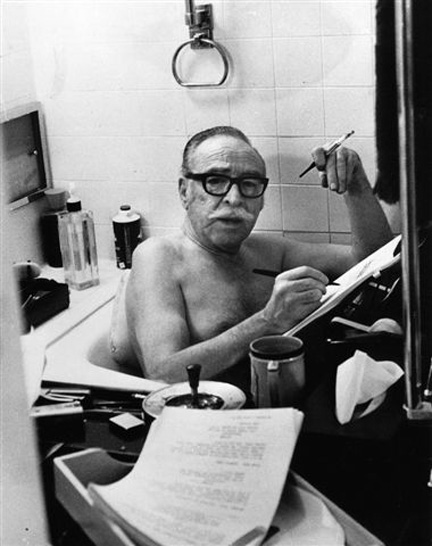
 In 2004-5, Christopher Trumbo’s play Trumbo: Red, White, and Blacklisted, based on the writings of his father, jailed Hollywood Ten screenwriter and novelist Dalton Trumbo (1905-76), toured the country, a staged reading directed by Peter Askin and starring such actors as Nathan Lane, Joe Mantegna, Bill Irwin, Brian Dennehy, and F. Murray Abraham in the title role. Christopher and Askin turned the show into a documentary film, with decidedly mixed results. Although Trumbo’s letters are works of art on their own, funny and incisive, biting and cynical, with a wry, dry sense of humor that summarizes the social and political climate of the cold war era, they lose much of their power when read overdramatically onscreen by Dennehy, Josh Lucas, Paul Giamatti, and others. The camera will linger on Michael Douglas or David Strathairn as they contemplate what they have just read, adding an unnecessary sense of seriousness and importance. It is almost impossible to concentrate on Trumbo’s words as you wonder why Joan Allen was selected, whether Liam Neeson should have tried an American accent, how long and white Donald Sutherland’s hair is, or how many sly gestures Lane will make as he relates a riotous treatise on onanism. Interviews with such friends and colleagues as Manny Azenberg, Kate Lardner, Kirk Douglas, and Trumbo’s children, Christopher and Mitzi, dig deeper into the kind of man Trumbo was, along with archival footage of Trumbo on talk shows, in home movies, and telling the House Un-American Committee to go to hell. Askin tries so hard to focus on the actual words of the Oscar-winning screenwriter behind such classics as Johnny Got His Gun, Roman Holiday, Spartacus, Exodus, and Papillon that he ends up obscuring the portrait as a whole. But oh, what words they are. Trumbo will be screening January 22 at the IFC Center as part of the Tuesday-night series “Stranger than Fiction,” with Askin on hand to participate in a Q&A. The series continues through February 26 with such other documentaries as Neil Barsky’s Koch, Amy Nicholson’s Zipper: Coney Island’s Last Wild Ride, and Terence Nance’s An Oversimplification of Her Beauty.
 In such unique films as Rushmore, The Royal Tenenbaums, and The Darjeeling Limited, black-comedy master Wes Anderson has created a bizarre collection of characters who seem to live in their own alternate realities. In his latest, Moonrise Kingdom, Anderson has once again assembled an oddball assortment of men, women, and children in a terrifically clever and entertaining fairy tale all its own. Tired of being abused by his fellow Khaki Scouts and dismissed by his foster parents, twelve-year-old orphan Sam Shakusky (Jared Gilman) runs away from Camp Ivanhoe on the island of New Penzance, much to the chagrin of dedicated scout master Randy Ward (Edward Norton). Meanwhile, twelve-year-old loner Suzy Bishop (Kara Hayward) is fed up with her life as well, which she mostly spends listening to Benjamin Britten, reading fairy tales (fictitious stories made up by Anderson), watching the world through a pair of ever-present binoculars, and despising her parents (Bill Murray and Frances McDormand). Afraid of what might have happened to the children, the local police officer, Captain Sharp (Bruce Willis), gets involved, as does a stern woman from social services (Tilda Swinton) and, eventually, a very different kind of scout, Cousin Ben (Jason Schwartzman). The proceedings are overseen by a narrator (Bob Balaban) who ends up being more than just an omniscient presence. Moonrise Kingdom is an absolute gem of a film, an exciting, original tale about growing up told in a fabulously funny deadpan manner that combines slapstick humor with wildly ironic elements, filled with the endless wonders of childhood, although it is most definitely not for children. Newcomers Gilman and Hayward appear wise beyond their years in the lead roles, with outstanding support from an all-star cast, most prominently Norton as the by-the-book scout master on a mission. Written by Anderson with Roman Coppola and featuring a lovely score by Alexandre Desplat, Moonrise Kingdom is one of the best films of 2012, by a director whose imagination never ceases to amaze, and the Museum of the Moving Image agrees, as Moonrise Kingdom is screening January 20 as part of the museum’s “Curators’ Choice: The Best of 2012” series, consisting of works selected by chief curator David Schwartz and assistant film curator Rachael Rakes; the series continues next month with David Cronenberg’s Cosmopolis and Hong Sang-soo’s In Another Country.