Eiko and Koma will be performing THE CARAVAN PROJECT through January 21 at MoMA (photo by twi-ny/mdr)
PERFORMING HISTORIES: LIVE ARTWORKS EXAMINING THE PAST
Museum of Modern Art, Agnes Gund Garden Lobby
11 West 53rd St. between Fifth & Sixth Aves.
Through January 21
Museum admission: $25 ($12 can be applied to the purchase of a film ticket within thirty days)
212-708-9400
www.moma.org
www.eikoandkoma.org
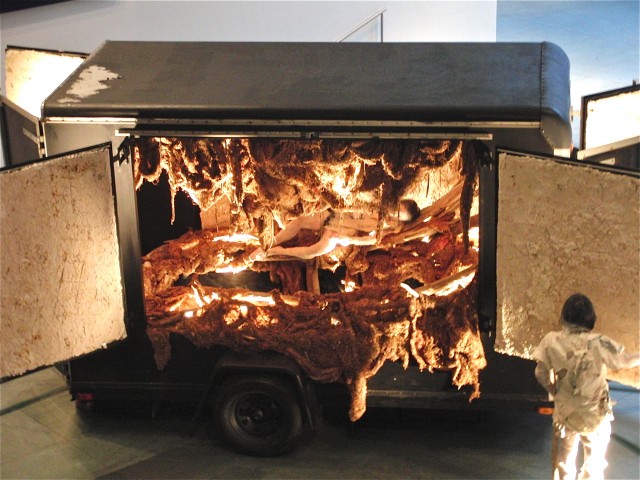
Although Eiko & Koma refer to their 1999 work, The Caravan Project, as “a vehicle for art activism,” it does not seek to make any comments on political or social issues. Instead, it was created to help promote art, particularly bringing it to those who either don’t have access to it or don’t know much about it. Reconfigured as part of their ongoing Retrospective Project, the 2012 version of Caravan has pulled into the MoMA lobby in front of Rodin’s “Monument to Balzac,” where the New York-based Japanese couple are performing during all hours the museum is open, through January 21. Placed right by the entrance, it forces people to see it on their way into MoMA as well as on their way out, so even if visitors intend to make a beeline straight for a specific exhibit, it is hard to miss an unhooked trailer that opens on all four sides, with a man and a woman either inside it or walking around outside, wearing decrepit white material that seems to be molting off their bodies as they move ever so slowly. It also can be seen without having to pay the $25 admission charge, furthering the dancers’ desire to bring the project to people who might not be able to afford hefty museum fees.
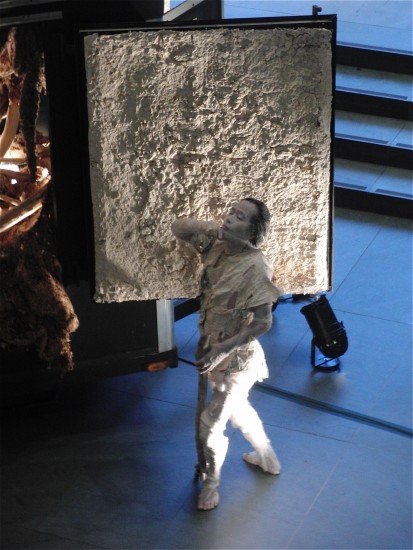
Koma emerges from trailer and takes slow walk in MoMA lobby (photo by twi-ny/mdr)
Held in conjunction with the “Tokyo 1955-1970: A New Avant-Garde” show, the “Art Theater Guild and Japanese Underground Cinema, 1960–1986” film series, and the “Performing Histories: Live Artworks Examining the Past” exhibition, The Caravan Project is for the first time being presented indoors without the Jeep that drives them to the site at the beginning and takes them away at the end. Instead, Eiko and Koma have become one with the museum, much as their work throughout the years has seen them merge with the natural environment, either real or constructed, in works such as Naked and Water. With The Caravan Project, at times they’ll be playing to a large crowd surrounding the trailer, where visitors are allowed to get within three feet of them, while at other moments there might be no one watching, just museumgoers passing by without even glancing their way, but that is all part of this compelling living installation. The trailer itself is filled with bare tree branches and beehive-like detritus above and below, with Eiko and Koma, in all white, emerging in between as if coming out of cocoons following an apocalyptic nightmare. Spiderwebs are wrapped around their faces, making it appear that they’ve been dormant for a long time before rising again. Their Butoh-like movements are painstakingly slow; it is electrifying when they actually touch each other, appearing to be so desperately in need of human contact in this barren, desolate scene, the only sound coming from the crowd itself. “Performing Histories” continues through May 25 with such upcoming programs as Kelly Nipper’s Tessa Pattern Takes a Picture, Fabian Barba’s A Mary Wigman Dance Evening, and El Arakawa’s Paris & Wizard: The Musical.
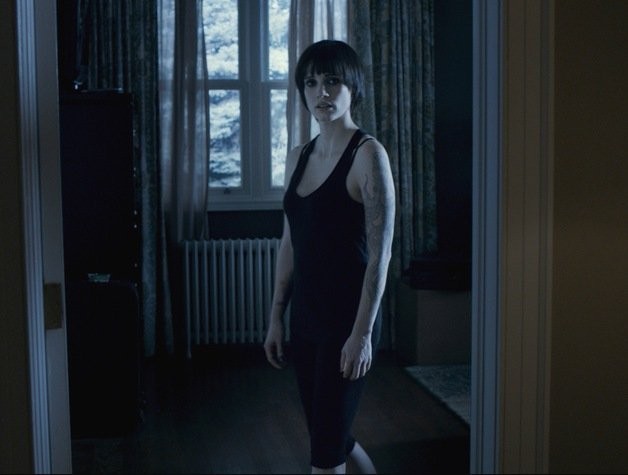
 Jessica Chastain has rocketed into stardom in just two years, starring in seven major motion pictures in 2011 (including The Help and The Tree of Life) and four more in 2012 (from Madagascar 3 to Zero Dark Thirty) while also playing the lead role in the Broadway revival of The Heiress. Chastain kicks off 2013 with the intensely creepy scarefest Mama. Expanded from his

 Inspired by actual events that took place in his hometown of Recife, Brazil, Kleber Mendonça Filho’s Neighboring Sounds is an engaging slice-of-life examination of class differences and a community in the midst of social and economic change. When Clodoaldo (Irandhir Santos) and Fernando (Nivaldo Nascimento) go door-to-door offering their services as overnight security guards protecting the street, only Francisco (W. J. Solha), an aging, wealthy sugar baron who owns much of the surrounding property, and his grandson João (Gustavo Jahn) refuse to participate in the shady proposal, but Francisco insists that they keep their hands off another of his grandsons, Dinho (Yuri Holanda), who is responsible for a spate of car-stereo robberies. This suburban neighborhood, ever more in the architectural shadow of bigger high rises going up all around them, is filled with little secrets and minor resentments. A mechanic keys an expensive car when the owner is rude to him. Clodoaldo and a maid (Clébia Souza) make use of a fancy gated house he is taking care of while the owners are away. Sisters fight over the size of a flat-screen television. And a co-op board wants to fire their longtime night watchman without a severance package because he has taken to napping on the job. Meanwhile, João, who has two children by the daughter of the family’s maid, has started a relationship with the more acceptable Sofia (Irma Brown), but the privileged João still lives in the past; when he shows an apartment in one of Francisco’s condos, he points out what would be the maid’s room, assuming everyone can afford domestic help. And Bia (Meve Jinkings) finds a different kind of domestic help, buying large quantities of pot from the water guy, finding unique ways to deal with her neighbor’s howling dog, and using household appliances to pleasure herself. A film critic who has previously made documentaries, Filho, who wrote, directed, and coedited (with João Maria) Neighboring Sounds, has populated his debut full-length feature with believable characters caught up in realistic situations, along with just the right dose of black comedy. The film was shot with natural sound at a relaxed pace, inviting viewers into this intriguing fictional tale filled with real-world implications, involving a decaying past and modern issues of safety and surveillance. While João might be the moral conscious of the story, it is Jinkings’s Bia who steals this small gem of a film, her unique methods of daily survival a joy to behold. Neighboring Sounds is screening January 19 at the Museum of the Moving Image as part of the “Curators’ Choice: The Best of 2012” series, consisting of works selected by chief curator David Schwartz and assistant film curator Rachael Rakes; upcoming screenings include Jafar Panahi’s This Is Not a Film, Wes Anderson’s Moonrise Kingdom, David Cronenberg’s Cosmopolis, and Hong Sang-soo’s In Another Country.