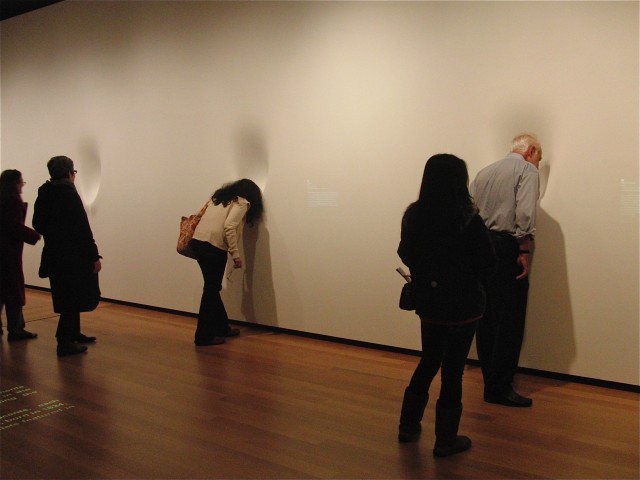
Fragrant exhibition at Museum of Arts and Design take visitors on an olfactory tour of the history of perfume (photo by twi-ny/mdr)
Museum of Arts and Design
2 Columbus Circle at 58th St. & Broadway
Through March 3
800-838-3006
www.madmuseum.org
A rather unique exhibit at the Museum of Arts & Design in Columbus Circle, one that truly “stinks,” has been extended through March 3. “The Art of Scent 1889-2012” collects twelve of the world’s most beloved, influential, and (in)famous perfumes, displaying them as if they were sculptures or paintings, firmly establishing them as individual works of art. Designed by the architectural firm Diller Scofidio + Renfro, the exhibition, the first major museum retrospective to elevate perfume in such a way, consists of a dozen stations along a wall, indentations where visitors put their head in and breathe in the fragrances, accompanied by an illuminated paragraph that appears then disappears, like the smells themselves, detailing the scent’s creator and development. Curated by Chandler Burr, the fragrances are arranged chronologically, following the changing trends in the industry, including the implementation of synthetic materials and modern technology. First up on the aromatic tour is Aimé Guerlain’s 1889 scent Jicky, which combines the terpene alcohol linalool, the chemical compound coumarin, and the flavorant ethyl vanillin; the text explains, “Though subtle in effect, the synthetics were both disorienting and liberating. By freeing olfactory artists from an exclusively natural palette, they turned scent into an artistic medium, and made Jicky one of the first true works of olfactory art.” Museumgoers will react differently to each scent as they get whiffs of Enest Beaux’s Chanel N°5, Pierre Wargnye’s Drakkar Noir, Annie Buzantian and Albert Morillas’s pleasures, Jean-Claude Ellena’s Osmanthe Yunnan, and Daniela Andrier’s disturbing Untitled, lent by such parfumeries as Hermès, Prada, L’Oréal, Clarins, Estée Lauder, Clinique, Guerlain, and other cosmetic companies. A second room delves into further detail about the creation of perfume with video interviews, a multipart evolution of one particular scent, and a table where visitors can dip strips into the actual liquid products and sample the real thing. The deluxe catalog ($285) includes eleven of the perfumes in printed glass vials — only Chanel chose not to participate — with each scent assigned to a different artistic discipline: Francis Fabron’s L’Interdit is considered abstract expressionism, Olivier Cresp’s Angel surrealism, Jacques Cavallier’s L’Eau d’issey minimalism, and Untitled post-brutalism. On February 13, MAD will host the special program “Technology and Innovation in Fine Fragrance,” with Burr and Rochas house perfumer Jean-Michel Duriez leading an interactive discussion in which attendees will be able to sniff-sample raw materials and complex fragrances.


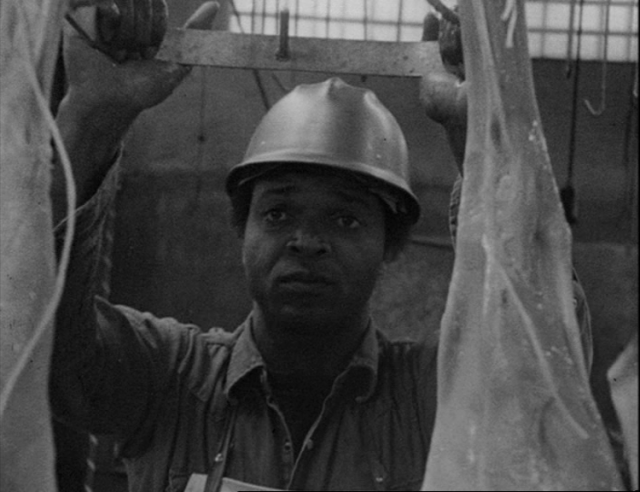
 In 2007, Milestone Films restored and released Charles Burnett’s low-budget feature-length debut, Killer of Sheep, with the original soundtrack intact; the film had not been available on VHS or DVD for decades because of music rights problems that were finally cleared. (The soundtrack includes such seminal black artists as Etta James, Dinah Washington, Little Walter, and Paul Robeson.) Shot on weekends for less than $10,000, Killer of Sheep took four years to put together and another four years to get noticed, when it won the FIPRESCI Prize at the 1981 Berlin Film Festival. Reminiscent of the work of Jean Renoir and the Italian neo-Realists, the film tells a simple story about a family just trying to get by, struggling to survive in their tough Watts neighborhood in the mid-1970s. The slice-of-life scenes are sometimes very funny, sometimes scary, but always poignant, as Stan (Henry Gayle Sanders) trudges to his dirty job in a slaughterhouse in order to provide for his wife (Kaycee Moore) and children (Jack Drummond and Angela Burnett). Every day he is faced with new choices, from participating in a murder to buying a used car engine, but he takes it all in stride. The motley cast of characters, including Charles Bracy and Eugene Cherry, is primarily made up of nonprofessional actors with a limited range of talent, but that is all part of what makes it all feel so real. Killer of Sheep was added to the National Film Registry of the Library of Congress in 1989, the second year of the program, making it among the first fifty to be selected, in the same group as Rebel Without a Cause, The Godfather, Duck Soup, All About Eve, and It’s a Wonderful Life, which certainly puts its place in history in context. Killer of Sheep will be screening on February 8 as part of the Museum of the Moving Image series “Changing the Picture” and “L.A. Rebellion: Creating a New Black Cinema,” focusing on films that look at the real black experience in postwar America, continuing through February 24 with such other films as Julie Dash’s Daughters of the Dust, Haile Gerima’s Bush Mama, Jamaa Fanaka’s Emma Mae (Black Sister’s Revenge), Zeinabu irene Davis’s Compensation, and Billy Woodberry’s Bless Their Little Hearts.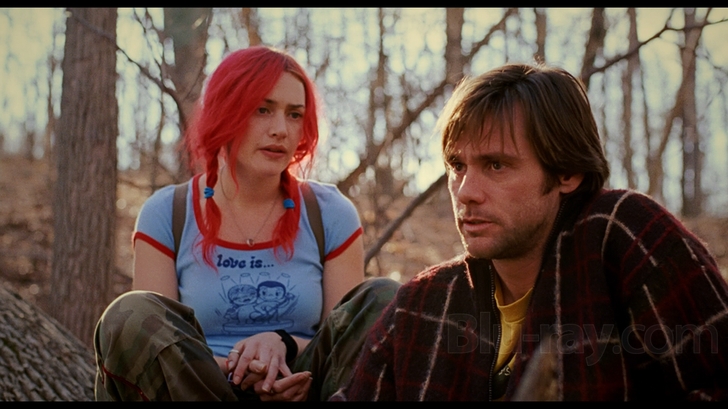
 Going to a hip new overrated Brooklyn restaurant for Valentine’s Day is so, well, 2012. For something completely different this year, Nitehawk Cinema’s monthly Beer, Dinner, and a Movie series is hosting a special presentation on February 13, screening Michel Gondry’s wickedly entertaining Eternal Sunshine of the Spotless Mind and serving a three-course meal inspired by the film (and dished out at very specific, related times), featuring drink pairings courtesy of Brooklyn’s own KelSo Beer Co. The brilliant film comes from the warped mind of Charlie Kaufman, the sensational scribe behind Being John Malkovich, Adaptation., and Confessions of a Dangerous Mind. (Chris Elliott fans will get a kick out of knowing that Kaufman was a writer for Get a Life, one of the great warped series of all time.) Eternal Sunshine of the Spotless Mind stars Jim Carrey and Kate Winslet as a couple looking to erase each other from their memories by . . . ah, don’t worry what it’s about. The less you know, the better. Just be prepared for a visual, metaphysical spectacle that will both exhilarate and depress you, filling you with wonder and amazement. The only thing keeping it from perfection is the ordinariness of the subplot involving Elijah Wood. Kaufman and Gondry (The Science of Sleep) mix in a little Punch-Drunk Love and Groundhog Day, both of which also starred former television comedians in more serious roles, but end up with something wholly original and, quite simply, one of the most romantic movies we have ever seen. As far as the food goes, after a welcoming KelSo pale ale, the dining kicks off with creamy tomato soup, grilled sourdough, and smoked Gouda with KelSo Rauchbier, followed by Blue Point oysters, local striped bass, vermouth, cauliflower, and KelSo pilsner. For dessert there’s Clementine vanilla sorbet, coconut “snow,” and KelSo rye aged pale ale. That frees you up on Valentine’s Day to snuggle with your loved one while everyone else is out eating mediocre food at mediocre restaurants that will not provide nearly the kinds of memories Nitehawk served up the night before.