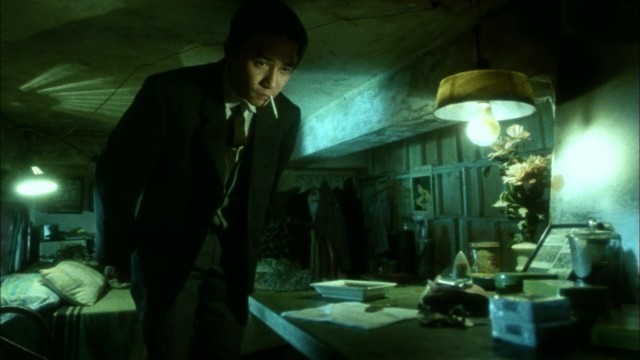
DAYS OF BEING WILD is Wong Kar-wai’s first collaboration with master cinematographer Christopher Doyle
DAYS OF BEING WILD (A FEI JING JUEN) (Wong Kar-wai, 1990)
Mid-Manhattan Library
455 Fifth Ave. at 40th St.
Wednesday, February 6, free, 7:00
www.nypl.org
 Wong Kar-wai’s second film, Days of Being Wild, following the surprising success of his debut feature, As Tears Go By, was a popular failure, as Hong Kong audiences were not yet ready for his introspective, character-driven, nonlinear style. (However, it did win five Hong Kong Film Awards, including Best Picture and Best Actor.) Days is Wong’s first film with master cinematographer Christopher Doyle, who has since shot all of Wong’s work, including Chungking Express, Fallen Angels, Happy Together, and In the Mood For Love. The late Leslie Cheung, who jumped out a hotel window in 2003, stars as Yuddy, a disaffected, beautiful youth who lures in women and then, after they fall in love with him, verbally mistreats them and cheats on them. Among his conquests are the gorgeous Su-Lizhen (Maggie Cheung), often shot in magnificent close-up, and the trampy Mimi (Carina Lau), who is jealous of Su, who takes comfort in telling her tale of woe to local police officer Tide (Andy Lau). Meanwhile, Yuddy, who was raised by a former prostitute, is obsessed with finding his birth mother, two facts that just might be part of the reason he treats women as he does. Set in 1960, the film’s leitmotif involves time and memory, with clocks ticking loudly and lots of long, lingering looks. The story goes a bit haywire in the latter sections, although the ending is a gem. (Look for Tony Leung there.) Days of Being Wild is screening for free February 6 at the Mid-Manhattan Library as part of the series “Three Auteurs of World Cinema: Wong Kar-wai,” which continues February 13 with Happy Together and February 20 with In the Mood for Love.

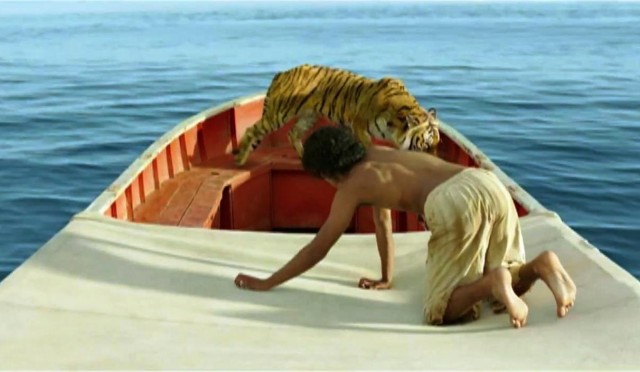
 Based on Canadian author Yann Martel’s 2001 award-winning bestseller, Life of Pi has been adapted into an up-and-down movie that moves between the terribly boring “real” world and a man’s wildly thrilling tale of adventure on the high seas as a teenager. Rafe Sprall plays a novelist desperate for an idea to replace his abandoned book, so he has been pointed in the direction of Piscine “Pi” Patel (Indian movie star Irrfan Khan of Slumdog Millionaire). Pi proceeds to tell the writer about his childhood growing up in his family’s zoo, a time when the young boy (played through the years by Gautam Belur, Ayush Tandon, and Suraj Sharma) explored various religions, including Christianity, Hinduism, and Islam, in his search for a supreme being and meaning. But while his family is on a freighter on their way to a new life in Canada, the ship sinks, leaving Pi alone on a lifeboat with a zebra, a hyena, an orangutan, and a Bengal tiger named Richard Parker from the zoo. As Pi desperately struggles to survive, he develops a unique relationship with the tiger, having been taught by his father (Adil Hussain) that no matter how much he might think the tiger can gain emotional understanding and compassion, he is still a vicious killer.

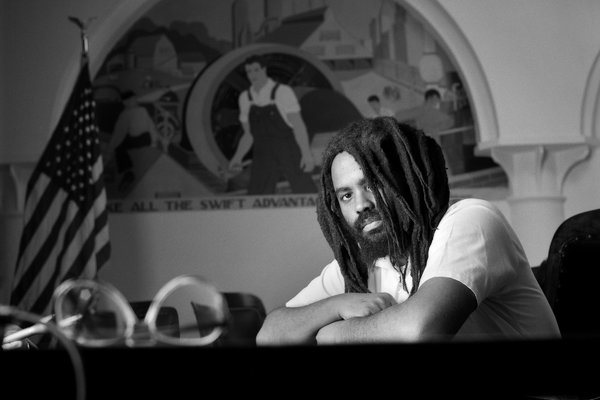
 In Stephen Vittoria’s overly reverential documentary Mumia: Long Distance Revolutionary, actors, activists, journalists, writers, and others celebrate the life and career of the former Wesley Cook, who changed his name to Mumia Abu-Jamal and helped found the Philadelphia wing of the Black Panther Party. The two-hour film begins with right-wing media mouths and the owner of Geno’s Steaks decrying the left’s embracing of Abu-Jamal, who was convicted in 1982 of killing Philadelphia police officer Daniel Faulkner. Denied access to Abu-Jamal in prison, Vittoria uses staged re-creations, archival footage, radio interviews, and such actors as Giancarlo Esposito, Ruby Dee, and Peter Coyote reading from his many books in order to portray him as a dedicated and talented journalist who became a feared target of FBI head J. Edgar Hoover and controversial Philly mayor Frank Rizzo, ultimately being set up for a murder he did not commit. Vittoria does not delve into the details of the case, instead exploring the man himself, with stories from Abu-Jamal’s sister Lydia Barashango, comedian and activist Dick Gregory, wrongly incarcerated boxer Rubin “Hurricane” Carter, philosopher Cornel West, Pulitzer Prize-winning writer Alice Walker, fellow investigative journalist Juan Gonzalez, radical activist Angela Davis, and radio host Amy Goodman, who has broadcast numerous phone interviews with Abu-Jamal, whose 1982 death sentence was commuted to life in prison last year. Mumia: Long Distance Revolutionary is completely one-sided, showing anyone against the golden-throated Abu-Jamal to be crazy as the filmmakers glorify its subject. However, it does reveal the City of Brotherly Love to be a frightening hotbed of violence and racism, even if that is not necessarily news. “Philadelphia has a veneer of liberalism and this whole Quaker mystique,” explains Temple associate professor and journalist Linn Washington. “The reality is it has been this ruthlessly racist city — really from its inception.” Mumia: Long Distance Revolutionary works better when it examines the social history of the civil rights movement and the Black Panthers as covered by Abu-Jamal but falters when it treats his writings as if they were Shakespearean soliloquies. Vittoria will be present at Cinema Village to participate in several Q&As opening weekend, following the 6:30 and 9:00 screenings on Friday and 4:00 and 6:30 shows on Saturday and Sunday.