twi-ny recommended events

THE FILMS OF STANLEY KUBRICK: BARRY LYNDON

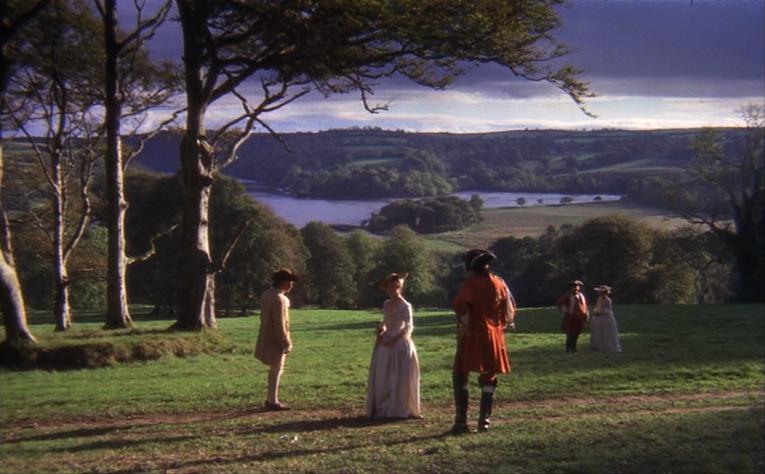
The sumptuous BARRY LYNDON is a treat for the eyes and ears

BARRY LYNDON (Stanley Kubrick, 1975)
IFC Center
323 Sixth Ave. at West Third St.
Tuesday, March 26, 11:30, 3:00, 8:20
Series runs March 20-28
212-924-7771
www.ifccenter.com

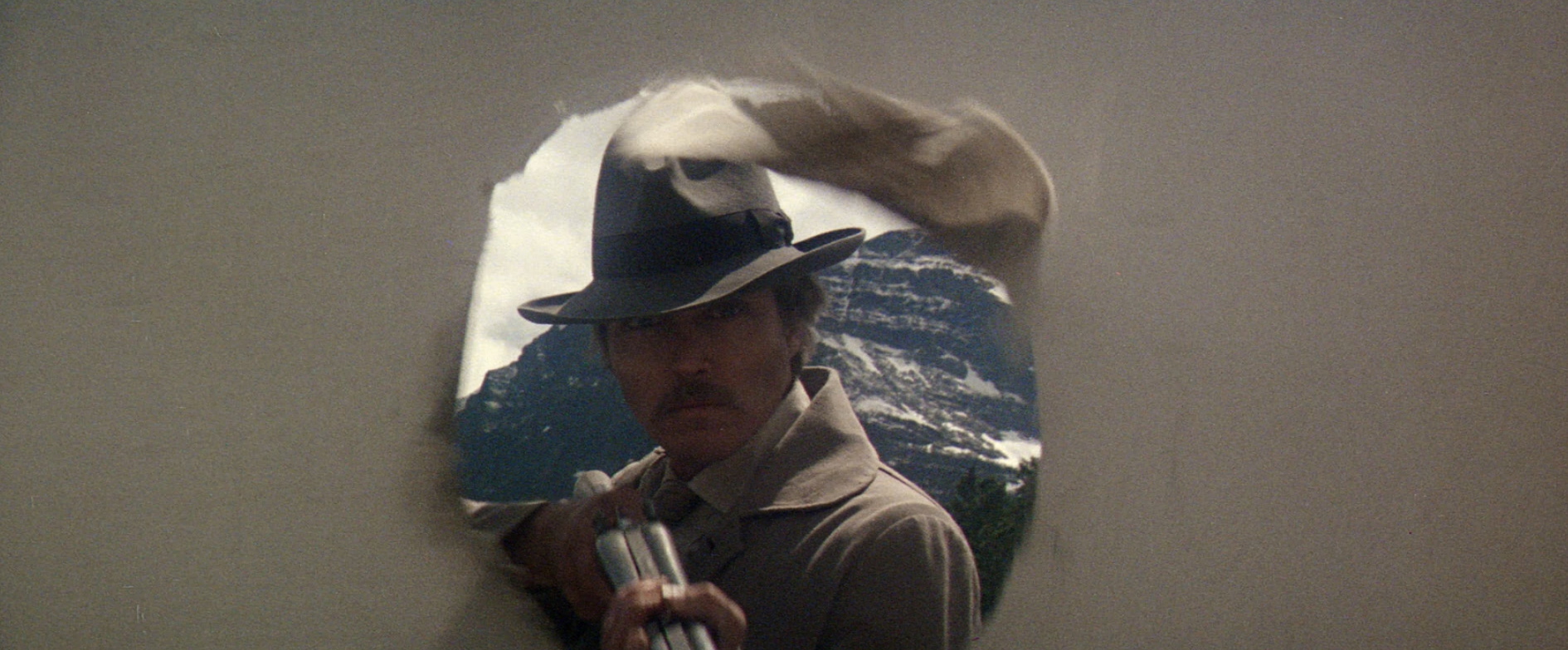
Stanley Kubrick’s lush, romantic epic, Barry Lyndon, is one of the most elegantly visual pictures ever made. Based on William Makepeace Thackeray’s 1844 serialized picaresque novel The Luck of Barry Lyndon, Kubrick’s extravagant three-hour tale follows the shenanigans of one Redmond Barry, played with endless charm by Ryan O’Neal. The man soon to be known as Barry Lyndon has a remarkable knack for survival — or maybe it’s just plain old Irish luck — as he rises in English society via a series of duels (with epees, guns, and bare knuckles), military battles (the Seven Years’ War), and, most prominently, sexual conquests. Consisting of two sections, “By What Means Redmond Barry Acquired the Style and Title of Barry Lyndon” and “Containing an Account of the Misfortunes and Disasters Which Befell Barry Lyndon,” the film features glorious music by Bach, Vivaldi, Handel, Mozart, Schubert, and the Chieftains in addition to absolutely divine locations that lay the groundwork for the sumptuous Oscar-winning art direction by Ken Adam, Vernon Dixon, and Roy Walker and cinematography by John Alcott; virtually every scene contains beautiful shots based on famous paintings, a treat for the eyes and the ears. (Leonard Rosenman took home an Academy Award as well for his adapted score.) The overly long story does drag at times, but it flows better once you get used to O’Neal in the title role. The underappreciated film also has a great supporting cast, with Marisa Berenson as Lady Lyndon, Patrick Magee as the Chevalier de Balibari, Hardy Krüger as Captain Potzdorf, Steven Berkoff as Lord Ludd, Leonard Rossiter as Captain John Quin, and Gay Hamilton as Nora Brady. A DCP projection of the film is screening March 26 as part of the IFC Center series “The Films of Stanley Kubrick,” which includes every one of the director’s feature works as well as A.I. Artificial Intelligence, a collaboration with Steven Spielberg, all shown in advance of the March 29 theatrical release of Rodney Ascher’s Room 237, a documentary that delves into the many metamysteries surrounding the making of The Shining.

VITAL VOX: A VOCAL FESTIVAL

The fourth annual Vital Vox Festival, which explores the far-reaching capabilities of the human voice, is back after Hurricane Sandy canceled fall performances

Roulette
509 Atlantic Ave.
March 25-26, $15, 8:00
917-267-0363
www.vitalfoxfest.com
www.roulette.org

The fourth annual Vital Vox Festival, dedicated to exploring the seemingly limitless range and power of the human voice, was scheduled to present a half dozen cutting-edge performers over the course of two nights at Roulette in Brooklyn on October 29-30, but Hurricane Sandy silenced the festivities. Not to let Mother Nature get it down, the festival will now take place March 25-26 at Roulette. Monday, March 25, will consist of a cappella jazz and blues singer and composer Philip Hamilton’s “Vocalscapes: Solitude” for voice, percussion, and electronics; excerpts from New York-based, Uruguayan-born audiovisual artist Sabrina Lastman’s “An Encounter with ‘El Duende,’” which pays tribute to Federico García Lorca using voice, movement, sound, bowed psaltery, megaphone, and visuals; Loom Trio’s “Music from Erosion: A Fable,” with Raphael Sacks, Kate Hamilton, and Sasha Bogdanowitsch playing excerpts from the 2012 multidisciplinary theatrical production; and San Francisco-born, Brooklyn-based violinist, composer, vocalist, and poet Sarah Bernstein’s Unearthish, a duo with percussionist Satoshi Takeishi. Tuesday’s program features Lisa Karrer’s “Collision Theory: Works and Premieres for Voice & Multi-Media,” a collaboration with partner David Simons that will include her “Meeting Max: Vocal Experiments with Interactive Video Mixer” and his “The Opera Within the Opera,” with electronics, triggered Theremin, and keyboard; multidisciplinary artist, composer, and teacher Bodganowitsch’s “Timbre Tree,” an excerpt from a song cycle involving live looping and processing, dance and movement, text, and such instruments as the syrinx, fujara, koncovka, halo drum, and karimba, featuring the Loom Ensemble (Andrew Broaddus, Helen Joyce, Sacks, Hamilton and Michael Bauer); and San Francisco-based Pamela Z’s “Works for Voice, Live Processing, and Video,” with excerpts from “Memory Trace” along with other short pieces.

HEAVEN’S GATE

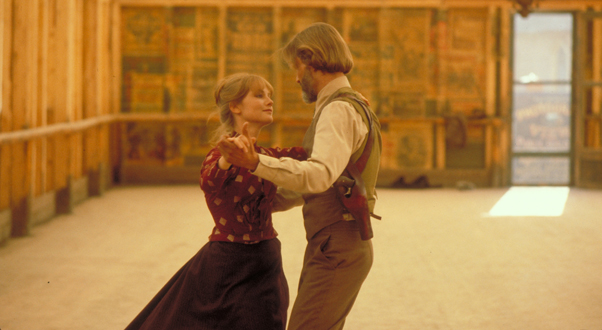
Isabelle Huppert and Kris Kristofferson waltz their way through HEAVEN’S GATE

Isabelle Huppert and Kris Kristofferson waltz their way through HEAVEN’S GATE

HEAVEN’S GATE (Michael Cimino, 1980)
Film Forum
209 West Houston St.
March 22-28
212-727-8110
www.filmforum.org

When I was a kid in school, one of the first movies I ever reviewed was Heaven’s Gate, Michael Cimino’s brazenly overbudget famous Hollywood disaster. Incensed that professional film critics were obsessed with the meta surrounding the making of the epic Western instead of simply taking it for what it was, I was determined to treat it like any other movie, forgetting about all the behind-the-scenes gossip and tales of financial gluttony. And what I found back then was that it was a noble failure, a bold exercise in genre that had its share of strong moments but ultimately fell apart, leaving me dissatisfied and disappointed but glad I had seen it; I did not want my three-plus hours back. In fact, I probably would have checked out the rumored five-hour version if it had been shown, hoping it would fill in the many gaps that plagued the official theatrical release. More than thirty years later, Cimino’s follow-up to his Oscar-winning sophomore effort, The Deer Hunter, has returned in a 216-minute digital restoration supervised by Cimino, playing March 22-28 at Film Forum, and it does indeed shed new light on the unfairly ridiculed work, which is still, after all this time, a noble failure. Inspired by the 1882 Johnson County War in Wyoming, the film stars Kris Kristofferson as Jim Averill, a Harvard-educated lawman hired by a group of immigrants, called “citizens,” whose livelihood — and lives — are being threatened by a wealthy cattlemen’s association run by the elitist Frank Canton (Sam Waterston). The association has come up with a kill list of 125 citizens, offering fifty dollars for each murder, a plan that has been authorized all the way up to the president of the United States. Leading the way for the cattlemen is hired killer Nate Champion (Christopher Walken), who has a particularly fierce aversion to the foreign-speaking immigrants. With a major battle on the horizon, Averill and Champion also fight for the love of the same woman, the luminous Ella Watson (Isabelle Huppert), a successful madam who soon finds herself in the middle of the controversy.


Christopher Walken sets his sights on immigrants in epic Western

Christopher Walken sets his sights on immigrants in epic Western

Heaven’s Gate is beautifully photographed by Vilmos Zsigmond, the first half bathed in sepia tones, with many shots evoking Impressionist painting. The narrative, which begins in Harvard in 1870 before jumping to 1890 Wyoming, moves far too slowly, with underdeveloped relationships and characters that don’t pay off in the long run, especially John Hurt as Billy Irvine, who wanders around lost throughout the film. Using a gentle rendition of Strauss’s “The Blue Danube” as a musical motif, Cimino creates repetitive scenes that start too early and go on too long, choosing style over substance, resulting in too much atmosphere and not enough motivation. The all-star cast also includes Joseph Cotten, Jeff Bridges, Brad Dourif, Richard Masur, Eastwood regular Geoffrey Lewis, Terry O’Quinn, Tom Noonan, and Mickey Rourke, but most of them are wasted in minor roles that are never fully developed. Whereas the film began by calling to mind such works as Akira Kurosawa’s Yojimbo, John Ford’s My Darling Clementine, and Robert Altman’s McCabe & Mrs. Miller, it devolves into Sam Peckinpah-lite as rape and violence take center stage, along with silly plot twists and clichéd dialogue, much of which is hard to make out. However, all of that does not add up to one of the worst movies ever made, despite its inclusion on many such lists. It even feels oddly relevant today, as America continues to debate immigration laws. But in the end it’s just a film that tried too hard, focusing on the wrong things. Back in 1980, I wanted to see the supposed five-hour version; now I think I’d prefer to see a two-hour Heaven’s Gate that would just get to the point.

VIDEO OF THE DAY: “WAKE THE DOGS” BY DONOTS

“Yeah, I’ll pick the lock / I’ll crash the gates / and then I’ll knock at your door,” the Donots declare on the title track of their latest record, 2012’s Wake the Dogs. The five-piece Ibbenbüren, Germany, band is preparing for its twentieth anniversary with its first major U.S. headlining tour, ready to pick locks, crash gates, and bang on doors as they storm the country. On Wake the Dogs, lead singer Ingo, guitarists Guido and Alex, bassist J.D., and drummer Eike, who all share the same last name, Donot, blast through sixteen tracks that go in and out of punk, hardcore, metal, rap, power pop, and even a little Celtic folk, tearing it up on such songs as “Into the Grey” “Born a Wolf,” “Control,” and “I Don’t Wanna Wake Up,” evoking a mix of Green Day, Rancid, and Anti-Flag. The album also includes two songs with British acoustic folk-punk Frank Turner. “Say my name,” Ingo proclaims on “Manifesto,” continuing, “One mind is loud, two make a crowd, three make a scene.” There should be quite a scene when Donots play Saint Vitus on March 24 ($10, 8:00) with I Hate Our Freedom and (Damn) This Desert Air and Webster Hall on March 25 ($10, 7:00) with the Company We Keep and Mister Pagoda.

THE (*) INN

THE (*) INN

Strange things are happening in the shtetl in centennial production of Peretz Hirschbein’s THE (*) INN (photo by Erik Carter)

Abrons Arts Center Playhouse
466 Grand St. at Pitt St.
Thursday – Sunday through March 30, $25
212-598-0400
www.abronsartscenter.org
www.targetmargin.org

In the foreword to the 1921 English version of Peretz Hirschbein’s Yiddish-language play The Haunted Inn, translator Isaac Goldberg explains, “So much of the drama is written with Mr. Hirschbein’s sensitivity to subdued tones; . . . here color tends to subside into nuance, and action . . . is refined into the suggestions of impulse and mood.” Target Margin Theater has wonderfully captured that nuance, impulse, and mood in its hundredth anniversary presentation of the experimental Yiddish play, which they call The (*) Inn, the asterisk meaning “empty, vacant, abandoned; usually translated as ‘Haunted.’” Directed by David Herskovits (who also handles the sound design), the play, running at Abrons Arts Center through March 30, is set in a shtetl where local farmers are preparing for an arranged wedding while also contemplating the future of a nearby shuttered inn that might just be home to spirits. The show opens with a hyper-stylized scene in which characters in overemphasized accents discuss life and love while a man and a woman playfully pass by with cutouts of farm animals, evoking amateur high school productions.

Meg MacCary and David Greenspan consider the crazy goings-on in avant-garde Yiddish theater revival (photo by Erik Carter)

Meg MacCary and David Greenspan consider the crazy goings-on in avant-garde Yiddish theater revival (photo by Erik Carter)

But things get a whole lot more adult during a wedding scene in which the bride, Meta (Rachel Claire), runs off with Itsik (Sam T. West) instead of marrying her arranged beau, Leibush (Susan Hyon), and winds up in a mysterious area, exploring both their lust and their fears. Meanwhile, Meta’s father, Bendet (Amir Darvish), begins to lose his mind as the show grows ever-more abstract, with nuance, impulse, and mood taking center stage. The (*) Inn is beautifully unconventional, offering unexpected surprise after unexpected surprise, with creative sets by Carolyn Mraz and intense lighting by Lenore Doxsee, ranging from the overly bright opening to the deep, dark conclusion. Performed by a cast that also includes Ugo Chukwo, David Greenspan, Meg MacCary, Julia Sirna-Frest, and J. H. Smith III, The (*) Inn is not your grandfather’s Yiddish theater. As dramaturg Debra Caplan writes in a program note, “When The (*) Inn first premiered in Vilna in 1913, critics and audiences had never seen anything quite like it before. One hundred years after the original production of this seminal Yiddish play, we at Target Margin are willing to bet that you’ve never seen anything quite like it either.” Target Margin Theater wins that bet, with a show that is part of its two-year “Beyond the Pale” exploration of Yiddish theater. (There will be a free panel discussion, “Yiddish Theater Lives!,” prior to the March 23 show, moderated by Caplan, as well as a discussion with Herskovits and other cast and crew members after the March 28 performance.)

NYC TEEN AUTHOR FESTIVAL

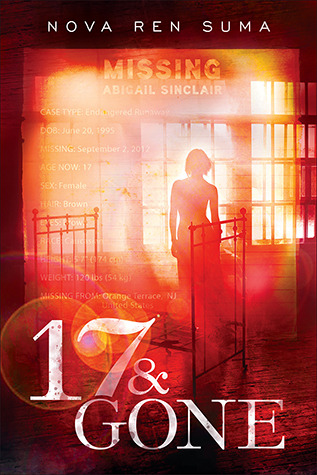
Nova Ren Suma will be celebrating the release of her second YA novel at this weekend's Teen Fair

Nova Ren Suma will be celebrating the release of her second YA novel at this weekend’s free NYC Teen Author Festival

The free NYC Teen Author Festival kicks into full swing this weekend with numerous special events featuring many of the best YA authors in the business. On Friday at 2:00 at the New York Public Library’s second-floor Margaret Liebman Berger Forum, Ted Goeglein, Gordon Korman, Lucas Klauss, and Michael Northrop will take on Susane Colasanti, E. Lockhart, Carolyn Mackler, Sarah Mlynowski, and Leila Sales in a “He Said, She Said” battle moderated by David Levithan, part of an afternoon symposium that continues at 3:00 with “Taking a Turn: YA Characters Dealing with Bad and Unexpected Choices,” with Caela Carter, Eireann Corrigan, Alissa Grosso, Terra Elan McVoy, Jacquelyn Mitchard, Elizabeth Scott, and K. M. Walton, moderated by Aaron Hartzler; at 4:10 with “That’s So Nineteenth Century,” with Sharon Cameron, Leanna Renee Hieber, Stephanie Strohm, and Suzanne Weyn, moderated by Sarah Beth Durst; and concluding at 4:40 with “Alternate World vs. Imaginary World,” with Durst, Jeff Hirsch, Emmy Laybourne, Lauren Miller, E. C. Myers, Diana Peterfreund, and Mary Thompson, moderated by Chris Shoemaker. Following that, a bunch of authors will be signing books at the Union Square B&N, from 7:00 to 8:30, including Corrigan, Elizabeth Eulberg, Hirsch, Levithan, Rainbow Rowell, and Nova Ren Suma. Saturday’s symposium in the Berger Forum begins at 1:00 with “Defying Description: Tackling the Many Facets of Identity in YA,” with Marissa Calin, Emily Danforth, Hartzler, A. S. King, and Jacqueline Woodson, moderated by Levithan, followed at 2:10 by a New Voices Spotlight featuring J. J. Howard, Kimberly Sabatini, Tiffany Schmidt, and Greg Takoudes; at 2:40 by “Under Many Influences: Shaping Identity When You’re a Teen Girl,” with Jen Calonita, Deborah Heiligman, Hilary Weisman Graham, Kody Keplinger, Amy Spalding, Katie Sise, and Kathryn Williams, moderated by Terra Elan McVoy; at 3:40 by “Born This Way: Nature, Nurture, and Paranormalcy,” with Jessica Brody, Gina Damico, Maya Gold, Alexandra Monir, Lindsay Ribar, Jeri Smith-Ready, and Jessica Spotswood, moderated by Adrienne Maria Vrettos; and at 4:20 by “The Next Big Thing,” with Jocelyn Davies, Hieber, Barry Lyga, and Maryrose Wood. From 7:00 to 8:30, there will be a Mutual Admiration Society reading at McNally Jackson on Prince St. consisting of Cameron, King, Northrop, Peterfreund, Victoria Schwab, and Suma, hosted by Levithan. And on Sunday, the weeklong festival comes to a close with nearly fifty YA authors taking part in “Our No-Foolin’ Mega-Signing” at Books of Wonder from 1:00 to 4:00, a smorgasbord of talent divided into forty-five-minute groups at 1:00, 1:45, 2:30, and 3:15.

LAST MAN CLUB

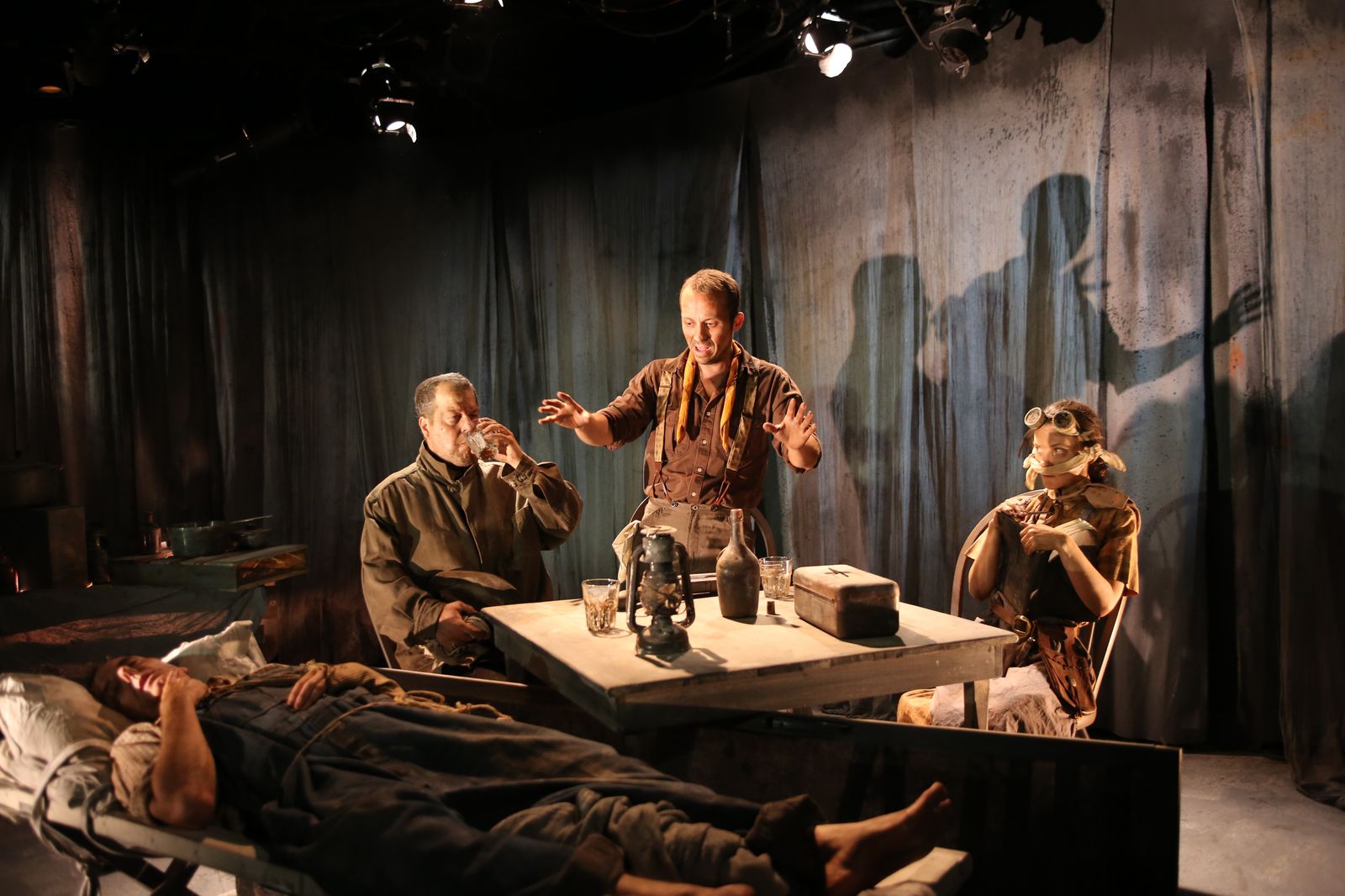
Poverty, destitution, and an overriding strangeness rule the day in Axis Company production of LAST MAN CLUB (photo by Dixie Sheridan)

Axis Company
One Sheridan Sq. between West Fourth & Washington Sts.
Thursday – Saturday through March 30, $20, 8:00
866-811-4111
www.axiscompany.org

Last October, the excellent Axis Company production of Last Man Club had to end its run early because of Hurricane Sandy. The show is now back, running Thursday through Sunday through March 30, giving people another chance to see Axis artistic director Randy Sharp’s unusual Grapes of Wrath meets The Road Warrior tale. In a depression-era middle America Dust Bowl that could double as a barren postapocalyptic landscape, a small family of ragged men and women tries to survive as sandstorms swirl around their deteriorating farm. Friends and kin took off with all the money, leaving the overly practical and far-too-trusting Major (David Crabb) in charge of the mumbling, OCD-riddled Pogord (Spencer Aste), who is waiting for the tank truck to show so that his dried-out sheets can be wetted down; the quirky, ultra-strange Wishful Hi (Lynn Mancinelli), who wears crazy goggles and sees ghosts; and would-be singer Saromybride (Britt Genelin), who wonders whether they should have all headed out to California with the others. As the worst dust storm in modern history approaches, two drifters arrive one at a time: first Middle Pints (George Demas), who has an idea he wants to present to the town’s local Last Man Club, then Henry Taper (Brian Barnhart), who says he’s a scientist on his way to the city to help figure out how to stop the terrible drought. “I can’t take it no more. I really can’t,” Pogord says. “It’s the end of the world,” Wishful Hi proclaims. Writer-director Sharp’s (Hospital) unpredictable dialogue and subtle plot shifts bring a compelling elegance to the proceedings while also making the play relevant to such twenty-first-century concerns as poverty, unemployment, climate change, the housing crisis, war, and a lack of faith in government. Karl Ruckdeschel’s costumes and the simple but effective set cast the production in browns and grays that emphasize the growing destitution, while solid acting all around gives the play an honesty despite the surreal craziness going on. Last Man Club might be set in the past and hint at the future, but it is, sadly, also firmly rooted in the here and now.