
Anna Khaja takes on many roles in examining the life and death of Benazir Bhutto (photo by Hunter Canning)
Culture Project
45 Bleecker St. between Lafayette & Bowery
Friday – Monday through April 21, $25-$55
866-811-4111
www.cultureproject.org
In 2007, exiled two-time Pakistani prime minister Benazir Bhutto returned to her native country to run for a third term, as a member of the Pakistan People’s Party. The party had been founded by her father, former prime minister Zulfikar Ali Bhutto, who was hanged in Rawalpindi by the government under questionable circumstances in 1979. On December 27, 2007, during a political rally in Rawalpindi, Benazir Bhutto was assassinated, dead at the age of fifty-four. Half-Pakistani actress Anna Khaja examines the life, career, and impact the popular, controversial leader had in the compelling one-woman show Shadeed: The Dream and Death of Benazir Bhutto. Khaja (True Blood, Stuff Happens) plays eight characters who share their views on Bhutto on that fateful day in late December. Khaja begins by appearing as herself, a young woman trying to discover her identity in a very personal journey, for she is the daughter of a Pakistani man who walked out on his American family to perhaps become a terrorist. Over the course of eighty minutes, Khaja portrays Sara, a worshipful student; U.S. secretary of state Condoleezza Rice, who declares, “I have not sent you into a death trap, Miss Bhutto”; investigative journalist and confidante Daphne Barak; Quasim, a professor who was interrogated and tortured for his beliefs; Bhutto’s estranged niece and journalist Fatima; excited street vendor Shamsher; student revolutionary Afshan; and Bhutto herself. After each segment, Khaja changes costumes simply and effectively, behind a slatted wooden fence designed by Maureen Weiss while Pakistani music composed by Phillip Young and Colyn Emery plays and Steven Calcote projects related images onto a white sheet draped over the fence. A hit at the 2010 New York Fringe Festival, Shaheed: The Dream and Death of Benazir Bhutto, written by the multitalented Khaja and directed by Heather de Michele and being presented at the Culture Project’s Women Center Stage through April 1, offers a unique look — or, actually, several unique looks — at a horrific tragedy and its effect on a deeply troubled nation.


 Stanley Kubrick’s Dr. Strangelove, or How I Stopped Worrying and Learned to Love the Bomb is one of the grandest satires ever made, the blackest of black comedies. With the threat of nuclear annihilation looming over the United States and the Soviet Union, General Jack D. Ripper (Sterling Hayden) has a meltdown, becoming obsessed with protecting the country’s “precious bodily fluids” and threatening to launch the bombs. While President Merkin Muffley (Peter Sellers) tries to make nice with the Soviets, General Buck Turgidson (George C. Scott) gets caught up in all the military excitement, Colonel Bat Guano (Keenan Wynn) defends the Coca-Cola Company, Group Captain Lionel Mandrake (Sellers) can’t get anyone to listen to him, and Major T. J. “King” Kong (Slim Pickens) prepares for the ride of his life. Based on Peter George’s novel Red Alert and written by George, Kubrick, and Terry Southern, Dr. Strangelove is hysterically funny and wickedly prescient, an absolute hoot from start to finish, featuring razor-sharp dialogue, inspired slapstick, and just enough truth to scare the hell out of you. (Be sure to watch for Peter Bull not being able to stop laughing as Sellers goes crazy in a wheelchair at the end.) A DCP projection of the film is screening March 21-28 as part of the IFC Center series “The Films of Stanley Kubrick,” which includes every one of the director’s feature works as well as A.I. Artificial Intelligence, a collaboration with Steven Spielberg, all shown in advance of the March 29 theatrical release of Rodney Ascher’s Room 237, a documentary that delves into the many metamysteries surrounding The Shining.

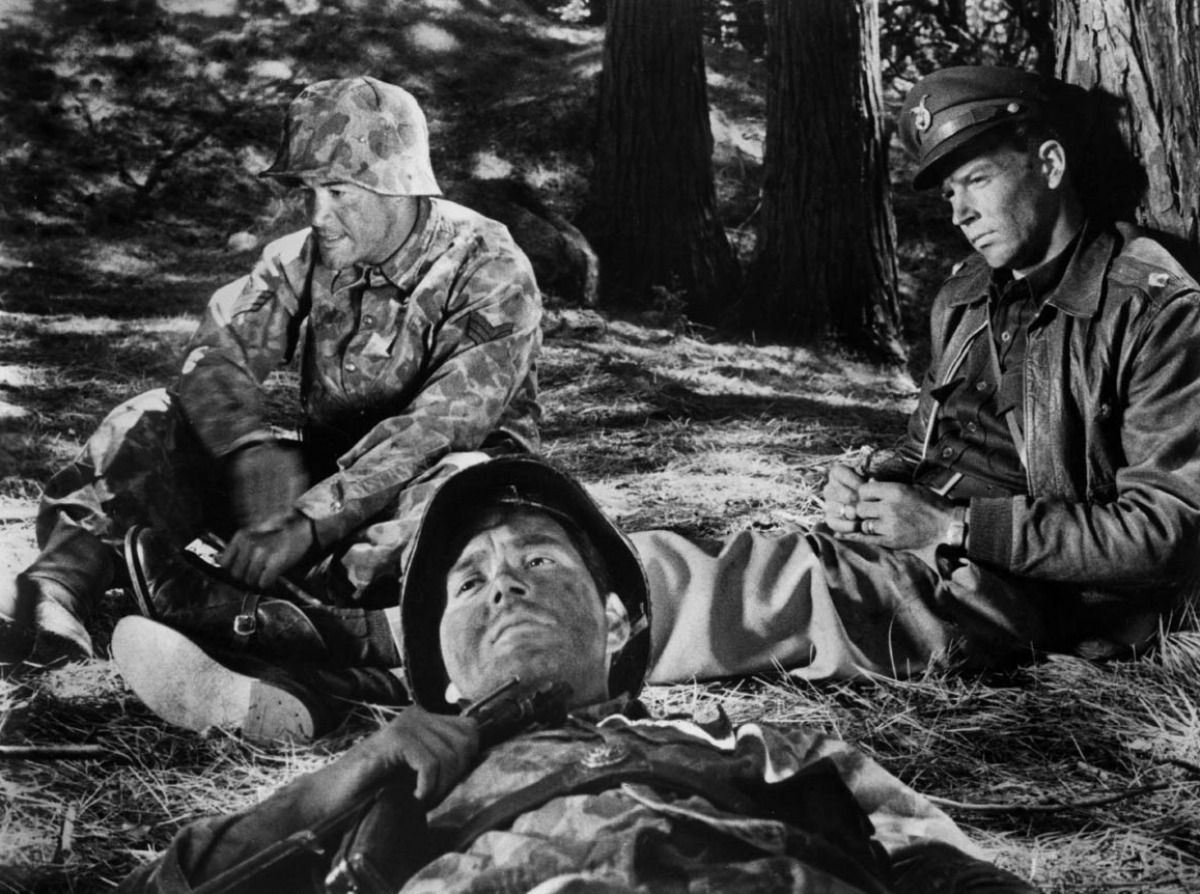
 The IFC Center is preparing for the March 29 theatrical release of Rodney Ascher’s documentary Room 237, which delves into metamysteries surrounding Stanley Kubrick’s The Shining, with the terrific series “The Films of Stanley Kubrick,” screening every one of the Bronx-born ex-pat’s feature works, most of which are being projected in DCP. Kubrick’s 1953 seldom-seen psychological war drama, Fear and Desire, will be shown March 20-25 in high definition. His first full-length film, made when he was twenty-four, Fear and Desire is a curious tale about four soldiers (Steve Coit, Kenneth Harp, Paul Mazursky, and Frank Silvera) trapped six miles behind enemy lines. When they are spotted by a local woman (Virginia Leith), they decide to capture her and tie her up, but leaving Sidney (Mazursky) behind to keep an eye on her turns out to be a bad idea. Meanwhile, they discover a nearby house that has been occupied by the enemy and argue over whether to attack or retreat. Written by Howard Sackler, who was a high school classmate of Kubrick’s in the Bronx and would later win the Pulitzer Prize for The Great White Hope, and directed, edited, and photographed by the man who would go on to make such war epics as Paths of Glory, Full Metal Jacket, and Dr. Strangelove, or How I Learned to Stop Worrying and Love the Bomb, Fear and Desire features stilted dialogue, much of which is spoken off-camera and feels like it was dubbed in later. Many of the cuts are jumpy and much of the framing amateurish. Kubrick was ultimately disappointed with the film and wanted it pulled from circulation; instead it was preserved by Eastman House in 1989 and restored twenty years later, which is good news for film lovers, as it is fascinating to watch Kubrick learning as the film continues. His exploration of the psyche of the American soldier is the heart and soul of this compelling black-and-white war drama that is worth seeing for more than just historical reasons. “There is a war in this forest. Not a war that has been fought, nor one that will be, but any war,” narrator David Allen explains at the beginning of the film. “And the enemies who struggle here do not exist unless we call them into being. This forest then, and all that happens now, is outside history. Only the unchanging shapes of fear and doubt and death are from our world. These soldiers that you see keep our language and our time but have no other country but the mind.” Fear and Desire lays the groundwork for much of what is to follow in Kubrick’s remarkable career, all of which can be seen March 20-28 at IFC.
 All work and no play makes Jack a not-so-quite dull boy in Stanley Kubrick’s classic horror story, based on the Stephen King novel. One of the all-time-great frightfests, The Shining is a truly scary movie about a writer named Jack Torrance (Jack Nicholson at his overacting best) who has agreed to become the caretaker of the old Overlook Hotel in Colorado during the snowy winter when the enormous mountain resort closes down for the season. He is joined by his perpetually nervous wife, Wendy (Shelley Duvall), and their young son, Danny (Danny Lloyd), who seems to have brought along his invisible friend, Tony, who speaks through Danny’s finger. Between taking care of the Overlook and working on his novel, Jack finds a whole bunch of other folks to hang out with, people who have populated the place during the ritzy establishment’s golden age, including a strange woman in room 237. Kubrick plays with horror conventions as he seeks to scare the crap out of the audience, something he accomplishes time and time again as Jack grows more disturbed, Wendy’s shrieks become more and more ear piercing and annoying, and Danny’s visions get more and more bloody. No matter how many times you’ve seen it, it still gets you, even when you know exactly what’s lurking around that corner. Only those who went to the film during its opening weekend, as we did, got to see the two-minute finale that Kubrick cut out immediately thereafter, which involved the iconoclastic director riding his bicycle to various theaters, armed with a pair of scissors. A DCP projection of The Shining is being shown March 20-28 as part of the IFC Center series “The Films of Stanley Kubrick,” which is screening every one of the Bronx-born ex-pat’s feature works in preparation for the March 29 theatrical release of Rodney Ascher’s Room 237, which delves into the many metamysteries surrounding the making of The Shining.