“I want my mojo back,” Scott H. Biram declares on his most recent record, fall 2011’s Bad Ingredients, but he sounds like he never lost it. Also known as the Dirty Old One Man Band, Biram is like an East Texas drifter on the album, with no place in this hard, cold world — sleeping underground or in the back of a car, only feeling alive when out on the open road. “Now I’m flyin’ ’cross the desert / slowly blowin’ out of my mind / I’m getting’ tired of seekin’ answers / that’ll only let me down / I been drinkin’ since forever / but I just can’t put it down / And I never felt nothin’ / like a warm safe place / ’til I hit that open road,” he howls on “Open Road,” one of thirteen tracks on the Bloodshot disc. Using old microphones, a 1959 Gibson, and an amplified left foot providing percussion, the Austin-based Biram makes his way through bluesy hillbilly punk raising his own kind of hell on such songs as “Born in Jail,” “Black Creek Risin’,” and “Killed a Chicken Last Night.” On “Broke Ass” he declares, “Well, I like makin’ money, honey / but I sure don’t like to work / when I could be down here just sinnin’ / wipin’ beer stains on my shirt.” No, Biram, who even plays his own gospel choir on “I Want My Mojo Back” (but doesn’t play the sax on the song, leaving that to the record’s only guest, Walter Daniels), has never lost his “motherfuckin’ mojo hand,” and he’ll be provin’ it on Thursday night when he plays Target Free Thursdays at the David Rubenstein Atrium at Lincoln Center. (And don’t be fooled by Lincoln Center’s web address for the event, which uses the name “birman” instead of “biram.”)
twi-ny recommended events
THE DANCE AND THE RAILROAD
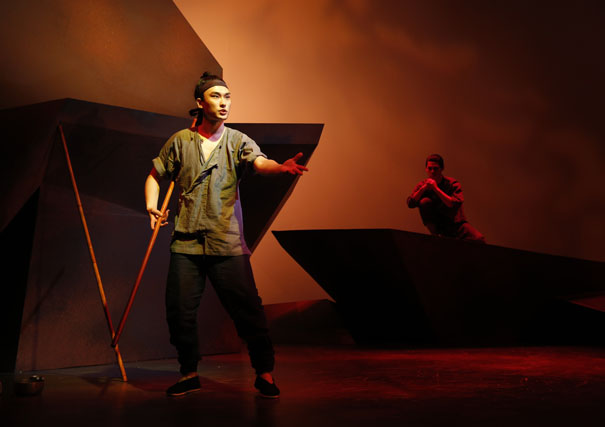
Ma (Ruy Iskandar) and Lone (Yuekun Wu) discuss immigration, unions, life, and opera in THE DANCE AND THE RAILROAD (photo by Joan Marcus)
The Pershing Square Signature Center
The Alice Griffin Jewel Box Theatre
480 West 42nd St. between Tenth & Eleventh Aves.
Through March 24, $75
212-244-7529
www.signaturetheatre.org
David Henry Hwang’s Residency One season at the Signature continues with an engaging revival of his second work, the short historical one-act The Dance and the Railroad. Written specifically for actors John Lone and Tzi Ma in 1981, the play was originally performed for children at the New Federal Theatre, but a rave review by Frank Rich helped it move to the Public, where it ran for six months to a more adult audience. The seventy-minute piece is set in California in 1867, where transcontinental railroad employees Lone (Yuekun Wu) and Ma (Ruy Iskandar) are taking a break on a mountaintop during a bold workers strike. The older, more experienced Lone, a master of Chinese opera, is practicing his discipline, which intrigues Ma, who only recently came over from China and thinks he can quickly learn to play Gwan Gung, a heroic mythical figure from the epic novel Romance of the Three Kingdoms. But Ma will have to learn a whole lot more about life, not just opera, before being able to earn such a challenge and honor. Mimi Lien’s set consists of rocks that offer numerous platforms at different heights — evoking architect Frank Gehry’s design of the Alice Griffin Jewel Box Theater itself — allowing director May Adrales (In the House, Whaddabloodclot!!!) to have the actors on the same level or above or below each other, changing the dynamic of their evolving relationship. Jiyoun Chang’s lighting changes night to day with projections on the background, while Huang Ruo’s score emphasizes the Chinese folk music tradition. The dance movements were choreographed by Chinese opera consultant Qian Yi, the star of the famous twenty-hour 1999 Lincoln Center Festival production of The Peony Pavilion. Wu and Iskandar make an excellent team in the two-person show, the former appropriately sly and serious, the latter wide-eyed and innocent. Despite its being more than three decades old and about an event that took place nearly 150 years ago, The Dance and the Railroad holds up extremely well, given America’s current battles over immigration and unions. Hwang’s residency at the Signature, which began with the disappointing Golden Child, will conclude next year with the world premiere of Kung Fu, about a Hong Kong martial artist who comes to America in the 1960s to become a movie star.
SANBASO, DIVINE DANCE
Solomon R. Guggenheim Museum
1071 Fifth Ave. at 89th St.
March 28-29, $30-$50
212-423-3587
www.guggenheim.org
In conjunction with the major Guggenheim exhibition “Gutai: Splendid Playground,” which continues through May 8, the museum is teaming up with Japan Society to present the North American premiere of Sanbaso, divine dance, taking place in the rotunda of the Frank Lloyd Wright building March 28 at 2:00 and 8:00 and March 29 at 8:00. The ancient celebratory ritual dance will feature Kyogen actor Mansai Nomura (Onmyoji, Ran) as the title character, joined by five noh musicians and three noh chanters, with the set and costumes designed by Japanese artist Hiroshi Sugimoto based on his recent “Lightning Fields” series of photographs. “It is believed that the roots of Sanbaso lie in the myth of Amaterasu-omikami, the goddess of the sun, who hid in the heavenly rock cave Ama-no-Iwato,” Sugimoto explained in a statement. “This performance expresses how the gods descend to earth and is regarded as the most important performance piece among all the Shinto rituals. . . . The audience of this performance will witness the gods’ presence even in these jaded modern times.” This special program, a tribute to Gutai avant-garde artist Shiraga Kazuo’s Ultramodern Sanbasō, which opened the seminal “Gutai Art on Stage” presentation in 1957, is sold out, but there will be a standby line, with each person allowed to buy one ticket if any become available. In addition, on March 26, Japan Society will host a screening of Yuko Nakamura’s 2012 documentary Memories of Origin — Hiroshi Sugimoto, which follows Sugimoto around the world and includes appearances by architect Tadao Ando, artist Lee Ufan, critic and curator Akira Asada, and actor Mansai Nomura; Sugimoto will introduce the film and participate in a Q&A afterward.
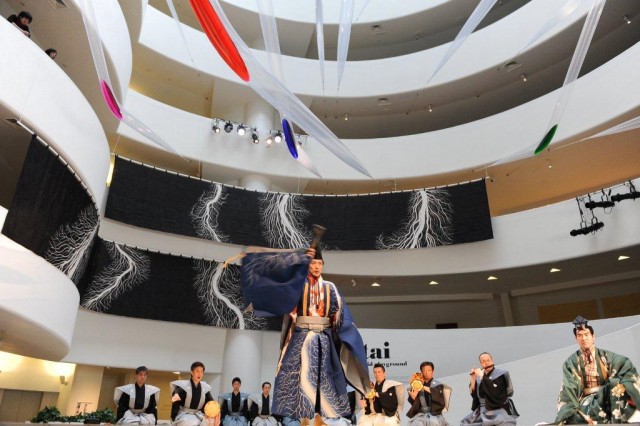
Striking production of SANBASO, DIVINE DANCE lights up the Guggenheim (photo by Enid Alvarez; © 2013 Solomon R. Guggenheim Foundation, New York)
Update: Slow and steady, performed with split-second timing, Sanbaso, divine dance is a striking piece, a highly stylized, precisely choreographed combination of music, vocalization, movement, architecture, and design, beautifully tailored to its surroundings in the Guggenheim rotunda. The mesmerizing performance begins with a noh music medley featuring drums and flute, a traditional sonic introduction that sets the mood for what follows. After the trio of musicians departs, the full cast enters, with Kazunori Takano as Senzai, Haruo Tsukizaki as Koken, and kyogen star Mansai Nomura as the title character, along with a slightly larger group of musicians and vocalists. They all proceed slowly down the spiral from the Guggenheim’s second floor, emerging from behind one of Hiroshi Sugimoto’s lightning-themed curtains and winding their way to the bare stage, which stands about three feet off the ground. As the musicians play — the earlier trio of Rokurobyoe Fujita on fue (flute), Atsushi Ueda on ko-tsuzumi (small hand drum), and Keinosuke Okura on o-tsuzumi (large hand drum) is joined by Yotaro Uzawa on ko-tsuzumi (lead hand drum), Kensaku Araki on waki-tsuzumi (second small hand drum), and a ji-utai (chorus) of Ren Naito, Hiroharu Fukata, and Shuichi Nakamura — a ritual takes place in which the senzai is presented with gold hand chimes, known as suzu, from a box held by the koken. Soon Sanbaso approaches the koken and is given a small, dark mask of an old man’s face that he puts on, then starts taking loud steps and shaking the chimes in unison with the drummers. Flashing his lightning-patterned blue robe designed by Sugimoto, he stops, jerks his head, then lifts and brings down a heavy foot, creating an echo that reverberates throughout the Guggenheim. Nomura is also wearing a tall, dark hat — similar to the one he wore in the two fantastical Onymoji films — that reflects light and the late Motonaga Sadamasa’s water tubes, which arc across the museum, in such a way that it looks like bolts of lightning are streaking down it. At times, Nomura’s foot stomps are like thunder, matching Rie Ono’s lighting that makes the bolts on Sugimoto’s curtains come alive, as if a storm has suddenly arrived. Having honored the gods, Sanbaso returns the mask and chimes to the koken, and the company prepares for the finale, after which they go back up the winding Guggenheim ramp and disappear behind the lightning curtains. It’s nearly impossible to take your eyes off Nomura, who inhabits his role like it’s part of his soul. He even adds a final flourish as he accepts the accolades of the delighted audience, which on Thursday night included Sugimoto as well as Cai Guo-Qiang, whose stunning “I Want to Believe” exhibition filled the Guggenheim five years ago.
VIDEO OF THE DAY: “NEVER DON’T STAY” BY KEVIN BOWE
Minneapolis native Kevin Bowe decided to become a musician after seeing one of the Replacements’ earliest gigs, blown away by the beautiful reckless abandon of the legendary Minnesota band. Years later Bowe, who wrote songs, produced, and/or played with Leiber and Stoller, Etta James, Kenny Wayne Shepherd, Jonny Lang, Alison Scott, Leo Kottke, Peter Case, John Mayall, the Proclaimers, Robben Ford, the Meat Puppets, and Freedy Johnston, got to become a Replacement, joining Paul Westerberg and Tommy Stinson on a four-track covers EP recorded this past September to help raise funds for former ’Mats guitarist Slim Dunlop, who suffered a stroke in February 2012. Now Bowe is back with his longtime band, the Okemah Prophets, on tour with their new disc, Natchez Trace, the follow-up to 2003’s Angels on the Freeway (Crosses on the Road) and 1999’s Restoration. The sixteen-song disc, made with Prophets Pete Anderson on drums and Steve Price on bass, along with contributions from Westerberg, Johnston, Chuck Prophet, Scarlet Rivera, Tim O’Regan, and Nels Cline, is a collection of countrified indie rock, pop, and blues, with such highlights as the rollicking “In Too Deep” and “Devil’s Garden,” the driving “Haven’t You Heard,” the horn-heavy “Everybody Lies,” the foot-stompin’ “Waitin’ for the Wheel” and “Just Restless,” and the Westerbergian “Never Don’t Stay” and “Gutters of Paradise.” (You can check out all the songs and more here.) Kevin Bowe + the Okemah Prophets will be at Rockwood Music Hall on March 26 at 7:00 (free), preceded by Jonathan Powell and followed by Caitlin Canty, and at the Rock Shop in Brooklyn on March 27 ($10) with Dear Comrade and A Is for Atom.
MICRO-BUDGET GENRE INVASION! BLOODY FIGHT IN IRON-ROCK VALLEY
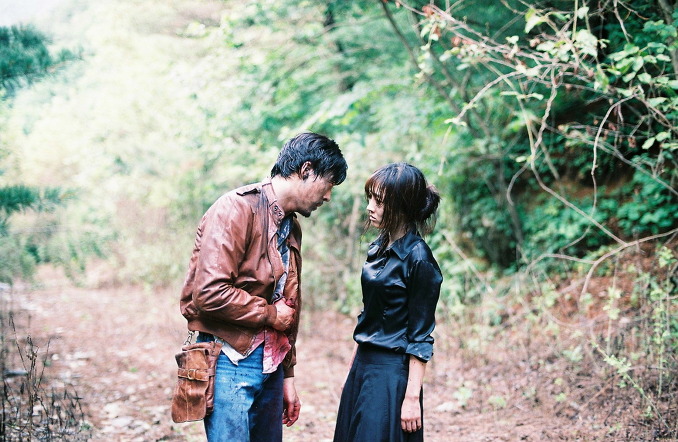
Lee Moo-saeng and Choi Ji-eun are after revenge in Ji Ha-jean’s debut thriller, BLOODY FIGHT IN IRON-ROCK VALLEY
KOREAN MOVIE NIGHT: BLOODY FIGHT IN IRON-ROCK VALLEY (CHEOLAM GYEKOKUI HYEOLTU) (Ji Ha-jean, 2011)
Tribeca Cinemas
54 Varick St. at Laight St.
Tuesday, March 26, free, 7:00
212-759-9550
www.koreanculture.org
www.tribecacinemas.com
 Writer-director Ji Ha-jean offers new twists on the Korean revenge thriller in Bloody Fight in Iron-Rock Valley. Winner of the European Fantastic Film Festival Asian Award for best Asian genre film and the Fujifilm Eterna Award for best Korean independent at the 2011 Puchon International Fantastic Film Festival in South Korea, Bloody Fight stars Lee Moo-saeng as a nameless antihero who is released from prison with vengeance on his mind. He sets out on his motorcycle, carrying with him a music box with a ballerina on top of it, determined to find the cold-blooded killers known as Ghostface and Ax who work for a gangster boss in a wheelchair and his drug-addled son. As he gets closer to his prey, coming upon gambling dens, a corrupt construction business, and a quiet monastery where a prostitute is staying, bits and pieces of his past are shown in flashback, slowly explaining the motive behind his spree. Filmed for thirty-five thousand dollars in a month in Gangwon province, Bloody Fight in Iron-Rock Valley combines such spaghetti Westerns as Once Upon a Time in the West and High Plains Drifter with such violent revenge films as Old Boy and Death Wish. Ji uses a wide range of weaponry throughout, including a nail gun, a blowtorch, and a unique little ax, in scenes that often involve torture as well as some head scratching, as Ji does not fill up the various plot holes and several inexplicable elements. Still, it’s a compelling revenge thriller that doesn’t try to be anything more than what it is. Bloody Fight in Iron-Rock Valley is screening for free March 26 at Tribeca Cinemas as part of the Korean Cultural Service Korean Movie Night series “Micro-Budget Genre Invasion!,” which continues April 16 with Oh Young-doo’s Invasion of Alien Bikini and April 30 with the four-part omnibus The Neighbor Zombie.
NICK CAVE: HEARD•NY
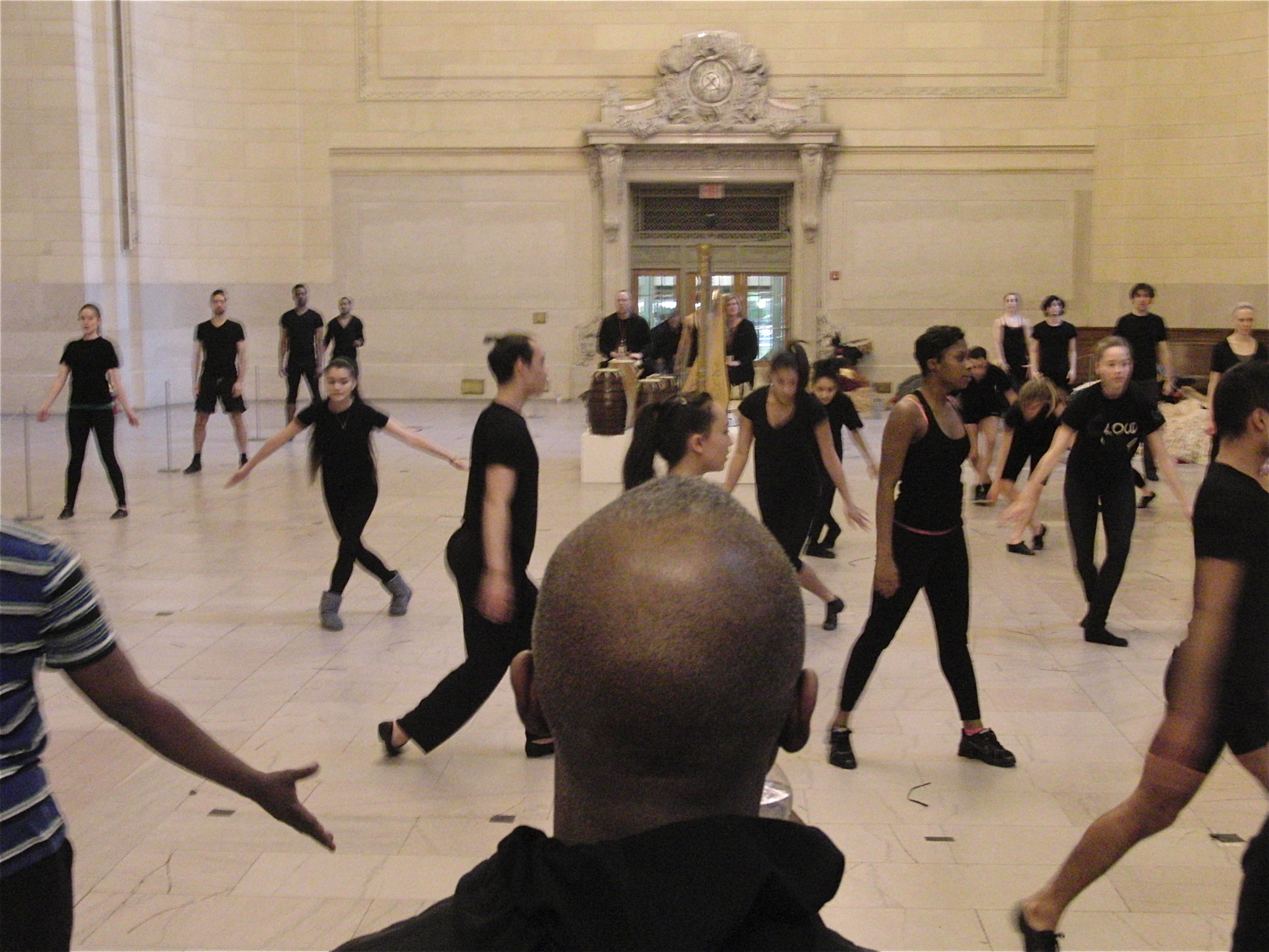
Artist Nick Cave watches a rehearsal of “Heard•NY” (sans horse costumes) in Vanderbilt Hall (photo by twi-ny/mdr)
Grand Central Terminal, Vanderbilt Hall
89 East 42nd St.between Lexington and Vanderbilt
March 25-31, free
Daily crossings at 11:00 and 2:00, daily tours at 3:30
www.creativetime.org
heard•ny rehearsal slideshow
Grand Central Terminal is famous for its cattle-like crowds — hence the overused cliché “It’s like Grand Central Station in here!” — but it’s about to take in a whole new kind of herd this week. Starting on Monday, March 25, and continuing through Sunday March 31, Nick Cave’s “Heard•NY” will add to all the hustle and bustle. The Missouri-born multidisciplinary artist, whose dual exhibits “Ever-After” at Jack Shainman and “For Now” at Mary Boone ran in Chelsea in the fall of 2011, is installing thirty of his life-size horse Soundsuits in Vanderbilt Hall, where they will be on view all week. But every day at 11:00 am and 2:00 pm, student dancers from the Ailey School will get inside the colorful suits and perform what are being called “Crossings,” making their through the world’s most famous train terminal in intricate movements developed by Cave and Chicago-based choreographer William Gill, with live music by harpists Shelley Burgon and Mary Lattimore and percussionists Robert Levin and Junior Wedderburn. (There will also be daily guided tours of the installation at 3:30.) The performances harken back to the days when horse-drawn carts were prevalent in the city, prior to the coming of the railways and automobiles. A collaboration between Creative Time and MTA Arts for Transit as part of Grand Central Terminal’s ongoing centennial celebration, “Heard•NY” continues Cave’s exploration of human and animal ritual behavior and social and cultural identity, using found and recycled materials to create sculpture, video, and combinations of the two. The artist will discuss his latest work in relation to masquerade, performance, and dreaming in public at a special presentation, “A Conversation with Nick Cave,” in the Metropolitan Museum of Art’s Bonnie J. Sacerdote Lecture Hall on March 29 at 6:00 (free with museum admission), with Cave, Creative Time curator Nato Thompson, and Met curator Alisa LaGamma. “A herd of horses has been unleashed in Grand Central Terminal,” Thompson poetically explains in a statement. “Grazing in Vanderbilt Hall, they move at a pace perhaps too slow for the needs of a commuter, seeming to ask us to slow down. To take a second. To look. . . . In the frantic pace of our contemporary age, in the monumental machine that is Grand Central Terminal, we are temporarily placed outside ourselves by crossing paths with Cave’s creations. We can observe these horses in the same way that we look upon our fellow travelers in the Main Concourse, sensing the texture of time and the dizzying visual seduction that is the pleasure and bewilderment of our contemporary moment.” People are always rushing through train stations, which primarily serve as weigh stations at the beginning, middle, or end of a journey, but “Heard•NY” should make everyone stop for a few minutes, take a deep breath, and enjoy the surrounding fun, taking advantage of where they are rather than hurrying to get where they are going. (Coincidentally, madman Australian musician Nick Cave is also in New York City this week, playing the Beacon Theatre March 28-30 with his longtime band, the Bad Seeds.)
CLASSICAL AT THE CORNELIA: BEETHOVEN BACH SHINNERS
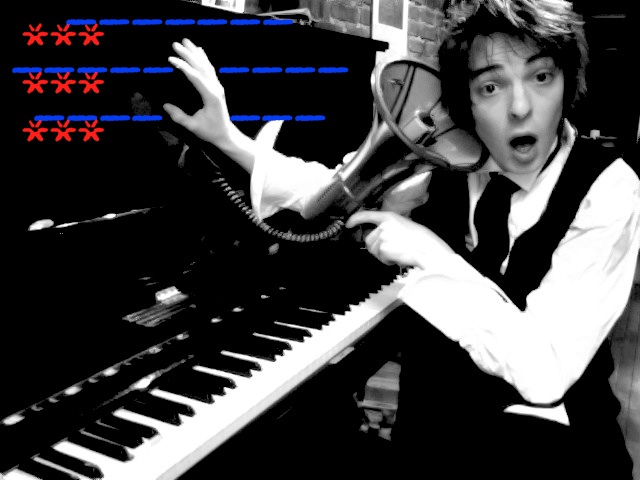
Evan Shinners promises to mix in a little bit of Passover along with Bach and Beethoven at Cornelia Street Café on March 25
Cornelia Street Café
29 Cornelia St.
Monday, March 25, $20 (includes one drink), 8:30
212-989-9319
corneliastreetcafe.com
www.facebook.com/evanshinners
It is traditional for the Passover seder to end with a series of songs sung by the whole mishpacha. Pianist extraordinaire Evan Shinners, who is bringing his unique take on classical and pop music to the Cornelia Street Café on March 25, the first night of Pesach, is promising that it will be “a perfect occasion to come down to the West Village to enjoy a seder led by Bach and me. There will be fugues on ‘Dayenu,’ the four duets will answer the Four Questions, and if these jokes have no effect on you, then you certainly have no excuse to miss it.” Born in Denver and based in New York City, Shinners has been playing piano since he was nine. He has performed for Pope John Paul II in Rome and President Barack Obama at the White House, and he has just returned from a sold-out tour of Europe, where he played original music as well as works by Bach and Beethoven. “Monday night is me in my element,” he explained in an e-mail, “an intimate space and an hour with you. . . . Sonatas by Ludwig, suites by Johann, song and dance by Evan.” We have no information on whether the self-described “poet and tummler” plans on hiding the afikoman as well.