
Orly Genger’s rope-based “Red, Yellow and Blue” winds through Madison Square Park (photo by twi-ny/mdr)
“Iron Maiden”: Larissa Goldston Gallery, 530 West 24th St. between Tenth & Eleventh Aves., through June 22, free, 212-206-7887, 11:00 am – 6:00 pm
“Red, Yellow and Blue”: Madison Square Park, through September 8, free
orly genger slideshow
New York City native Orly Genger has two very different, yet at the same time very similar, exhibits in her hometown right now. Through September 8, her sprawling “Red, Yellow and Blue” winds through Madison Square Park, melding with the green grass of summer to create simply lovely combinations of primary colors inspired by Barnett Newman’s series “Who’s Afraid of Red, Yellow and Blue.” The exhibit consists of three elongated structures composed of 1.4 million feet of hand-knotted rope, in three different parts of the north side of the park. Evoking playful fortresses as well as captivating waves, the works, which weigh more than one hundred thousand pounds and are covered in three thousand gallons of paint, invite visitors to sit on them or rest against them, offering respites from the surrounding traffic and the rest of the New York City maelstrom. They reference the knitting craze, a traditionally female-centric activity, while adding an inherent strength and power that goes beyond mere materiality. “I wanted to create a work that would impress in scale but still engage rather than intimidate,” she explains in a statement. “The repurposed rope brings with it the stories of different locations and by knotting it, a space is created for the words and thoughts of viewers in New York City to complete the work, creating a silent dialogue that waves along.” The bold primary colors create happy, uplifting sensations that help bring out the kid in people, while also dazzling actual kids, who have a ball running around the pieces.

Orly Genger’s miniatures are on view in a tiny room in Chelsea through June 22 (photo by twi-ny/mdr)
In conjunction with the spacious outdoor installation, Genger, who won the 2011 Rappaport Prize from the deCordova Sculpture Park and Museum, where “Red, Yellow and Blue” will be seen next — the first Mad. Sq. Art commission to travel — is also currently showing “Iron Maiden” in Larissa Goldston’s closet-size pop-up gallery in Chelsea, through June 22. The small exhibition begins with a pair of 2013 gold rope sculptures on white pedestals, the cast-bronze “Caught” and the rope “Sink Man,” which winds onto the floor, leading to a nearly claustrophobic back room where a table is populated by gold- and silver-colored miniatures that range from rope works to comical depictions of fantastical cartoonish figures. “Iron Maiden” offers quite a visual and physical contrast to “Red, Yellow and Blue,” yet both have an innocent intimacy that is a hallmark of Genger’s oeuvre. Perhaps unsurprisingly, Genger’s work has also inspired several jewelry collections by designer Jaclyn Mayer, including MSP, based on the Madison Square Park exhibition.


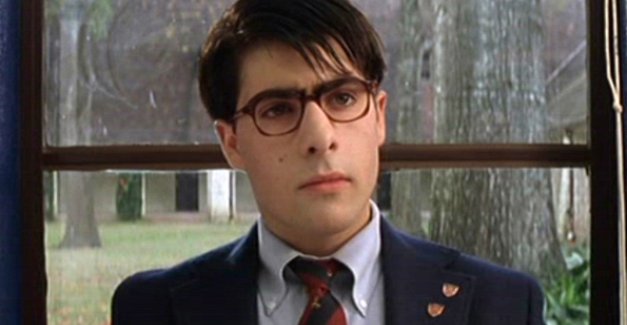
 Wes Anderson’s Rushmore is a dazzlingly dark, sublime masterpiece. Anderson (The Royal Tenenbaums, Moonrise Kingdom) created one of the all-time-great quirky indie antiheroes in Max Fischer, played with relish by Jason Schwartzman. Max is a troubled genius at the private Rushmore Academy, where his eccentricities make him somewhat of an outcast. His best friend is wealthy iconoclast Herman Blume (Bill Murray in a career-redefining role), but their relationship turns sour when it becomes apparent that they both have their hearts set on beautiful teacher Rosemary Cross (Olivia Williams). A unique take on disaffected youth, Rushmore, which also features such Anderson regulars as Luke Wilson and Seymour Cassel and was cowritten by Owen Wilson, helped launch a new wave of American independent cinema with its offbeat narrative and eclectic soundtrack, which includes songs by Donovan, the Rolling Stones, Django Reinhardt, Cat Stevens, Yves Montand, and the Faces, along with original material by Devo’s Mark Mothersbaugh. Rushmore is screening June 20 as part of the free Films in Tompkins programming in Tompkins Square Park and will be preceded by a live performance by the all-women’s AfroBrazilian Samba Reggae drumming band BatalaNYC. The summer series continues into August with such other fab films as Reservoir Dogs (with Amour Obscur), Easy Rider (with Main Street Quintet), The Big Lebowski (with Jade Pinto and the Yeahtones), and O Brother, Where Art Thou?, which was rescheduled for August 22 after getting rained out on June 13.
 Award-winning Haitian filmmaker Raoul Peck’s Fatal Assistance begins by posting remarkable numbers onscreen: In the wake of the devastating earthquake that hit his native country on January 12, 2010, there were 230,000 deaths, 300,000 wounded, and 1.5 million people homeless, with some 4,000 NGOs coming to Haiti to make use of a promised $11 billion in relief over a five-year period. But as Peck reveals, there is significant controversy over where the money is and how it’s being spent as the troubled Haitian people are still seeking proper health care and a place to live. “The line between intrusion, support, and aid is very fine,” says Jean-Max Bellerive, the Haitian prime minister at the time of the disaster, explaining that too many of the donors want to cherry-pick how their money is used. Bill Vastine, senior “debris” adviser for the Interim Commission for the Reconstruction of Haiti (CIRH), which was co-chaired by Bellerive and President Bill Clinton, responds, “The international community said they were gonna grant so many billions of dollars to Haiti. That didn’t mean we were gonna send so many billions of dollars to a bank account and let the Haitian government do with it as they will.” Somewhere in the middle is CIRH senior housing adviser Priscilla Phelps, who seems to be the only person who recognizes why the relief effort has turned into a disaster all its own; by the end of the film, she is struggling to hold back tears. A self-described “political radical,” Peck doesn’t play it neutral in Fatal Assistance, instead adding mournful music by Alexei Aigui, somber English narration by a male voice (Peck narrates the French-language version), and a female voice-over reading melodramatic “Dear friend” letters that poetically trash what is happening in Haiti. “Every few decades, the rich promise everything to the poor,” the male voice-over says. “The dream of eradication of poverty, disease, death remains a perpetual fantasy.” Even though Peck (Lumumba, 2010 Human Rights Watch Film Festival centerpiece