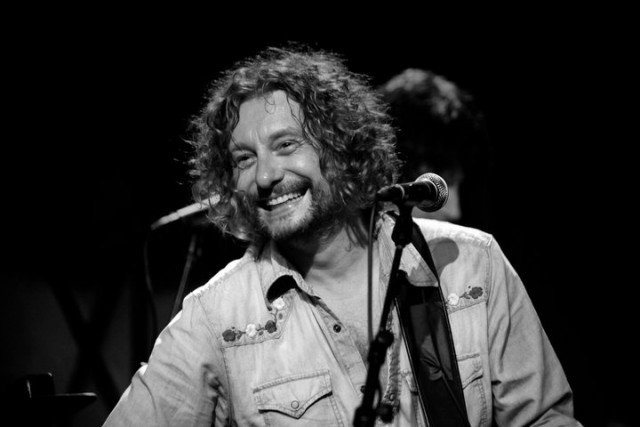
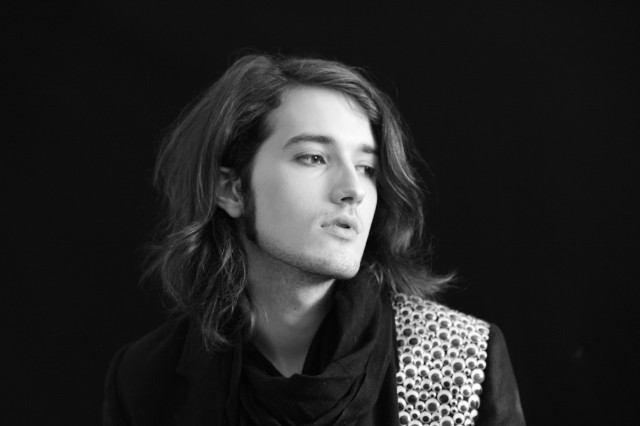
James Maddock will be playing a pair of free hometown shows this week as part of River to River Festival (photo by Seth Neuffer)
Tuesday, June 25, Brookfield Place Plaza, 220 Vesey St., free, 5:30
Thursday, June 27, One New York Plaza, free, 12:30 pm
www.rivertorivernyc.com
www.jamesmaddock.net
British-born, New York City-based singer-songwriter James Maddock will be playing a pair of free shows this week as part of the River to River Festival, June 25 at Brookfield Place Plaza at 5:30 and June 27 at One New York Plaza at 12:30. The fifty-year-old Maddock, who made a name for himself with his band Wood and their 1999 album Songs from Stamford Hill, will be featuring songs from his upcoming record, Another Life (Jullian, July 23), which was completely funded through donations via PledgeMusic. The follow-up to 2010’s Sunrise on Avenue C and 2011’s Wake Up & Dream, the new disc is an intimate collection of acoustic-based rootsy Americana songs dealing with love and loss and facing the second half of one’s life. “My future’s uncertain / My back starts hurting / as soon as I get out of bed / I listen to the news station / Trouble in the whole nation / Airplane passes by / Gotta be a mile high / Reminds me that I’m not a bird,” Maddock sings on the title track. Accompanied by Larry Campbell on guitar, violin, and mandolin, Tony Scherr on bass, Oli Rockberger and Raymond Angry on keyboards, Bashir Johnson on percussion, and Kenny Wolleson on drums, Maddock’s raspy voice evokes the likes of Rod Stewart and Tom Waits, his melodies reminiscent of Paul Simon, Cat Stevens, and even a touch of Bob Marley. On “Better on My Own,” Maddock tries to convince himself that he can survive a breakup. “Better on my own / Better on my own / I tell myself as I’m walking home,” he sings. “Better on my own / better on my own / I don’t know how to stop or how to carry on.” Most of the songs are of a personal nature, but Maddock takes on the controversial topic of PTSD on “That’s Heavy,” which features an Irish flourish. And album closer “Making Memories” goes even further, liberally borrowing from the Waterboys classic “And a Bang on the Ear” as Maddock confidently declares that “a better world is possible.” In fact, Maddock is friends with Waterboys leader Mike Scott; the two cowrote “Beautiful Now” on Wake Up and Dream, and Scott and Waterboys violinist Steve Wickham joined Maddock onstage this past November to sing Scott’s “Fisherman’s Blues” at Rockwood Music Hall. Maddock will also be at Swing the Teapot in Floral Park on June 28 before heading off on a brief Italian stint and returning for the Great South Bay Festival on July 20 and a gig at the Cutting Room on August 1.
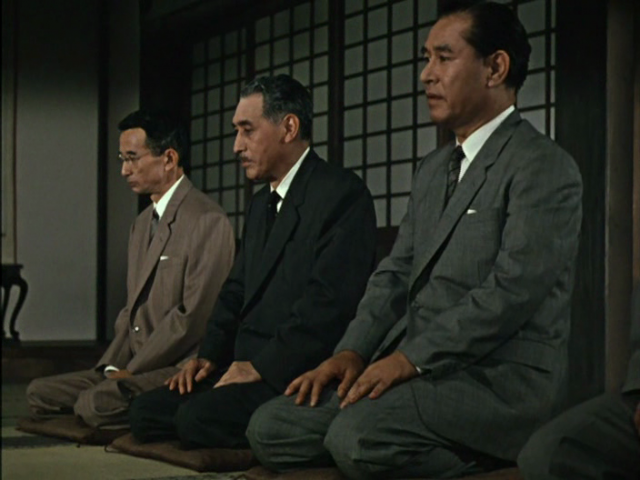
 Yasujirō Ozu revisits one of his greatest triumphs, 1949’s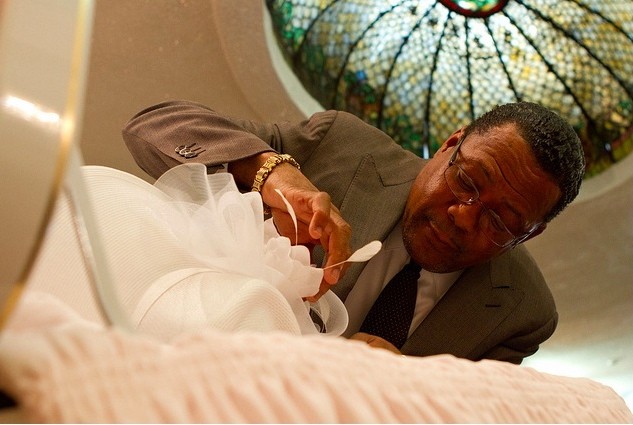
 Ever since he was a boy growing up on a farm in South Carolina, Isaiah Owens, the son of a sharecropper, has been burying the dead, beginning with small animals. As a teenager, he moved to New York City to train to become a funeral director, and for the last forty years, he has run the Owens Funeral Home in Harlem, where he continues to be a longtime pillar of the community, known for the great care and consideration he gives each family as they deal with the loss of a loved one. His company motto is “Where Beauty Softens Your Grief,” and that is evident throughout Christine Turner’s new documentary, Homegoings. Turner followed Owens over the course of four years as he and his staff — his wife, son, daughter, and mother all work in the family business — set up funerals for such clients as Walter Simons, whose octogenarian grandparents died within two days of each other; Queen Petra’s children, who want something special for their mother, including a horse and carriage; and Linda “Redd” Williams-Miller, who is planning her funeral in advance, wanting to get every detail right. And details are what Owens is all about, not only working hard to make sure the deceased look their best in their coffin but guaranteeing that every aspect of the funeral is handled with great thought and humanity. Owens narrates the documentary, sharing his views on life and death as well as the history of mourning in the African-American community. He is an inspiring man who is not what most people expect in funeral directors, who are often portrayed as being dark and morose. Williams-Miller says that homegoings should be “a happy occasion,” and Owens is ready, willing, and able to ensure that the experience is precisely what each individual family wants and needs. Homegoings, which was made in conjunction with PBS’s POV program and features an original score by Daniel Bernard Roumain, is having its U.S. theatrical premiere June 24-30 at the Maysles Cinema in Harlem, not very far from the Owens Funeral Home itself, as part of guest curator Livia Bloom’s continuing “Documentary in Bloom” series. The hour-long film will be preceded by StoryCorps Shorts: A Tenth Anniversary Program, a twenty-minute collection of animations the Rauch Brothers have made with the organization that has been amassing an oral history of America for a decade. The June 25 and 28 screenings of Homegoings will be followed by a Q&A with Turner and members of the cast, with a reception as well on June 28.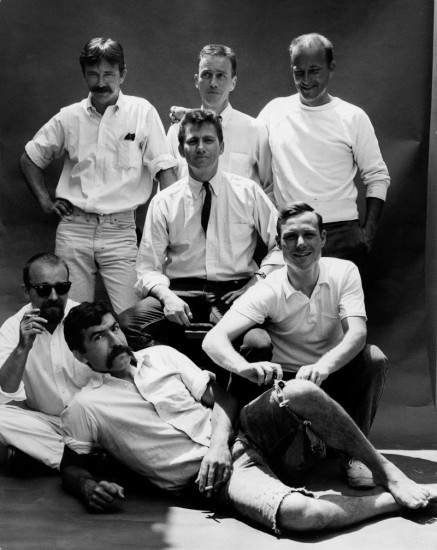
 While postwar modern art was exploding in New York in the 1950s, a small, close-knit group of artists were coming together in Los Angeles, exploring abstract expressionism in a tiny gallery called Ferus. Mixing archival footage with new interviews — shot in black and white to maintain the old-time, DIY feel — director Morgan Neville delves into the fascinating world of the L.A. art scene as seen through the Ferus Gallery, which was founded in 1957 by Walter Hopps, a medical-school dropout who looked and acted like a Fed, and assemblage artist Ed Kienholz. “The work was really special,” notes Dennis Hopper, enjoying a cigar with Dean Stockwell. “And there [were] a lot of really, really gifted artists that really have to be looked at again.” Among those artists were Wallace Berman, Ed Moses, Ed Ruscha, Robert Irwin, Craig Kauffman, John Baldessari, and Larry Bell. (All of them participate in the documentary except for Berman, who died in 1976.) In addition to featuring up-and-coming West Coast painters, sculptors, and conceptual artists, Ferus also hosted a Marcel Duchamp retrospective as well as early shows by Andy Warhol, Roy Lichtenstein, Jasper Johns, and other East Coast favorites. For nearly ten years, Hopps, Kienholz, and crafty businessman Irwin Blum kept Ferus going until various personality clashes led to its demise. The film includes an engaging roundtable from 2004 in which Neville brought many of the artists together to discuss what Ferus meant to them — and the art world in general. Behind a jazzy score, Neville also speaks with collectors, curators, and critics, putting it all into perspective. The Cool School, narrated by actor and photographer Jeff Bridges, is a fun-filled trip through a heretofore little-known part of postwar American art. The film is screening June 23 at 11:15 am as part of the Nitehawk Cinema’s monthly series “Art Seen” along with Paul McCarthy’s The Black and White Tapes, artist works by Kelly Kleinschrodt and Alexa Garrity, and Henry Joost and Ariel Schulman’s brilliant video bio A Brief History of John Baldessari, narrated by Tom Waits. The series continues July 20-21 with Neil Berkeley’s Beauty Is Embarrassing.
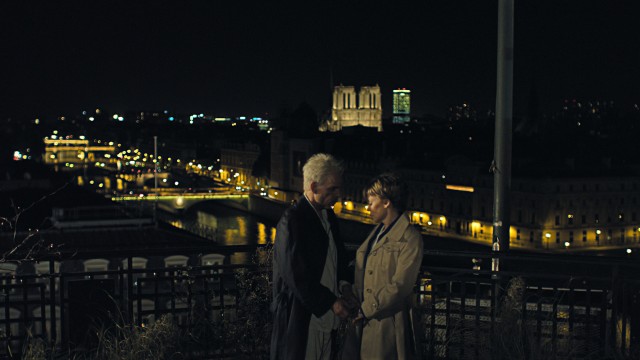
 French writer-director Léos Carax (