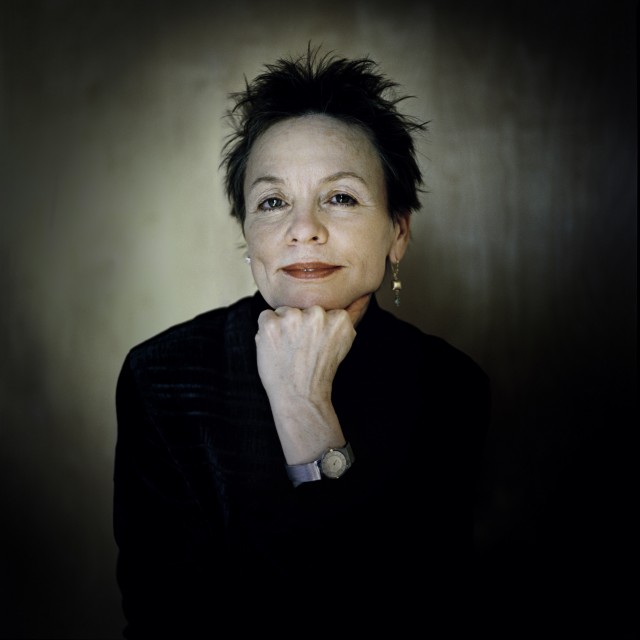
Suzanne Vega will perform her unique brand of intelligent indie folk pop for free in Madison Square Park on June 19
THE OVAL LAWN SERIES
Madison Square Park
Between 23rd & 26th St. and Madison & Fifth Aves.
Wednesday, June 19, free, 7:00
www.madisonsquarepark.org
www.suzannevega.com
Madison Square Park’s free annual summer music program kicks off in a big way on June 19 with a performance by longtime New York City favorite Suzanne Vega. The singer-songwriter broke through in the mid-1980s with her eponymous debut album and follow-up, Solitude Standing, displaying a supremely original, poetic take on indie folk pop with such songs as “Marlene on the Wall,” “Undertow,” “Tom’s Diner,” and “Luka,” which opened a national discussion on child abuse. During the first twenty-two years of her career, the California-born, New York-raised Vega, one of the early MTV stars, released seven well-regarded records, including 1992’s 99.9F°, 1996’s Nine Objects of Desire, and 2007’s Beauty & Crime, but she’s put out four records over the last two years as she reinvestigates her old songs and adds a few new and/or previously unreleased ones as part of her Close-Up series, which is divided thematically into Love Songs, People & Places, States of Being, and Songs of Family. Her performance in Madison Square Park is one of the highlights of the city’s free summer music season; she’ll be back for a ticketed residency July 3 and 10 at City Winery, after which she heads out to Japan, Lithuania, Russia, Estonia, Finland, Denmark, and Switzerland. Mad. Sq. Music’s Oval Lawn Series continues every Wednesday through August 7 with such other acts as Rene Marie’s “Experiment in Truth,” Ben Sollee, Erin McKeown, and Ivan Neville’s Dumpstaphunk.
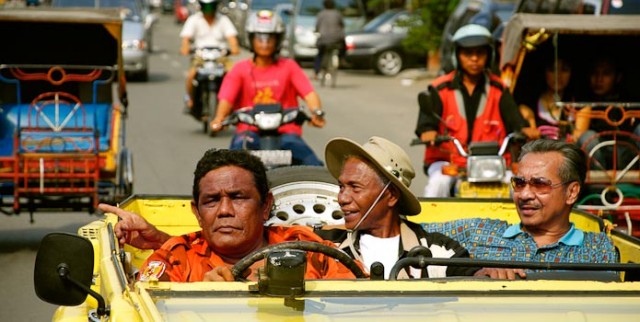
 Joshua Oppenheimer’s The Act of Killing is one of the most disturbing, and unusual, films ever made about genocide. In 1965-66, as many as a million supposed communists and enemies of the state were killed in the aftermath of a military coup in Indonesia. Nearly fifty years later, many of the murderers are still living in the very neighborhoods where they committed the atrocities, openly boasting about what they did, being celebrated on television talk shows, and even being asked to run for public office. While making The Globalization Tapes in Indonesia in 2004, the Texas-born Oppenheimer met some of these self-described gangsters and, struck by their brash, bold attitudes, decided to create a different kind of documentary. In addition to following them around as they go bowling, play golf, sing, and dance, proudly showing off how happy their lives are, Oppenheimer offered them the opportunity to tell their story as if it were a Hollywood movie. The men, whose love of American noir and Westerns heavily influenced the stylized killings they perpetrated, loved the idea and began to restage torture and murder scenes in great detail for the camera, getting in period costumes, putting on makeup, going over script details, reviewing the dailies, and playing both the violent criminals and their victims. The leader is master executioner Anwar Congo, who is perhaps the only one haunted by his deeds; although on the surface he is proud of what he did, he is tormented by constant nightmares. Such is not the case for the others, who laugh as they go over the gory details, especially paramilitary leader Herman Koto, Congo’s protégé and a man seemingly without a conscience. Meanwhile, fellow executioner Adi Zulkadry wonders whether telling the truth will actually negatively impact their legendary status. “Human rights! All this talk about ‘human rights’ pisses me off,” Congo says in one scene. “Back then there was no human rights.” Oppenheimer also depicts how frighteningly powerful the three-million-strong, government-connected Pancasila Youth is, ready to fight for the very same things that led to the genocide in the first place. It’s hard to comprehend how these men continue to walk free, and one can argue whether Oppenheimer should indeed be giving them the platform that he does. Watching these gangsters — or “free men,” as they like to call themselves, since the Indonesian word for gangster is “preman,” derived from the Dutch “vrijman” — artistically re-create scenes of horrific violence is both illuminating and infuriating on multiple levels that will leave viewers angry and incredulous. The Act of Killing is screening June 18 & 19 at the IFC Center as part of the “Focus on Asia” section of the 2013 Human Rights Watch Film Festival before opening July 19 at the Landmark Sunshine Cinema.
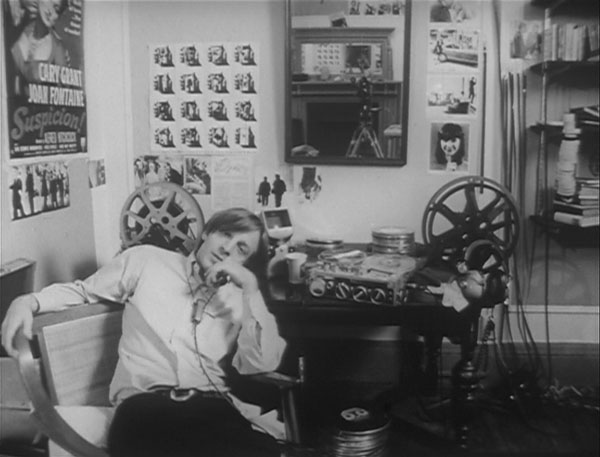
 New York City native Jim McBride’s directorial debut, the seminal David Holzman’s Diary, presages the YouTube Generation and reality shows in its depiction of a man obsessed with capturing virtually every moment of his life on camera. L. M. Kit Carson stars as David Holzman, a twenty-five-year-old unemployed schlemiel who goes everywhere with his 16mm camera, photographing the streets of his Upper West Side neighborhood, his model girlfriend, Penny (Eileen Dietz), and the woman in the apartment across the street. He also often turns the camera on himself as he discusses his life and moviemaking, directly and indirectly referencing Jean-Luc Godard, Alfred Hitchcock, Vincente Minnelli, Orson Welles, and Luchino Visconti. The black-and-white film is set up as if it’s a documentary, with choppy cuts and a barely audible soundtrack of a radio playing music and sharing the news of the day (July 1967). Holzman is happiest when he gets a new fish-eye lens and shows it off by carrying it through the streets above his head, offering a different perspective of the city. Like today’s world, McBride (The Big Easy, Great Balls of Fire!) brings up issues of voyeurism and privacy, because to Holzman, it’s as if nothing really exists unless it’s on film or television (or, now, the internet). Thus, it makes sense that David Holzman’s Diary is screening this week at Northside Film, on June 20 at 6:30 at UnionDocs. The four-day festival runs June 17-20 and includes some fifty films, from shorts in a DIY college competition to such full-length works as Franck Khalfoun’s Maniac with Elijah Wood, Aaron Schimberg’s Go Down Death, Jennie Livingston’s classic Paris Is Burning (with a live performance by House of Ladosha), Neil Jordan’s Byzantium, William Greaves’s 1968 Symbiopsychotaxiplasm Take One, and Nadia Szold’s Joy de V.