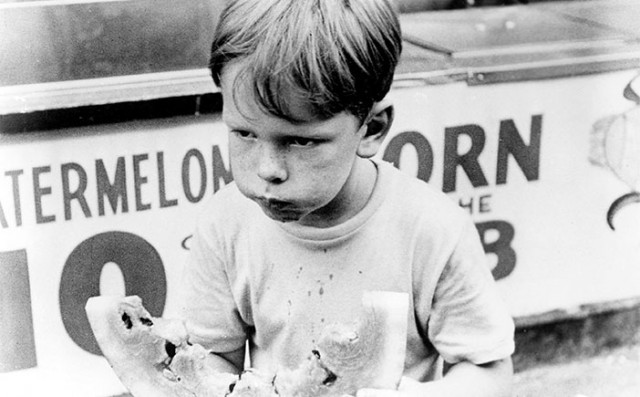
Sweikert Alley, Nathan’s Famous
1310 Surf Ave. at Stillwell Ave.
Wednesday July 4, free, 10:30 am
212-627-5766 www.nathansfamous.com www.ifoce.com
Last year, San Jose’s Joey Chestnut, the world’s number-one-ranked competitive eater, devoured sixty-eight hot dogs and buns in ten minutes, tying his record as he captured the Nathan’s Famous Fourth of July International Hot Dog Eating Contest for the sixth year in a row. The man with an edible last name has also won titles by ingesting chili, funnel cakes, gyoza, ice cream, corned beef and pastrami sandwiches, jalapeño poppers, tacos, tamales, and other delicacies, but he was shocked in May when Matthew “the Megatoad” Stonie defeated him by inhaling nine and a half pounds of deep-fried asparagus to Chestnut’s mere eight pounds in Stockton. Chestnut will be defending his hot-dog title in Sweikert Alley in Coney Island on July 4, along with women’s champ Sonya “the Black Widow” Thomas, against a yet-to-be-revealed roster of challengers. The festivities for the ninety-eighth annual battle begin at 10:30 with performances by the Brooklyn Community Choir, the Ken Gross Orchestra, the Skyriders, and longtime competitive-eating favorite Eric “Badlands” Booker, followed by the women going at it at 11:25 and then the men at 12 noon, with $40,000 in total prize money at stake. The competition will also be carried live on ESPN.
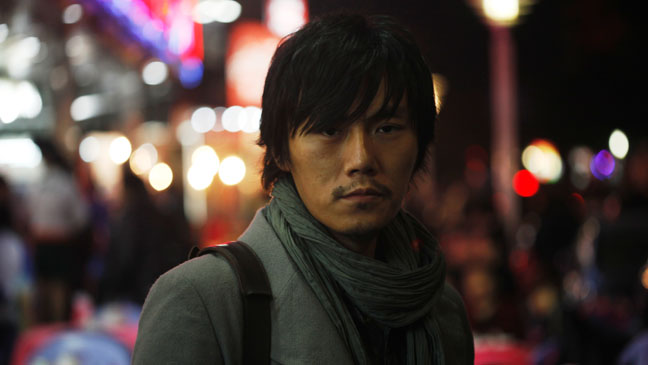
Yongzhao (Qin Hao) leads a double life in Lou Ye’s Asian Film Awards winner MYSTERY
MYSTERY (Lou Ye, 2012)
Film Society of Lincoln Center, Walter Reade Theater
165 West 65th St. at Amsterdam Ave.
Wednesday, July 3, 5:45, and Thursday, July 11, 1:00
212-875-5601 www.filmlinc.com www.wildbunch.biz
Controversial Sixth Generation director Lou Ye, who scored an international hit with 2000’s Suzhou River but whose work is regularly banned by Chinese authorities, officially returns to his homeland with Mystery, a complex tale that weaves together two main stories in the centrally located city of Wuhan. The dark film opens with a young woman, Xiaomin (Chang Fangyuan), getting mowed down by a car racing down the highway on a rainy night. Meanwhile, the married Sang Qi (Qi Xi) tells her new friend, single mother Lu Jie (Hao Lei), that she thinks her husband, Yongzhao (Qin Hao), is having an affair, but both women soon have more surprises in store for them as an intricate web of infidelity, betrayal, obsession, lies, class, cover-ups, and payoffs slowly reveals itself. Written by Lou (Purple Butterfly, Summer Palace) with Mei Feng and Yu Fan, Mystery, a selection of the Un Certain Regard sidebar at the 2012 Cannes Film Festival and Best Picture, Best Screenwriter, and Best Newcomer (Qi Xi) winner at the Asian Film Awards, is a moody, often uneasy work that tries too hard to confuse the viewer yet still manages to be compelling as things eventually come into focus. Inspired by three stories Mei found on the internet about changing social structures on the mainland, the film ends with unexpected violence that Lou was forced to edit for the Chinese release, leading him to remove his name from that version. Mystery is having its North American premiere July 3 & 11 at the Walter Reade Theater as part of the New York Asian Film Festival, which continues through July 15 with works from China, Japan, Thailand, Korea, the Philippines, and other countries, including Jang Cheol-Soo’s Secretly Greatly, Hideo Nakata’s The Complex, Jeong Byeong-Gil’s Confession of Murder, Johnnie To’s Drug War, Takashi Miike’s Lesson of the Evil, and a retrospective of Taiwanese director Tsai Yang-Ming.
They don’t come much cooler than Jean-Paul Belmondo and Jean Seberg in Jean-Luc Godard’s Nouvelle Vague classic
BREATHLESS (À BOUT DE SOUFFLE) (Jean-Luc Godard, 1960)
MoMA Film, Museum of Modern Art
11 West 53rd St. between Fifth & Sixth Aves.
Wednesday, July 3, and Thursday, July 4, 1:30
Tickets: $12, in person only, may be applied to museum admission within thirty days, same-day screenings free with museum admission, available at Film and Media Desk beginning at 9:30 am
212-708-9400 www.moma.org
The fiftieth-anniversary restoration of Jean-Luc Godard’s Nouvelle Vague classic, Breathless, which came out in 2010, will leave audiences, well, breathless. Godard’s first feature-length film, buoyed by an original treatment by François Truffaut and with Claude Chabrol serving as technical adviser, is as much about the cinema itself as it is about would-be small-time gangster Michel Poiccard (an iconic Jean-Paul Belmondo), an ultra-cool dude wandering from girl to girl in Paris, looking for extra helpings of sex and money and having trouble getting either. Along the way he steals a car and shoots a cop as if shooing away a fly before teaming up with Patricia Franchini (Jean Seberg) and heading out on the run. Godard references William Faulkner and Dashiell Hammett, Humphrey Bogart and Sam Fuller as Michel and Patricia make faces at each other, discuss death, and are chased by the police. Anarchy prevails, both in Belmondo’s character and the film as a whole, which can go off in any direction at any time. Godard himself shows up as the man who identifies Michel, and there are also cameos by New Wave directors Jean-Pierre Melville and Jacques Rivette. The beautiful restoration, supervised by the film’s director of photography, Raoul Coutard, also includes a new translation and subtitles that breathe new life into one of cinema’s greatest treasures. Breathless is screening July 3 & 4 at 1:30 as as part of MoMA’s continuing series “An Auteurist History of Film,” which continues in July with such other seminal international works as Satyajit Ray’s Teen Kanya, Blake Edwards’s Breakfast at Tiffany’s, and Truffaut’s Shoot the Piano Player.
Penelope Umbrico’s “Five Photographs of Rays of Sunlight in Grand Central Station, Grand Central Terminal . . .” collects iconic images of GCT (photo by twi-ny/mdr)
New York Transit Museum Gallery Annex
Grand Central Terminal Shuttle Passage
Shuttle Passage next to the Station Masters’ Office
Open daily through July 7, free, 8:00/10:00 am – 6:00/8:00 pm
718-694-1600 www.mta.info www.grandcentralterminal.com
Grand Central Terminal’s grand centennial celebration continues with the art exhibit “On Time / Grand Central at 100,” on view at the New York Transit Museum Gallery Annex through July 7. The display features painting, sculpture, video, photography, and poetry examining the historic structure, which was designed by the firms of Reed and Stern and Warren and Wetmore and preserved by Jacqueline Kennedy Onassis when major changes were being planned. The exhibit opens with Lothar Osterburg’s “Zeppelins Docking in Grand Central,” the very cool model he built in order to make the art card “Grand Central” that can be found in many subway cars. “Lift up your eyes from the moving hive / and you will see time circling / under a vault of stars and know just when and where you are,” explains a new poem by former U.S. poet laureate Billy Collins. Oliver Ayhens’s “Grand Central Inside Outside” cartoonishly twists the building. Alexander Chen’s “Conductor” reimagines the subway map as a musical composition. Jane Greengold’s “Lost and Found” consists of unclaimed items that have been collected by four generations of conductors from the Wenham family. Penelope Umbrico’s “Five Photographs of Rays of Sunlight in Grand Central Station, Grand Central Terminal . . .” brings together hundreds of versions from the internet of five iconic photos of sunlight streaming into GCT. Improv Everywhere’s short film “Frozen Grand Central” documents two minutes in 2008 when two hundred people suddenly came to a full stop inside the terminal, confusing and delighting everyone else. The exhibition also includes classic photographs by Paul Himmel, original MTA Arts for Transit prints by Marcos Chin, Sophie Blackall, Peter Sis, and Pop Chart Lab, Jim Campbell’s “Fundamental Interval (Commuters)” LED piece of shadowy figures moving through the terminal, and other works. And don’t miss Carolyn and Andy London’s five-minute video “Grand Central Diary,” shown in a corner outside the gallery annex, which takes actual conversations and animates them as if they’re being spoken by objects in and around Grand Central, from the clock itself to a mailbox, garbage cans, water fountains, benches, and more.
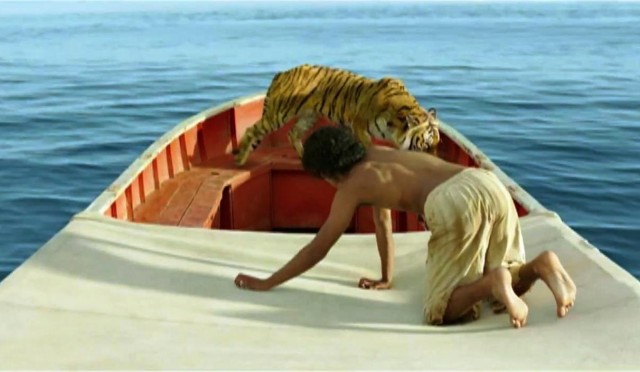
Based on Canadian author Yann Martel’s 2001 award-winning bestseller, Life of Pi has been adapted into an up-and-down movie that moves between the terribly boring “real” world and a man’s wildly thrilling tale of adventure on the high seas as a teenager. Rafe Sprall plays a novelist desperate for an idea to replace his abandoned book, so he has been pointed in the direction of Piscine “Pi” Patel (Indian movie star Irrfan Khan of Slumdog Millionaire). Pi proceeds to tell the writer about his childhood growing up in his family’s zoo, a time when the young boy (played through the years by Gautam Belur, Ayush Tandon, and Suraj Sharma) explored various religions, including Christianity, Hinduism, and Islam, in his search for a supreme being and meaning. But while his family is on a freighter on their way to a new life in Canada, the ship sinks, leaving Pi alone on a lifeboat with a zebra, a hyena, an orangutan, and a Bengal tiger named Richard Parker from the zoo. As Pi desperately struggles to survive, he develops a unique relationship with the tiger, having been taught by his father (Adil Hussain) that no matter how much he might think the tiger can gain emotional understanding and compassion, he is still a vicious killer. Directed by Ang Lee (Brokeback Mountain; Crouching Tiger, Hidden Dragon; The Ice Storm), the film borders on the spectacular when it is on the water, detailing the teenage Pi’s battle to stay alive, gorgeously shot by cinematographer Claudio Miranda and edited with heart-stopping excitement by regular Lee editor Tim Squyres. But the framing story, in which the elder Pi discusses his life and religious beliefs, is dry and dull, at times seeming like a vignette better left for an evangelistic cable channel. Perhaps Lee needed his longtime producing partner and cowriter, James Schamus, to help work his way through the muddle; Life of Pi is Lee’s first feature film made without Schamus, with the screenplay here written by David Magee (Finding Neverland). Nevertheless, Life of Pi still supplies enough thrills and chills, especially in 3D, to get past the psych 101 philosophizing. The film earned eleven Oscar nominations, including Best Picture, Best Director (won), Best Cinematography (won), Best Film Editing, Best Production Design, Best Visual Effects (won), Best Original Score (won), and Best Original Song. The film is screening July 1 at 8:30 as part of the free Williamsburg Summer Nights, Movies in the Park series in East River State Park.
Isabel Jeans stars as a woman unfairly wronged in Alfred Hithcock’s silent melodrama EASY VIRTUE
EASY VIRTUE (Alfred Hitchcock, 1927)
BAMcinématek, BAM Harvey Theater
651 Fulton St. between Ashland & Rockwell Pl.
Tuesday, July 2, $15, 7:30
Series runs June 29 – July 3
718-636-4100 www.bam.org
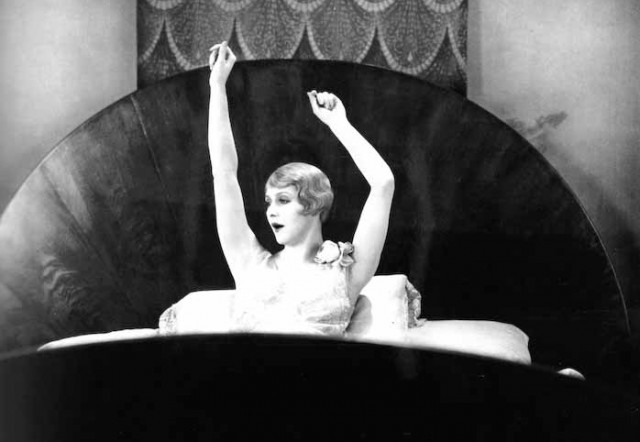
Loosely based on a Noël Coward play that was recently made into a film starring Colin Firth, Jessica Biel, and Kristin Scott Thomas, Alfred Hitchcock’s Easy Virtue is another of the Master of Suspense’s cleverly told melodramas, a risqué tale of a woman unfairly placed in a lurid situation. Isabel Jeans stars as Larita Filton, a loving wife whose husband, Aubrey (Franklin Dyall), has commissioned her portrait by painter Claude Robson (Eric Bransby Williams). Just as Claude makes a play for Larita, she fights him off and Aubrey walks in. He misinterprets the scene, shots ring out, the artist is dead, and Claude files a highly publicized divorce case in which Larita is found guilty of misconduct. Trying to put her notorious past behind her, she heads for the Mediterranean, where she meets John Whittaker (Robin Irvine), a wealthy mama’s boy who falls instantly in love with her and brings her back to his parents’ country estate. But once there, Whittaker’s nasty mother (Violet Farebrother) and conniving sisters (Dacia Deane and Dorothy Boyd) do everything they can to ruin the relationship, seeking to uncover Larita’s history while also attempting to put her son back together with longtime family friend Sarah (Enid Stamp Taylor). Easy Virtue, which features yet another Hitchcock blonde, is a gripping film about honesty, reputation, individuality, and character as an innocent woman is forced to face undeserved consequences in the superficial world of high society. Hitchcock, who makes his cameo holding a walking stick, gliding past Larita while she sits by a tennis court, includes several wonderful touches involving circles and ovals, from a close-up of a judge’s wig to a shot through a tennis racket’s strings to a dining room dominated by a group of elongated, haloed saints on one wall. Easy Virtue is also one of Hitchcock’s dourest silent melodramas, lacking any comic relief as a wronged woman desperately tries to right her life. A DCP restoration of Easy Virtue is being screened July 2 at 7:30 in the BAM Harvey Theater as part of “The Hitchcock 9,” with live piano music by Stephen Horne. The series continues through July 3 with such other rarely shown Hitchcock silents as The Farmer’s Wife, Downhill, Champagne, and The Pleasure Garden, Sir Alfred’s debut, which has been restored with an additional twenty minutes that have been missing since its initial release.
Joey Norton goes on the adventure of a lifetime in Coney Island in underground indie classic LITTLE FUGITIVE
LITTLE FUGITIVE (Morris Engel, Ray Ashley, and Ruth Orkin, 1953)
Coney Island
1001 Boardwalk West
Rained out: Monday, July 1, free, dusk
Rescheduled: Tuesday, August 27, free, dusk www.coneyislandfunguide.com
A summer night in Coney Island is the perfect time and place to see one of the most influential and important — and vastly entertaining — works to ever come out of the city, Morris Engel’s charming Little Fugitive. In celebration of the film’s sixtieth anniversary, the free summer series “Flicks on the Beach” is screening the newly restored 35mm print of the underground classic, which won the Silver Lion at the Venice Film Festival in 1953, was nominated for a Best Screenplay Oscar, and was entered into the National Film Registry in 1997. Written and directed with Ray Ashley and Ruth Orkin, Engel’s future wife, Little Fugitive follows the gritty, adorable exploits of seven-year-old wannabe cowboy Joey Norton (Richie Andrusco, in his only film role), who runs away to Coney Island after his older brother, Lennie (Richard Brewster), and his brother’s friends, Harry (Charlie Moss) and Charley (Tommy DeCanio), play a trick on the young boy, using ketchup to convince Joey that he accidentally killed Lennie. With their single mother (Winifred Cushing) off visiting their ailing mother, Joey heads out on his own, determined to escape the cops who are surely after him. But once he gets to Coney Island, he decides to take advantage of all the crazy things to be found on the beach, along the boardwalk, and in the surrounding area, including, if he can get the money, riding a real pony.
A no-budget black-and-white neo-Realist masterpiece shot by Engel with a specially designed lightweight camera that was often hidden so people didn’t know they were being filmed, Little Fugitive explores the many pleasures and pains of childhood and the innate value of home and family. As Joey wanders around Coney Island, he meets all levels of humanity, preparing him for the world that awaits as he grows older. Meanwhile, Engel gets into the nooks and crannies of the popular beach area, from gorgeous sunrises to beguiling shadows under the boardwalk. In creating their beautifully told tale, Engel, Ashley, and Orkin use both trained and nonprofessional actors, including Jay Williams as Jay, the sensitive pony ride man, and Will Lee, who went on to play Mr. Hooper on Sesame Street, as an understanding photographer, while Eddie Manson’s score continually references “Home on the Range.” Rough around the edges in all the right ways, Little Fugitive became a major influence on the French New Wave, with Truffaut himself singing its well-deserved praises. There’s really nothing quite like it, before or since.
 Controversial Sixth Generation director Lou Ye, who scored an international hit with 2000’s Suzhou River but whose work is regularly banned by Chinese authorities, officially returns to his homeland with Mystery, a complex tale that weaves together two main stories in the centrally located city of Wuhan. The dark film opens with a young woman, Xiaomin (Chang Fangyuan), getting mowed down by a car racing down the highway on a rainy night. Meanwhile, the married Sang Qi (Qi Xi) tells her new friend, single mother Lu Jie (Hao Lei), that she thinks her husband, Yongzhao (Qin Hao), is having an affair, but both women soon have more surprises in store for them as an intricate web of infidelity, betrayal, obsession, lies, class, cover-ups, and payoffs slowly reveals itself. Written by Lou (Purple Butterfly, Summer Palace) with Mei Feng and Yu Fan, Mystery, a selection of the Un Certain Regard sidebar at the 2012 Cannes Film Festival and Best Picture, Best Screenwriter, and Best Newcomer (Qi Xi) winner at the Asian Film Awards, is a moody, often uneasy work that tries too hard to confuse the viewer yet still manages to be compelling as things eventually come into focus. Inspired by three stories Mei found on the internet about changing social structures on the mainland, the film ends with unexpected violence that Lou was forced to edit for the Chinese release, leading him to remove his name from that version. Mystery is having its North American premiere July 3 & 11 at the Walter Reade Theater as part of the New York Asian Film Festival, which continues through July 15 with works from China, Japan, Thailand, Korea, the Philippines, and other countries, including Jang Cheol-Soo’s Secretly Greatly, Hideo Nakata’s The Complex, Jeong Byeong-Gil’s Confession of Murder, Johnnie To’s Drug War, Takashi Miike’s Lesson of the Evil, and a retrospective of Taiwanese director Tsai Yang-Ming.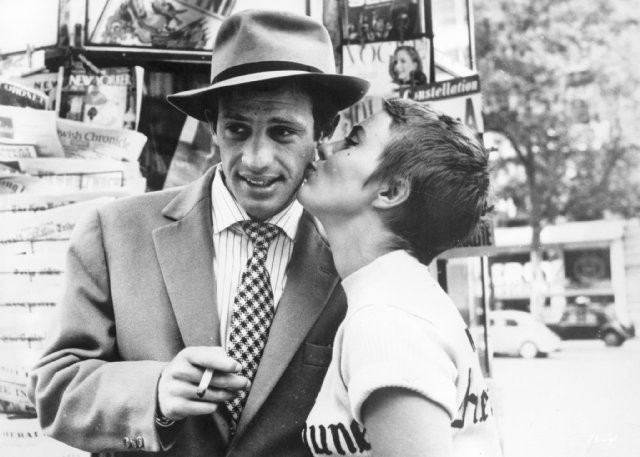
 The fiftieth-anniversary restoration of Jean-Luc Godard’s Nouvelle Vague classic, Breathless, which came out in 2010, will leave audiences, well, breathless. Godard’s first feature-length film, buoyed by an original treatment by François Truffaut and with Claude Chabrol serving as technical adviser, is as much about the cinema itself as it is about would-be small-time gangster Michel Poiccard (an iconic Jean-Paul Belmondo), an ultra-cool dude wandering from girl to girl in Paris, looking for extra helpings of sex and money and having trouble getting either. Along the way he steals a car and shoots a cop as if shooing away a fly before teaming up with Patricia Franchini (Jean Seberg) and heading out on the run. Godard references William Faulkner and Dashiell Hammett, Humphrey Bogart and Sam Fuller as Michel and Patricia make faces at each other, discuss death, and are chased by the police. Anarchy prevails, both in Belmondo’s character and the film as a whole, which can go off in any direction at any time. Godard himself shows up as the man who identifies Michel, and there are also cameos by New Wave directors Jean-Pierre Melville and Jacques Rivette. The beautiful restoration, supervised by the film’s director of photography, Raoul Coutard, also includes a new translation and subtitles that breathe new life into one of cinema’s greatest treasures. Breathless is screening July 3 & 4 at 1:30 as as part of MoMA’s continuing series “An Auteurist History of Film,” which continues in July with such other seminal international works as Satyajit Ray’s Teen Kanya, Blake Edwards’s Breakfast at Tiffany’s, and Truffaut’s Shoot the Piano Player.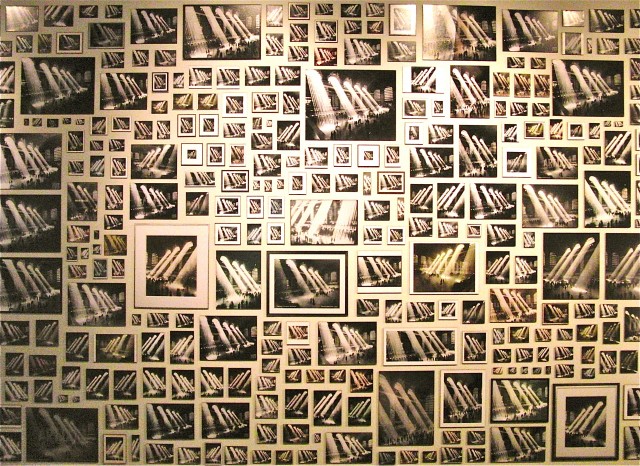
 Loosely based on a Noël Coward play that was recently made into a film starring Colin Firth, Jessica Biel, and Kristin Scott Thomas, Alfred Hitchcock’s Easy Virtue is another of the Master of Suspense’s cleverly told melodramas, a risqué tale of a woman unfairly placed in a lurid situation. Isabel Jeans stars as Larita Filton, a loving wife whose husband, Aubrey (Franklin Dyall), has commissioned her portrait by painter Claude Robson (Eric Bransby Williams). Just as Claude makes a play for Larita, she fights him off and Aubrey walks in. He misinterprets the scene, shots ring out, the artist is dead, and Claude files a highly publicized divorce case in which Larita is found guilty of misconduct. Trying to put her notorious past behind her, she heads for the Mediterranean, where she meets John Whittaker (Robin Irvine), a wealthy mama’s boy who falls instantly in love with her and brings her back to his parents’ country estate. But once there, Whittaker’s nasty mother (Violet Farebrother) and conniving sisters (Dacia Deane and Dorothy Boyd) do everything they can to ruin the relationship, seeking to uncover Larita’s history while also attempting to put her son back together with longtime family friend Sarah (Enid Stamp Taylor). Easy Virtue, which features yet another Hitchcock blonde, is a gripping film about honesty, reputation, individuality, and character as an innocent woman is forced to face undeserved consequences in the superficial world of high society. Hitchcock, who makes his cameo holding a walking stick, gliding past Larita while she sits by a tennis court, includes several wonderful touches involving circles and ovals, from a close-up of a judge’s wig to a shot through a tennis racket’s strings to a dining room dominated by a group of elongated, haloed saints on one wall. Easy Virtue is also one of Hitchcock’s dourest silent melodramas, lacking any comic relief as a wronged woman desperately tries to right her life. A DCP restoration of Easy Virtue is being screened July 2 at 7:30 in the BAM Harvey Theater as part of “The Hitchcock 9,” with live piano music by Stephen Horne. The series continues through July 3 with such other rarely shown Hitchcock silents as The Farmer’s Wife, Downhill, Champagne, and The Pleasure Garden, Sir Alfred’s debut, which has been restored with an additional twenty minutes that have been missing since its initial release.