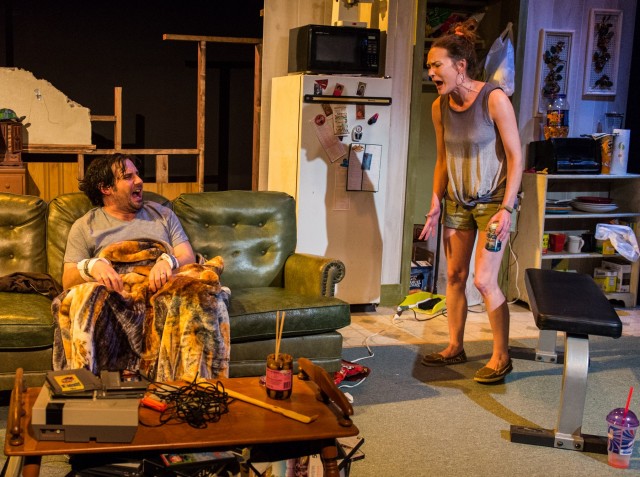
Rallis (Derek Ahonen) and Debbie (Sarah Lemp) are at the end of their ropes in RANTOUL AND DIE (photo by Russ Rowland)
Cherry Lane Studio Theatre
38 Commerce St.
Through July 20, $51
212-989-2020
www.amoralists.com
www.cherrylanetheatre.org
One of the city’s best, most adventurous and unpredictable theater companies is currently presenting the first must-see show of the summer. The Amoralists, whose recent successes include The Bad and the Better, which squeezed twenty-six actors playing thirty-three characters onto one set, and HotelMotel, a pair of plays that took place around a bed in a room in the Gershwin Hotel, are now dazzling audiences in the tiny Cherry Lane Studio Theatre with the outrageously funny Rantoul and Die. Written by Mike & Molly creator and executive producer Mark Roberts, the play begins as sad-sack Rallis (Amoralists cofounder and associate artistic director Derek Ahonen) is being chastised by his best friend, Gary (Amoralists cofounder and associate artistic director Matthew Pilieci), for having tried to kill himself because his wife, Debbie (Sarah Lemp), is divorcing him. “I’m just looking for the sufferin’ to end. Can you understand that?” the depressed, tenderhearted Rallis says in a hysterically funny and pathetically whiny singsong voice. “I got nine kinds of misery livin’ inside of me right now.” When Debbie returns from her job at the local Dairy Queen, she laces into poor Rallis as well. “It’s very simple, Rallis,” she says. “I see your face and I think of the time I have wasted. The life I have pissed away on you. That fills me with hatred and rage, and therefore my interactions with you are less than nurturing. You get it?” In the second act, the trio is joined by cat lover Callie (Vanessa Vaché), Debbie’s boss at the DQ, a young woman with a rather sickeningly sweet view of life. “We all got stuff we ain’t proud of. And we have things that we are proud of,” Carrie tells Debbie. “Which one you choose to focus on is the difference between a smile and a frown.” As plot twists ensue, this black comedy about so-called white trash grows both deeper and darker, but the belly laughs never stop coming.
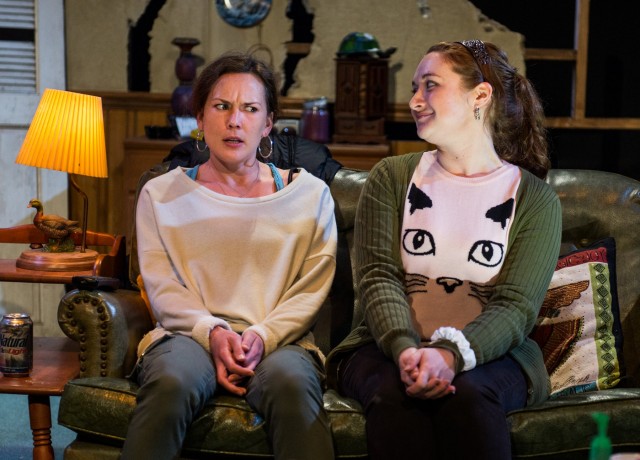
Debbie (Sarah Lemp) learns a little too much about her cat-loving DQ boss, Callie (Vanessa Vaché), in new Amoralists show (photo by Russ Rowland)
Over the course of about ninety minutes (plus intermission), director Jay Stull (Strange Heart, The Capables) includes four interludes in which each of the characters get their own moment to step out of the story and address the audience directly, sharing something personal or absurd that reveals more about them. The play is set in a ramshackle trailer-park-like house designed by Alfred Schatz, with garbage strewn all around and most of the action occurring on a couch at front and center. Each of the two acts starts with the lights out, with dialogue that ultimately equates sex with violence in clever, funny ways. The cast, all of whom have performed in multiple Amoralist productions previously — Ahonen also has written and/or directed several of the company’s shows — is clearly comfortable with one another, adding an involving intimacy in the already intimate Cherry Lane space. Roberts and Stull also avoid belittling the “white trash” setting, finding plenty of humor without being mean-spirited or obvious. Rantoul and Die is a brilliantly conceived and executed play that examines the darker side of human nature in beautifully bizarre ways.
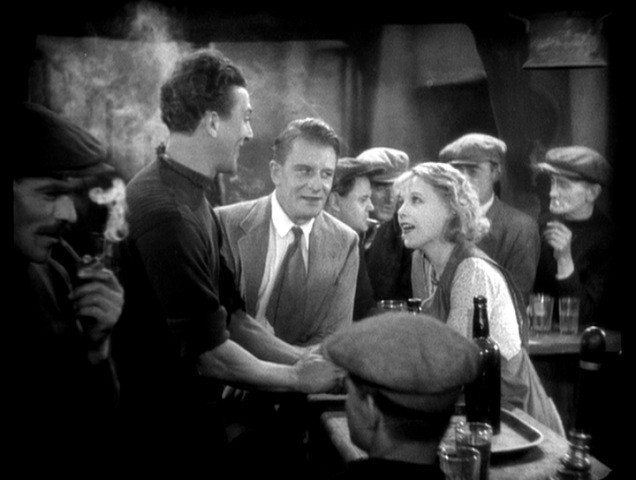
 An underrated gem, The Manxman is one of Alfred Hitchcock’s best early works from his British silent period. Based on an 1896 novel by Hall Caine, the 1929 melodrama, Hitchcock’s last fully silent film, tells the story of a romantic love triangle between two best friends, fisherman Pete Quilliam (Carl Brisson), lawyer Philip Christian (Malcolm Keen), and the woman they both love, Kate Cregeen (Anny Ondra). When Kate’s father, Caesar (Randle Ayrton), rejects Pete’s bid for his daughter’s hand, calling him a “penniless lout,” the fisherman takes to the sea, vowing to return from Africa a wealthy man worthy of marrying her. But while Pete is away, Philip and Kate grow much closer and contemplate whether they should break Kate’s promise to wait for Pete. When they learn of Pete’s death, they are ready to celebrate their love, but when the report turns out to be a mistake and Pete comes back a successful man, the drama heats up amid lies, betrayal, and public humiliation. Set on the Isle of Man but actually filmed on the Cornwall coast, The Manxman is a gripping tale that rises above pure soap opera through Hitchcock and cinematographer Jack E. Cox’s (Blackmail, The Lady Vanishes) intricate compositions and the German Expressionist acting style employed by Keen (The Lodger), who seems to have walked out of a von Sternberg film. One of the most memorable shots occurs with the three protagonists standing as if alone in Kate and Pete’s home, Kate leaning by a window, Philip bowed by the front door, and Pete in the front, head raised, confused and worried about the future. Hitchcock employs his mastery of suspense in several critical scenes, which he lets go on at length without any intertitles, forcing the viewer to wonder what is being said and then surprising them with what actually happens. Hitchcock sold The Manxman short when he told François Truffaut, “It was a very banal picture. . . . It was not a Hitchcock movie.” A DCP restoration of The Manxman, including a long-missing scene, is screening June 30 at 3:00 in the BAM Harvey Theater as part of “The Hitchcock 9,” with live music by pianist Stephen Horne and harpist Diana Rowan. The series continues through July 3 with such other rarely shown, carefully restored Hitchcock silents as The Farmer’s Wife, The Pleasure Garden, Downhill, and Champagne.

 For seven successive Tuesday nights, a serial killer who calls himself the Avenger has murdered a golden-haired woman. When a lodger (Ivor Novello) comes to rent a room from Mr. and Mrs. Bunting (Arthur Chesney and Marie Ault), the landlady soon suspects that the curious character might just be the murderer, especially when he shows an interest in their daughter, a golden-haired fashion model named Daisy (the one-named June), which angers Daisy’s beau, Joe (Malcolm Keen), a cop just assigned to the case. Based on a novel and play by Marie Belloc Lowndes, The Lodger is one of Alfred Hitchcock’s first films; he uses very few title cards in the silent work, allowing the story to tell itself. He serves up a heavy dose of red herrings in the Jack the Ripper-like tale, which drags on for quite a bit before shifting gears in the later scenes. The mediocre picture is most notable for the groundwork it lays for Hitchcock’s future films, investigating such themes as sexual obsession and innocent men on the run while displaying the director’s never-ending — and rather frightening — cinematic relationship with blondes. A DCP restoration of The Lodger is being screened June 30 at 7:30 in the BAM Harvey Theater as part of “The Hitchcock 9,” with live music by the Mont Alto Motion Picture Orchestra. The series continues through July 3 with such other rarely shown Hitchcock silents as The Manxman, The Pleasure Garden, Downhill, and Champagne.
 Based on the play by Charles Bennett, Alfred Hitchcock’s 1929 thriller, Blackmail, is both his last silent picture as well as his first sound film. The transition is evident from the very beginning, eight glorious minutes of a police arrest with incidental music only, highlighted by an unforgettable mirror shot (courtesy of cinematographer Jack E. Cox) as the cops close in on their suspect. After those opening moments, the film switches to a talkie in the nonsilent version, as New Scotland Yard detective Frank Webber (John Longden) gets into a fight with his girlfriend, Alice White (Anny Ondra, later to become the longtime Mrs. Max Schmeling), who goes off on a secret rendezvous with a slick artist named Crewe (Cyril Ritchard). When things go horribly wrong at Crewe’s studio, Frank assures Alice that he will help her, but slimy ex-con Tracy (Donald Calthrop) has other ideas, thinking he can use some inside information to make a small killing. After shooting the picture with sound — including having Ondra’s dialogue spoken off-screen by Joan Barry because Ondra’s Eastern European accent was too thick — Sir Alfred filmed some scenes over again in silence, resulting in two versions of this splendid psychological thriller, both laced with elements of German Expressionism and early film noir as well as flashes of Edgar Allan Poe’s “The Tell-Tale Heart” and Fyodor Dostoyevsky’s Crime and Punishment. Look for the Master of Suspense as the man on the subway being menaced by a young boy. A DCP restoration of the silent version of Blackmail is being screened June 29 at 7:30 in the BAM Harvey Theater as part of “The Hitchcock 9,” with live music by the Mont Alto Motion Picture Orchestra. The series continues through July 3 with such other rarely shown Hitchcock silents as The Manxman, The Pleasure Garden, Downhill, and Champagne.