twi-ny recommended events

UGO RONDINONE: HUMAN NATURE

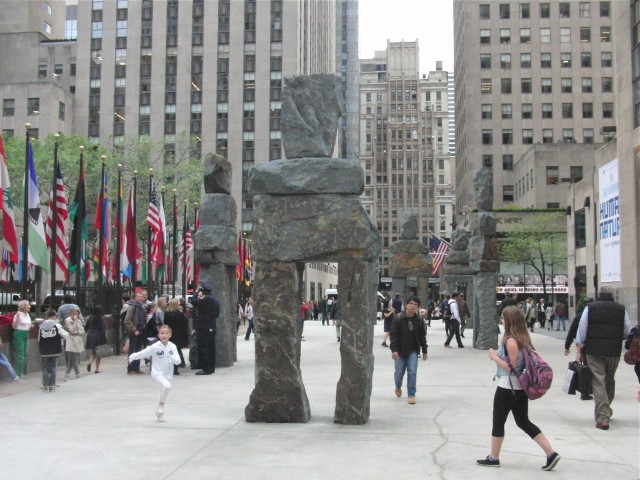
Ugo Rondinone’s “Human Nature” continues to rise at Rockefeller Center through July 7 (photo by twi-ny/mdr)

Ugo Rondinone’s “Human Nature” continues to rise at Rockefeller Center through July 7 (photo by twi-ny/mdr)

Rockefeller Center Plaza
Fifth & Sixth Aves. between 49th & 50th Sts.
Through July 7, free
www.publicartfund.org
human nature slideshow

For several years, Swiss-born installation artist Ugo Rondinone’s “Hell, Yes” rainbow could be seen on the facade of the New Museum downtown. For the last few months, the New York City-based Rondinone has filled Rockefeller Center Plaza with something quite different: giant rock sculptures standing tall, as if tourists posing for pictures at the historic site. Of course, tourists are actually having their pictures taken standing in front of the imposing yet seemingly friendly objects, which rise between sixteen and twenty feet high and weigh up to fifteen tons each. The nine figures are made of blocks of bluestone rock from northern Pennsylvania, and they do indeed appear to contain human characteristics, although more from the, er, stone age. Over time, they even appear to have weathered somewhat, rusting as if growing old. “The stone figure is the most archetypal representation of the human form, an elemental symbol of the human spirit, connected to the earth yet mythic in the imagination,” Rondinone said about the work, a project of the Public Art Fund. “The image of the figure belongs to nobody, is timeless, and universal.” Visitors can touch the sculptures, walk between their massive legs, and marvel at their unique shadows that fill the popular space. Smaller versions of these rock-people were recently on view at the Gladstone Gallery in Chelsea, in an exhibition titled “soul,” but this grouping takes it all to another level.

DO IT (OUTSIDE)

(photo by twi-ny/mdr)

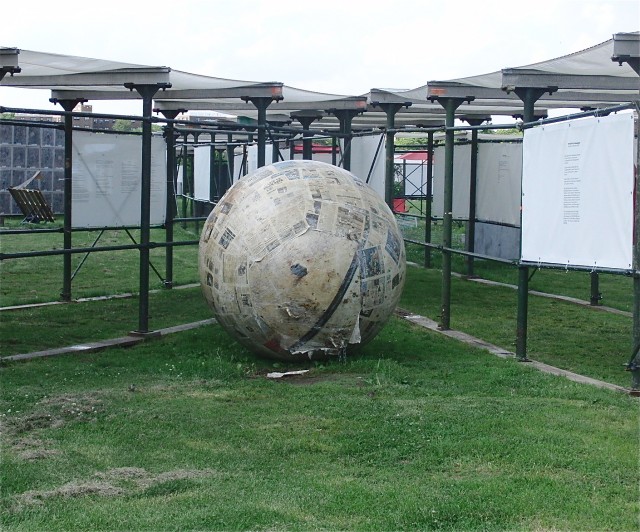
Michelangelo Pistoletto’s “Sculpture for Strolling” serves as a kind of centerpiece of “do it (outside)” exhibition at Socrates Sculpture Park (photo by twi-ny/mdr)

Socrates Sculpture Park
32-01 Vernon Blvd.
Through July 7, free
718-956-1819
www.socratessculpturepark.org

Art is usually not about following the rules, but the “do it” series of international exhibitions is indeed based on specific instructions laid out by an ever-growing number of established artists. Twenty years ago, artists Christian Boltanski and Bertrand Lavier and curator Hans Ulrich Obrist came up with an idea for an evolving, perennially in-progress exhibition in which these instructions would be interpreted by emerging artists and community groups in local displays. Even the rules have rules, including “There will be no artist-created ‘original’ and “Each interpreted instruction must be fully documented.” The latest such show continues through this weekend at Socrates Sculpture Park, where the very first fully outdoor iteration of “do it” in a public venue opened in May. Set in a white-tented walkway designed by Christoff : Finio Architecture, “do it (outside)” features instructions from more than sixty artists, some of which are meant specifically for the viewer to enact, and others that are interpreted in the park, but all of which are meant to exist only for the length of the show. Lars Fisk has constructed a trio of Ai Weiwei’s “CCTV Sprays,” which can spray-paint over surveillance cameras. Becky Sellinger realizes Paul McCarthy’s backyard trench of silver buckets and body parts used as paintbrushes. An unidentified artist has created Michelangelo Pistoletto’s “Sculpture for Strolling,” consisting of wet newspapers formed into a giant sphere; if someone wants to keep the object, they must wire $3,000 into a foreign bank account. Anyone can rent Anibal López’s “For Rent” sign for $20 a day, as long as they replace it with a nondigital picture of it.

Grayson Revoir followed Darren Bader instructions to “glue a [rectangular] table to the sky [table top up, somewhere not too close to the sky’s zenith]” (photo by twi-ny/mdr)

Grayson Revoir followed Darren Bader instructions to “glue a [rectangular] table to the sky [table top up, somewhere not too close to the sky’s zenith]” (photo by twi-ny/mdr)

Katie Mangiardi danced with a large piece of chalk as per Joan Jonas’s “Instruction.” Grayson Revoir built Darren Bader’s description of gluing a table to the sky, cleverly using a mirrored surface. Jory Rabinovitz created David Lynch’s “Do It: How to Make a Ricky Board,” which comes with a poem from the filmmaker. Shaun Leonardo’s interpretation of Bruce Nauman’s “Body Pressure” asks that you press yourself against a cement wall until your mind removes the wall; “This may become a very erotic exercise,” Nauman points out. Ernesto Neto’s “Watching birds fly, the game of the three points” encourages visitors to follow the flight of birds flying above, noting, “flying insects are pretty good too, a bit more nervous though.” There are also instructions from Tracey Emin, John Baldessari, Sol LeWitt, Joan Jonas, Anna Halprin, Yoko Ono, Rivane Neuenschwander, Felix Gonzalez-Torres, William Forsythe, Tacita Dean, Christian Marclay, Robert Morris, Martha Rosler, Tomas Saraceno, Nancy Spero, and others, some more philosophical and less physical than others. The show comes down on Sunday, July 7, when it will have to follow rule number 5: “At the end of each do it exhibition the presenting institution is obliged to destroy the artworks and the instructions from which they were created, thus removing the possibility that do it artworks can become standing exhibition pieces or fetishes.” (Also on view in the park right now are Heather Rowe’s “Beyond the Hedges [Slivered Gazebo],” Chitra Ganesh’s “Broadway Billboard: Her Nuclear Waters,” and Toshihiro Oki architect pc’s “FOLLY: tree wood.”)
FIRST SATURDAY: REMIXING THE AMERICAN STORY

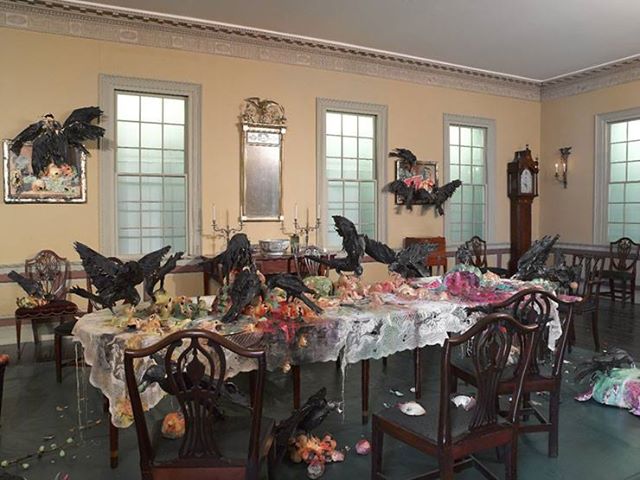
Valerie Hegarty, “Still Life with Peaches, Pear, Grapes and Crows”; “Still Life with Watermelon, Peaches and Crows”; and “Table Cloth with Fruit and Crows,” canvas, stretcher, paper, acrylic paint, foam, papier-mâché, wire, glue, gold foil, epoxy, fabric, thread, dimensions variable, in “Dining Room, Cane Acres Plantation, Summerville, South Carolina” (photo by Brooklyn Museum)

Valerie Hegarty, “Still Life with Peaches, Pear, Grapes and Crows”; “Still Life with Watermelon, Peaches and Crows”; and “Table Cloth with Fruit and Crows,” canvas, stretcher, paper, acrylic paint, foam, papier-mâché, wire, glue, gold foil, epoxy, fabric, thread, dimensions variable, in “Dining Room, Cane Acres Plantation, Summerville, South Carolina” (photo by Brooklyn Museum)

Brooklyn Museum
200 Eastern Parkway at Washington St.
Saturday, July 6, free, 5:00 – 11:00 (some events require free tickets distributed in advance at the Visitor Center)
212-864-5400
www.brooklynmuseum.org

For its free First Saturday program during the July 4 weekend, the Brooklyn Museum looks back at American history through dance, music, art, literature, and film. “Remixing the American Story” includes live performances by the Hungry March Band, Michael Hill’s Blues Mob, Frankie Rose, the Brown Bag All Stars, and the Redhawk Native American Arts Council, pop-up gallery talks, a dance workshop, a Forum Project discussion on current events, a poetry slam with the Nuyorican Poets Café, a photo booth, sketching of live models based on portraits in the “American Identities: A New Look” exhibition, and screenings of Michael and Timothy Rauch’s StoryCorps’ animated shorts, celebrating the tenth anniversary of the organization that is collecting an oral history of the country. In addition, artist Valerie Hegarty will give a talk about “Alternative Histories,” her fascinating interventions into three of the museum’s period rooms, which have been seemingly destroyed by a murder of crows. The galleries will remain open late so visitors can also check out “John Singer Sargent Watercolors,” “The Bruce High Quality Foundation: Ode to Joy,” “LaToya Ruby Frazier: A Haunted Capital,” “Käthe Kollwitz: Prints from the ‘War’ and ‘Death’ Portfolios,” “‘Workt by Hand’: Hidden Labor and Historical Quilts,” “Gravity and Grace: Monumental Works by El Anatsui,” “Raw/Cooked: Caitlin Cherry,” and other exhibitions.

12 ANGRY MEN

12 ANGRY MEN

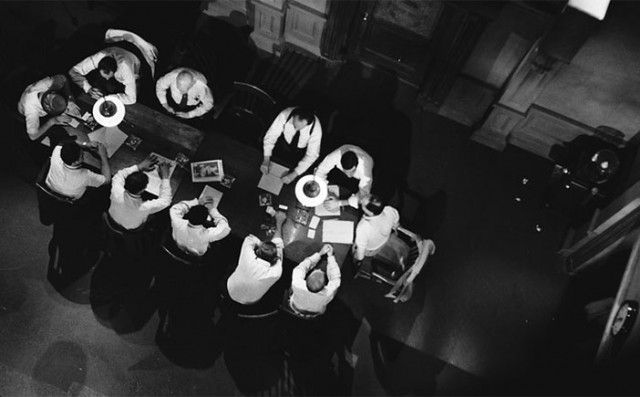
Sidney Lumet’s 12 ANGRY MEN explores the consciences and more of a dozen jurors deciding a murder case

12 ANGRY MEN (Sidney Lumet, 1957)
Film Forum
209 West Houston St.
July 5-11
212-727-8110
www.filmforum.org

The fate of an eighteen-year-old boy charged with the murder of his father is at stake in Sidney Lumet’s first film, the gripping, genre-defining 12 Angry Men. After a series of establishing shots, a judge sends a dozen New Yorkers into the jurors room, where they need to come to a unanimous verdict that could lead to the execution of the teen. Over the course of about ninety minutes, an all-star cast examines and reexamines the case — and their own personal biases — as the heat increases, both literally and figuratively. At first, the nameless dozen men make small talk, trying to be friendly, but it’s not long before some of them are at others’ throats, primarily the gruff Lee J. Cobb, who has it in for the calm and thoughtful Henry Fonda, who is ready to stand alone if necessary for what he believes in. The other uniformly excellent actors playing a very specific cross-section of white, male America are John Fiedler, Martin Balsam, Robert Webber, E. G. Marshall, Jack Klugman, Edward Binns, Jack Warden, Ed Begley, Joseph Sweeney, and George Voskovec. “I tell you, we were lucky to get a murder case,” Webber tells Fonda, but he won’t feel the same as the tension reaches near-violent proportions. 12 Angry Men is a searing examination of the criminal justice system as well as basic human instincts, behavior, and common decency. The Philadelphia-born Lumet, whose parents were both in the Yiddish theater, is able to tell the story in cinematic ways despite its taking place mostly in one small, sweaty room, letting the intense acting drive the narrative; the director, who was nominated for an Oscar for the film, would go on to make such other classic New York City dramas as The Pawnbroker, The Anderson Tapes, Serpico, Dog Day Afternoon, and Prince of the City. Nominated for a Best Picture Oscar and winner of the Golden Bear at Berlin, 12 Angry Men, based on an original teleplay by Reginald Rose, will be presented in a DCP restoration at Film Forum July 5-11.
JODY OBERFELDER DANCE PROJECTS: 4CHAMBERS

4chambers

4CHAMBERS
Governors Island, Officers House #15
Saturday & Sunday, July 6-21, free with advance RSVP, 11:30 am, 1:00 pm. 2:30, 4:00, 5:30
www.govisland.com
www.jodyoberfelder.com

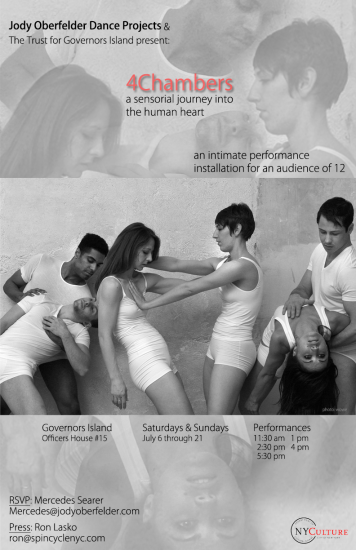
Following a successful Kickstarter campaign, choreographer and filmmaker Jody Oberfelder (Throb, Re-Dress, Come Sit Stay) and her Dance Projects company are ready to present the opening of their latest piece, the site-specific 4Chambers. Six dancers will lead an audience of twelve through hallways, corridors, and four main rooms of Officers’ House #15 on Governors Island, equating the human heart with that of the structure, which boasts a historic past. Oberfelder has reimagined the ghostly quarters as the circulatory system, with the chambers representing the visual, the physical, the synaptic, and the pulsing. Meanwhile, the “artery of knowledge” features films and scientific displays about the heart. “We want the audience to feel their own hearts, to feel something inside, something you can’t see or touch,” Oberfelder says about the work, which she calls “a sensorial journey into the human heart.” The multimedia piece will be performed live by Michele Jongeneel, Mary Madsen, Zachary Denison, Jake Szczypek, Joey Kipp, and Mercedes Searer; appearing in the films are Edward Einhorn, Ishmael Houston Jones, Dr. Wendy Suzuki, Dr. Andre Fenton, Kathryn Merry, Sarah Parton, Lonnie Poupard, ChristinaNoel Reaves, and Jessica Weiss. Juergen Riehm designed the set, with music by Andy Akiho, Richard Einhorn, Matt McBane, and Jonathan Melville Pratt and videos by Jason Bahling and Jake Witlen. Admission is free, but advance RSVP is required; two more preview performances are scheduled for July 5 at 12 noon and 1:30, after which 4Chambers runs Saturdays and Sundays, July 6-21, at 11:30, 1:00, 2:30, 4:00, and 5:30.

SAY A LITTLE PRAYER: THE TREASURE OF THE SIERRA MADRE

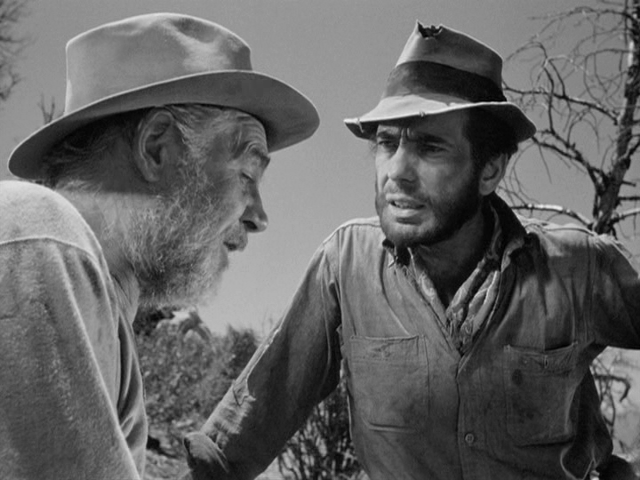
Howard (Walter Huston) and Dobbs (Humphrey Bogart) have differing views on gold in classic American Western

Howard (Walter Huston) and Dobbs (Humphrey Bogart) have differing views about wealth and success in classic American Western

CABARET CINEMA: THE TREASURE OF THE SIERRA MADRE (John Huston, 1948)
Rubin Museum of Art
150 West 17th St. at Seventh Ave.
Friday, July 5, free with $7 bar minimum, 9:30
212-620-5000
www.rmanyc.org

“I know what gold does to men’s souls,” crusty old prospector Howard (Walter Huston) says early on in the classic 1948 Western The Treasure of the Sierra Madre. Written and directed by Walter’s son, John, the psychological tale of greed and paranoia stars Humphrey Bogart as Fred C. Dobbs and Tim Holt as Bob Curtin, a pair of penniless drifters in Tampico, Mexico, who join up with Howard to go after gold in the mountains, where they face not only the elements but bandits, thieves, and their own fears. And once they do find a potential source of wealth, their budding relationship starts to turn toxic, primarily as Dobbs grows suspicious of everything and everyone that comes close to him. Based on the novel by B. Traven, The Treasure of the Sierra Madre is masterfully told by Huston, who also directed Bogart in The Maltese Falcon, Across the Pacific, Key Largo, The African Queen, and Beat the Devil. This is a different kind of Bogie, constantly peering over his shoulder, not nearly as cool as he usually is. He even looks different, especially after getting a haircut and then growing a beard and mustache out in the desert. Huston, who also plays the man in the white suit who gives change to Dobbs, won Oscars for Best Director and Best Adapted Screenplay, and his father won for Best Supporting Oscar; the film lost Best Picture to Laurence Olivier’s Hamlet. It all plays out like a kind of heist movie, with an unforgettable ending that perfectly captures Howard’s surprising Zen-like spirit. And yes, this is the film in which Gold Hat (Alfonso Bedoya) utters that immortal phrase, “Badges? We ain’t got no badges. We don’t need no badges! I don’t have to show you any stinkin’ badges!” The Treasure of the Sierra Madre is screening July 5 as part of the Rubin Museum’s Cabaret Cinema series “Say a Little Prayer,” held in conjunction with the exhibition “Count Your Blessings,” which opens August 2 and explores the use of prayer beads in various Buddhist traditions. The series continues through August 30 with such other great films as Billy Wilder’s Ace in the Hole, Fred Zinnemann’s A Man for All Seasons, and Ingmar Bergman’s The Magician.

MACY’S FOURTH OF JULY FIREWORKS: LIGHT IT UP

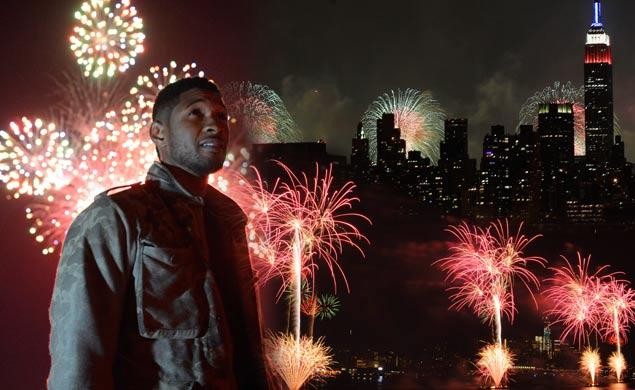
Usher will help usher in America’s 237th birthday by curating fireworks show (photo by Kevin Mazur / Getty Images / Macy’s Inc.)

Usher will help usher in America’s 237th birthday by guest-curating fireworks show (photo by Kevin Mazur / Getty Images / Macy’s Inc.)

Televised live on NBC-TV
Broadcast live on WINS 1010 and Z-100
Thursday, July 4, free, 9:20 pm (approx.)
212-494-4495
www.macys.com

For some unknown reason, our building couldn’t wait just a few more days before beginning renovations on the roof deck, denying us our annual great view of the Macy’s Fourth of July Fireworks display. Things are being done a little differently this year, as Macy’s has hired its first-ever guest curator, handing the reins over to R&B star Usher, who put together the music and also worked with Pyro Spectaculars by Souza to develop new pyrotechnic effects. The award-winning singer of such hits as “Burn,” “Yeah,” “Lovers & Friends,” and “OMG” has lined up live performances by Tim McGraw, Taylor Swift, Selena Gomez, and Mariah Carey, hosted by Nick Cannon, along with a prerecorded setlist that includes Jimi Hendrix, Rihanna, Kelly Clarkson, Sam Cooke, Miranda Lambert, Blake Shelton, and Frank Sinatra, as well as a trio of Usher songs that will be accompanied by the explosive new Usher Shell. For the fifth year in a row, the fireworks will be blasting off on the West Side, from four barges situated between 24th & 42nd Sts.; vehicular traffic will be closed on 12th Ave. between 22nd and 59th Sts., with viewing spots not available along the Hudson River Park promenade and bike path and most piers. (There will be extremely limited access to Pier 84.) Public access points can be found at 24th, 26th-27th, 29th, 33rd-34th, 40th, 42nd, 44th, 50th, 52nd, 54th, and 56th-57th Sts. as forty thousand fireworks explode over the course of twenty-five minutes; the finale will be accompanied by a special LED show at the top of the Empire State Building. Happy 237th birthday, America!