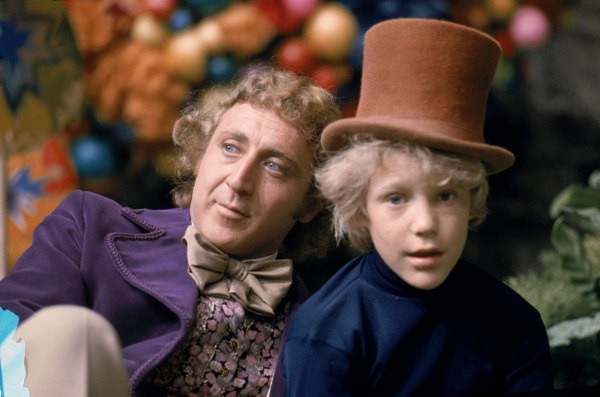
Willy Wonka (Gene Wilder) offers the experience of a lifetime to young Charlie Bucket (Peter Ostrum) in classic family film
WILLY WONKA & THE CHOCOLATE FACTORY (Mel Stuart, 1971)
Brooklyn Bridge Park
Harbor View Lawn
Thursday, July 25, free, 6:00
www.brooklynbridgepark.org
 Based on a 1964 Roald Dahl novel, Willy Wonka & the Chocolate Factory is a fanciful frolic through a children’s wonderland, filled with fear, trepidation, love, and lots of candy, both sweet and sour. Charlie Bucket (Peter Ostrum, in his only film appearance) lives with his dirt-poor family in a ramshackle room, where Grandpa Joe (Jack Albertson) can’t even get out of bed. But when goodhearted Charlie finds one of the golden tickets that will allow him to join a once-in-a-lifetime tour of Willy Wonka’s chocolate factory, Grandpa Joe is suddenly up and about, singing and dancing, and so will you be. Among the other kids with the golden tickets are the spoiled Veruca Salt (Julie Dawn Cole), the selfish Violet Beauregarde (Denise Nickerson), the tube-loving Mike Teevee (Paris Themmen), and the rather sloppy Augustus Gloop (Michael Bollner). Meanwhile, the creepy Mr. Slugworth (Günter Meisne) tries to lure the kids to the dark side as they slowly learn (well, some more than others) that there is more to life than just candy — and themselves. As they are ultimately led through this dreamland by the unpredictable Willy Wonka (Gene Wilder), they encounter chocolate rivers, bubble machines that make people float, and small Oompa Loompas who are quick to clean up any messes, of which there are several. The memorable soundtrack of this thoroughly entertaining, charming family film includes “The Candy Man Can,” “(I’ve Got a) Golden Ticket,” “Pure Imagination,” and, of course, “Oompa Loompa, Doompa-Dee-Do.” Directed by Mel Stuart, who passed away last August after a career that also included Wattstax, Four Days in November, and If It’s Tuesday, This Must Be Belgium, the film was remade by Tim Burton in 2005 starring Johnny Depp as Wonka with mixed results, but you can catch the original for free on July 25 as part of Brooklyn Bridge Park’s annual summer Movies with a View festival, with DJ Ayres kicking things off at 6:00, followed by a screening of Tony Donoghue’s short film Irish Folk Furniture.
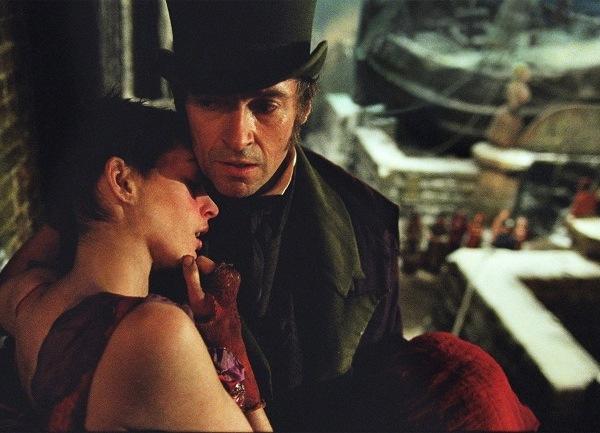
 For more than thirty years, Cameron Mackintosh’s musical theater production of Victor Hugo’s 1862 novel, Les Misérables, has been entertaining audiences in Paris, on London’s West End, on Broadway, and on tours around the world. Fans have been eagerly anticipating the film version for decades, and now that it’s here, they can let out a big sigh of . . . what, relief? Regret? Revolution? Revulsion? Oscar-winning director Tom Hooper (The King’s Speech) has put together a lavish, star-studded spectacle that ends up biting off a whole lot more than it can chew, which doesn’t go over well in the slums of early-nineteenth-century Paris. Hugh Jackman is wonderfully cast as Jean Valjean, a valiant man who has spent nineteen brutal years in prison for stealing a loaf of bread. Russell Crowe tries hard as Inspector Javert, who is determined to bring Valjean to justice after he breaks his suffocating parole. Changing his life — and his name — Valjean becomes a model citizen, even mayor, and seeks to help the disadvantaged, including Fantine (Best Supporting Actress Oscar winner Anne Hathaway), a former employee of his who will do whatever it takes to provide for her young daughter, Cosette (Isabelle Allen). The first half of the film, which goes from 1815 to 1823, develops well enough, with strong, emotional performances by Jackman and Hathaway and a haughty “Master of the House” number led by Helena Bonham Carter and Sacha Baron Cohen as innkeepers taking care of — and taking advantage of — Cosette. But things start falling apart quickly once the story jumps to 1832 and an older Cosette (Amanda Seyfried) has fallen in love with young revolutionary Marius Pontmercy (Eddie Redmayne), while Javert is still hunting down Valjean. The budding romance and coming battle are simply dreadful, as are the songs. (“Do You Hear the People Sing?” We wish we didn’t. “Empty Chairs at Empty Tables”? Alas, just about every seat in the large theater was taken.) The overly melodramatic final scenes, which seem to never end, suck any life that was left over from the first hour or so, which had at least created a compelling mood and intriguing characters. Unable to decide whether it’s a historical epic or a timeless romance, Les Misérables ends up being neither. Perhaps the best way to see the Oscar-nominated film is with a cadre of fellow fanatics belting out the tunes along with the characters, and you can do just that on July 25 when the JCC in Manhattan presents a communal sing-along as part of its summer “Up on the Roof” series, with everyone encouraged to join in with Hugh, Anne, Amanda, Russell, Helena, Sacha, and the rest of the cast, giving a whole new meaning to “Do You Hear the People Sing?”

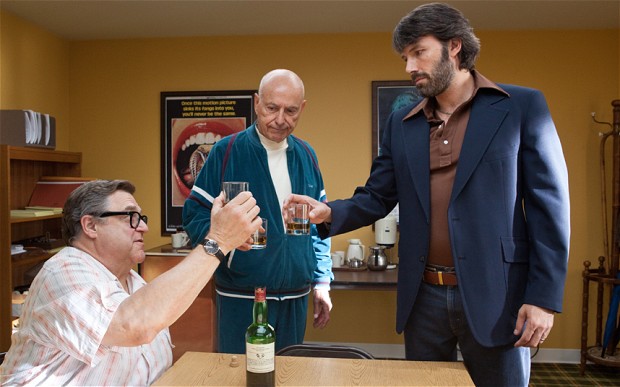
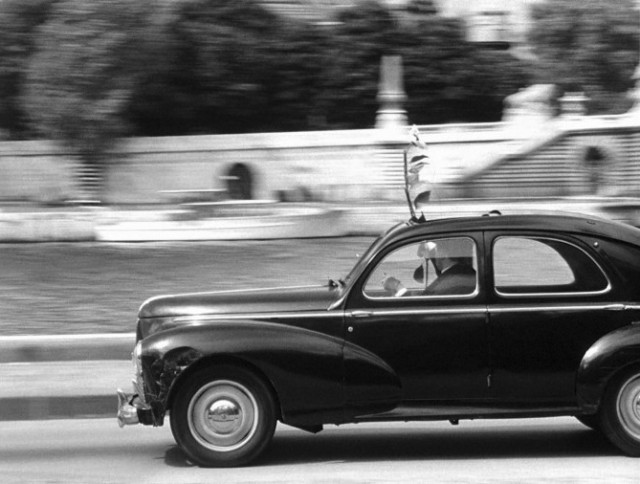
 François Truffaut shot out of the blocks in 1959 with the classic 400 Blows, and he followed it up with Shoot the Piano Player, a magnificent noir about a virtuoso saloon piano player and his always-in-trouble brother. French crooner Charles Aznavour is super-cool as the secretive, shy pianist with a hidden past who gets caught up in his crooked brother’s dangerous predicament, against his better judgment. Comedy mixes with pathos, dance-hall jollies lead to murder and kidnapping, and lost love holds a curse in a dark, haunting film you will never forget. Loosely based on David Goodis’s pulp novel Down There, the film also stars Claudine Huzé, whom Truffaut renamed Marie Dubois, as the waitress Léna and Nicole Berger, Richard Kanayan, Albert Rémy, and Jean-Jacques Aslanian as members of Aznavour’s troubled family. Shoot the Piano Player is screening July 24-26 at 1:30 in MoMA’s ongoing “An Auteurist History of Film” series, along with another black-and-white classic, Pierre Étaix and Jean-Claude Carrière’s deliriously funny short, Happy Anniversary, which won the 1963 Oscar for Best Live Action Short Subject. As a woman (Laurence Lignières) prepares a special anniversary dinner at home, her husband (Étaix) gets trapped in all kinds of craziness as he desperately tries to make it home in time, but the traffic and parking gods are against him. Hysterical slapstick ensues virtually without dialogue, like a classic silent film with a wacky score, melding Chaplin and Keaton with Tati and, dare we say, Jerry Lewis. And you’ll never be able to look at Mr. Bean the same way again. Truffaut called Étaix’s 1965 feature, Yoyo, “a beautiful film in which I loved every shot and every idea, and which taught me many things about movies,” forever linking the two French directors. It’s quite a treat, therefore, to see Truffaut’s slyly comic gangster picture right alongside Étaix’s wildly funny short.
 Korean auteur Hong Sang-soo continues his fascinating exploration of cinematic narrative in In Another Country, although this one turns somewhat nasty and tiresome by the end. After being duped in a bad business deal by a family member, an older woman (Youn Yuh-jung) and her daughter, Wonju (Jung Yumi), move to the small seaside town of Mohjang, where the disenchanted Wonju decides to write a screenplay to deal with her frustration. Based on an actual experience she had, she writes three tales in which a French woman named Anne (each played by an English-speaking Isabelle Huppert) comes to the town for different reasons. In the first section, Anne is a prominent filmmaker invited by Korean director Jungsoo (Kwon Hye-hyo), who has a thing for her even though he is about to become a father with his very suspicious wife, Kumhee (Moon So-ri). In the second story, Anne, a woman married to a wealthy CEO, has come to Mohjang to continue her affair with a well-known director, Munsoo (Moon Sung-keun), who is careful that the two are not seen together in public. And in the final part, Anne, whose husband recently left her for a young Korean woman, has arrived in Mohjang with an older friend (Youn), seeking to rediscover herself. In all three stories, Anne searches for a lighthouse, as if that could shine a light on her future, and meets up with a goofy lifeguard (Yu Jun-sang) who offers the possibility of sex, but each Anne reacts in different ways to his advances. Dialogue and scenes repeat, with slight adjustments made based on the different versions of Anne, investigating character, identity, and desire both in film and in real life. Hong wrote the film specifically for Huppert, who is charming and delightful in the first two sections before turning ugly in the third as Anne suddenly becomes annoying, selfish, and irritating, the plot taking hard-to-believe twists that nearly undermine what has gone on before. As he has done in such previous films as