twi-ny recommended events

FUN CITY — NEW YORK IN THE MOVIES 1967-75: MIDNIGHT COWBOY

MIDNIGHT COWBOY

Oscar nominees Jon Voight and Dustin Hoffman try to make it in the big city in John Schlesinger’s powerful and moving MIDNIGHT COWBOY

MIDNIGHT COWBOY (John Schlesinger, 1969)
Museum of the Moving Image
35th Ave. at 36th St., Astoria
Sunday, August 25, free with museum admission, 5:00
Series runs through September 1
718-777-6800
www.movingimage.us

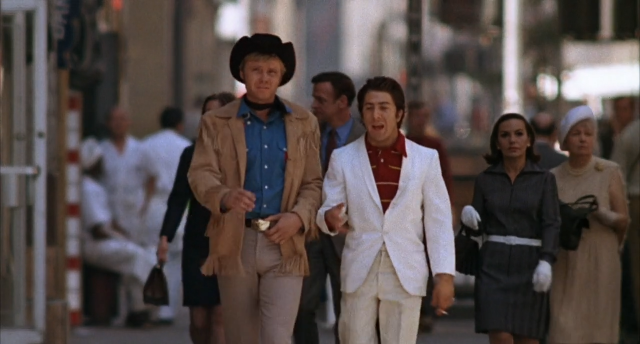
Dustin Hoffman and Jon Voight star as the worst hustlers ever in John Schlesinger’s masterful Midnight Cowboy. The only X-rated film to win a Best Picture Oscar, Midnight Cowboy follows the exploits of Joe Buck, a friendly sort of chap who leaves his small Texas town, determined to make it as a male prostitute in Manhattan. Wearing his cowboy gear and clutching his beloved transistor radio, he trolls the streets with little success. Things take a turn when he meets up with Enrico Salvatore “Ratso” Rizzo (Hoffman), an ill, hobbled con man living in a condemned building. The two loners soon develop an unusual relationship as Buck is haunted by nightmares, shown in black-and-white, about his childhood and a tragic event that happened to him and his girlfriend, Crazy Annie (Jennifer Salt), while Rizzo dreams of a beautiful life, depicted in bright color, without sickness or limps on the beach in Miami. Adapted by Waldo Salt (Serpico, The Day of the Locust) from the novel by James Leo Herlihy, Midnight Cowboy is essentially a string of fascinating and revealing set pieces in which Buck encounters unusual characters as he tries desperately to succeed in the big city; along the way he beds an older, wealthy Park Ave. matron (Sylvia Miles), is asked to get down on his knees by a Bible thumper (John McGiver), gets propositioned in a movie theater by a nerdy college student (Bob Balaban), has a disagreement with a confused older man (Barnard Hughes), and attends a Warholian party (thrown by Viva and Gastone Rosilli and featuring Ultra Violet, Paul Jabara, International Velvet, Taylor Mead, and Paul Morrissey) where he hooks up with an adventurous socialite (Brenda Vaccaro). Photographed by first-time cinematographer Adam Holender (The Panic in Needle Park, Blue in the Face), the film captures the seedy, lurid environment that was Times Square in the late 1960s; when Buck looks out his hotel window, he sees the flashing neon, with a sign for Mutual of New York front and center, the letters “MONY” bouncing across his face with promise. The film is anchored by Harry Nilsson’s Grammy-winning version of “Everybody’s Talkin’,” along with John Barry’s memorable theme. Iconic shots are littered throughout, along with such classic lines as “I’m walkin’ here!” Midnight Cowboy, which was nominated for seven Oscars and won three (Best Picture, Best Adapted Screenplay, and Best Director) is screening August 25 at 5:00 as part of the Museum of the Moving Image series “Fun City: New York in the Movies 1967-75,” which is guest curated by J. Hoberman and continues through September 1 with such other Big Apple fare as The Taking of Pelham One Two Three, Born to Win, Dog Day Afternoon, and Taking Off.
ROBERT IRWIN — SCRIM VEIL — BLACK RECTANGLE — NATURAL LIGHT, WHITNEY MUSEUM OF AMERICAN ART, NEW YORK (1977)

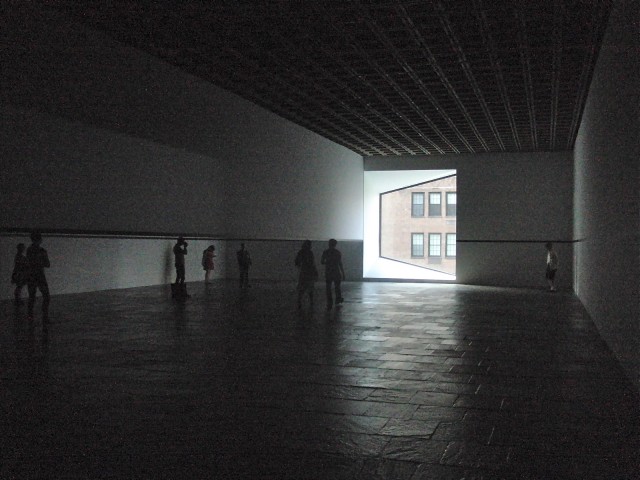
Robert Irwin’s site-specific “Scrim veil” invites visitors into its many charms and mysteries (photo by twi-ny/mdr)

Robert Irwin’s site-specific “Scrim veil” invites visitors into its many charms and mysteries (photo by twi-ny/mdr)

Whitney Museum of American Art
945 Madison Ave. at 75th St.
Wednesday – Sunday through September 1, $16-$20 (pay-what-you-wish Fridays, 6:00 – 9:00)
212-570-3600
www.whitney.org
robert irwin photo set

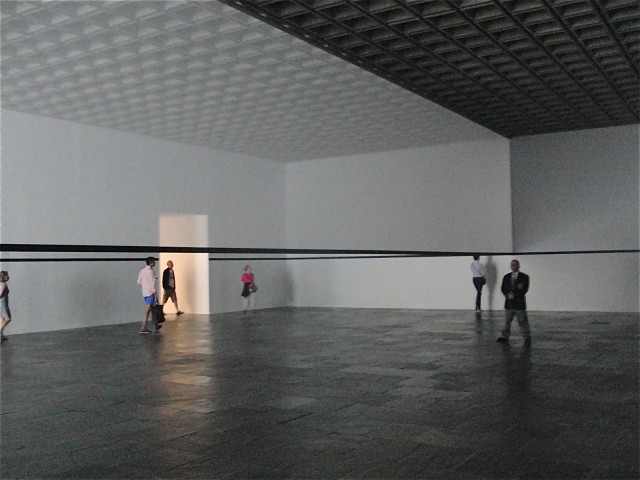
As the Whitney prepares for its move to the Meatpacking District in 2015, it has been combing through its holdings, mounting exhibitions (“Sinister Pop,” “Signs & Symbols,” “Real/Surreal”) that offer new ways to experience works, both familiar and not, from its collection. One significant piece is being brought back for the first and last time, as it was designed specifically for the fourth floor of Marcel Breuer’s building and cannot be shown anywhere else. In 1977, California-based artist Robert Irwin installed “Scrim veil — Black rectangle — Natural light, Whitney Museum of American Art, New York,” a deceptively simple project made of cloth, metal, black paint, and wood. At one end of the rectangular room is Breuer’s trapezoidal window, streaming in oddly shaped light. A translucent scrim runs the length of the room, hanging from the ceiling, with five and a half feet from the floor to its black metal base, allowing people to easily walk under it. In addition, a black line has been painted along the wall at the same five-and-a-half-foot height, parallel to the base of the scrim. Upon exiting the elevators, visitors are instantly transported into the compelling space, which takes a bit of time to adjust to. “Scrim veil” is something that can’t just be seen but needs to be experienced; it seems to shift with changes in the outside light and as other people make their way around it. The black metal base of the scrim and the black painted line on the walls meld together then break apart, appearing to create morphing physical elements.

Robert Irwin, “Scrim veil — Black rectangle — Natural light, Whitney Museum of American Art, New York,” cloth, metal, and wood, 1977 (photo by twi-ny/mdr)

Robert Irwin, “Scrim veil — Black rectangle — Natural light, Whitney Museum of American Art, New York,” cloth, metal, and wood, 1977 (photo by twi-ny/mdr)

In the original exhibition catalog — “Scrim veil” was part of a larger show — Irwin, who is now eighty-four and still making challenging, fascinating new work, contributed the complex essay “Notes Toward a Model,” in which he explored the nature of form, context, content, perception, abstraction, conception, experience, and response. “There is probably no such thing as a pure naïve perception of the world,” he writes in the heavily illustrated discussion. “As noted earlier, we do not begin at the beginning in such matters but already somewhere in the middle. For example: Conceive in your mind the idea of a straight line (which has only a limited actuality in nature). In extended time consider our ‘straight line’ as the basis for the compounded abstraction known as Euclidean geometry. Again in extended time, consider a world developed and structured in line with our concept — i.e., grid to city; frame and plane to painting — point-to-point as a way of procedure through life. Now, place yourself in the middle of this milieu as the actual (physical) frame of your experiential reference, your reality, and ask yourself, ‘What can I know?’” (The full catalog can be read here.) Indeed, as one travels around the room, losing track of time and space, “Scrim veil” provides personal questions and answers that explore just what it is we might know about our individual and shared environment, both physically and psychologically. Interestingly, although Irwin was against the taking of photographs during the piece’s initial 1977 run, the Whitney is allowing pictures this time around, but don’t get too caught up in trying to snap a good photo and instead just allow yourself to be enveloped in this unique and involving experience, one that will never happen again.

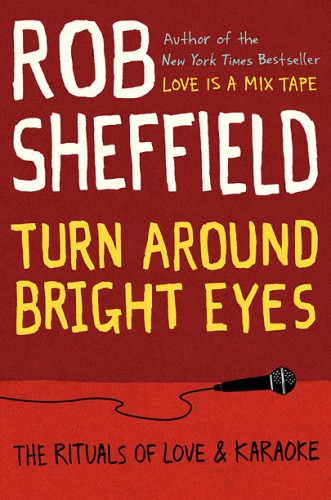
READING OF THE DAY: TURN AROUND BRIGHT EYES BY ROB SHEFFIELD

TurnAroundBrightEyes hc c.JPG

Rolling Stone contributing editor Rob Sheffield has been entertaining us for years with his sly, hysterical, and unique take on pop culture, from his merry meanderings through movies and television to music and more. The Brooklyn-based Sheffield has just released his third book, Turn Around Bright Eyes: The Rituals of Love & Karaoke (Harper, August 6, $25.99), the follow-up to 2007’s Love Is a Mix Tape: Life and Loss, One Song at a Time and 2011’s Talking to Girls About Duran Duran: One Young Man’s Quest for True Love and a Cooler Haircut. The new tome, which features such song-related chapter titles as “Total Eclipse of the Heart,” “Livin’ on a Prayer,” “99 Luftballons,” “Hot Legs,” “Debaser,” and “Stop Draggin’ My Heart Around,” reveals Sheffield and his wife’s addiction to karaoke, something we can’t say we share but makes for some very funny reading. There should be some very funny reading and discussion on August 23, when Sheffield presents the book at the Barnes & Noble at 2289 Broadway at 82nd St. at 7:00. “Once upon a time I was falling apart. Now I’m always falling in love,” the book begins. “This spiritual quest, like so many spiritual quests, involves Bonnie Tyler,” Sheffield adds. That’s more than enough for us; count us in.

VIDEO OF THE DAY: “YOU RUINED LOVE” BY ASHLEY ALLEN

Ashley Allen burst out of the gate in June with her debut single, the sugary sweet YouTube dance-pop hit “Let’s Go.” The perennially upbeat singer-songwriter gets much more introspective on “You Ruined Love,” a folk-country lament about first love and heartbreak. The New York native, who is currently working on her debut EP, due out later this year, to be followed by a full-length LP in 2014, has also recorded the catchy “Body Say No, Heart Say Yes” and the pop ballad “Dancing in My Head.” According to her Facebook page, Allen is “just a girl from New York City. Total Weirdo and totally okay with it,” which is okay with us too. On “Let’s Go,” she declares, “I wanna scream and lose my voice,” but hopefully the second part of that statement won’t take place when Allen plays Santos Party House on August 23 with Free Keys and Glass Mansion.

CENTRAL PARK CONSERVANCY FILM FESTIVAL 2013

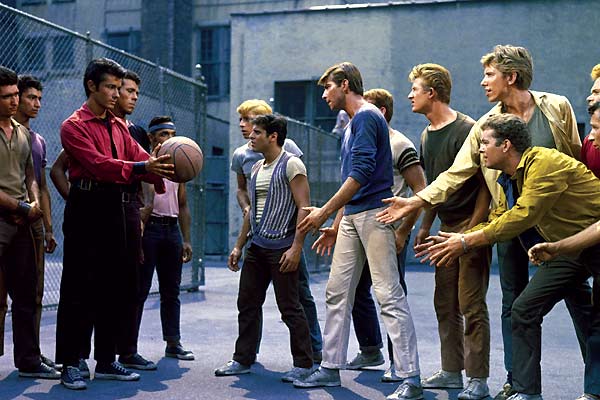
The game is over, and WEST SIDE STORY has won the battle for favorite classic

The game is over, and WEST SIDE STORY has won the battle for favorite classic

Central Park
Landscape between Sheep Meadow & 72nd St. Cross Dr.
August 22-26, free, DJs at 6:30, film at 8:00
www.centralparknyc.org

For this year’s Central Park Conservancy Film Festival, the programming was left to the will of the people, who got to select from four pictures in five categories. The results are in, and the movies will be screened August 22-26 on the landscape between Sheep Meadow and the 72nd St. Cross Dr. The series begins on Thursday with Classics night, as West Side Story, garnering 3,617 votes, beat out Funny Lady, Dr. Strangelove, or How I Stopped Worrying and Learned to Love the Bomb, and On the Waterfront. Friday’s Family selection is Hook (2,212), which triumphed over Kung Fu Panda, An American Tail, and Annie. Saturday’s Rom-Com is Silver Linings Playbook (3,731), which came out on top over When Harry Met Sally, The Gay Divorcee, and Love Jones. Horror rules the day on Sunday night, with The Shining (2,656) scaring off Psycho, Frankenstein, and Christine. The festival concludes on Monday night with Adventure winner Raiders of the Lost Ark (3,055), which ran away from Goldfinger, The Matrix, and The Fifth Element. Each program kicks off with a DJ spinning tunes at 6:30, with the films beginning at 8:00. Admission, and popcorn, is free; lawn chairs are not allowed.

ARTWORK OF THE DAY: “DWARF AND RHINOCEROS (WITH LARGE BLACK SHAPE)” BY JOHN BALDESSARI

John Baldessari (photo by twi-ny/mdr)

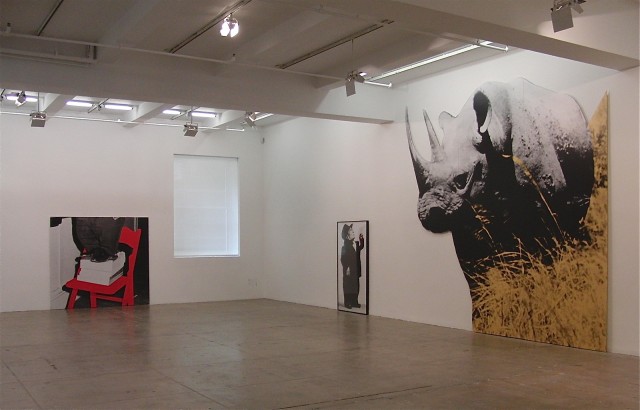
John Baldessari, “Dwarf and Rhinoceros (with Large Black Shape),” detail, archival inkjet prints mounted on Lexan with inset aluminum frame, latex paint, archival inkjet print mounted on plexiglass, 1989/2013 (photo by twi-ny/mdr)

“I’ve got to say, I don’t like being labeled a California artist, or a Los Angeles artist, or a Conceptual artist,” John Baldessari told us last year in a wide-ranging twi-ny talk. “I just like it to be artist.” The artist is back at Marian Goodman with a solo show that reinstalls a trio of works first seen in 1987-89, three rooms that feature Baldessari’s unique way of combining painting, photography, and sculpture; words, image, and meaning; the real world and its cinematic equivalent; and humanity and the animal kingdom. “Dwarf and Rhinoceros (with Large Black Shape)” (“Ni por Esas/ Not Even So: John Baldessari,” Museo Nacional Centro de Arte Reina Sofia, Madrid, 1989) focuses on a black-and-white photo of a little man, seemingly squeezed into a rectangular frame, looking up and pointing at a rhino in the wild. “Two Stories (Yellow and Blue) and Commentary (with Giraffe)” (“Magiciens de la Terre,” Centre Georges Pompidou and Grande Halle La Villette, Paris, 1989) includes a giraffe emerging from a corner, facing a cross of pop-culture images. And “The Difference Between Fête and Fate” (“John Baldessari,” Museo d’Arte Contemporanea, Castello di Rivoli, Rivoli, Italy, 1987) consists of striking photographs of people and animals, including polar bears, an owl, and a burning man. The eponymously titled exhibition continues in Midtown through August 23.

ANOTHER DAY, ANOTHER TIME: CELEBRATING THE MUSIC OF “INSIDE LLEWYN DAVIS”

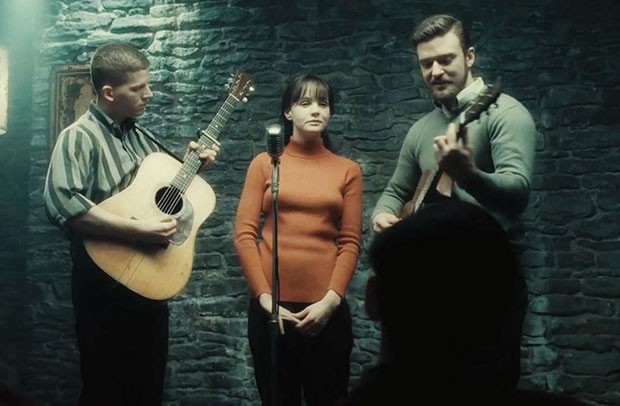
Benefit concert will celebrate music of latest Coen brothers film, INSIDE LLEWYN DAVIS

Benefit concert will celebrate music of latest Coen brothers film, INSIDE LLEWYN DAVIS

The Town Hall
123 West 43rd St. between Sixth Ave. & Broadway
Tickets on sale Wednesday, August 21, 12 noon
Concert takes place September 29, $75-$150, 7:30
212-840-2824
www.insidellewyndavis.com
www.the-townhall-nyc.org

In 2000, filmmakers Joel and Ethan Coen teamed up with producer T Bone Burnett to create an award-winning soundtrack for their hit film O Brother, Where Art Thou? The 1930s-set movie featured a mix of traditional Americana, country, folk, and blues, including such songs as “Big Rock Candy Mountain,” “I Am a Man of Constant Sorrow,” “O Death,” and “Lonesome Valley” performed by such musicians as Norman Blake, Jerry Douglas, Alison Krauss, Ralph Stanley, Emmylou Harris, Gillian Welch, and the Soggy Bottom Boys. In their latest film, Inside Llewyn Davis, which premiered at Cannes in May, the Coens tell the story of a week in the life of a 1960s Greenwich Village folksinger, with Burnett once again on board to steer the soundtrack. On September 29, the music of the film will take center stage at the Town Hall, when “Another Day, Another Time: Celebrating the Music of Inside Llewyn Davis” takes place, featuring an all-star lineup raising funds for the National Recording Preservation Foundation. The roster is unusually impressive, featuring the Avett Brothers, Joan Baez, Rhiannon Giddens, Lake Street Drive, Colin Meloy, the Milk Carton Kids, Marcus Mumford, Conor Oberst, the Punch Brothers, Secret Sisters, Patti Smith, Gillian Welch & David Rawlings, Willie Watson, and Jack White in addition to cast members Oscar Isaac, John Goodman, Carey Mulligan, and Stark Sands. The concert will include songs from the film in addition to 1960s tunes that inspired them. The film will screen at this fall’s New York Film Festival before opening in December. Tickets are $75 and $150 and go on sale August 21 at noon.