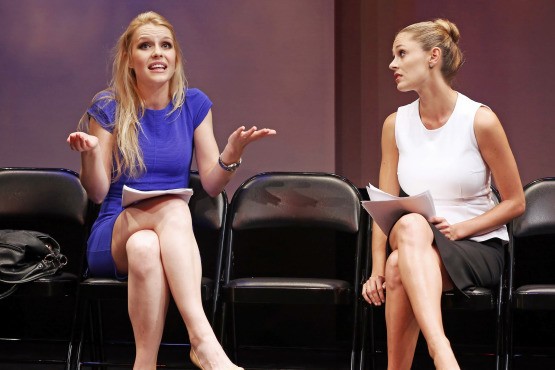
Kate (Gia Crovatin) and Paige (Elizabeth Masucci) are after the same plum part in Neil LaBute’s new one-act, GOOD LUCK (IN FARSI) (photo by Carol Rosegg)
59E59 Theaters
59 East 59th St. between Park & Madison Aves.
Tuesday – Sunday through August 31, $25
212-279-4200
www.summershortsfestival.com
www.59e59.org
One of the best theater deals of the season is the seventh annual Summer Shorts program at 59E59, two evenings of three one-acts each by award-winning writers, with tickets only $25 per night or $40 for both. Series A begins with Neil LaBute’s Good Luck (in Farsi), in which two actresses, the somewhat successful and well-put-together Paige (Elizabeth Masucci) and the more harried Kate (Gia Crovatin), are waiting to audition for the same role on a series. The two rivals discuss life, love, craft, and competition as they make subtle, and not so subtle, digs at each other while also seemingly helping each other out — or at least pretending to. Writer-director LaBute (The Shape of Things, reasons to be pretty) is able to take a clichéd setup and twist it just enough to turn it into an engaging little battle of wits that is not just about acting, with fine performances by Masucci and Crovatin.
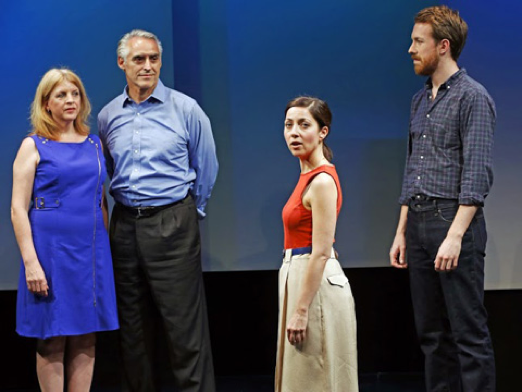
The initial meeting between the McCains and the Palins is documented in a unique way in Lucas Hnath’s ABOUT A WOMAN NAMED SARAH (photo by Carol Rosegg)
Lucas Hnath’s About a Woman Named Sarah is a curious exercise in narrative, built around the first meeting between the Palins and the McCains at the latters’ Sedona ranch. The play is set up as a series of quickly paced one-on-one conversations among the four characters, with Sarah (Marisa Viola) first getting offered the vice presidency by John (Mark Elliot Wilson), then having a very different kind of talk with Cindy (Stephanie Cannon) before explaining things to her husband, Todd (Ben Vigus). Much of the dialogue consists of small fragments cut short by an annoyingly sharp offstage percussive bang, and Hnath (Red Speedo, Death Tax) and director Eric Hoff don’t bother with developing any kind of realistic setting or having the actors look anything like the characters they’re playing. The scene between Cindy and Sarah works the best, but otherwise the play feels lost in old news.
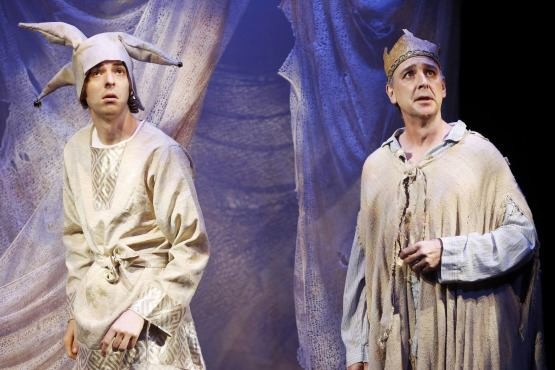
Poor Wretched Fool (Evan Shinners) and the king (Michael Countryman) fear the end is near in Tina Howe’s BREAKING THE SPELL (photo by Carol Rosegg)
The gem of the evening is Tina Howe’s Breaking the Spell, an engaging riff on the Sleeping Beauty fairy tale, directed by Birgitta Victorson. In “merrie olde England,” the king (Michael Countryman) has been waiting for his beloved daughter, Christabel (Crystal Finn), to rise from a hundred-year slumber. But time is running out; if she does not wake soon, the king and the princess and everyone else will die. So the ruler, who spends much of the show sitting in his less-than-impressive throne, fighting severe back pain, desperately implores his Poor Wretched Fool (Bach master Evan Shinners in his impressive, wide-ranging theatrical debut) to bring in a parade of musicians to try to stir Christabel out of her deep sleep. PWF, who can speak only gibberish, then introduces a series of men, all played by Shinners or musician Jesse Scheinin, who use various instruments in a last-ditch effort to save the kingdom. The musical interludes are highlighted by Shinners’s dazzling performance of a prelude from Bach’s Well-Tempered Clavier, Book Two; Shinners will actually play a different prelude at each show throughout the run. In fact, the play was specifically written for Shinners. Howe met the pianist backstage after a concert, and Shinners later e-mailed her, boldly asking the writer of such works as Painting Churches and Coastal Disturbances to cast him and his friend Scheinin in a play, which she has done, to all our benefit. (Summer Shorts, Series B consists of Marian Fontana’s Falling Short, Paul Weitz’s Change, and Alan Zweibel’s Pine Cone Moment.)

 When Leslie Braverman suddenly dies at the ripe old age of forty-one, four of his childhood friends reunite to attend the funeral in this very different kind of road movie. Morroe Rieff (George Segal), Barnet Weinstein (Jack Warden), Felix Ottensteen (Joseph Wiseman), and Holly Levine (Sorrell Booke) have one helluva time trying to get to temple on time as they battle traffic, a crazy cabbie (Godfrey Cambridge), and other urban impediments on their way from Sheridan Square to Brooklyn — even though they don’t know exactly which funeral house to go to. Jessica Walter as Inez Braverman, Phyllis Newman as Miss Mandelbaum, and Alan King as a wacky rabbi add to the fun. Based on Wallace Markfield’s 1964 novel, To an Early Grave, this charming little cult fave was written by longtime television variety show scribe Herb Sargent (Saturday Night Live, The Tonight Show Starring Johnny Carson), directed by Sidney Lumet (Serpico, Dog Day Afternoon), and shot by Boris Kaufman (one of Dziga Vertov’s brothers). This very funny absurdist comedy will sneak up on you when you least expect it. Bye Bye Braverman is screening August 11 as part of the Museum of the Moving Image series “Fun City: New York in the Movies 1967-75,” guest curated by J. Hoberman, which runs August 10 – September 1 and includes such other Big Apple films as Cotton Comes to Harlem, The French Connection, Coogan’s Bluff, The Taking of Pelham One Two Three, and Gordon Parks Jr.’s Superfly, which will be followed by a “Changing the Picture” discussion with actress Sheila Frazier, Bow Legged Lou, Paul Anthony, and George Logan, moderated by Warrington Hudlin.
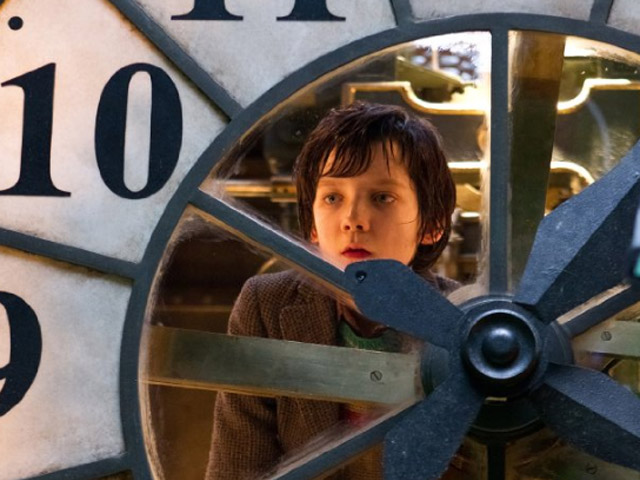
 Martin Scorsese wears his cinematic heart on his sleeve in his first family-friendly film, Hugo. Based on Brian Selznick’s Caldecott-winning 2007 illustrated historical-fiction novel The Invention of Hugo Cabret, the 3-D movie follows the adventures of the title character, a homeless orphan boy (Asa Butterfield) who survives by his wits in a Paris train station in the early 1900s. He spends his days stealing small bits of food, winding the big clock, avoiding Inspector Gustav (Sacha Baron Cohen), and trying to find parts for an automaton he is rebuilding, hoping it will have a message for him from his father (Jude Law). He soon makes his only friend, a girl named Isabelle (Chloë Grace Moretz) who is being raised by her godparents, the bitter Papa Georges (Ben Kingsley) and his wife, Mama Jeanne (Helen McCrory). When it turns out that Papa Georges is the one and only Georges Méliès, who made the world’s first science-fiction film, A Trip to the Moon, among hundreds of others, then was thought to have died in obscurity, all of his work destroyed, Hugo and Isabelle, along with the help of film historian René Tabard (Michael Stuhlbarg), are determined to resurrect Papa Georges and his reputation. Gorgeously shot by Robert Richardson and featuring marvelous period sets by Dante Ferretti, Hugo is beautiful to look at, the camera roaming through the immense train station and up the tall clock tower like in a Jules Verne story. Such side plots as the budding romances between a café owner (Frances de la Tour) and the newspaper seller (Richard Griffiths) and between Gustav and a shy flower girl (Emily Mortimer) feel forced, and the main narrative meanders its way into treacly territory as all the parts slowly come together. At its heart, Hugo is a movie about the love of movies, paying tribute to the early cinema of Méliès, Harold Lloyd, and others but it gets too stuck on the underlying theme of the preservation of old films, one of Scorsese’s driving forces. Still, Hugo is a visual treat in which Scorsese makes the most of 3-D technology, particularly in the first half, before things get a little too sticky (and slickly) sweet, even for a children’s film. Hugo, which was nominated for eleven Oscars and won five technical awards — Best Cinematography, Best Art Direction, Best Visual Effects, Best Sound Editing, and Best Sound Mixing — is screening August 10 as part of the South Street Seaport’s “Front/Row” “See/Change” series, which continues August 14 with The Amazing Spider-Man, August 17 with Chicago, and August 21 with Back to the Future. For a day-by-day listing of free summer movie screenings throughout New York City, go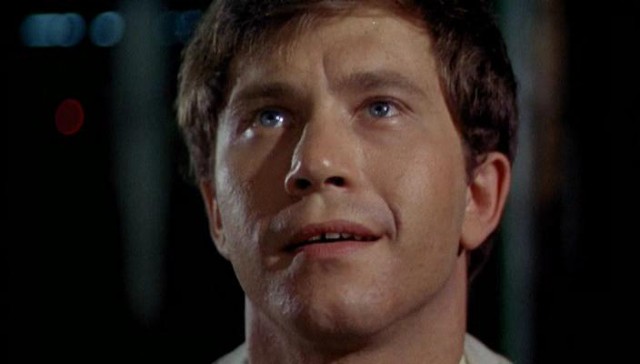
 Poor Bernard Chanticleer (Peter Kastner). His mother (Geraldine Page) sends him locks of her hair and pays a prudish landlord (Julie Harris), aided by a tough cop (Dolph Sweet), to make sure no girls visit him in his new apartment. Bernard’s father (Rip Torn) rules over him with an iron fist in the basement of the New York Public Library. A nice, innocent young woman (Karen Black in her first major role) is interested in him, but he wants a psycho go-go dancer/actress (Elizabeth Hartman). Meanwhile, he is getting all the wrong advice from his best friend (Tony Bill). Francis Ford Coppola’s little-known romantic comedy — his second feature, following Dementia 13 — earned Page an Academy Award nomination, Kastner a BAFTA nomination as Most Promising Newcomer, and a Palme d’Or nomination at Cannes. Coppola uses the New York City settings with a charming intelligence and wit, whether Bernard is chasing a kite across the Sheep Meadow, wandering through the Times Square peep shows, or being chased through the New York Public Library. The Lovin’ Spoonful supplies the fabulously sixties soundtrack. Based on David Benedictus’s novel, You’re a Big Boy Now kicks off the Museum of the Moving Image series “Fun City: New York in the Movies 1967-75,” with guest curator J. Hoberman on hand to introduce the film. The festival, which runs August 10 through September 1, includes a wide range of works made in and about the Big Apple, from such familiar favorites as Rosemary’s Baby, The French Connection, Superfly, Midnight Cowboy, and Dog Day Afternoon to such lesser-known treats as Bye Bye Braverman, The Angel Levine, Little Murders, The Landlord, and Dick Fontaine’s 1970 documentary, Norman Mailer vs. Fun City.