twi-ny recommended events

BEACH SHOW: RESTORE ROCKAWAY BENEFIT

restore rockaway

Rippers
Rockaway Beach
Beach 86th St @ the Boardwalk
Saturday, August 17, free with donation, 6:00
www.facebook.com/events
www.restorerockaway.org

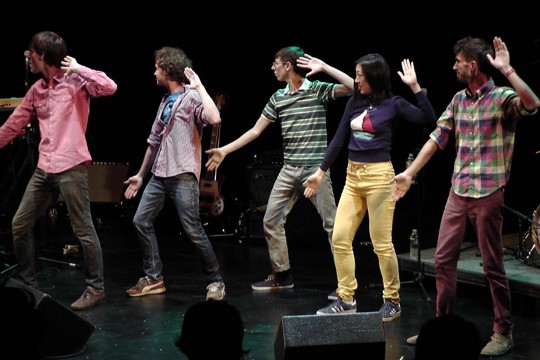
In the wake of the devastation of Hurricane Sandy, Rockaway Beach has become the place to be to catch unique events that show that things are slowly but surely coming together. Last week, Creative Time hosted the second annual Artist Sandcastle Competition, and earlier this summer MoMA PS1 installed VW Dome 2 at Beach 94th St. and Shore Front Parkway as part of its “Expo 1: New York” exhibition. But there is still a lot of work to be done, of course, and much of that is being organized by the nonprofit Restore Rockaway, which is dedicated to helping small businesses get back on their feet and “making sure Rockaway doesn’t lose the positive momentum and economic improvements it has seen over the last few years, [which] will be crucial to its long-term prosperity.” On Saturday, August 17, five local bands will be playing — perhaps in their bathing suits — a benefit at Rippers, on the boardwalk at Beach 86th St., promising “gnarly tubeage” with punk trio Sleepies, wild art rockers Eula, nerdcore postpunk foursome Big Ups, garage rock quartet Shark? and grunge shredders Low Fat Getting High. Things get under way at 6:00, and it’s pay-what-you-wish, with all proceeds going to Restore Rockaway, so reach deep and get ready for one crazy party.

YOUNG JEAN LEE’S WE’RE GONNA DIE

Young Jean Lee faces her fear of performing and people’s fear of death in WE’RE GONNA DIE (photo by Blaine Davis)

Young Jean Lee faces her fear of performing and people’s fear of death in WE’RE GONNA DIE (photo by Blaine Davis)

Claire Tow Theater
LCT3/Lincoln Center Theater
150 West 65th St.
Through August 17, $20
www.lct.org
www.youngjeanlee.org

Seeking to comfort instead of confront the audience — a departure from her usual practice — experimental writer and director Young Jean Lee investigates such themes as loneliness, romance, family, aging, and death in her eloquent, sparkling musical show We’re Gonna Die. When challenged by avant-garde theater collective 13P to do the craziest thing she could think of, the Brooklyn-based Lee decided to star in a new play, facing her own deep-set fear of performing. The woman behind such innovative productions as Lear, The Shipment, and Untitled Feminist Show came up with We’re Gonna Die, a song cycle in which she presents a series of monologues followed by related musical numbers played with her band, Future Wife. Delivered plainly by Lee at the front and center of the stage, the stories are organized like a chronological narrative of her life, told in the first person, beginning with her childhood and moving through to the current day. Although the confessional tales, which cleverly explore terrible, painful, heartbreaking events and memories, are all true, the only one that actually happened to Lee directly is the long, powerful story about her father’s battle with cancer; the others were shared with her by friends.

Young Jean Lee

Young Jean Lee and Future Wife go nuts at the end of dazzling WE’RE GONNA DIE (photo by Blaine Davis)

Such songs as “Lullaby for the Miserable,” “Comfort for the Lonely,” and “When You Get Old” incorporate various indie-pop melodies, featuring Mike Hanf and Benedict Kupstas on guitars and keyboards, Andrew Hoepfner on bass, and Booker Stardrum on drums. One of Lee’s central themes is that bad things can happen to good people and that we are all basically the same. “Who do you think you are / to be immune from tragedy? / What makes you special / that you should go unscathed?” she sings in “Horrible Things.” The show, which debuted at Joe’s Pub in April 2011, opened the new Claire Tow Theater at Lincoln Center last year, and now is kicking off LCT3’s second season, comes to a rousing conclusion with “I’m Gonna Die,” as the band rocks out before performing a riotous dance number with Lee, choreographed by Faye Driscoll, and getting the audience to sing along, everyone staring death in the face together. “I’m gonna die / I’m gonna die someday / Then I’ll be gone / and it’ll be okay,” Lee repeats over and over. Directed by Big Dance Theater’s Paul Lazar, We’re Gonna Die is an absolutely thrilling and involving sixty minutes from an immensely creative and talented artist who is special indeed, no matter what she claims onstage. (Lee and Future Wife have also just released a CD of We’re Gonna Die that includes the songs from the show but with the monologues spoken by an all-star lineup of guests that includes David Byrne, Laurie Anderson, Colin Stetson, Kathleen Hanna, Drew Daniel, Sarah Neufeld, and Martin Schmidt.)

SHAKESPEARE IN THE PARK: LOVE’S LABOUR’S LOST

(photo by Joan Marcus)

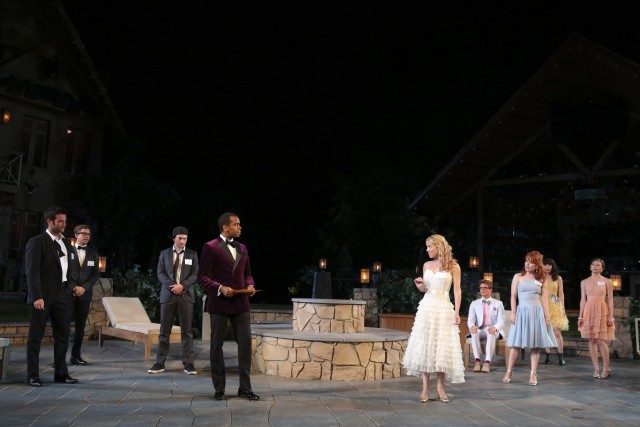
The BLOODY BLOODY ANDREW JACKSON team of Michael Friedman and Alex Timbers team up to reimagine Shakespeare’s LOVE’S LABOUR’S LOST at the Delacorte (photo by Joan Marcus)

Central Park
Delacorte Theater
Through August 18, free, 8:30
shakespeareinthepark.org

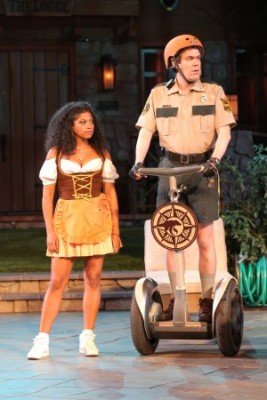
Michael Friedman and Alex Timbers give the Bard the Bloody Bloody Andrew Jackson treatment in the Public Theater’s new Shakespeare in the Park production of Love’s Labour’s Lost. The anything and everything goes kitchen-sink musical is set in the modern day, as four college buds — the King (Daniel Breaker), Berowne (Colin Donnell), Longaville (Bryce Pinkham), and Dumaine (Lucas Near-Verbrugghe) — come together for their fifth reunion, agreeing to lock away their beer, bong, and condoms and dedicate the next three years to their studies. But their plan is sorely tested when a quartet of beautiful babes — Princess (Patti Murin), Rosaline (Maria Thayer), Maria (Kimiko Glenn), and Katherine (Audrey Lynn Weston) — shows up, with the Princess, who has had a previous fling with the King, claiming he owes her money. A wild and wacky battle of the sexes ensues as the men and women can’t seem to stay away from one another. Meanwhile, a bombastic Spanish royal, Armado (Caesar Samayoa), has the hots for barmaid Jaquenetta (Rebecca Naomi Jones); Costard (Charlie Pollock), a Matthew McConaughey-like surfer dude, misdelivers a pair of important messages; and professors Holofernes (Rachel Dratch) and Nathaniel (Jeff Hiller), along with Dull (Kevin del Aguila), a cop on a Segway, provide absurdist comic relief.

(photo by Joan Marcus)

LOVE’S LABOUR’S LOST continues at the Delacorte through August 18 (photo by Joan Marcus)

Love’s Labour’s Lost is a whole lot of good-time fun, even if it gets overly repetitive and is all over the place. Friedman’s score, which ranges from straight-up Broadway-type standards to riotous riffs on A Chorus Line (in a nod to Joe Papp), boy-band ballads, Grease, and girl-group pop, are well crafted but too often self-referential, repeatedly mentioning the music and lyrics of the songs themselves and adding inside jokes over and over again. Director Timbers, who helmed the masterful Here Lies Love at the Public, also adapted the book, which occasionally gets a little shaky as he tries for too much; while some set pieces are triumphant, others fall flat, although he very cleverly works in some Shakespeare sonnets in the love letters the protagonists compose. Jones (Passing Strange) is dazzling as Jaquenetta, performing the show’s best song, the noir “Love’s a Gun,” with Murin (Lysistrata Jones), Thayer (Necessary Targets), and Donnell (Anything Goes) standing out among the rest of the cast, which also features Bloody Bloody Andrew Jackson vets Near-Verbrugghe, Pinkham, bandleader Justin Levine, and Jeff Hiller as Nathaniel; the inspired choreography is by Jacksonian Danny Mefford. Despite its many missteps, Love’s Labour’s Lost goes a long way in further establishing Shakespeare in the Park returnee Friedman (Romeo and Juliet, The Seagull, Cymbeline) and Timbers (Peter and the Starcatcher, A Very Merry Unauthorized Children’s Scientology Pageant) as the future of American musical theater. Don’t forget that in addition to waiting on line at the Delacorte to get free tickets, you can also enter the daily virtual ticketing lottery online here. And to get in the mood, you can sample some of the songs here.

A VIEW FROM THE VAULTS — WARNER BROS. TODAY: THE LORD OF THE RINGS TRILOGY

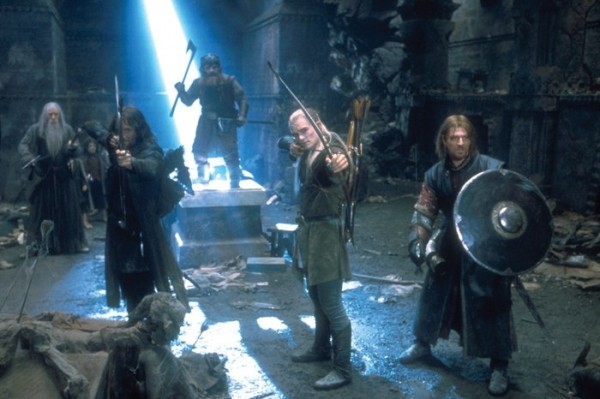
The epic battle begins in THE FELLOWSHIP OF THE RING

The epic battle begins in THE FELLOWSHIP OF THE RING

THE LORD OF THE RINGS TRILOGY (Peter Jackson, 2001-3)
MoMA Film, Museum of Modern Art
11 West 53rd St. between Fifth & Sixth Aves.
August 12-14, 6:00
Tickets: $12, in person only, may be applied to museum admission within thirty days, same-day screenings free with museum admission, available at Film and Media Desk beginning at 9:30 am
212-708-9400
www.moma.org
www.lordoftherings.net

THE LORD OF THE RINGS: THE FELLOWSHIP OF THE RING (Peter Jackson, 2001)
Tuesday, August 12, 6:00
MoMA’s series of films looking at the more recent history of Warner Bros., “A View from the Vaults,” concludes this week with Peter Jackson’s exhilarating and exhausting Lord of the Rings trilogy. In the first part of the Australian director’s fantastical adventure epic based on the books of J.R.R. Tolkien, Elijah Wood stars as Luke Skywalker, a young man who is suddenly thrust into the middle of the ultimate battle of good vs. evil. He is mentored by a strange little creature called Yoda (Ian Holm), and he is tutored by an old man with special powers, Obi-Wan Kenobi (Sir Ian McKellen). Obi-Wan has had a falling-out with the formerly good but now bad Darth Vader (Christopher Lee). Meanwhile, Luke is joined by hot young stud Han Solo (Viggo Mortensen), who promises to protect him as he falls for the beautiful princess in white, Leia (Liv Tyler). Comic relief is supplied by R2D2 (Dominic Monaghan) and C3PO (Billy Boyd). Jackson’s film, which was nominated for thirteen Academy Awards and won four (Best Cinematography, Best Visual Effects, Best Makeup, and Best Original Song), is a whole lot of fun, even if you haven’t read the books. And to think that it was made by the man who once gave us the infantile, disgusting, hysterical Meet the Feebles.

THE TWO TOWERS

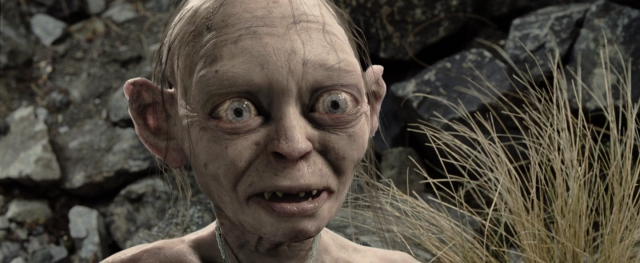
Gollum (Andy Serkis) is after “the precious.” in THE TWO TOWERS

THE LORD OF THE RINGS: THE TWO TOWERS (Peter Jackson, 2002)
Wednesday, August 13, 6:00
Peter Jackson continues Tolkien’s immortal tale as Frodo (Elijah Wood) is off to see the wizard (Christopher Lee) at Mordor, where he can destroy evil by throwing the Ring into a fiery volcano. In addition to loyal Samwise (Sean Astin), Frodo is joined by a creature called Gollum (Andy Serkis), which is what you come up with when you mix Yoda with Steve Buscemi. Throw in a bunch of Ents and Orcs, the kingdoms of Rohan and Gondor, and lots of great music and special effects and you have a three-hour film — which earned six more Oscar nods, winning two (Best Sound Effects Editing and Best Visual Effects) — that surpasses the first part and will leave you unwilling to wait another whole year for the conclusion.

THE RETURN OF THE KING

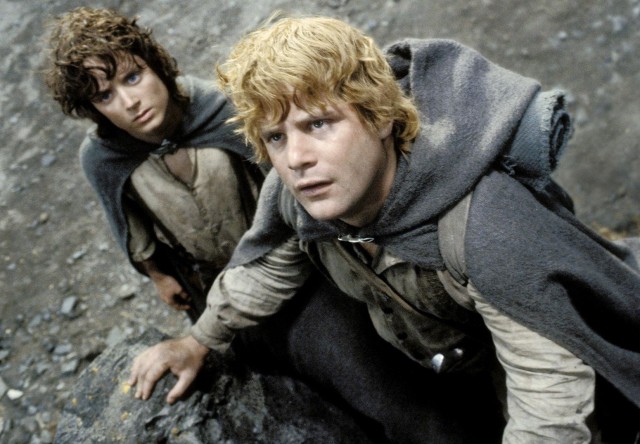
Frodo (Elijah Wood) and Samwise (Sean Astin) have one last chance in THE RETURN OF THE KING

THE LORD OF THE RINGS: THE RETURN OF THE KING (Peter Jackson, 2003)
Thursday, August 14, 6:00
Peter Jackson remains faithful to J.R.R. Tolkien’s vision in the thrilling conclusion to one of the great cinematic trilogies of all time. Frodo (Elijah Wood) and Sam (Sean Astin) are on their way to Mordor to cast the evil ring into the fires of Mt. Doom, but their guide, Gollom (Andy Serkis), has other plans for “the precious.” Meanwhile, Gandalf (Sir Ian McKellen) and Aragorn (Viggo Mortensen, who was once married to Exene Cervenka) are preparing to do battle in a sure-suicide mission. This is a grand adventure movie that, although it lags during the anticlimactic wrap-up, is well worth its epic length (nearly three and a half hours). The finale captured another eleven Academy Award nominations, winning them all, including, at last, a Best Director victory for Jackson as well as Best Picture. Fortunately, the MoMA series stops here, not including the 2012 critical and popular prequel flop, The Hobbit: An Unexpected Journey.

BRYANT PARK SUMMER FILM FESTIVAL: THE WOMEN

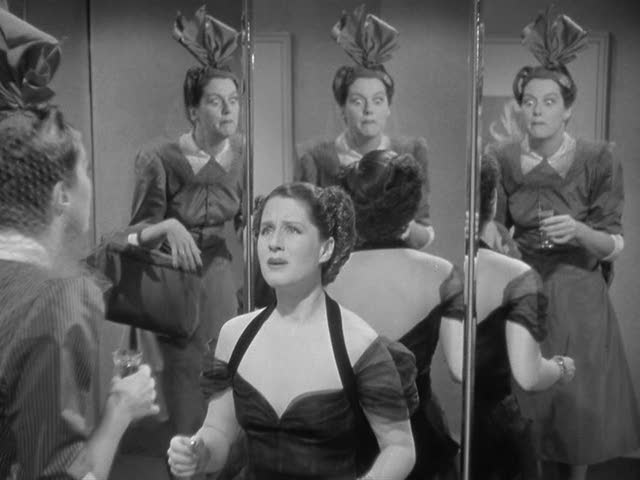
Mrs. Stephen Haines (Norma Shearer) learns the awful truth in George Cukor’s THE WOMEN

Mrs. Stephen Haines (Norma Shearer) discovers some awful truths in George Cukor’s THE WOMEN

THE WOMEN (George Cukor, 1939)
Bryant Park
Sixth Ave. between 40th & 42nd Sts.
Monday, August 12, free, sunset
Festival runs through August 19
www.bryantpark.org

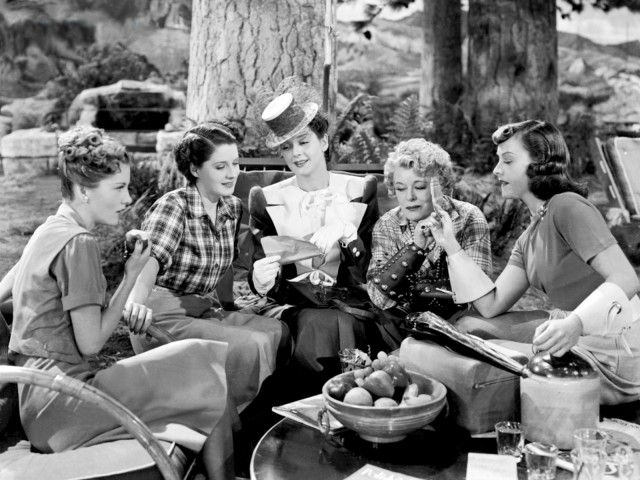
One of the cattiest movies ever made, The Women is a screwball comedy that has the distinction of not having a single man in it; it was even written by Anita Loos and Jane Murfin, based on Clare Booth’s 1936 Broadway play, and helmed by George Cukor, who is often considered “the women’s director.” Set in Manhattan, the film follows the intrigue and gossip surrounding a group of socialite women who yap yap yap all day long while shopping in ritzy stores, eating in fancy restaurants, and getting their nails done in high-end salons. Their attention is suddenly turned to the sweetly innocent Mary Haines (Norma Shearer) when it is believed that her husband, Stephen, is having an affair with conniving perfume salesperson Crystal Allen (Joan Crawford). Mary’s supposed best friends, Sylvia Fowler (Rosalind Russell), Edith Potter (Phyllis Povah), and Peggy Day (Joan Fontaine), at first keep the story from her, but as the facts continue to pile up, Mary considers heading to Reno to get a quickie divorce, even as her mother (Lucile Watson) tells her to just live with the deception, as most women do. In Reno, Mary stays at a ranch with other wives trying to get out of their marriages, including a boisterous, oft-wed countess (Mary Boland), a tough-talking chorus girl (Paulette Goddard), and a few surprises. As the women discuss life and love, wealth and poverty, heartache and motherhood — Mary is desperate to protect her daughter, also named Mary (Virginia Weidler), from the nasty proceedings — relationships twist and turn, loyalty is questioned, and the possibility of true love is clouded in doubt.
THE WOMEN

An all-star cast discuss what went wrong with their marriages in THE WOMEN

The Women is a riotous, fast-paced romp that flies by despite clocking in at more than two hours. The opening title sequence sets the stage, with each of the main characters represented by a different animal: deer (Mary), leopard (Crystal), black cat (Sylvia), monkey (the countess), hyena (Miriam), sheep (Peggy), owl (Mary’s mother), cow (Edith), doe (Mary’s daughter), and horse (Lucy). The narrative mixes slapstick humor and tender moments with scenes of backstabbing bravado. Dennie Moore nearly steals the show as fabulously gossipy manicurist Olga, who unwittingly sets the main plot in motion and is responsible for painting many of the characters’ nails in the critical color Jungle Red. (Among the other highlights are an exercise class at the spa and the maid spying on a heated argument between Mary and Stephen.) The cast also features Hedda Hopper as gossip columnist Dolly Dupuyster, Butterfly McQueen as Crystal’s assistant, Lulu, and Marjorie Main as Lucy, who runs the Reno divorce ranch. Although the film was primarily shot in black-and-white, it has an oddball Adrian fashion show in Technicolor that feels out of place, and some of the ideas regarding a woman’s freedom versus her dependence on men don’t quite hold up, but The Women is still one of the greatest Hollywood pictures ever told from the perspective of the fairer sex. Amazingly, Cukor’s film did not receive a single Oscar nomination, having come out the same year as Wuthering Heights, Stagecoach, Mr. Smith Goes to Washington, Gone with the Wind, Ninotchka, Love Affair, Dark Victory, The Wizard of Oz, and Goodbye, Mr. Chips. The Women is screening August 12 at dusk as part of the Bryant Park Summer Film Festival and will be preceded at 7:00 by a Reel Talk on the upper terrace with Scott Adlerberg and Kevin Lewis.


SON OF SUMMER SCI-FI, FANTASY & HORROR: SOLARIS

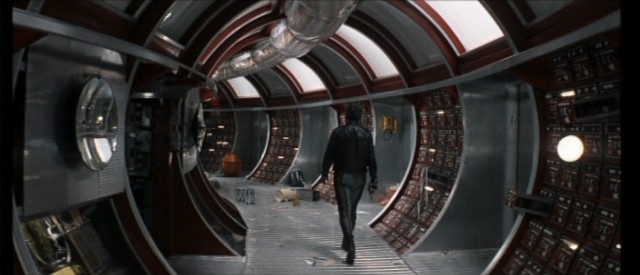
Reality gets twisted up in outer space in Andrei Tarkovsky’s SOLARIS

Reality gets twisted up in outer space in Andrei Tarkovsky’s SOLARIS

SOLARIS (Andrei Tarkovsky, 1972)
Film Forum
209 West Houston St.
Monday, August 12, 1:00, 4:10, 7:15
Series runs through September 5
212-727-8110
www.filmforum.org

In Andrei Tarkovsky’s Solaris, the Russian 2001: A Space Odyssey, Natalya Bondarchuk and Donatus Banionis star as a different kind of couple caught up in something very strange that is going on in outer space, unexplainable to both the characters in the film and the people in the audience. Banionis plays Dr. Kris Kelvin, a psychologist who is sent to the Solaris space station to decide whether to put an end to the solaristics project that Burton (Vladislav Dvorzhetsky) complicated twenty years before. What he discovers is one death, two possibly insane men, and his supposedly dead wife (Bondarchuk). Ambiguity reigns supreme in this gorgeously shot (in color and black and white by cinematographer Vadim Yusov) and scored (by Eduard Artemyev) film that, while technically science fiction, is really about the human conscience, another gem from master Russian director Tarkovsky (Ivan’s Childhood, Andrei Rublev, Nostalghia). See it whether or not you checked out Steven Soderbergh’s underrated remake with George Clooney and Natascha McElhone.

Stanley Kubrick’s 2001: A SPACE ODYSSEY helps cast a light on far-out sci-fi summer series at Film Forum

Stanley Kubrick’s 2001: A SPACE ODYSSEY helps cast a light on far-out sci-fi summer series at Film Forum

Based on Stanislaw Lem’s novel, Solaris is screening August 12 as part of Film Forum’s “Son of Summer Sci-Fi, Fantasy & Horror” series, which returns to the indie house for the first time in seventeen years. The festival continues through September 5 with such great double features as Jason and the Argonauts and The 7th Voyage of Sinbad, The Thing from Another World and It! The Terror from Beyond Space, Psycho and Peeping Tom, The Fearless Vampire Killers and The Abominable Dr. Phibes, the 1958 and 1978 versions of Invasion of the Body Snatchers, the 1958 and 1986 versions of The Fly, and other creepy classics in addition to 2001: A Space Odyssey.

CHAPLIN IN 35MM: THE GREAT DICTATOR

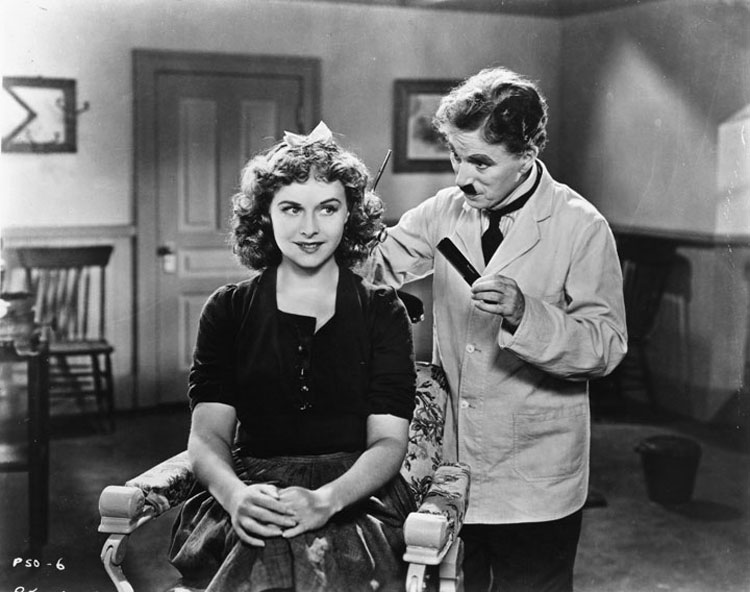
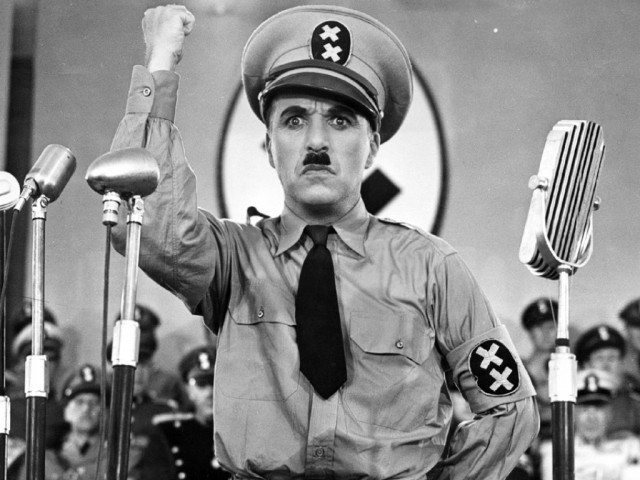
Paulette Goddard and Charlie Chaplin take on the Third Reich in his first talkie, THE GREAT DICTATOR

THE GREAT DICTATOR (Charles Chaplin, 1940)
BAMcinématek, BAM Rose Cinemas
30 Lafayette Ave. between Ashland Pl. & St. Felix St. Sunday, August 11, 2:00, 4:30, 7:00, 9:30
718-636-4100
www.bam.org

Learning of many of the horrible things the Third Reich was doing, Charlie Chaplin could not hold his tongue anymore, finally making his first talking picture in 1940. In The Great Dictator, writer-director-producer Chaplin unrelentingly mocks Adolf Hitler and the rise of the Nazis in Germany, albeit with a very serious edge, as WWII threatens. Chaplin plays the dual roles of a simple Jewish barber living in the ghetto (who has elements of the Little Tramp) and Adenoid Hinkle, the rather Hitler-esque Fascist leader of the country of Tomania. Just as he named the nation after a foodborne illness (ptomaine poisoning), Chaplin does not go for subtlety in the film; his right-hand man is Herr Garbitsch (Henry Daniel spoofing Nazi Minister of Propaganda Joseph Goebbels), and his military mastermind is Field Marshal Herring (Billy Gilbert making fun of Heinrich Himmler). Chaplin plays Hinkle like a cartoon character, with pratfalls galore, and when he speaks in German, especially when he gives a major speech, he spits out fake German words with a smattering of funny English ones. When he learns that Benzino Napaloni (Jack Oakie as a melding of Benito Mussolini and Napoleon Bonaparte) has gathered his troops on the Osterlitz border (think Anschluss), Hinkle invites the Bacteria dictator to his Tomanian palace, where they engage in numerous hysterical bouts of one-upmanship, including a riotous battle involving barber chairs. Meanwhile, Chaplin performs another of the film’s most memorable scenes, the shave of an old man set to Brahms’s “Hungarian Dance No. 5.” But when Commander Schultz (Reginald Gardiner) leaves the Nazi regime and decides to help the Jewish people in the ghetto, Hinkle sends his stormtroopers out to find the traitor, leading to a major case of mistaken identity and a heartfelt, if overly melodramatic, finale. In addition, Chaplin’s lover at the time, Paulette Goddard, plays Hannah (named for Chaplin’s mother), a young Jewish woman living in the ghetto, and Bowery Boys fans will recognize Bernard Gorcey, who played sweet-shop owner Louie Dombrowski in the goofy film series, as Mr. Mann.

Charlie Chaplin plays dual roles while examining Fascism and anti-Semitism in classic comedy

Charlie Chaplin plays dual roles while taking on Fascism and anti-Semitism in classic comedy

The Great Dictator is filled with marvelous moments, from Hinkle dancing with a balloon globe to several of the Jews in the ghetto trying to hide in the same chest, but the film does suffer from pedagoguery in making its political points, and some of the slapstick is too lowbrow. Nominated for five Oscars, it falls somewhere between the Marx Brothers’ Duck Soup (1933) and the Three Stooges’ You Nazty Spy! (1940) while also referencing the 1921 silent film King, Queen, Joker, in which Chaplin’s older half-brother, Sidney (who also directed), played the dual role of a modest barber and the king of the fictional Coronia. A seminal achievement that was supposedly seen by Hitler twice, The Great Dictator is screening August 11 as part of the BAMcinématek series “Chaplin in 35mm,” which concludes August 12 with A King in New York.