Over the years, Prince has put the spotlight on a series of musical protégés, from Wendy and Lisa, Sheila E., and Vanity to Apollonia 6, Carmen Electra, and Sheena Easton. City Winery will be celebrating His Most Purpleness’s newest up-and-comers as current backup singers Shelby J and Liv Warfield take center stage, with the NPG Hornz, for a series of hotly anticipated shows. The Purple Week festivities begin on August 19 with a free screening (advance RSVP required) of Albert Magnoli’s 1984 film Purple Rain, in which Prince stars as the Kid, performing such classic tracks as “Let’s Go Crazy,” “Darling Nikki,” “When Doves Cry,” and “I Would Die 4 U.” The movie will be preceded by a set by Prince tour DJ Dudley. Then Shelby J, Liv Warfield, and the New Power Generation Hornz will play two shows a night August 21, 22, 23, and 25 ($75 – $150), with special unannounced guests at each show. Will TAFKAP himself show up? He currently is not out on the road, so who knows. In any case, it should be one funky week.
twi-ny recommended events
SOUL DOCTOR: JOURNEY OF A ROCK STAR RABBI
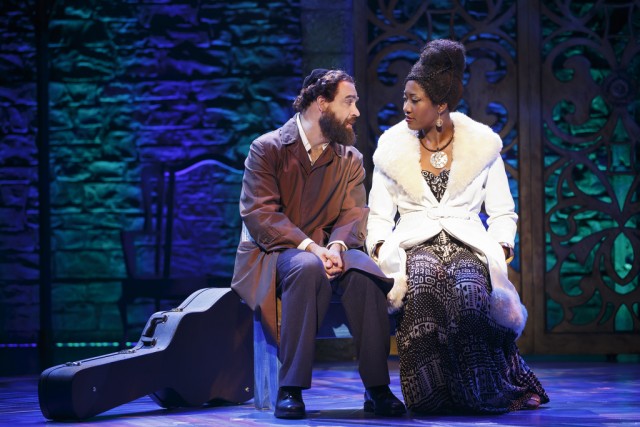
Shlomo Carlebach (Eric Anderson) and Nina Simone (Amber Iman) develop an unusual friendship in SOUL DOCTOR (photo by Carol Rosegg)
Circle in the Square Theatre
1633 Broadway at 50th St.
Tuesday – Sunday through October 13, $39 – $135
www.souldoctorbroadway.com
The new Broadway musical Soul Doctor follows the unusual relationship between a gentle, soft-spoken Orthodox rabbi and a vivacious chanteuse who wind up having a lot more in common that either would ever think. Eric Anderson stars as Shlomo Carlebach, the real-life Singing Rabbi whose family left Nazi-occupied Vienna when he was a boy, making a new life in New York City. While trying to find his place in America, Carlebach meets singer and activist Nina Simone (Amber Iman), and the two develop a long-term friendship, becoming each other’s muse. As Simone goes on to become the High Priestess of Soul, Carlebach turns away from the rigid rules of his Orthodox background, which severely disappoints his rabbi father (Jamie Jackson), his worried mother (Jacqueline Antaramian), and his devout brother (Ryan Strand), who has fallen under the influence of Lubavitcher Rebbe Menachem Schneerson (Jackson). But soon Carlebach, the King of Kosher Music, has a hit record, is playing in nightclubs, and forms his own, unique temple, the House of Love and Prayer, in hippie-era San Francisco. But he’s constantly trying to prove to himself and his family that what he is doing matters, that it is all part of the expansion of the Jewish faith.
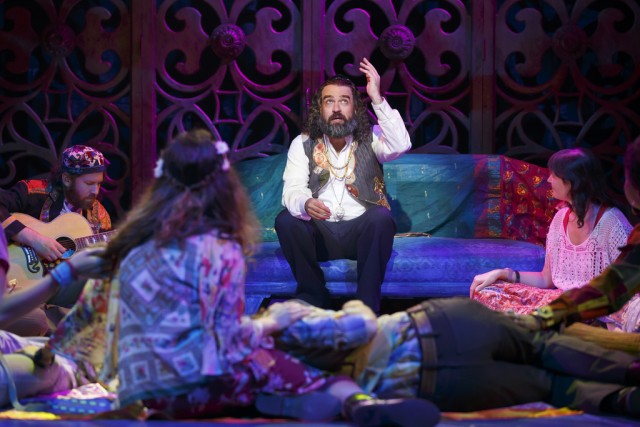
The King of Kosher Music preaches love and peace in San Francisco temple (photo by Carol Rosegg)
Anderson, who left the Kinky Boots ensemble to reprise the role of Carlebach, which earned him a Drama Desk nomination for last year’s presentation at New York Theatre Workshop, brings a sweet innocence to the mild-mannered Rock Star Rabbi, displaying the kind of charm that established Carlebach’s success and reputation. And Iman is a force as Simone, dominating the stage with her bold, brash style. The book, by director Daniel S. Wise, glosses over too many details, including Carlebach’s relationship with follower Ruth (Zarah Mahler), and just skips over others, leaving too many unexplained holes, and Carlebach’s never-ending battle with his childhood teacher and later cantor, Reb Pinchas (Ron Orbach), who he calls the “holy heckler,” grows repetitive and tiresome. The script is filled with such platitudes as Carlebach telling Pinchas, “If I had two hearts, I could use one to love and one to hate. But I only have one heart, so . . . I use it to love!” Despite less-than-inspiring choreography by former Cedar Lake artistic director Benoit-Swan Pouffer, the musical numbers, from the Carlebach tunes (“Rosh Hashanah Rock,” “Ki Va Moed,” “Yerushalyim,” “Am Yisrael Chai”) to new songs with lyrics by David Schechter, are mostly a lot of fun, with the exuberant cast, dressed in Maggie Morgan’s period costumes, often running up and down the aisles. Mahler turns in a strong solo near the end, “I Was a Sparrow,” that will have audiences wondering why she wasn’t featured more. Although you don’t have to be Jewish to enjoy the show, those who attend High Holiday services will be thrilled to hear many familiar liturgical melodies that were written by Carlebach. But Soul Doctor does more than merely preach to the converted, instead exploring a fascinating figure in American folk music.
FUN CITY — NEW YORK IN THE MOVIES 1967-75: THE LANDLORD
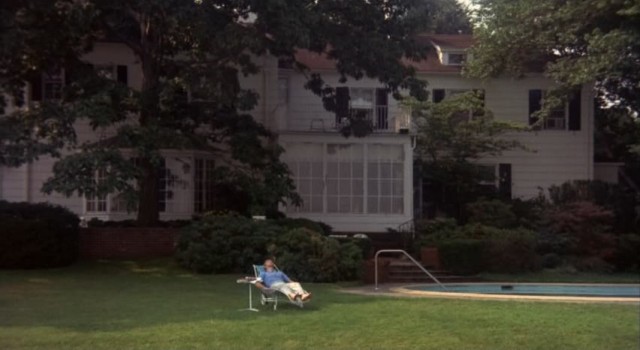
Young Elgar Winthrop Julius Enders’s (Beau Bridges) spoiled life of privilege is about to dramatically change in THE LANDLORD
THE LANDLORD (Hal Ashby, 1970)
Museum of the Moving Image
35th Ave. at 36th St., Astoria
Sunday, August 18, free with museum admission, 2:00
Series runs through September 1
718-777-6800
www.movingimage.us
 When rich kid Elgar Winthrop Julius Enders (Beau Bridges) finally decides to do something with his spoiled life of privilege, he takes a rather curious turn, buying a dilapidated tenement in a pregentrified Park Slope that resembles the South Bronx in Hal Ashby’s poignant directorial debut, The Landlord. At first, the less-than-worldly Elgar doesn’t quite know what he’s gotten himself into, believing it will be easy to kick out the current residents and then replace the decrepit building with luxury apartments. He pulls up to the place in his VW bug convertible, thinking he can just waltz in and do whatever he wants, but just as his car is vandalized, so is his previously charmed existence, as he gets to know wise house mother Marge (Pearl Bailey), the sexy Francine (Diana Sands), her activist husband, Copee (Louis Gossett Jr.), and Black Power professor Duboise (Melvin Stewart), none of whom is up-to-date with the rent. Meanwhile, Elgar starts dating Lanie (Marki Bey), a light-skinned half-black club dancer he assumed was white, infuriating his father, William (Walter Brooke), and mother, Joyce (a delightful, Oscar-nominated Lee Grant), who are in the process of setting up their daughter, Susan (Susan Anspach), with the white-bread Peter Coots (Robert Klein).
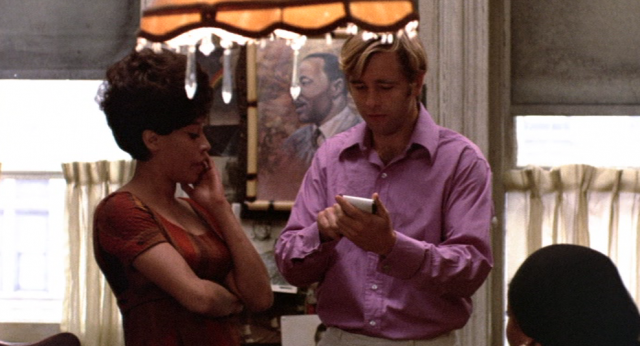
Elgar has a whole lot of learning to do in Hal Ashby’s New York City-set black comedy
Based on the novel by Kristin Hunter, The Landlord is a telling microcosm of race relations and class conflict in a tumultuous period in the nation’s history, as well as that of New York City, coming shortly after the civil rights movement and the free-love late ’60s. The film is masterfully shot by Astoria-born cinematographer Gordon Willis (Klute, Annie Hall, Manhattan, all three Godfather movies), who sets the bright, open spaces of the Enderses’ massive estate against the dark, claustrophobic rooms of the dank tenement. Screenwriter Bill Gunn (Ganja and Hess) and Ashby avoid getting overly preachy in this at times outrageous black comedy, incorporating slapstick along with some more tender moments; the scene in which Joyce meets Marge is a marvel of both. And just wait till you see Coots’s costume at a fancy fundraiser. The Landlord began quite a string for Ashby, who followed it up with Harold and Maude, The Last Detail, Shampoo, Bound for Glory, Coming Home, and Being There in a remarkable decade for the former film editor (In the Heat of the Night) who died in 1988 at the age of fifty-nine. The Landlord is screening August 18 at 2:00 as part of the Museum of the Moving Image series “Fun City: New York in the Movies 1967-75,” guest curated by J. Hoberman and continuing through September 1 with such other Big Apple fare as The Angel Levine, The French Connection, Coogan’s Bluff, The Taking of Pelham One Two Three, and Taking Off.
NEW YORK METS SOCIAL MEDIA NIGHT
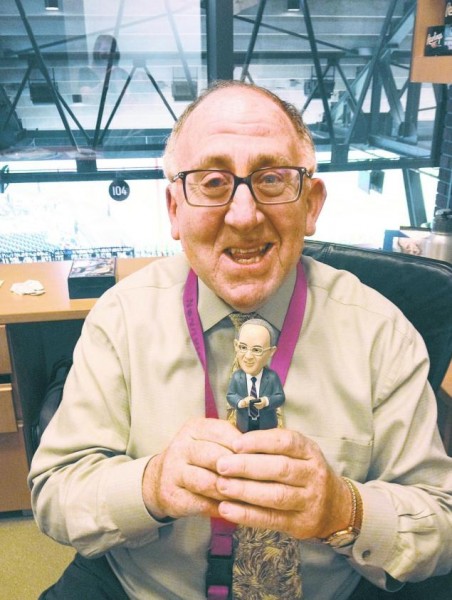
Mets media guru Jay Horwitz will be honored with his own Mini Me bobblehead at Social Media Night benefit for Shannon Forde
NEW YORK METS vs. DETROIT TIGERS
Citi Field
123-01 Roosevelt Ave. at 126th St.
Friday, August 23, $35, 7:10
www.newyorkmetscom
When we were at a Mets spring training game in Port St. Lucie back in March, we saw a surprising sight. A large group of autograph seekers were gathered around a schlubby older man, thrusting baseballs, photos, shirts, hats, and other items at him for his John Hancock. Two men approached us and asked who the guy was. We told them that it was Jay Horwitz, the team’s longtime PR guru, and they got all excited and immediately sped over to join the crowd like they were Mookie Wilson dashing for home. Horwitz, the Mets’ vice president of media relations, has been the team’s mouthpiece since April 1980, and he is now a Twitter sensation, with more than twenty-five thousand followers. He posts numerous times a day, writing about how the team is doing (“Gonzalez Germen impressive on and off mound. First save and did great job in doing his post game interview in English.”), pointing out odd stories (“Meet the only elephant who is a Mets fan at the San Diego Zoo. His name is Horace. Big fan since 1978. pic.twitter.com/0TeUYyF3d1”), answering questions directly, and joining the debate about recently being caught on camera with his finger in his nose (“Plan to appeal my nose case to Supreme Court. Judge Roberts saw game and said it was a scratch not a pick. Says I have the votes.”) On August 23, the Mets will honor Horwitz, who just turned sixty-eight, with his own bobblehead as part of Social Media Night, which is also a benefit for Shannon Forde, the team’s forty-one-year-old senior director of media relations and married mother of two who has been battling Stage 4 breast cancer since last August. Fans who buy $35 tickets through this link will receive the bobblehead, which Horwitz has dubbed Mini Me (“After an extra inning game and a two hour bus trip to SD, Mini Me sleeps in today. Have to get up soon. pic.twitter.com/fLcuyjNfBU”), with a portion of the proceeds going to Hope Shines for Shannon. In addition, the interleague game against the first-place Detroit Tigers will be followed by a concert by Third Eye Blind (“Semi-Charmed Life,” “Graduate”). When asked by NY Sports Dog back in 2008 what his secret was, Horwitz said, “Never lie. You can’t lie in New York with all the exposure here. Be up front with people even in the worst of times.” Clearly, it also helps to have a wacky sense of humor, especially as a member of the Mets franchise.
CUTIE AND THE BOXER
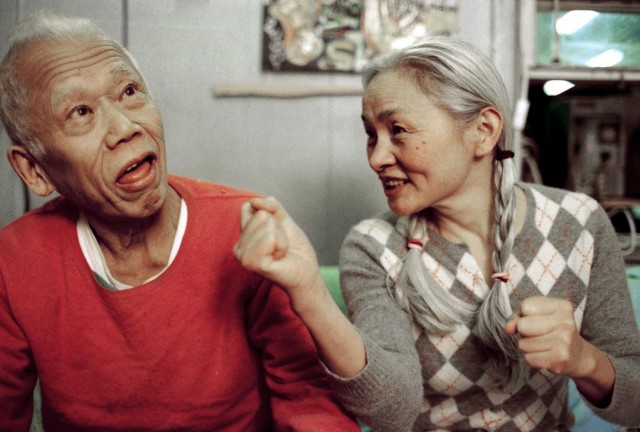
Documentary tells the engaging story of a pair of Japanese artists and the life they have made for themselves in Brooklyn
CUTIE AND THE BOXER (Zachary Heinzerling, 2013)
Lincoln Plaza Cinema, 1886 Broadway between 62nd & 63rd Sts., 212-757-2280
Landmark Sunshine Cinema, 143 East Houston St. between First & Second Aves., 212-330-8182
Opens Friday, August 16
www.facebook.com/cutieandtheboxer
 Zachary Heinzerling’s Cutie and the Boxer is a beautifully told story of love and art and the many sacrifices one must make to try to succeed in both. In 1969, controversial Japanese Neo Dada action painter and sculptor Ushio Shinohara came to New York City, looking to expand his career. According to the catalog for the recent MoMA show “Tokyo 1955-1970: A New Avant-Garde,” which featured four works by Ushio, “American art had seemed to him to be ‘marching toward the glorious prairie of the rainbow and oasis of the future, carrying all the world’s expectations of modern painting.’” Four years later, he met nineteen-year-old Noriko, who had left Japan to become an artist in New York as well. The two fell in love and have been together ever since, immersed in a fascinating relationship that Heinzerling explores over a five-year period in his splendid feature-length theatrical debut. Ushio and Noriko live in a cramped apartment and studio in DUMBO, where he puts on boxing gloves, dips them in paint, and pounds away at large, rectangular canvases and builds oversized motorcycle sculptures out of found materials. Meanwhile, Noriko, who has spent most of the last forty years taking care of her often childlike husband and staying with him through some rowdy times and battles with the bottle, is finally creating her own work, an R. Crumb-like series of drawings detailing the life of her alter ego, Cutie, and her often cruel husband, Bullie. (“Ushi” means “bull” in Japanese.) While Ushio is more forthcoming verbally in the film, mugging for the camera and speaking his mind, the pig-tailed Noriko is far more tentative, so director and cinematographer Heinzerling brings her tale to life by animating her work, her characters jumping off the page to show Cutie’s constant frustration with Bullie.
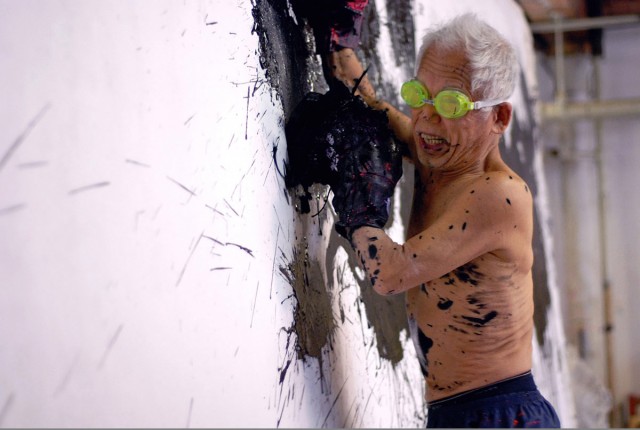
Ushio Shinohara creates one of his action paintings in CUTIE AND THE BOXER
During the course of the too-short eighty-two-minute film — it would have been great to spend even more time with these unique and compelling figures — the audience is introduced to the couple’s forty-year-old son, who has some issues of his own; Guggenheim senior curator of Asian Art Alexandra Munroe, who stops by the studio to consider purchasing one of Ushio’s boxing paintings for the museum; and Chelsea gallery owner Ethan Cohen, who represents Ushio. But things never quite take off for Ushio, who seems to always be right on the cusp of making it. Instead, the couple struggles to pay their rent. One of the funniest, yet somehow tragic, scenes in the film involves Ushio packing up some of his sculptures — forcing them into a suitcase like clothing — and heading back to Japan to try to sell some pieces. Cutie and the Boxer is a special documentary that gets to the heart of the creative process as it applies both to art and love, focusing on two disparate people who have made a strange yet thoroughly charming life for themselves. Cutie and the Boxer opens August 16 at Lincoln Plaza and the Landmark Sunshine; Ushio and Noriko will be at the latter for several Q&As over the weekend, including some with Heinzerling as well.
FUN CITY — NEW YORK IN THE MOVIES 1967-75: LITTLE MURDERS
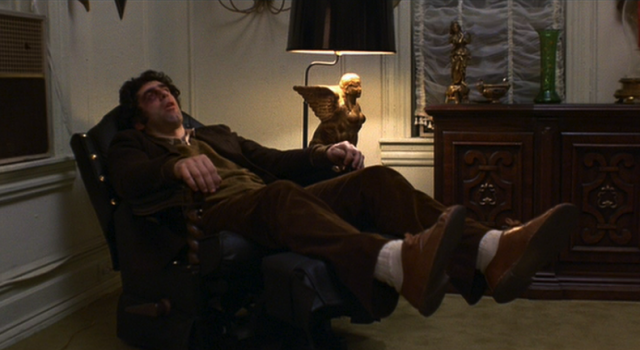
Alfred Chamberlain (Elliott Gould) takes a break in Alan Arkin’s LITTLE MURDERS
LITTLE MURDERS (Alan Arkin, 1971)
Museum of the Moving Image
35th Ave. at 36th St., Astoria
Saturday, August 17, free with museum admission, 5:30
Series runs August 10 – September 1
718-777-6800
www.movingimage.us
Alan Arkin’s directorial debut is a hysterically absurdist foray into the urban paranoia that haunted a lawless New York City in the late 1960s and 1970s. Based on Jules Feiffer’s first play, which was a Broadway flop in 1969 but became a hit in London and off Broadway, Little Murders centers on the offbeat relationship between the determined and domineering Patsy Newquist (Marcia Rodd) and the calm, easygoing Alfred Chamberlain (Elliott Gould). They first meet when Patsy tries to save him from getting beaten up yet again by a group of thugs, but he doesn’t want any help; he never fights back, instead letting them tire themselves out. A former successful commercial photographer, Alfred now spends his time taking artistic pictures of feces he finds on the filthy streets. He and Patsy sort of start dating, but Alfred, who regularly says, “I don’t know what love is,” is too passive for Patsy, who makes it her project to mold him into a stronger man, as if he were one of her interior design projects. The black comedy reaches new heights when Alfred meets Patsy’s rather eccentric family, played by the three actors who originated the roles on the stage. Vincent Gardenia is her high-strung father who laments what has become of the city, Elizabeth Wilson is her prim and proper mother who only sees what she wants to see, and Jon Korkes is deliciously funny as her crazy brother, who finds humor in just about everything. Meanwhile, wherever Patsy goes, a heavy-breathing phone caller follows.
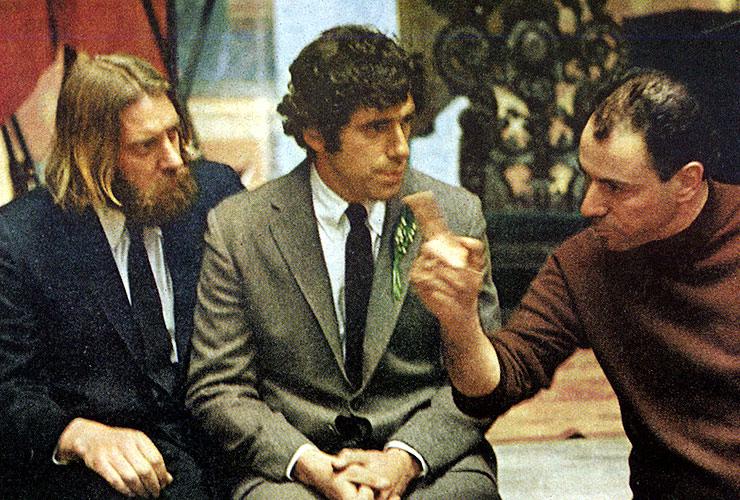
Donald Sutherland, Elliott Gould, and Alan Arkin discuss the wacky wedding scene in LITTLE MURDERS
Little Murders is one of the great unsung films of the 1970s, a wickedly funny, at times manic examination of love, fear, family, faith, and violence. The story is highlighted by several riotous monologues about the state of the world, including an epic rant delivered by Lou Jacobi as an angry judge and an oddball hippie speech by Donald Sutherland (Gould’s M*A*S*H costar) as an alternative minister. Arkin also appears as Lt. Practice, a cop stuttering about how many unsolved murders there have been in the past six months. The film is shot in a beautifully subdued, lurid palette by Gordon Willis, who photographed such other seminal New York-set ’70s pics as The Landlord, Klute, The Godfather I and II, Annie Hall, and Manhattan. A genuine underground cult classic, Little Murders is screening August 17 at 5:30 as part of the Museum of the Moving Image series “Fun City: New York in the Movies 1967-75,” guest curated by J. Hoberman and continuing through September 1 with such other Big Apple films as the French Connection, Across 110th Street, Born to Win, and The Landlord.
VIDEO OF THE DAY: “SAVE OUR SHIP” BY CATHERINE IRWIN
It’s been ten years since Catherine Irwin’s debut solo album, Cut Yourself a Switch, and as her sophomore Thrill Jockey release, 2012’s Little Heater, so clearly displays, that has been way too long. On the 2012 disc, the Connecticut-born Irwin, who cofounded the alterna-country band Freakwater with Eleventh Dream Day’s Janet Beveridge Bean a quarter-century ago, continues her exploration of folk, country, and American roots music, combining lovely melodies and lilting harmonies with stark, incisive lyrics. Recorded in Woodstock, the album features such gorgeous tracks as “Mockingbird,” “Sinner Saves a Saint,” “The Whole of the Law,” and the swamp-blues “Piss to Gin.” You can catch Irwin at Union Pool in Brooklyn on August 15, playing with the Phantom Family Halo and Old Baby. In addition, you can stream all of Little Heater here.