twi-ny recommended events

ARTWORK OF THE DAY: “DWARF AND RHINOCEROS (WITH LARGE BLACK SHAPE)” BY JOHN BALDESSARI

John Baldessari (photo by twi-ny/mdr)

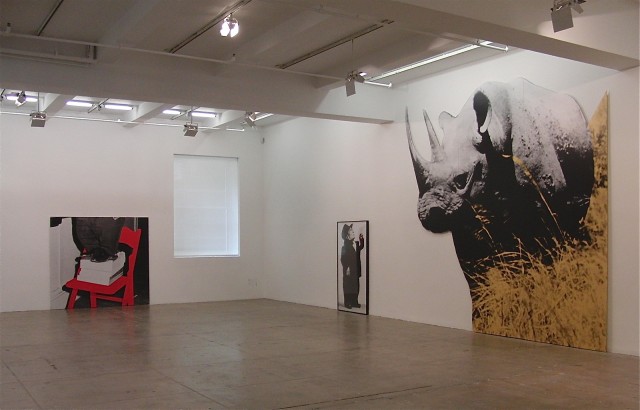
John Baldessari, “Dwarf and Rhinoceros (with Large Black Shape),” detail, archival inkjet prints mounted on Lexan with inset aluminum frame, latex paint, archival inkjet print mounted on plexiglass, 1989/2013 (photo by twi-ny/mdr)

“I’ve got to say, I don’t like being labeled a California artist, or a Los Angeles artist, or a Conceptual artist,” John Baldessari told us last year in a wide-ranging twi-ny talk. “I just like it to be artist.” The artist is back at Marian Goodman with a solo show that reinstalls a trio of works first seen in 1987-89, three rooms that feature Baldessari’s unique way of combining painting, photography, and sculpture; words, image, and meaning; the real world and its cinematic equivalent; and humanity and the animal kingdom. “Dwarf and Rhinoceros (with Large Black Shape)” (“Ni por Esas/ Not Even So: John Baldessari,” Museo Nacional Centro de Arte Reina Sofia, Madrid, 1989) focuses on a black-and-white photo of a little man, seemingly squeezed into a rectangular frame, looking up and pointing at a rhino in the wild. “Two Stories (Yellow and Blue) and Commentary (with Giraffe)” (“Magiciens de la Terre,” Centre Georges Pompidou and Grande Halle La Villette, Paris, 1989) includes a giraffe emerging from a corner, facing a cross of pop-culture images. And “The Difference Between Fête and Fate” (“John Baldessari,” Museo d’Arte Contemporanea, Castello di Rivoli, Rivoli, Italy, 1987) consists of striking photographs of people and animals, including polar bears, an owl, and a burning man. The eponymously titled exhibition continues in Midtown through August 23.

ANOTHER DAY, ANOTHER TIME: CELEBRATING THE MUSIC OF “INSIDE LLEWYN DAVIS”

Benefit concert will celebrate music of latest Coen brothers film, INSIDE LLEWYN DAVIS

Benefit concert will celebrate music of latest Coen brothers film, INSIDE LLEWYN DAVIS

The Town Hall
123 West 43rd St. between Sixth Ave. & Broadway
Tickets on sale Wednesday, August 21, 12 noon
Concert takes place September 29, $75-$150, 7:30
212-840-2824
www.insidellewyndavis.com
www.the-townhall-nyc.org

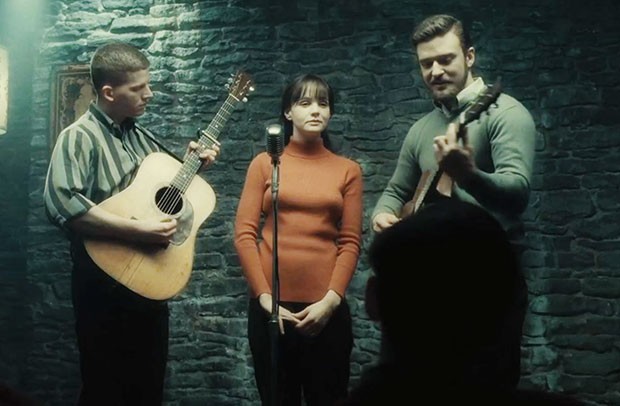
In 2000, filmmakers Joel and Ethan Coen teamed up with producer T Bone Burnett to create an award-winning soundtrack for their hit film O Brother, Where Art Thou? The 1930s-set movie featured a mix of traditional Americana, country, folk, and blues, including such songs as “Big Rock Candy Mountain,” “I Am a Man of Constant Sorrow,” “O Death,” and “Lonesome Valley” performed by such musicians as Norman Blake, Jerry Douglas, Alison Krauss, Ralph Stanley, Emmylou Harris, Gillian Welch, and the Soggy Bottom Boys. In their latest film, Inside Llewyn Davis, which premiered at Cannes in May, the Coens tell the story of a week in the life of a 1960s Greenwich Village folksinger, with Burnett once again on board to steer the soundtrack. On September 29, the music of the film will take center stage at the Town Hall, when “Another Day, Another Time: Celebrating the Music of Inside Llewyn Davis” takes place, featuring an all-star lineup raising funds for the National Recording Preservation Foundation. The roster is unusually impressive, featuring the Avett Brothers, Joan Baez, Rhiannon Giddens, Lake Street Drive, Colin Meloy, the Milk Carton Kids, Marcus Mumford, Conor Oberst, the Punch Brothers, Secret Sisters, Patti Smith, Gillian Welch & David Rawlings, Willie Watson, and Jack White in addition to cast members Oscar Isaac, John Goodman, Carey Mulligan, and Stark Sands. The concert will include songs from the film in addition to 1960s tunes that inspired them. The film will screen at this fall’s New York Film Festival before opening in December. Tickets are $75 and $150 and go on sale August 21 at noon.

SPEAKEASY DOLLHOUSE

(photo © Margee Challa, 2012)

Immersive production re-creates shady tale in 1930s New York City (photo © Margee Challa, 2012)

102 Norfolk St.
First monthly Saturday and Monday, September 7 – December 14, $55 general admission, $145 VIP
800-838-3006
www.speakeasydollhouse.com

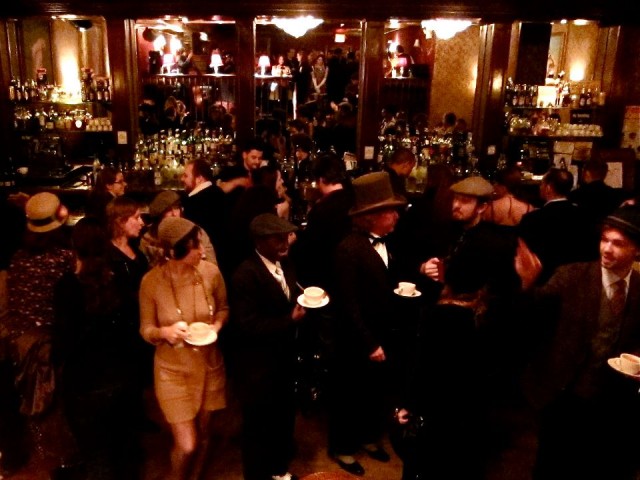
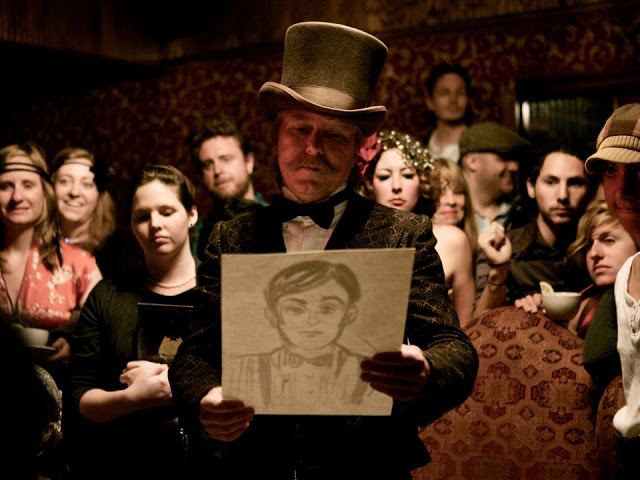
New York has gone crazy for immersive theatrical productions recently, as the audience interacts with the actors in various ways in such hit shows as Sleep No More at the McKittrick Hotel and Natasha, Pierre & the Great Comet of 1812 at the temporary Klub Kazino. Things go even further in Speakeasy Dollhouse, a flashy, lurid tale of murder and deception taking place in a series of rooms in an underground location on Norfolk St. Once you purchase your tickets — which just jumped from $30/$55 to $55/$145 — you start receiving e-mails from Cynthia von Buhler detailing the real-life murder of her grandfather Frank Spano and its cover-up, which reached all the way inside Tammany Hall. “My grandmother died in the 1980s and I never knew my grandfather,” one von Buhler missive explains. “He was mysteriously killed in 1935. He died on the very same day my mother was born. She told us that he was shot and nobody knew why. It was a secret. They boarded up the club and bakery after that.” Speakeasy Dollhouse re-creates that time period, acting out the events that led to the shooting, based on both facts and supposition, as von Buhler seeks to uncover the truth. Attendees are given a password and asked to dress in Prohibition-era costumes, which is a good idea, as the vast majority of people do so. Upon entering the nightclub, each person receives a piece of paper from the Fortune Teller (Jordana Rollerdazzler) giving them a specific role to carry out. For the next few hours, the cast, crew, and audience mingle as they travel from room to room and various plot elements are revealed, from an autopsy and a secret lovers tryst to back-room machinations and a card game.

Evidence is presented as SPEAKEASY DOLLHOUSE seeks to find answers to real-life murder (photo © Margee Challa, 2012)

Evidence is presented as SPEAKEASY DOLLHOUSE seeks to find answers to real-life murder (photo © Margee Challa, 2012)

The story revolves around the killing of club owner Frank Spano (Russell Farhang) by barber John Guerrieri (Silent James), which soon involves such figures as Detective Thomas Crane (Justin Moore), mobster Dutch Schultz (Travis Moore), Tammany Hall party boss Jimmy Hines (Charley Layton), and Magistrate Hulon Capshaw (Scott Southard). To further the atmosphere, there are a series of live performances by burlesque singers and dancers and the Howard Fishman Quartet. Meanwhile, a cash bar serves drinks and a bakery offers cannoli and other pastries. Originally planned as a one-time-only presentation, Speakeasy Dollhouse is now playing the first Saturday and Monday of each month through December, with each show centering on a different theme investigating the possible motive behind the killing; on October 26, there will be a special Halloween performance only for people who have previously attended a show, complete with zombies, werewolves, vampires, and unicorns. The production captures the feel of 1930s New York City, but the allowance of photography detracts a bit from the overall experience; the producers might want to have pictures spread all over social media, but there weren’t really many iPhones back in those days. Still, the more you immerse yourself in Speakeasy Dollhouse, the more fun you’re going to have. And there’s a whole lot of fun to be had as von Buhler, who appears as herself, keeps trying to get to the bottom of what happened to her family.

TCM CLASSIC FILM TOUR

tcm tour

Meet near Broadway at 51st St.
Tuesday, Thursday, Saturday, August 22 – January 9, children $27, adults $43, 11:30 am
212-913-9780
www.onlocationtours.com

Throughout Hollywood’s fabled history, many of its greatest films were made right here in New York City. Turner Classic Movies and On Location Tours have now teamed up to present the TCM Classic Film Tour, a three-hour exploration through some of the Big Apple’s most iconic cinema sites. Among the dozens of stops the bus will make are at the Empire State Building (King Kong, An Affair to Remember), Grand Central Terminal (North by Northwest, Superman), Central Park (Ghostbusters, The Fisher King), the Dakota (Rosemary’s Baby, Hannah and Her Sisters), the Plaza Hotel (Plaza Suite, Barefoot in the Park), Rockefeller Center (Elf, On the Town), Tiffany’s (Breakfast at Tiffany’s), FAO Schwarz (Big, Baby Boom), and Zabar’s (You’ve Got Mail). There will also be trivia quizzes and movie clips along the way. We’re a little disturbed that the On Location website promises a “fantastic view of the Manhattan Bridge you’ll recognized [sic] from Woody Allen’s Manhattan,” since it’s actually the Queensboro Bridge that appears in the iconic scene (as displayed in the tour logo), but we’ll catch them a break this time and hope that the tour itself isn’t laden with additional mistakes.

FANTASTIC FICTION AT KGB: LIBBA BRAY AND NOVA REN SUMA

17 and gone

KGB Bar
85 East Fourth St. off Second Ave.
Wednesday, August 21, free, 7:00
www.kgbbar.com

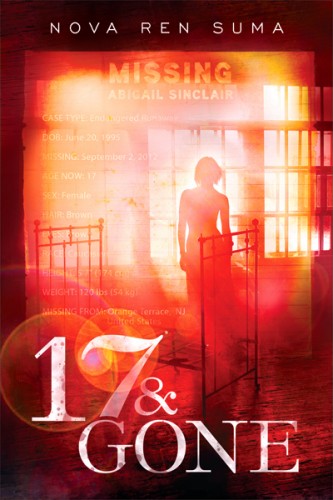
KGB Bar’s latest Fantastic Fiction lineup should be a mutual lovefest, as Michael L. Printz Award winner Libba Bray (Going Bovine, Beauty Queens) teams up with rising YA star Nova Ren Suma (Imaginary Girls) for an evening of readings and discussion hosted by Ellen Datlow and Matthew Kressel. Here’s what Bray, who is a YA goddess — from her popular books to her band, Tiger Beat, which features fellow YA authors Natalie Standiford, Barnabas Miller, and Daniel Ehrenhaft, to her potentially lucrative Tampon Poetry™ — has to say about Suma’s latest novel, 17 & Gone: “Elegant, riveting, powerful, and poignant, this suspenseful, supernatural tale slips under the skin, inking out a haunting tapestry of menace and madness. Nova Ren Suma is, quite simply, a masterful storyteller and one of my favorite writers.” Suma is one of our favorite writers as well, and not only because we used to work with her and that she gave her first public reading of Imaginary Girls at twi-ny’s tenth anniversary party. She is also an expert craftsperson who agonizes over every word of the complex, fascinating worlds she creates, filled with wholly believable characters trapped in extraordinary situations. Here’s a tiny taste, from the first chapter of 17 & Gone (Dutton, March 2013, $17.99): “Abby Sinclair. There at the intersection. I’m not saying she was there in the flesh with her thumb out and her hair wild in the wind and her bare knees purpled from cold — it didn’t start out that way. The first time I saw Abby, it was only a picture: the class photograph reproduced on her Missing poster.” We know that makes us want to read a whole lot more, and it should do the same to you. Suma’s next book, The Walls Around Us, is due out from Algonquin in 2015.

JOHN CHAMBERLAIN: THE HEDGE

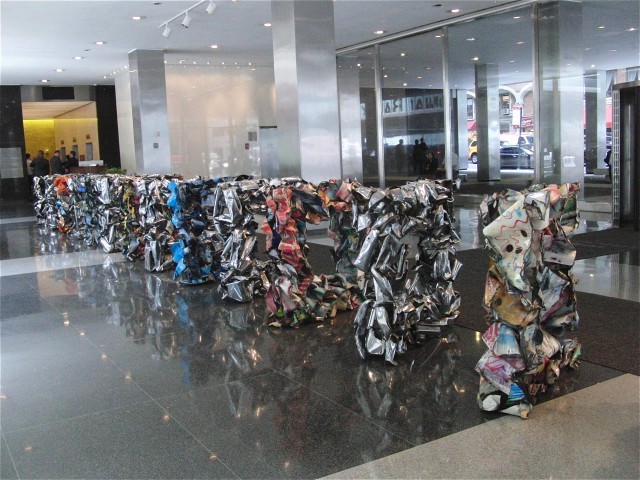
John Chamberlain, “The Hedge,” painted and chromium-plated steel, sixteen elements, 1997 (photo by twi-ny/mdr)

John Chamberlain, “The Hedge,” painted and chromium-plated steel, sixteen elements, 1997 (photo by twi-ny/mdr)

Lever House Art Collection
390 Park Ave. at 54th St.
Through August 31, free
www.leverhouseartcollection.com
the hedge photo set

Indiana-born sculptor John Chamberlain has seemingly been omnipresent since his death in December 2011 at the age of eighty-four. Sadly, the longtime Shelter Island resident passed away shortly before his wonderful career retrospective, “Choices,” last year at the Guggenheim, which showed off the surprising breadth of his work, which went well beyond car chrome and steel assemblages. Then the Gagosian put together a small outdoor sculpture installation on Seagram Plaza in Midtown last summer and fall, allowing such recent biomorphic aluminum pieces as “FROSTYDICKFANTASY,” “MERMAIDSMISCHIEF,” and “ROBUSTFAGOTTO” to glitter in the sun. Now Lever House is presenting one of Chamberlain’s largest sculptures, 1997’s “The Hedge,” which consists of a forty-six-foot-long row of sixteen evenly spaced forty-four-inch-high squares composed of painted chromium-plated steel from automobiles. A kind of three-dimensional Abstract Expressionist canvas come to life, “The Hedge” cuts through the mostly black-and-gray glassed-in Lever House lobby, where it can be seen residing next to a row of live green plantings. Each piece has a square hole in the middle, allowing visitors to look through them all, directly out onto Park Ave., where more colors pass by with the traffic, adding sly commentary on America’s consumerist car culture. Using such tools as a sledgehammer, a compactor, an acetylene torch, a band saw, and a steel cutter on automobile parts, Chamberlain is able to evoke the natural world with “The Hedge,” which features an array of bright, bold colors in a unique kind of metallic topiary. Each piece is a work of art in its own right, but together they invite viewers into a multifaceted, multidimensional space that seems to morph as seen from different angles.

A TIME FOR BURNING — CINEMA OF THE CIVIL RIGHTS MOVEMENT: THE INTRUDER / NINE FROM LITTLE ROCK

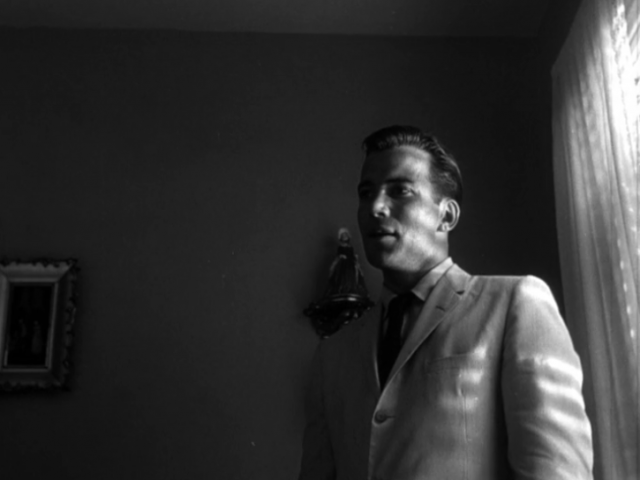
William Shatner plays shady character Adam Cramer in powerful film about school integration in a southern town

William Shatner plays shady character Adam Cramer in powerful film about school integration in a southern town

THE INTRUDER (Roger Corman, 1962)
BAMcinématek, BAM Rose Cinemas
30 Lafayette Ave. between Ashland Pl. & St. Felix St.
Tuesday, August 20, 9:30
Series continues through August 28
718-636-4100
www.bam.org

Exploitation master Roger Corman shot out of the gates in the mid-1950s, directing and/or producing more than three dozen films between 1955 and 1961, directing doomsday disasters (Day the World Ended, Last Woman on Earth) and sci-fi quickies (It Conquered the World, Attack of the Crab Monsters), cheapie Westerns (Gunslinger, The Oklahoma Woman) and teen rave-ups (Sorority Girl, Teenage Doll), crime dramas (Machine-Gun Kelly; I, Mobster) and horror (A Bucket of Blood, The Undead), as well as the tales of Poe (House of Usher, The Pit and the Pendulum). But he tried something a little different with 1962’s The Intruder, a gripping, yet still exploitative, story of integration set in the ultraconservative south. Adapted by Charles Beaumont from his 1959 novel, which itself was inspired by the Little Rock Nine, the film stars William Shatner as Adam Cramer, a self-styled “social reformer” who arrives in the small southern town of Caxton just after integration has become law and just as ten black students, led by Joey Greene (Charles Barnes), are about to join whites at the local high school. Under the auspices of the John Birch-like Patrick Henry Society, Cramer is determined to continue the fight against integration, stirring the locals to potential mob violence through carefully orchestrated speeches filled with hate and lies. He allies himself with wealthy plantation owner Verne Shipman (Robert Emhardt) and cozies up to high school girl Ella McDaniel (Beverly Lunsford), daughter of newspaper editor Tom McDaniel (Frank Maxwell), one of the only reasonable white men in town. The manipulative Cramer will do just about anything to rile up the masses to keep the blacks from ruining America, but his own questionable personal morality might just get in the way, especially as he flirts with Vi (Jeanne Cooper), the wife of traveling salesman Sam Griffin (Leo Gordon).

Beaumont, who wrote nearly two dozen episodes of The Twilight Zone — though neither of the classics starring Shatner — appears in the film as Mr. Paton, a teacher in the school, along with fellow Twilight Zone scribe George Clayton Johnson, who plays Phil West; Johnson later wrote “The Man Trap,” the first regular episode of Star Trek. Indeed, The Intruder contains numerous Rod Serling-like elements, from the general social and political themes to Taylor Byars’s black-and-white cinematography and Herman Stein’s score. The Intruder is screening August 20 with Charles Guggenheim’s Oscar-winning short, Nine from Little Rock, as part of the BAMcinématek series “A Time for Burning: Cinema of the Civil Rights Movement,” which runs through August 28 with such other political films as Robert Wise’s Odds Against Tomorrow, Daniel Petrie’s A Raisin in the Sun, Edward Pincus and David Neuman’s Black Natchez, and St. Clair Bourne’s Let the Church Say Amen! The two-week festival was organized to commemorate the fiftieth anniversary of the March on Washington, but it now takes on even more meaning with the recent U.S. Supreme Court ruling that a central part of the Voting Rights Act of 1965 is unconstitutional.