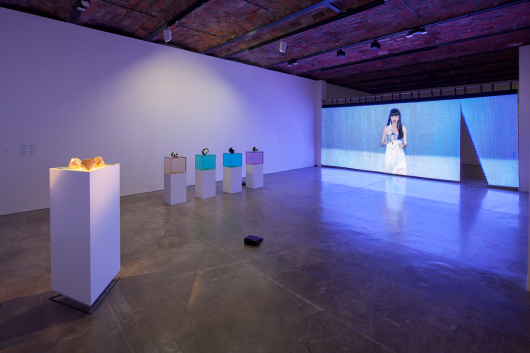
“ProBio” looks at the future with “dark optimism” at MoMA PS 1 (photo by Matthew Septimus)
MoMA PS1
22-25 Jackson Ave. at 46th Ave.
Thursday – Monday through September 2, suggested admission $10 (free with paid MoMA ticket within fourteen days), 12 noon – 6:00
718-784-2084
www.momaps1.org
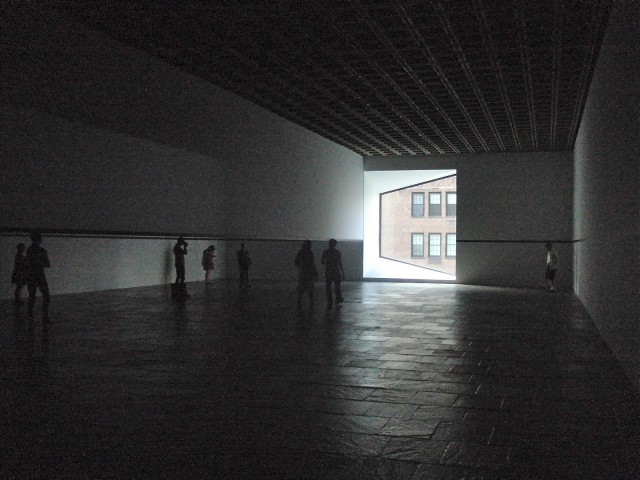
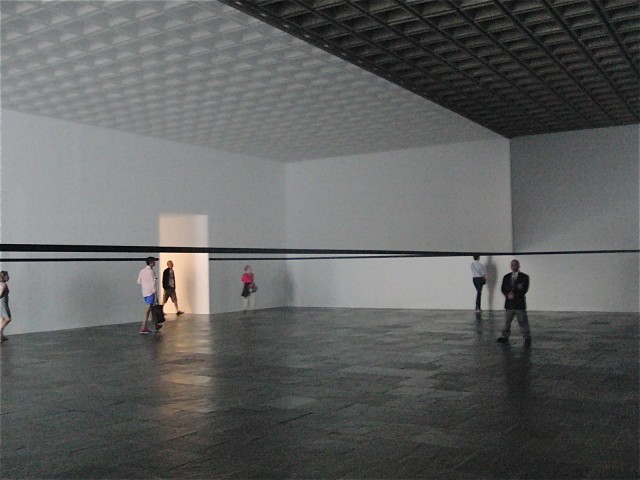
The presentation of MoMA PS1’s summer exhibition, “Expo 1: New York,” smartly echoes how climate change, technology, and evolution have impacted the progression and devastation of the natural world in the twenty-first century. The show began in May with a series of modules in various locations, with some of those individual parts, including “Rain Room” at MoMA, Olafur Eliasson’s Icelandic glacier installation “Your waste of time” at PS1, Adrián Villar Rojas’s “La inocencia de los animales (The innocence of animals)” PS 1 lecture hall, and the VW Dome on Rockaway Beach, now having gone extinct, disappearing like the melting ice caps. But the show, which promotes Triple Canopy’s concept of a “dark optimism” for the future of humanity and the planet, still has several worthwhile displays at its primary hub at PS 1, examining its mission statement that “we live in a time that is marked by both the seeming end of the world and its beginning, being on the brink of apocalypse but also at the onset of unprecedented technological transformation.” Curators Klaus Biesenbach and Hans Ulrich Obrist reach back fifteen years for Meg Webster’s “Pool,” which PS 1 founder Alanna Heiss originally commissioned in 1998, a swampy water environment that could not exist without the coming together of natural materials and man-made electronic elements. Downstairs in the basement, the Cinema is offering up recent film, video games, and online content from the YouTube generation; the upcoming schedule includes the video games “Journey” and “Proteus,” Sterling Ruby’s Transient Trilogy, Althea Thauberger’s Northern, and Khavn de la Cruz’s Kalakala and Mondomanila or: How I Fixed My Hair After a Rather Long Journey, with the director on hand to discuss his work (and provide live piano accompaniment for the former). Organized by Josh Kline, “ProBio” takes a futuristic look at the intersection of technology and the human body, with intriguing cutting-edge works by such artists as Alisa Baremboym, Antoine Catala, Carissa Rodriguez, and Georgia Sagri; watch out for those Roomba-like robots scouring the floor. One offsite project still remains, Marie Lorenz’s “The Tide and Current Taxi,” which visitors can hail in New York harbor. As always at MoMA PS 1, the many rooms hold little surprises, so be sure to explore so you can also catch pieces by Charles Ray, Matthew Barney, Zoe Leonard, Steve McQueen, Mark Dion, Chris Burden, Pierre Huyghe, Agnes Denes, Ugo Rondinone, and others. And for the final week of “Expo 1,” a77’s communal courtyard installation “Colony” is taken over by Glenn O’Brien, who will be hosting “TV Party Goes to Camp.”
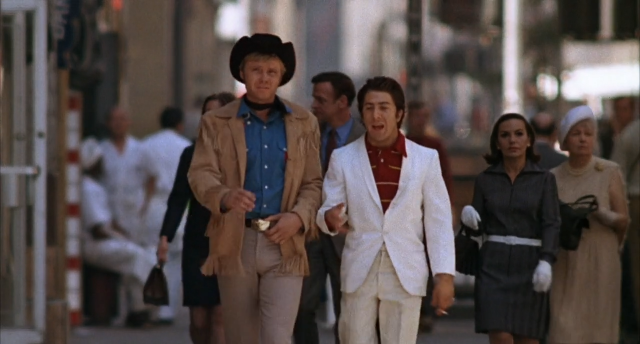
 Dustin Hoffman and Jon Voight star as the worst hustlers ever in John Schlesinger’s masterful Midnight Cowboy. The only X-rated film to win a Best Picture Oscar, Midnight Cowboy follows the exploits of Joe Buck, a friendly sort of chap who leaves his small Texas town, determined to make it as a male prostitute in Manhattan. Wearing his cowboy gear and clutching his beloved transistor radio, he trolls the streets with little success. Things take a turn when he meets up with Enrico Salvatore “Ratso” Rizzo (Hoffman), an ill, hobbled con man living in a condemned building. The two loners soon develop an unusual relationship as Buck is haunted by nightmares, shown in black-and-white, about his childhood and a tragic event that happened to him and his girlfriend, Crazy Annie (Jennifer Salt), while Rizzo dreams of a beautiful life, depicted in bright color, without sickness or limps on the beach in Miami. Adapted by Waldo Salt (Serpico, The Day of the Locust) from the novel by James Leo Herlihy, Midnight Cowboy is essentially a string of fascinating and revealing set pieces in which Buck encounters unusual characters as he tries desperately to succeed in the big city; along the way he beds an older, wealthy Park Ave. matron (Sylvia Miles), is asked to get down on his knees by a Bible thumper (John McGiver), gets propositioned in a movie theater by a nerdy college student (Bob Balaban), has a disagreement with a confused older man (Barnard Hughes), and attends a Warholian party (thrown by Viva and Gastone Rosilli and featuring Ultra Violet, Paul Jabara, International Velvet, Taylor Mead, and Paul Morrissey) where he hooks up with an adventurous socialite (Brenda Vaccaro). Photographed by first-time cinematographer Adam Holender (The Panic in Needle Park, Blue in the Face), the film captures the seedy, lurid environment that was Times Square in the late 1960s; when Buck looks out his hotel window, he sees the flashing neon, with a sign for Mutual of New York front and center, the letters “MONY” bouncing across his face with promise. The film is anchored by Harry Nilsson’s Grammy-winning version of “Everybody’s Talkin’,” along with John Barry’s memorable theme. Iconic shots are littered throughout, along with such classic lines as “I’m walkin’ here!” Midnight Cowboy, which was nominated for seven Oscars and won three (Best Picture, Best Adapted Screenplay, and Best Director) is screening August 25 at 5:00 as part of the Museum of the Moving Image series “Fun City: New York in the Movies 1967-75,” which is guest curated by J. Hoberman and continues through September 1 with such other Big Apple fare as The Taking of Pelham One Two Three, Born to Win, Dog Day Afternoon, and Taking Off.