twi-ny recommended events

BROADWAY WEEK 2013

New production of ROMEO AND JULIET, starring Orlando Bloom and Condola Rashad, is one of nineteen Broadway shows offering two-for-one tickets September 2-15

New production of ROMEO AND JULIET, starring Orlando Bloom and Condola Rashad, is one of nineteen Broadway shows offering two-for-one tickets September 2-15

Multiple venues
September 2-15, buy one, get one free
www.nycgo.com/broadwayweek

After the long, hot summer, the Great White Way looks to keep fans filling seats during the annual Broadway Week discount, when tickets for nineteen shows are available for half price for performances September 2-15. You can buy one ticket and get one free for such newer productions, some still in previews, as Big Fish, First Date, Forever Tango, The Glass Menagerie (with Cherry Jones and Zachary Quinto), Romeo and Juliet (with Orlando Bloom and Condola Rashad), and Soul Doctor as well as such mainstays as Chicago, Jersey Boys, The Lion King, Rock of Ages, Wicked, The Phantom of the Opera, and Mamma Mia! Also available are seats to Once, The Trip to Bountiful, Rodgers & Hammerstein’s Cinderella, Newsies, Annie, and Spider-Man: Turn Off the Dark. Quantities are limited, so you have to act fast.

AWAKE AND SING!

AWAKE AND SING!

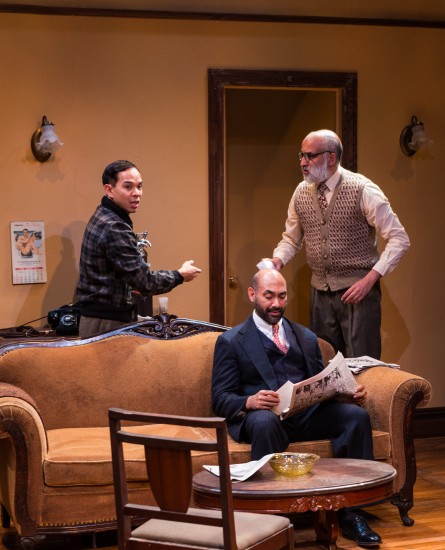
Ralph (Jon Norman Schneider), Uncle Morty (Andrew Ramcharan Guilarte), and Grandpa Jacob (Alok Tewari) face a series of crises in all-Asian revival of Clifford Odets’s AWAKE AND SING! (photo by William P. Steele)

Walkerspace
46 Walker St.
Tuesday – Sunday, through September 8, $25
866-811-4111
www.naatco.org

It’s been fifty years since writer and director Clifford Odets died of stomach cancer at the age of fifty-seven, and it is thrilling to see his work currently undergoing a kind of renaissance. Late last year, a seventy-fifth anniversary production of Golden Boy opened on Broadway and was nominated for a Tony, and this past spring brought the first Broadway revival of the 1949 Hollywood drama The Big Knife. But the National Asian American Theatre Co. (NAATCO) takes a somewhat different approach in its wonderfully small-scale, deeply intimate version of Odets’s first, and one of his best, plays, Awake and Sing! Written for Odets’s Group Theatre in 1935, the play follows the exploits of the Berger family, who live together in a cramped Bronx apartment. It’s 1933, and the Great Depression is continuing to take its toll. The household is run by domineering mother Bessie (NAATCO cofounder and artistic producing director Mia Katigbak), who is married to the meek and often clueless Myron (Henry Yuk). Son Ralph (Jon Norman Schneider) has no career direction and a girlfriend his mother disapproves of, while daughter Hennie (Teresa Avia Lim) has just gotten knocked up, with the man who did it out of the picture. While Bessie tries to orchestrate and control everyone’s lives, her father, Jacob (Alok Tewari), spouts Marxist doctrine and her well-dressed brother, Morty (Andrew Ramcharan Guilarte), waxes poetic about success in business. Also hanging around is Moe Axelrod (Sanjit De Silva), a street-smart character who offers his own take on the future.
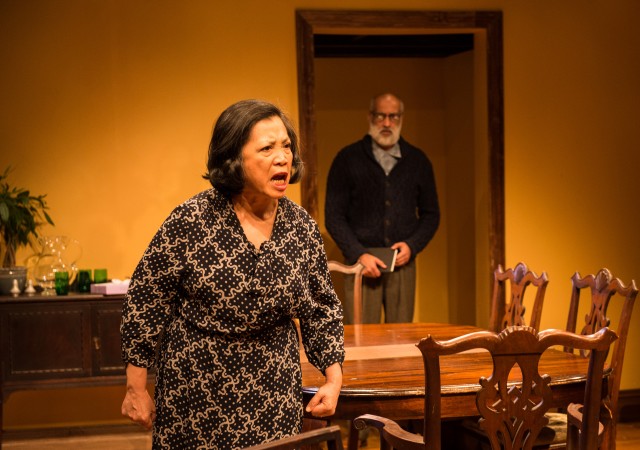
Bessie Berger (Mia Katigback) will do whatever it takes to protect the honor of her family in NAATCO revival of Clifford Odets’s first play (photo by William P. Steele)

Bessie Berger (Mia Katigback) will do whatever it takes to protect the honor of her family in NAATCO revival of Clifford Odets’s first play (photo by William P. Steele)

As opposed to its two big-time Broadway productions — Awake and Sing! premiered on the Great White Way in 1935, directed by Harold Clurman and starring Luther Adler, Stella Adler, Morris Carnovsky, John Garfield, and Sanford Meisner, while the Tony-winning 2006 revival was directed by Bartlett Sher and featured Ben Gazzara, Zoe Wanamaker, Mark Ruffalo, Lauren Ambrose, and Pablo Schreiber — NAATCO’s three-act production takes place in the reconfigured Walkerspace theater in SoHo, where Anshuman Bhatia’s set design consists of a dining-room table, a couch, and some chairs in a narrow rectangular center area, with the fifty-member audience seated in two rows on the longer sides, making them feel like part of the family. The all-Asian cast gives splendid performances as the Jewish clan, a conceit that lends additional insight into the general themes of poverty, class, and pride, resulting in a more universal scope. Katigbak is particularly effective as the manipulative mother, while De Silva stands out as Axelrod, a voice of reason amid the escalating chaos. Directed by Shakespearean Stephen Fried, the play benefits strongly from the intense eye contact the characters make with one another, something that gets lost on larger stages but is powerful and dramatic here. The Bergers might not find that the streets of America are paved with gold, but this production of Awake and Sing! is very rich indeed.

VIDEO OF THE DAY: “LIGHT ON” BY BAD COP

Nashville anarchic punks Bad Cop are out on the road in support of their latest release, The Light On EP (Jeffery Drag, July 2013), and detailing their madventures through a series of webisodes dubbed The Light On Chronicles. The five-song EP, which can be streamed for free here, includes “Can’t Get Enough,” which cofounder Adam Hoult wrote while in the hoosegow, and “Light On,” which is about other cofounder Alex Hartness’s nearly fatal overdose — he was actually pronounced dead at one point. Fleshed out with bassist Mike Frazier and drummer Kevin Kilpatrick, the band goes all-tilt shriek-out on “Post McDonalds Punks,” while EP opener and closer, “The Wind” and “My Dying Days,” respectively, are downright melodic in comparison. Bad Cop will be at Cameo Gallery on August 27 with Automotive High School, Plastic Visions, and Such Hounds and at Pianos on August 28 with Monogold, Slonk Donkerson, Plastic Visions, and Of the Opera.

PHOTOGRAPHY AND THE AMERICAN CIVIL WAR

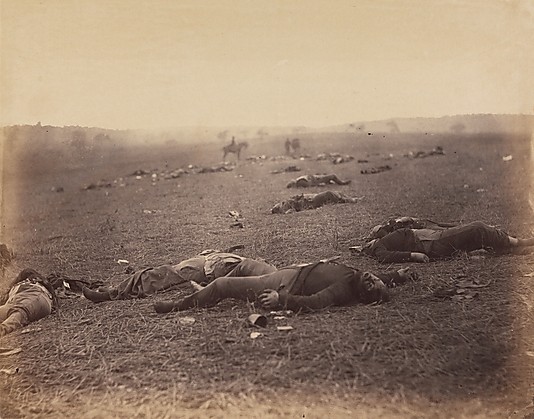
Timothy O’Sullivan, “A Harvest of Death, Gettysburg, Pennsylvania,” albumen silver print from glass negative, 1863 (Gilman Collection, Museum Purchase, 2005)

Timothy O’Sullivan, “A Harvest of Death, Gettysburg, Pennsylvania,” albumen silver print from glass negative, 1863 (Gilman Collection, Museum Purchase, 2005)

Metropolitan Museum of Art
1000 Fifth Ave. at 82nd St.
Through August September 2, $25 adults, children under twelve free
212-535-7710
www.metmuseum.org

“First, a warning shot from the battlefield,” curator Jeff L. Rosenheim begins in the “Shadows of Ourselves” prologue to the catalog that accompanies the expansive exhibition “Photography and the American Civil War,” which continues at the Metropolitan Museum of Art through September 2. “This book is not a history of the Civil War, but rather an exploration of the role of the camera at a watershed moment in American culture.” Held in commemoration of the 150th anniversary of the Battle of Gettysburg, the wide-ranging show features more than two hundred images taken at the dawn of the art of photography, by such early camera enthusiasts as Timothy H. O’Sullivan, soldier A. J. Russell, Mathew B. Brady, George N. Barnard, and Alexander Gardner. The works include tintype studio portraits, battlefield scenes, a close-up of a runaway slave’s flayed skin, medical procedures including amputation, a haunting “Burial Party” of skeletons, a shocking photo of an “Emaciated Union Soldier Liberated from Andersonville Prison,” and shots of such key figures as Sojourner Truth, Robert E. Lee, and Abraham Lincoln.

Unknown, “[Captain Charles A. and Sergeant John M. Hawkins, Company E, ‘Tom Cobb Infantry,’ Thirty-eighth Regiment, Georgia Volunteer Infantry],” ambrotype, 1861-62 (David Wynn Vaughan Collection)

Unknown, “[Captain Charles A. and Sergeant John M. Hawkins, Company E, ‘Tom Cobb Infantry,’ Thirty-eighth Regiment, Georgia Volunteer Infantry],” ambrotype, 1861-62 (David Wynn Vaughan Collection)

Combining pure reportage with an artistic bent, the photographs changed the way the public saw the war, and themselves. As printer and photographer Andrew Gardner wrote in a caption for O’Sullivan’s “A Harvest of Death, Gettysburg, Pennsylvania,” which depicts a field of fallen solders, “Such a picture conveys a useful moral: It shows the blank horror and reality of war, in opposition to its pageantry. Here are the dreadful details! Let them aid in preventing such another calamity falling upon the nation.” These images also went on to influence such twentieth-century social realist photojournalists as Walker Evans and Dorothea Lange. In addition, the availability of cameras and portrait studios allowed the soldiers to pose for a kind of ID card that could be used to both identify them and show to their families, in full dress regalia. “Photography and the American Civil War” provides a gripping view of the war itself as well as the new ways it was being portrayed. The companion exhibition, “The Civil War and American Art,” comprising approximately sixty paintings (and another eighteen photographs) made between 1852 and 1877 by such artists as Frederic E. Church, Sanford R. Gifford, Winslow Homer, and Eastman Johnson, also runs through September 2.

VICE PRESENTS THE FILM FOUNDATION SCREENING SERIES: THE RED SHOES

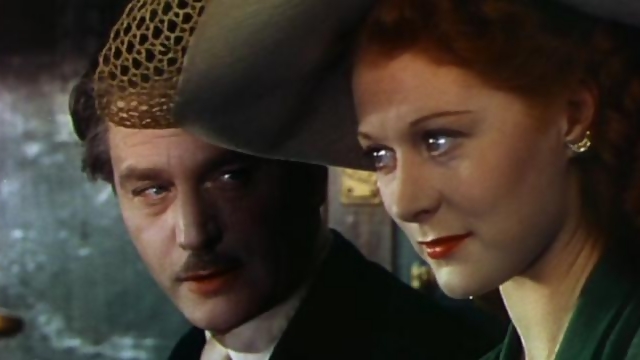
Boris Lermontov (Anton Walbrook) and Victoria Page (Moira Shearer) contemplate their future in Michael Powell and Emeric Pressburger’s THE RED SHOES

Boris Lermontov (Anton Walbrook) and Victoria Page (Moira Shearer) contemplate their future in Michael Powell and Emeric Pressburger’s THE RED SHOES

THE RED SHOES (Michael Powell & Emeric Pressburger, 1948)
Nitehawk Cinema
136 Metropolitan Ave.
Tuesday, August 27, $16, 9:30
718-384-3980
www.nitehawkcinema.com

Michael Powell and Emeric Pressburger’s The Red Shoes is a lush, gorgeous examination of the creative process and living — and dying — for one’s art. Sadler’s Wells dancer Moira Shearer stars as Victoria Page, a young socialite who dreams of becoming a successful ballerina. She is brought to the attention of ballet master Boris Lermontov (Anton Walbrook) and soon is a member of his famed company. Meanwhile, composer Julian Craster (Marius Goring), whose music was stolen by his professor and used in a Lermontov ballet, also joins the company, as chorus master. As Vicky and Julian’s roles grow, so does their affection for each other, with a jealous Lermontov seething in between. Inspired by Sergei Diaghilev and the Ballets Russes, The Red Shoes is a masterful behind-the-scenes depiction of the world of dance, highlighted by the dazzlingly surreal title ballet, which mimics the narrative of the central plot. Based on the Hans Christian Andersen fairy tale, the fifteen-minute ballet takes viewers into a completely different fantasy realm, using such cinematic devices as jump cuts and superimposition as the drama unfolds well beyond the limits of the stage. To increase the believability of the story and make sure the dance scenes were effective, Powell and Pressburger enlisted players from the international dance community; the film’s cast includes Russian choreographer and dancer Léonide Massine as Lermontov choreographer Grischa Ljubov, French prima ballerina Ludmilla Tchérina as Lermontov star Irina Boronskaja, and Australian dancer Robert Helpmann as Ivan Boleslawsky; Helpmann also served as the film’s choreographer.
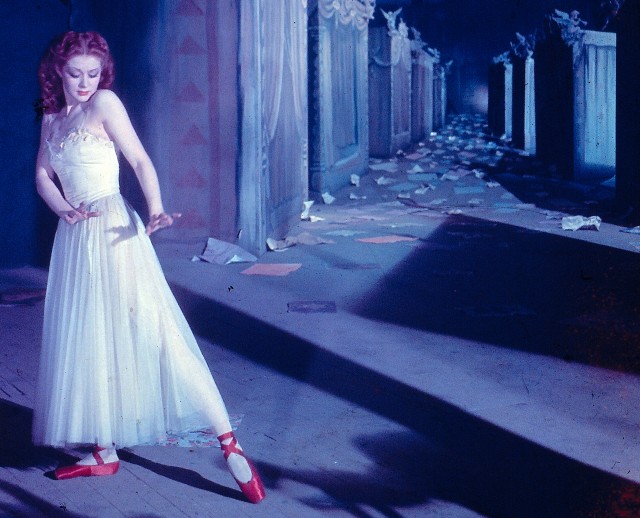

Victoria Page (Moira Shearer) gets immersed in a surreal ballet in classic dance drama THE RED SHOES

Victoria Page (Moira Shearer) gets immersed in a surreal ballet in classic dance drama THE RED SHOES

Brian Easdale won an Oscar for his score, which ranges from sweet and lovely to dark and ominous, with an Academy Award also going to Hein Heckroth’s stunning art direction and Arthur Lawson’s fabulous set design. The film was photographed in glorious Technicolor by Jack Cardiff. Upon meeting Vicky, Lermontov asks, “Why do you want to dance?” to which she instantly responds, “Why do you want to live?” No mere ballet film, The Red Shoes is about so much more. The Red Shoes is being shown August 27 at 9:30 as part of Nitehawk Cinema’s monthly Vice Presents: The Film Foundation Screening Series, which consists of works that have been restored and preserved by Martin Scorsese’s Film Foundation; the series continues September 24 with Stanley Kubrick’s Paths of Glory, with all films including a prerecorded introduction by Scorsese and followed by an after-party with free Larceny Bourbon. In addition, a portion of the ticket sales goes to the Film Foundation.

THE ART OF THE SCORE: FILM WEEK AT THE PHILHARMONIC

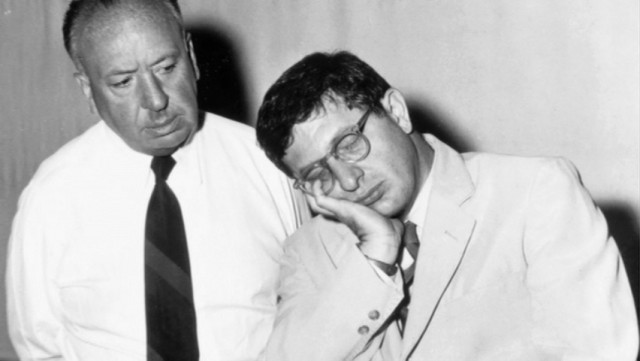
There shouldn’t be much sleeping when the scores of films by Alfred Hitchcock (above, with composer Bernard Herrmann) and Stanley Kubrick take center stage at the Philharmonic

There shouldn’t be much sleeping when the scores of films by Alfred Hitchcock (above, with composer Bernard Herrmann) and Stanley Kubrick take center stage at the Philharmonic

Avery Fisher Hall
10 Lincoln Square, Broadway at 64th St.
September 17-21, $45-$125
www.nyphil.org

Perhaps no two directors used music as effectively as Alfred Hitchcock and Stanley Kubrick, the former employing original compositions to build unwavering suspense, the latter including famous classical pieces to immerse viewers in magical atmospheres. The New York Philharmonic will pay tribute to both men during “The Art of the Score: Film Week at the Philharmonic,” as the orchestra performs the scores while film clips are shown on the big screen at Avery Fisher Hall. Curated by artistic director Alec Baldwin, “The Art of the Score” begins September 17-18 with “Hitchcock!,” comprising music by Lyn Murray (To Catch a Thief), Bernard Herrmann (Vertigo, North by Northwest), Dimitri Tiomkin (Strangers on a Train, Dial M for Murder), and Charles Gounod (“Funeral March of a Marionette,” the theme from Alfred Hitchcock Presents), conducted by Constantine Kitsopoulos; the first night will be hosted by Baldwin, the second by Sam Waterston. The Philharmonic then focuses on Kubrick’s epic 2001: A Space Odyssey on September 20-21, consisting of works by György Ligeti (“Atmosphères,” “Lux aeterna,” “Aventures,” “Kyrie” from Requiem), Richard Strauss (“Also sprach Zarathustra”), and Johann Strauss II (“On the Beautiful Blue Danube”), conducted by Alan Gilbert and featuring the Musica Sacra Chorus, directed by Kent Tritle. The final event, “Mind, Music, and the Moving Image,” being held on September 21 at the Gerald W. Lynch Theatre, in which Baldwin speaks with filmmakers Joel and Ethan Coen, their regular composer, Carter Burwell, and neuroscientest Aniruddh D. Patel, has already sold out.

IGNORANCE

Susan Sarandon will discuss “The Path Itself” with the Gyalwang Drukpa as part of Rubin Museum series on “Ignorance”

Susan Sarandon will discuss “The Path Itself” with the Gyalwang Drukpa as part of Rubin Museum series on “Ignorance”

Rubin Museum of Art
150 West 17th St. at Seventh Ave.
September 25 – December 27, $15 – $45 (Acoustic Cash $85, Cabaret Cinema free with $7 bar purchase)
212-620-5000
www.rmanyc.org

Last fall, the Rubin Museum examined the concept of happiness through specially introduced film screenings, live performances, and a series of talks pairing artists with scientific and philosophical experts. This fall the museum and its mad-genius programmer, Tim McHenry, tackle a different kind of bliss: ignorance. In 1742, British poet Thomas Gray concluded his “Ode on a Distant Prospect of Eton College” thusly: “Since sorrow never comes too late, / And happiness too swiftly flies. / Thought would destroy their paradise. / No more; where ignorance is bliss, / ’Tis folly to be wise.” More than two centuries earlier, Gautama Buddha explained in the Sutta Nipata that “it is ignorance that smothers, and it is carelessness that makes it invisible. The hunger of craving pollutes the world, and the pain of suffering causes the greatest fear.” The Rubin’s “Ignorance” series, which explores the idea that “what you don’t know could hurt you,” begins September 25 with artist Ernesto Pujol and cultural critic Carol Becker discussing “Ignorance and Ritual,” followed September 26 with lama the Gyalwang Drukpa and actress Susan Sarandon delving into “The Path Itself” and September 27 with psychologist Daniel Gilbert and cartoonist Tim Kreider investigating “Delusion.” Among the other highlights are writer Neil Gaiman and multimedia artist Laurie Anderson sitting down for “Fantasy and Fact,” director Mira Nair and anthropologist Christopher Pinney getting into “Allegory and Illusion,” and playwright Neil LaBute and actor Alec Baldwin rapping about “Ignorance in the Information Age.” Live music includes Holly Near on September 27, Rosanne Cash and Cory Chisel on October 18, and Toshi Reagon on November 8. The Friday-night film programs kicks off September 6 with drama critic John Heilpern introducing Kind Hearts and Coronets and continues with such other beauties as actor and photographer Joel Grey introducing Cabaret, comedian Rachel Dratch introducing Lord of the Flies, and multidisciplinary performance artist John Kelly introducing Shadow of a Doubt. Nineteenth-century British preacher Charles Haddon Spurgeon wrote, “The doorstep to the temple of wisdom is the knowledge of our own ignorance”; this Rubin series should throw that door wide open.