LEIMAY’s BECOMING-CORPUS explores the nature of the human body (photo by Yara Travies)
BAM Fisher, Fishman Space
321 Ashland Pl.
Through September 15, $20
718-636-4100
www.bam.org
www.leimaymain.cavearts.org
Becoming-Corpus is another mesmerizing, meditative multimedia production from director and choreographer Ximena Garnica and video and installation artist Shige Moriya, the principals behind the Brooklyn-based LEIMAY company (Floating Point Waves, Furnace). The seventy-minute piece opens with a breathtaking scene in which seven dancers (Masanori Asahara, Andrew Braddock, Andrea Jones, Liz McAuliffe, Denisa Musilova, Eija Ranta, and Savina Theodoru) stand still onstage, louvered black-and-white shadows projected across their bodies. Slowly they begin swaying, giving the impression that they are gently rocking on the sea. Meanwhile, Tommy Schell walks imperceptibly slowly across the back, a trip that will last all seventy minutes. Soon the dancers, five of whom are topless, start exploring their bodies as if they’ve just been born, in intricate ensemble movements that feature solos created by picking out individual dancers with spotlights. At one point they balance with their shoulders on the floor, their backs facing the audience, making them appear headless, arms and legs emerging as if they are hatching out of an egg. Birth is one of the subjects of the piece, as the dancers learn what their bodies are capable of by learning and experimenting with their limbs. The piece features an electronic score by Roland Ventura Toldeo, Christopher Loar, and Laddio Bolocko, with light projections by Moriya that create fascinating meshlike and shadowy elements directly on the dancers’ bodies and futuristic computer visuals on the floor and backdrop. A beautiful, elegant piece expertly performed with a playful dose of humor, Becoming-Corpus continues through September 15 at BAM Fisher’s Fishman Space, supplemented by an art installation in the Peter Jay Sharp Lobby that includes mixed-media representations of the creators’ and dancers’ faces, heads, and bodies as well as casts of Garnica and Moriya dangling from the ceiling, in addition to a specially designed “artifact” publication that details the development and process of the work. (There will be a post-show audience roundtable on September 13, the preshow “Tracing the Art” talk with Garnica and Moriya on September 14, and a closing night toast on September 15. To see our 2012 interview with Garnica and Moriya, please go here.)
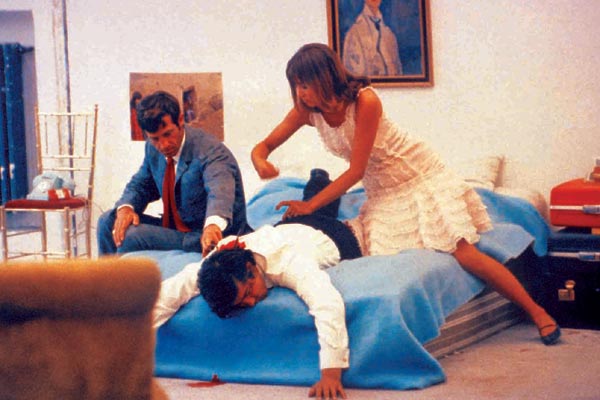
 Art, American consumerism, the Vietnam and Algerian wars, Hollywood, and the cinema itself get skewered in Jean-Luc Godard’s fab feaux gangster flick / road comedy / romance epic / musical Pierrot Le Fou. Based on Lionel White’s novel Obsession, the film follows the chaotic exploits of Ferdinand Griffon (Jean-Paul Belmondo) and Marianne Renoir (Anna Karina, Godard’s then-wife), former lovers who meet up again quite by accident. The bored Ferdinand immediately decides to leave his wife and family for the flirtatious, unpredictable Marianne, who insists on calling him Pierrot despite his protestations. Soon Ferdinand is caught in the middle of a freewheeling journey involving gun running, stolen cars, dead bodies, and half-truths, all the while not quite sure how much he can trust Marianne. Filmed in reverse-scene order without much of a script, the mostly improvised Pierrot Le Fou was shot in stunning color by Raoul Coutard. Many of Godard’s recurring themes and style appear in the movie, including jump cuts, confusing dialogue, written protests on walls, and characters speaking directly at the audience, who are more or less along for the same ride as Ferdinand. And as with many Godard films, the ending is a doozy.