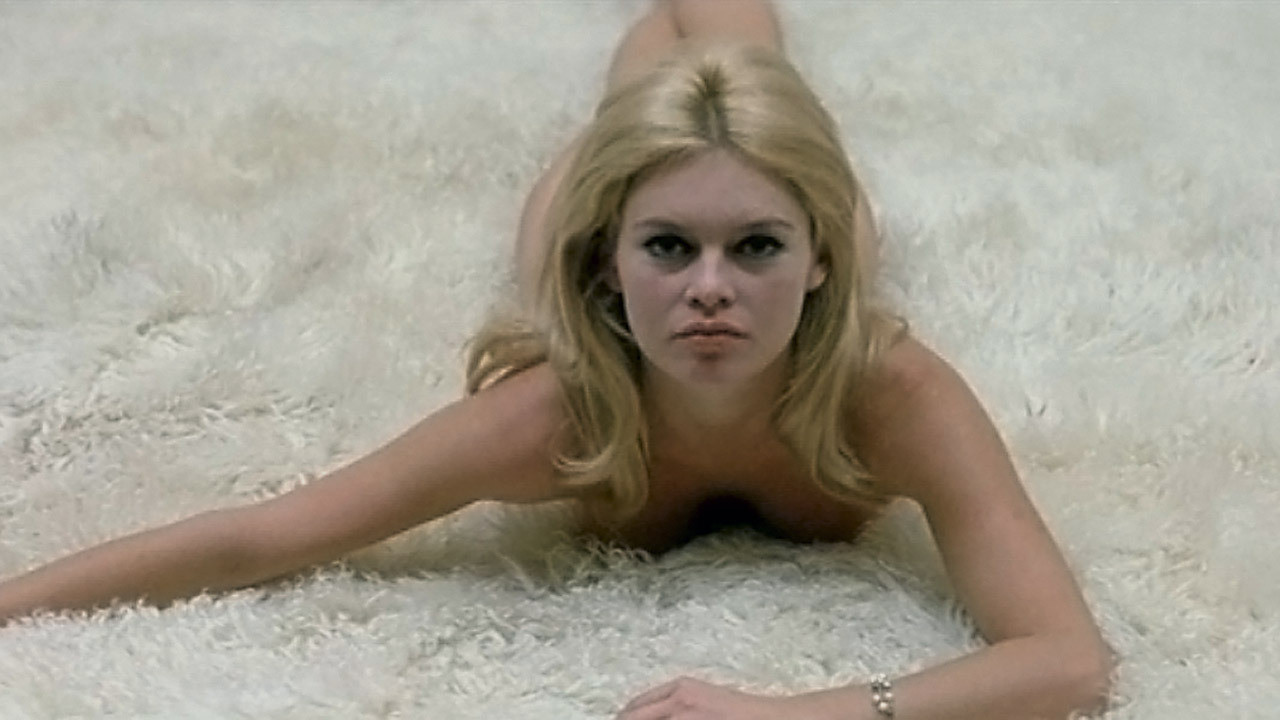
Brigitte Bardot shows off both her acting talent and beautiful body in Jean-Luc Godard’s CONTEMPT
CONTEMPT (LE MEPRIS) (Jean-Luc Godard, 1963)
Film Forum
209 West Houston St.
September 6-19
Series runs through September 5
212-727-8110
www.filmforum.org
 French auteur Jean-Luc Godard doesn’t hold back any of his contempt for Hollywood cinema in his multilayered masterpiece Contempt, which is being shown September 6-19 in a fiftieth-anniversary restoration at Film Forum. Loosely based on Alberto Moravia’s Il Disprezzo, Contempt stars Michel Piccoli as Paul Javal, a French screenwriter called to Rome’s famed Cinecittà studios by American producer Jeremy Prokosch (Jack Palance ) to perform rewrites on Austrian director Fritz Lang’s (played by Lang himself) adaptation of The Odyssey by ancient Greek writer Homer. Paul brings along his young wife, the beautiful Camille (Brigitte Bardot), whom Prokosch takes an immediate liking to. With so many languages being spoken, Prokosch’s assistant, Francesca Vanini (Giorgia Moll), serves as translator, but getting the various characters to communicate with one another and say precisely what is on their mind grows more and more difficult as the story continues and Camille and Paul’s love starts to crumble. Contempt is a spectacularly made film, bathed in deep red, white, and blue, as Godard and cinematographer Raoul Coutard poke fun at the American way of life. (Both Godard and Coutard appear in the film, the former as Lang’s assistant director, the latter as Lang’s cameraman — as well as the cameraman who aims the lens right at the viewer at the start of the film.)
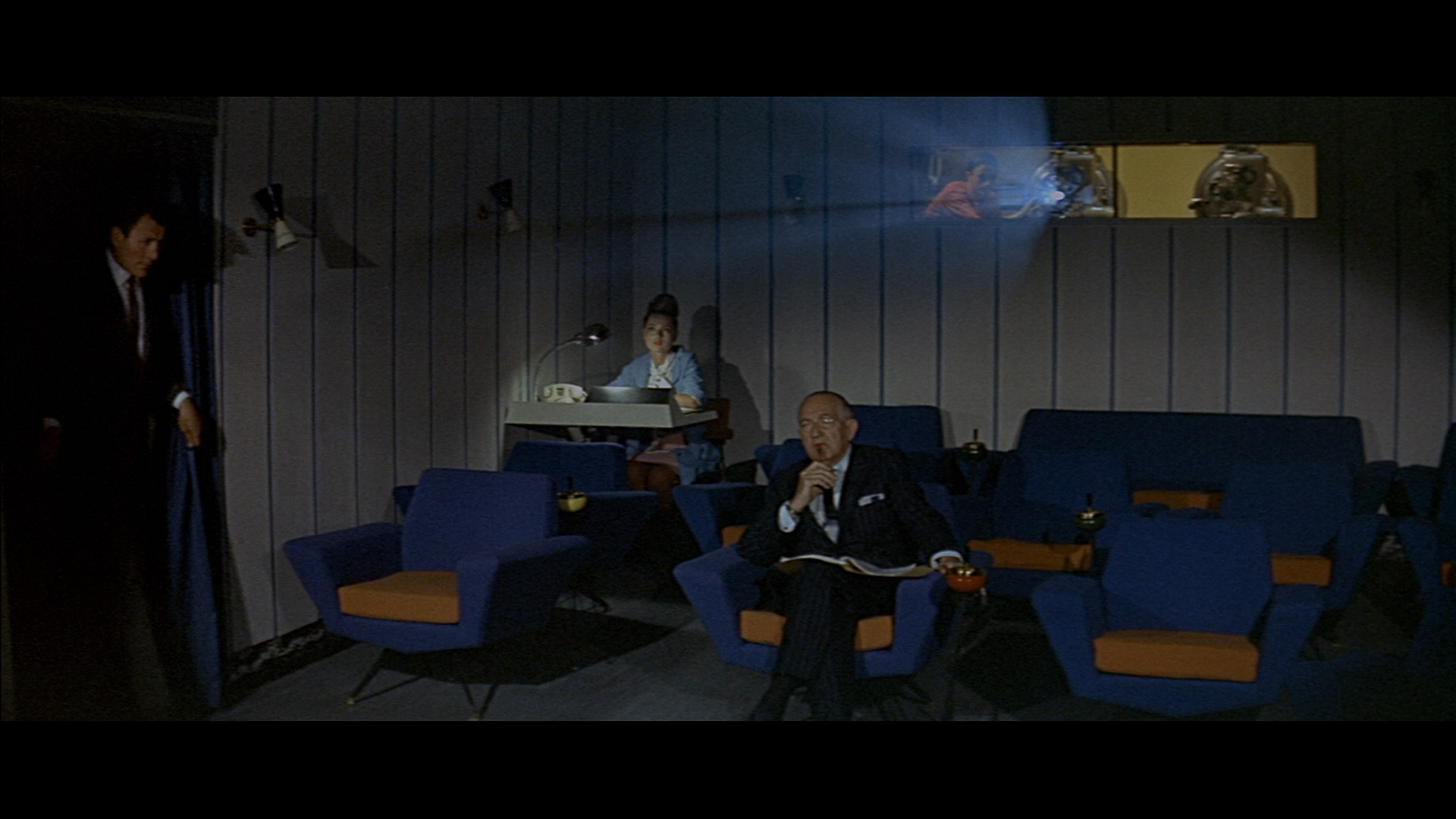
Producer Jeremy Prokosch (Jack Palance) doesn’t always have the kindest of words for director Fritz Lang in CONTEMPT
Bardot is sensational in one of her best roles, whether teasing Paul at a marvelously filmed sequence in their Rome apartment (watch for him opening and stepping through a door without any glass), lying naked on the bed, asking Paul what he thinks of various parts of her body (while Coutard changes the filter from a lurid red to a lush blue), or pouting when it appears that Paul is willing to pimp her out in order to get the writing job. Palance is a hoot as the big-time producer, regularly reading fortune-cookie-like quotes from an extremely little red book he carries around that couldn’t possibly hold so many words. And Lang, who left Germany in the mid-1930s for a career in Hollywood, has a ball playing a version of himself, an experienced veteran willing to put up with Prokosch’s crazy demands. Vastly entertaining from start to finish, Contempt is filled with a slew of inside jokes about the filmmaking industry and even Godard’s personal and professional life, along with some of the French director’s expected assortment of political statements and a string of small flourishes that are easy to miss but add to the immense fun, all set to a gorgeous romantic score by Georges Delerue.
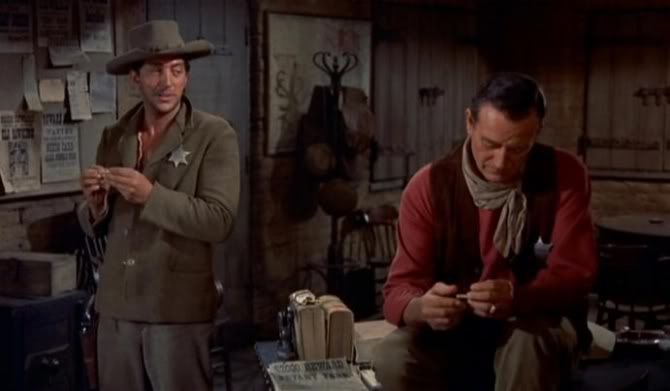
 Howard Hawks’s anti-High Noon is a surprisingly sensitive, extremely clever exploration of interpersonal relationships disguised as a Western genre picture. John Wayne stars as Sheriff John T. Chance, a big, bold small-town Texas lawman who arrests local bully Joe Burdette (Claude Akins) for committing cold-blooded murder. The cocky Burdette doesn’t expect to be in jail long, not with his brother, Nathan (John Russell), being the most powerful — and potentially dangerous — man in Rio Bravo, and what with Chance’s deputies being useless drunk Dude (Dean Martin) and an old cripple known as Stumpy (Walter Brennan). Despite offers of help from such friends as businessman Pat Wheeler (Ward Bond), Chance is determined to go it with just Dude and Stumpy as they attempt to hold Joe until the federal marshal arrives. But Nathan and his hired band of bounty hunters are just as determined to free Joe, whatever the cost. Chance is not so foolish as to think that he can take Burdette’s crew on just by himself; he actually doesn’t want anyone else to die for something he considers his responsibility. Meanwhile, he is keeping his eyes on Feathers (Angie Dickinson), a tough-talking young woman with a sordid past, and Colorado (Ricky Nelson), a sharpshooting young stud only out for himself. The set-up is merely an excuse for Hawks to delve into some serious male bonding and potential romance as Dude, called Borrachón (“Drunk”), tries to put down the bottle, Feathers attempts to prove that she’s not all bad, and Colorado eventually replaces his guns for a few minutes with a guitar to sing with Dude and Stumpy. Wayne plays it all marvelously, portraying Chance as a complex individual who understands the fears and desires, limitations and possibilities inherent in everyone he meets, yet always remaining cool. Appropriately enough, the local hotel, run by the always helpful Carlos (Pedro Gonzalez-Gonzalez) and his wife, Consuela (Estelita Rodriguez), is named the Alamo, not boding well for Chance and his meager team. Even at its 141-minute running time, Rio Bravo feels far more intimate than epic. Rio Bravo is screening September 7 in a restored 35mm print at the Museum of the Moving Image as part of the two-month series “The Complete Howard Hawks,” comprising more than three dozen works by the legendary director and producer, from the famous (To Have and Have Not, The Big Sleep, Scarface, Bringing Up Baby, Red River, Ball of Fire, Sergeant York, His Girl Friday, The Thing from Another World, Gentlemen Prefer Blondes) to the more obscure, including his silent films (Trent’s Last Case, Fig Leaves, A Girl in Every Port, Fazil).

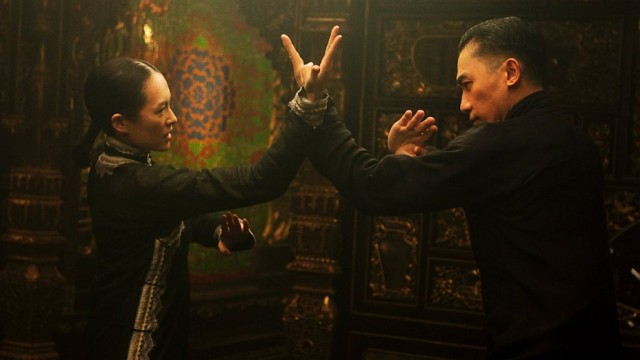
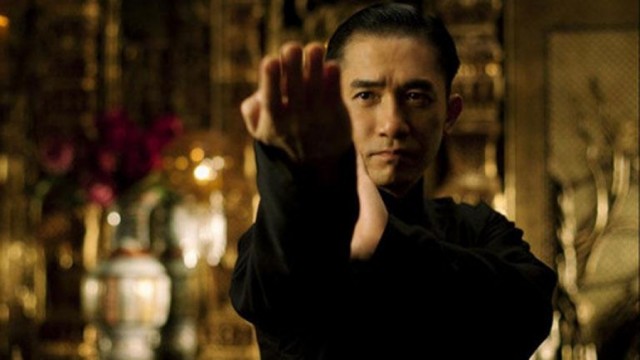
 Hong Kong Second Wave grandmaster filmmaker Wong Kar-wai once again chooses style over substance in his latest work, the visually sumptuous but ultimately confusing martial arts drama The Grandmaster. Wong regular Tony Leung Chiu-Wai (Days of Being Wild, Ashes of Time, In the Mood for Love) stars as Ip Man, the real-life Wing Chun master who eventually taught such students as Bruce Lee. The film follows Ip Man from his early days in Foshan, where he is chosen to defend the south against the more famous masters of the north, through the Second Sino-Japanese War and his move to Hong Kong. Along the way there are gorgeously filmed fight scenes (shot by cinematographer Philippe Le Sourd and choreographed by Yuen Woo-ping) involving “The Razor” Yixiantian (Chang Chen), Ma San (Zhang Jin), and, most intimately, Gong Er (Zhang Ziyi), daughter of retired master Gong Yutian (Wang Qingxiang), as challengers to Ip Man display their martial arts disciplines in attempts to defeat Wing Chun. An early battle in the rain is particularly breathtaking, bathed in alluring silver tones. But the screenplay, written by Wong with Zou Jingzhi and Xu Haofeng, never really delves deep enough into Ip Man’s character, giving especially short shrift to his relationship with his wife, Cheung Wing-sing (Song Hye-kyo), and children.