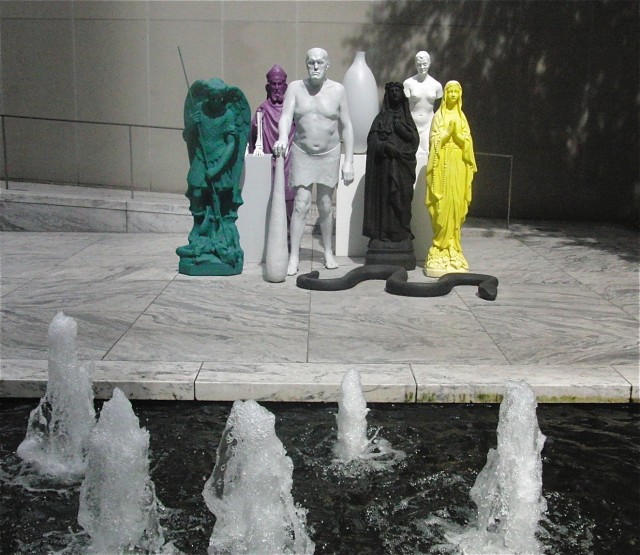
Katharina Fritsch’s “Group of Figures” is back in MoMA’s Abby Aldrich Rockefeller Sculpture Garden, which is now open for free every morning from 9:00 to 10:30 (photo by twi-ny/mdr)
Museum of Modern Art
The Abby Aldrich Rockefeller Sculpture Garden
West 54th St. between Fifth & Sixth Aves.
Early hours: open daily 9:00 – 10:30 am, free
www.moma.org
Designed in 1953 by architect Philip Johnson, the Abby Aldrich Rockefeller Sculpture Garden resides on the site that was once the town-house home of Abby Aldrich Rockefeller, one of the founders of the Museum of Modern Art. A socialite and philanthropist who married John D. Rockefeller Jr. in 1901, Aldrich was the mother of Abby, John III, Nelson, Laurance, Winthrop, and David Rockefeller. The garden has been one of the great, peaceful respites of New York City for sixty years, its multiple levels and reflecting pools, which Johnson called “canals,” along with its birches and beeches, offering visitors a beautiful space to commune with both art and nature en plein air. Beginning September 9, the sculpture garden will be open for free starting at 9:00 each morning, ninety minutes before the rest of the museum opens to paying customers. Early risers can buy coffee and other drinks and enjoy the garden’s current arrangement of sculptures, “The Modern Monument,” which consists of old favorites as well as newer delights. Walking around the garden, one will encounter Alberto Giacometti’s “Tall Figure, III,” Jenny Holzer’s “Granite Bench,” Joan Miró’s “Moonbird,” Barnett Newman’s “Broken Obelisk,” and Pablo Picasso’s “She-Goat.” Aristide Maillol’s “The River” still dangles over one of the pools, while Hector Guimard’s “Entrance Gate to Paris Subway (Métropolitain) Station, Paris, France” stands in its longtime space at the far east end and Henri Matisse’s stunning quartet, “The Back,” lines its usual wall, celebrating the human body. Also on view are Mark di Suvero’s “For Roebling,” Tony Smith’s “Die,” Claes Oldenburg’s “Geometric Mouse, Scale A,” Picasso’s “Monument,” and Katharina Fritsch’s colorful “Group of Figures.” The most recent addition to the garden is Stephen Vitiello’s audiovisual installation “A Bell for Every Minute,” which was created for the High Line and now resides outside at MoMA, a collection of different bells from around the city chiming minute after minute. In 2004, when the museum returned to Midtown after a major renovation and expansion (and temporary move to Queens), architect Yoshio Taniguchi restored the garden to its original dimensions, explaining that it is “perhaps the most distinctive single element of the museum today.” And now entrance to this most distinctive element is free every morning from 9:00 to 10:30.
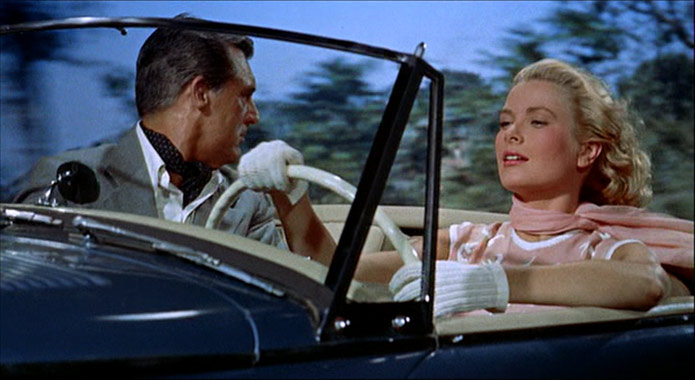
 Is he or isn’t he? In Alfred Hitchcock’s glamorous thriller set on the French Riviera, Cary Grant stars as John Robie, a famous burglar known as the Cat who has supposedly retired but is suddenly believed to be responsible for a rash of new jewelry thefts. Determined to prove his innocence and catch the real thief, he enlists the help of Lloyd’s of London insurance agent H. H. Hughson (John Williams), who supplies him with a list of women on the Riviera who have expensive baubles ripe for the taking. At the top of the list are the Americans Jessie Stevens (Jessie Royce Landis) and her gorgeous daughter, Francie (a radiant Grace Kelly), who teases Robie, hinting that she might in fact be the Cat — if he isn’t. As Robie avoids the cops and looks to his old friends in the French Resistance for further help, the tension heats up, leading to a climax that takes place on the rooftops of the French Riviera. Grant’s third of four outings with Hitchcock and Kelly’s third and final turn with the suspense master is an exciting “who’s doing it” featuring the dream pairing of two of Hollywood’s most beautiful and talented superstars, filled with just the right amount of comedy and romance in a glorious setting. Look for Alfie to make his appearance early on, causing Grant to do a double take in the back of a bus. To Catch a Thief is screening September 8 at 2:30 as part of MoMA’s “An Auteurist History of Film Reprise,” which gives film enthusiasts a second chance to catch works that have previously been shown at MoMA during weekday afternoons, when many people cannot see them.