twi-ny recommended events

UNSPEAKABLE: A DRAMATIC FANTASIA

UNSPEAKABLE

UNSPEAKABLE looks at the tumultuous life and career of comedian Richard Pryor

Apollo Theater Soundstage
253 West 125th St.
November 1-3, $20
800-745-3000
www.apollotheater.org
www.facebook.com

One of the most influential and controversial comics of his generation, Richard Pryor was not afraid to take on difficult issues of race and class in his brilliant stand-up routines. Born in Peoria, Illinois, in 1940, Pryor made such films as Richard Pryor: Live on the Sunset Strip, Blue Collar, and Silver Streak and such records as That N*gger’s Crazy and Outrageous, quickly earning a reputation for someone who says exactly what’s on his mind. Earlier this year, Marina Zenovich’s documentary Richard Pryor: Omit the Logic played at the Tribeca Film Festival and on Showtime, and now comes Unspeakable: A Dramatic Fantasia, a stage show inspired by Pryor’s tumultuous life, which ended in 2005 at the age of sixty-five. Written by Rod Gailes OBC and James Murray Jackson, Jr., Unspeakable is a work in development that explores Pryor’s life from childhood to death, focusing on the era between 1967 and 1982. Jackson, Jr., who was named Outstanding Lead Actor for playing the role in a 2005 version at the New York International Fringe Festival, is reprising the part this weekend at the Apollo, with Gailes OBC directing. The cast also includes Benja Kay Thomas, Margot White, Alvin Keith, Nedra McClyde, Adam Couperthwaite, and Nyahale A. Allie. “Richard Pryor broke down barriers, and stereotypes once thought unimaginable, said the unspeakable and did the unthinkable,” Gailes OBC said in a statement. “He taught us by holding a mirror to the conscience of America while self-destructing, and imploding on his own pain and grief. Though flawed in life, he lived uninhibited onstage. He was part preacher, social commentator, political activist, addict, and a whole lot of devil.” Unspeakable runs November 1-3 at the Apollo Theater’s Soundstage; tickets are $20.

TWI-NY TALK: AMY NICHOLSON / ZIPPER

LOCAL COLOR — ZIPPER: CONEY ISLAND’S LAST WILD RIDE (Amy Nicholson, 2012)
Nitehawk Cinema
136 Metropolitan Ave. between Berry St. & Wythe Ave.
Wednesday, October 30, 9:30
718-384-3980
www.zipperfilm.com
www.nitehawkcinema.com

This past August, Amy Nicholson’s compelling, bittersweet documentary Zipper: Coney Island’s Last Wild Ride opened to wide acclaim during an extended run at the IFC Center. Winner of a Special Jury Prize at the 2012 DOC NYC festival, Zipper follows the fate of Eddie Miranda’s Zipper amusement park ride as a microcosm of the controversial rezoning and commercialization plans that threaten to change Coney Island forever. In her director’s statement, Nicholson, a longtime marketing creative director in New York City who has taken the film, her third documentary, all over the country, explains, “I have two ambitions for Zipper. First, to expose how and why the ‘poor people’s Riviera’ became the prize in a fight between a billionaire developer and a billionaire mayor. Second, to remind the world of Coney Island’s true character, so that other great cultural icons might be valued more for their sense of place than for their real estate.” Her next stop is Nitehawk Cinema in Williamsburg, where she’ll take part in a Q&A following a special “Local Color” screening on October 30 at 9:30. As an added bonus, each attendee gets a free Coney Island beer. In anticipation of the Nitehawk event, Nicholson recently discussed with twi-ny the Zipper, the advertising business, the future of Coney Island, and more.

twi-ny: What was the genesis of the Zipper project?

Amy Nicholson: Believe it or not, I was looking for the Jumble in the Daily News when I came across an article about the Zipper leaving Coney Island and my heart sank. I loved that ride as a kid; it’s the quintessential crazy carnival contraption and the perfect symbol of all that’s great about a place like Coney Island. Originally I was just going to do a short homage to the Zipper, but I got sucked into the politics of why Eddie Miranda and a lot of other small operators were leaving. The more I looked into it, the bigger it got.

twi-ny: What kind of personal connection did you have with Coney Island prior to starting the project? How would you say it has changed since then?

Amy Nicholson: I have lived in New York since the late ’80s and my best friend and I would go down to Coney Island on hot summer nights and just hang out and people watch. It’s really the best place in the world to soak up that beach/carnival/melting pot atmosphere. As Joey says in the film, “Once you get the sand in your shoes….”

(Sidebar about riding the Zipper in Coney: Eddie’s Zipper was an older hydraulic model, which meant it used a lot of oil. If the temperature was hot during the day — and cooler at night — the Zipper would spin a lot more aggressively as the oil cooled. The loader, Freddie, and I made a pact to ride on the last night after the very last shot, but when he chickened out, so did I. Apparently the conditions were perfect for making the Zipper spin like crazy that day and he said there had been a lot of barfing!)

twi-ny: How would you say it has changed since the late ’80s?

Amy Nicholson: Coney Island is a really addicting place for so many reasons. I can never sum it up as well as the guys do in the last scenes of Zipper. But I can tell you for certain that’s been the biggest change. The complexion of the place is very different now and not in a good way. There are still a few of the old guard there, but the rest is either an empty lot or new construction that feels soulless. The new rides are nice, but Coney Island is well on its way to being sterilized.

twi-ny: Has anything changed in the rezoning/development fight since the film was released?

Amy Nicholson: When the film leaves off at the end of 2009, Bloomberg was just reelected to a third term. A deal was made with Thor Equities to purchase about half of their property for around $100 million, and the city leased newly created parkland to a single operator. Since then, Thor has built one retail building and Central Amusements International has brought in new rides, primarily in areas where there were rides before the fight began. There have been some nice improvements, but there are still plenty of empty lots and none of the promised affordable housing or hotels have materialized. Nor is Coney Island year-round — the reason the public was told the rezoning had to happen. We are also coming up on the one-year anniversary of Sandy, which did some horrific damage, but almost all of the rides and games survived. The final super[title] of the film that states what the resolution was after all the years of battling still stands.
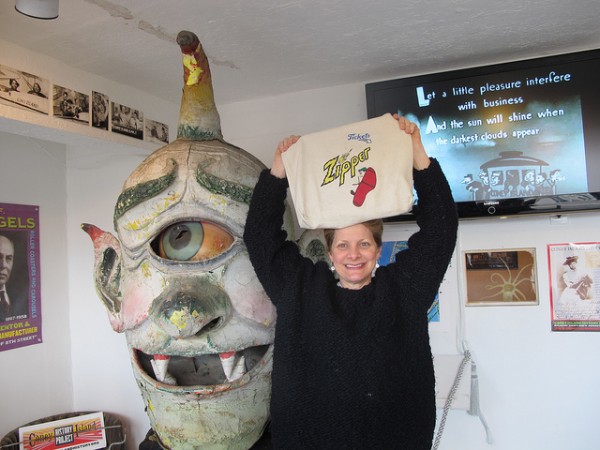
ZIPPER director Amy Nicholson celebrates documentary at Coney Island History Project

ZIPPER director Amy Nicholson celebrates documentary at Coney Island History Project

twi-ny: How do you think documentaries like yours can make a difference in such battles?

Amy Nicholson: I think documentaries like mine not only serve as a record of history, but I hope they exposed the truth about how politics and the constant need for growth can change cities far too quickly and not necessarily for the better. As a regular citizen, you would have had to follow the story for six years, digging around, attending meetings, and asking questions. It’s a lot to ask for a busy public, and in the end, the public process is pretty much a joke. So on the most basic level, you can watch Zipper and see the whole story unfold in seventy-seven minutes and at least walk away with a basic understanding of why there’s an Applebee’s in Coney Island now.

twi-ny: You’ve shown the film all over the country. How do audiences in other cities react to such a New York story? Coney Island has a unique legend, but most of those people have probably never been there.

Amy Nicholson: The film speaks to people everywhere because there has been such an increase in development like this where cities decide to proactively stimulate economic growth with developer incentives. The easiest way to do that is to change the zoning. Right now, Los Angeles is doing exactly what New York did with a huge zoning overhaul. It hasn’t escaped anyone’s attention that small businesses everywhere are being displaced by chains.

And then there are the sweetest older people everywhere we go who attend the screenings and they just want to relive a little bit of their Brooklyn childhood. When we get compliments on how well we captured the feeling of the place, that’s when I think we’ve been successful. That’s the best.

twi-ny: You’ve spent a lot of years in advertising. What kind of impact do you think that has on your filmmaking style, as well as the film’s promotion?

Amy Nicholson: Well, in this case it gave me a fairly keen understanding of the attempted branding of both Coney Island and Brooklyn. (In the case of Brooklyn, the city has been far too successful!) It definitely gave me the radar to know when I was being sold something. I could feel it in the interviews, and twice I found “talking points” left behind in the rooms we were in. As far as how it applies to the marketing of the film, I can’t take all the credit. Coney Island was the most amazing place visually. And I had help. That best friend who I went to Coney with on hot summer nights is also an amazing designer. We just did our best attempt to bring it to life.

twi-ny: You’ve previously made Beauty School and Muskrat Lovely. Do you have any plans yet for your next film?

Amy Nicholson: I have to recover financially from this one first (we could not get funding), but I have a few ideas rolling around in my head. Stay tuned….
NEXT WAVE THEATER: NOSFERATU

(photo by Stefan Okolowicz)

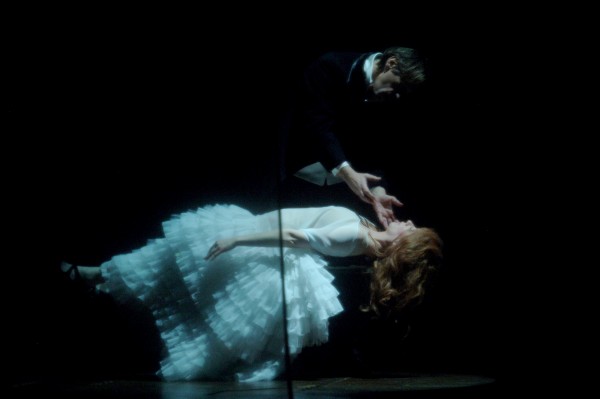
Grzegorz Jarzyna adds to the vampire legend in multimedia NOSFERATU running this week at BAM (photo by Stefan Okolowicz)

Brooklyn Academy of Music
BAM Harvey Theater
651 Fulton St. between Ashland & Rockwell Pl.
October 30 – November 2, $20-$65
718-636-4100
www.bam.org

Halloween is quickly upon us, so arts organizations across the city are turning to horror to try to scare the hell out of us this week. Over at BAM, you can catch the frightening “Puppets on Film” series, which includes Godzilla, Aliens, and the terrifying The Great Muppet Caper; Alfred Hitchcock’s Family Plot and The Lodger, the latter with live music by Morricone Youth; and the twelfth annual BAMboo!, a free, child-friendly block party with music, candy, games, workshops, and more. But the strangest of them all is likely to be TR Warszawa and Teatr Narodowy’s multimedia production of Nosferatu, inspired by Bram Stoker’s 1897 novel Dracula — which was also the inspiration for F. W. Murnau’s 1922 horror classic, Nosferatu, a film that had to change its title, character names, and plot details because the Stoker family would not authorize the rights. Written and directed by Grzegorz Jarzyna, who brought Thomas Vinterberg’s Dogme 95 film The Celebration to mesmerizing life as Festen at St. Ann’s Warehouse last year, Nosferatu has an original score by John Zorn, with sets and costumes by Magdalena Maciejewska, lighting by Jacqueline Sobiszewski, and video design by Bartek Macias. The cast consists of Sandra Korzeniak, Katarzyna Warnke, Wolfgang Michael, Jan Englert, Jan Frycz, Krzysztof Franieczek, Marcin Hycnar, Lech Łotocki, and Adam Woronowicz. The show runs October 30 through November 2 at the BAM Harvey; on November 1 at 6:00 in the Hillman Attic Studio ($15), New Yorker journalist Joan Acocella will give the related talk “On Vampires.” In addition, Film Forum is showing Werner Herzog’s remake Nosferatu the Vampyre through November 7, with a bonus screening of Murnau’s original on November 4 at 7:30.

A CELEBRITY BENEFIT READING: CRIMES OF THE HEART

benefit reading

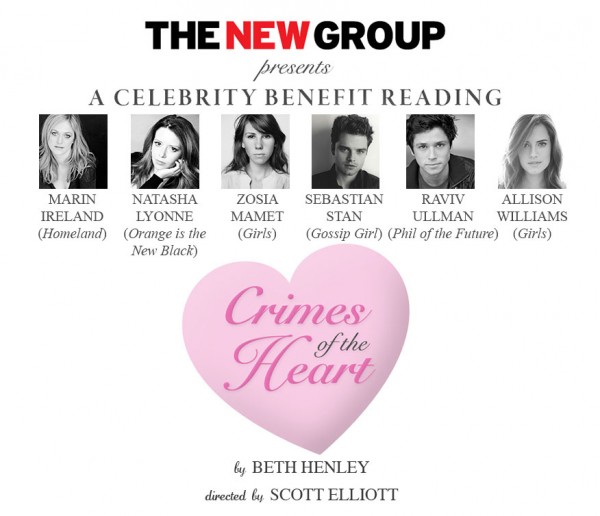
A ONE-NIGHT-ONLY READING TO BENEFIT THE NEW GROUP: BETH HENLEY’S CRIMES OF THE HEART
The New Group @ Theatre Row
The Acorn Theatre
410 West 42nd St. between Eighth & Ninth Sts.
Monday, October 28, $100, 7:00
212-244-3380 ext308 / jamie@thenewgroup.org
www.thenewgroup.org

Since 1995, the New Group has been staging contemporary, adventurous shows, including productions of Kenneth Lonergan’s This Is Our Youth with Josh Hamilton and Mark Ruffalo; the Tony-winning Avenue Q; Joe Orton’s What the Butler Saw with Dylan Baker and Chloë Sevigny; David Rabe’s Hurlyburly with New Group mainstay Ethan Hawke, Bobby Cannavale, Parker Posey, Wallace Shawn, Catherine Kellner, and Hamilton; Jonathan Marc Sherman’s Things We Want with Peter Dinklage, Paul Dano, Hamilton, and Zoe Kazan; and Sam Shepard’s A Lie of the Mind with Keith Carradine, Marin Ireland, Laurie Metcalf, Frank Whaley, and Hamilton, directed by Hawke. The company, founded by artistic director Scott Elliott, who helms many of its productions, has won or been nominated for multiple Obie, Lucille Lortel, Drama Desk, and other awards during its eighteen seasons. On October 28, in conjunction with its brand-new production, Beth Henley’s eagerly awaited The Jacksonian, starring Ed Harris, Glenne Headly, Amy Madigan, Bill Pullman, and Juliet Brett, the nonprofit New Group is holding a benefit reading of Henley’s Tony and Pulitzer Prize-winning Crimes of the Heart, the southern tragicomedy that was also turned into a film directed by Bruce Beresford. The reading, directed by Elliott, will feature Ireland (Homeland, Marie Antoinette) as Lenny, Natasha Lyonne (Orange Is the New Black, Slums of Beverly Hills) as Chick, Zosia Mamet (Girls, Really Really) as Babe, Sebastian Stan (Gossip Girl, Picnic) as Doc, Raviv Ullman (Phil of the Future, Russian Transport) as Barnette, and Allison Williams (Girls, The Mindy Project) as Meg. Tickets are $100 and are fully tax deductible.

TICKET ALERT: ENNIO MORRICONE AT BARCLAYS CENTER

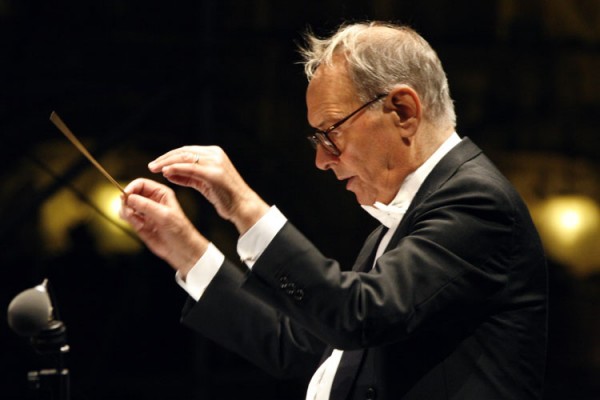
Tickets have just gone on sale to see movie maestro Ennio Morricone at Barclays Center next March

Tickets have just gone on sale to see movie maestro Ennio Morricone at Barclays Center next March

THE MUSIC THE MOVIES THE LEGEND: ENNIO MORRICONE US TOUR 2014
Barclays Center
620 Atlantic Ave.
Sunday, March 23, $80-$355, 7:00
917-618-6700
www.barclayscenter.com
www.enniomorricone-usa-2014.com

Maestro Ennio Morricone will be performing in New York City for the first time in more than six years, leading an orchestra and choir of more than two hundred on March 23 at Barclays Center in Brooklyn. Born in Rome in 1928, the composer of such classic soundtracks as Once Upon a Time in the West, The Battle of Algiers, The Mission, Cinema Paradiso, and The Good, the Bad, and the Ugly will conduct pieces from throughout his long and storied career, which includes five Oscar nominations (and an honorary Academy Award), three Grammys, and myriad other international honors. His U.S. “tour” consists of two appearances, March 20 at the Nokia Theatre in Los Angeles, followed by the March 23 show in Brooklyn. Tickets are now on sale for this rare opportunity to see one of cinema’s all-time greats in action.

LOWER EAST SIDE PICKLE DAY

pickle day

Orchard St. between East Houston & Delancey Sts.
Sunday, October 27, free, 12 noon – 5:00
www.lowereastsideny.com

What’s better than getting pickled on a beautiful fall afternoon? On October 27, more than a dozen picklers will be on hand for Lower East Side Pickle Day, including Rick’s Picks, MacDonald Farms, McClure’s Pickles, Adamah, Guss’ Pickles, Divine Brine, the Pickle Guys, Mama O’s Premium Kimchi, Grillo’s Pickles, Pickleña, Sour Puss Pickles, Mrs. Kim’s Kimchi, Brooklyn Brine, Horman’s Best Pickles, and others. If pickles ain’t your thing — a whole lot more than just cucumbers can be pickled, you know — you can get food from Pop Karma, Souvlaki GR, Georgia’s Eastside BBQ, Brooklyn Taco, the Meatball Shop, Russ & Daughters, Cheeky Sandwich, Mi Case es Su Casa, Tiengarden, Grazer, Mission Chinese, Saxelbee Cheesemongers, Spur Tree, Goodfella’s Pizza, Ni Japanese Deli, Grey Lady, Roasting Plant, Lush, Luca & Bosco, and Sweet Buttons. But if you eat too much, you might not fit into chic duds from David Owens Vintage Clothing, Old Hollywood, the Hoodie Shop, Grit N Glory, By Robert James, Urban Cricket, Quinn, and Yaf Sparkle, all of which will also have booths at the event. In addition, there will be a kids Halloween costume contest, free yoga lessons, a fitness challenge, badminton, urban croquet, face painting, a kids craft table, and a home pickling contest, featuring celebrity judges Nell Casey, Melissa Gaman, Niki Russ-Federman, Helen Rosner, and Claudia Sidoti. Live performances kick off at 12:30 with deejay Bruce Tantum and continue with DJ Deja NYC at 1:30, guitarist Joshua Micah at 2:45, comedian Fantasy Grandma at 3:20, and deejay, musician, and producer Anton Bass at 4:00.

WILLIAM KENTRIDGE: SECOND-HAND READING

William Kentridge

William Kentridge’s latest show at Marian Goodman is another multimedia wonder (photo courtesy Marian Goodman Gallery)

Marian Goodman Gallery
24 West 57th St. between Fifth & Sixth Aves.
Through October 26, free, 10:00 am – 6:00 pm
212-977-7160
www.mariangoodman.com

In his latest exhibit at the Marian Goodman Gallery in Midtown, “Second-hand Reading,” South African multidisciplinary artist William Kentridge examines the concepts of construction, deconstruction, and reconstruction in unique, creative, and, as always, playful ways as they relate to both the artist himself and the viewer. As he noted in “Drawing Lesson One: In Praise of Shadows,” the first of six hour-long Charles Eliot Norton Lectures he gave in the spring of 2012 during his one-year residency at Harvard, we are “made aware of our part in the construction of the image, our part in the construction of the illusion, but most importantly our part in the construction of ourselves. It is in the gap between the object and its representation that this energy emerges, the gap we fill in.” Over the course of the talks, which can be viewed here, Kentridge also discusses mistranslation, practical epistemology, meaning, shadows, words, seeing, the movement between images and ideas, anti-entropy, and life in the studio, where he makes all of his work.

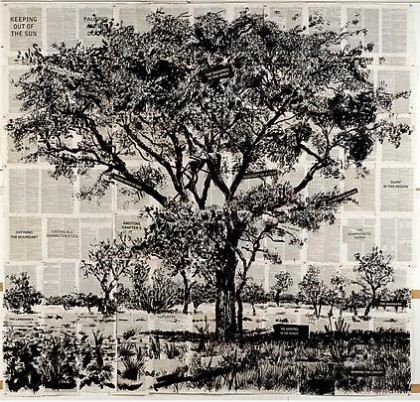
William Kentridge, “The Shrapnel in the Woods,” Indian ink on CRAGGS UNIVERSAL TECHNOLOGICAL DICTIONARY (1826), 2013 (photo courtesy Marian Goodman Gallery)

William Kentridge, “The Shrapnel in the Woods,” India ink on CRAGGS UNIVERSAL TECHNOLOGICAL DICTIONARY (1826), 2013 (photo courtesy Marian Goodman Gallery)

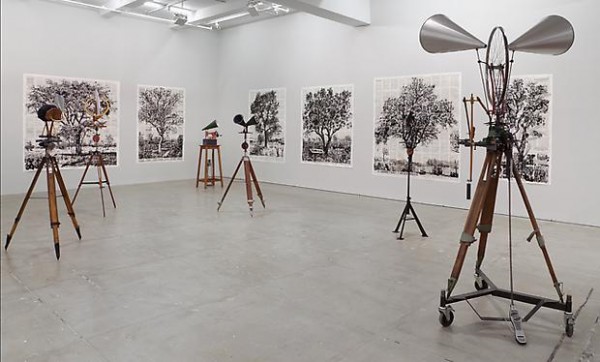
As complex as his talks can get, Kentridge also instills his trademark sense of humor and explores his very personal inclusion of the hand — and full body — of the artist, two elements that are central to the new show, which continues through October 26. “Second-hand Reading” is filled with energy, and its myriad rewards are indeed affected by how much constructing visitors do in their mind. The North Gallery is dominated by kinetic machines, including repurposed megaphones, sewing machines, a bicycle wheel, and a drum kit hanging from the ceiling, all of which must be operated by a gallery employee, who will do so for the asking. Surrounding the machines is a series of large-scale India ink drawings on pages from Craggs Universal Technology Dictionary, featuring trees on which Kentridge has added such phrases as “Tear & Repair,” “The Nicely Built City Never Resists Destruction,” and “The Death of Trees.” The trees not only represent life in South Africa but the source of the paper on which they are drawn; in today’s society, of course, less and less writing is being done on paper.

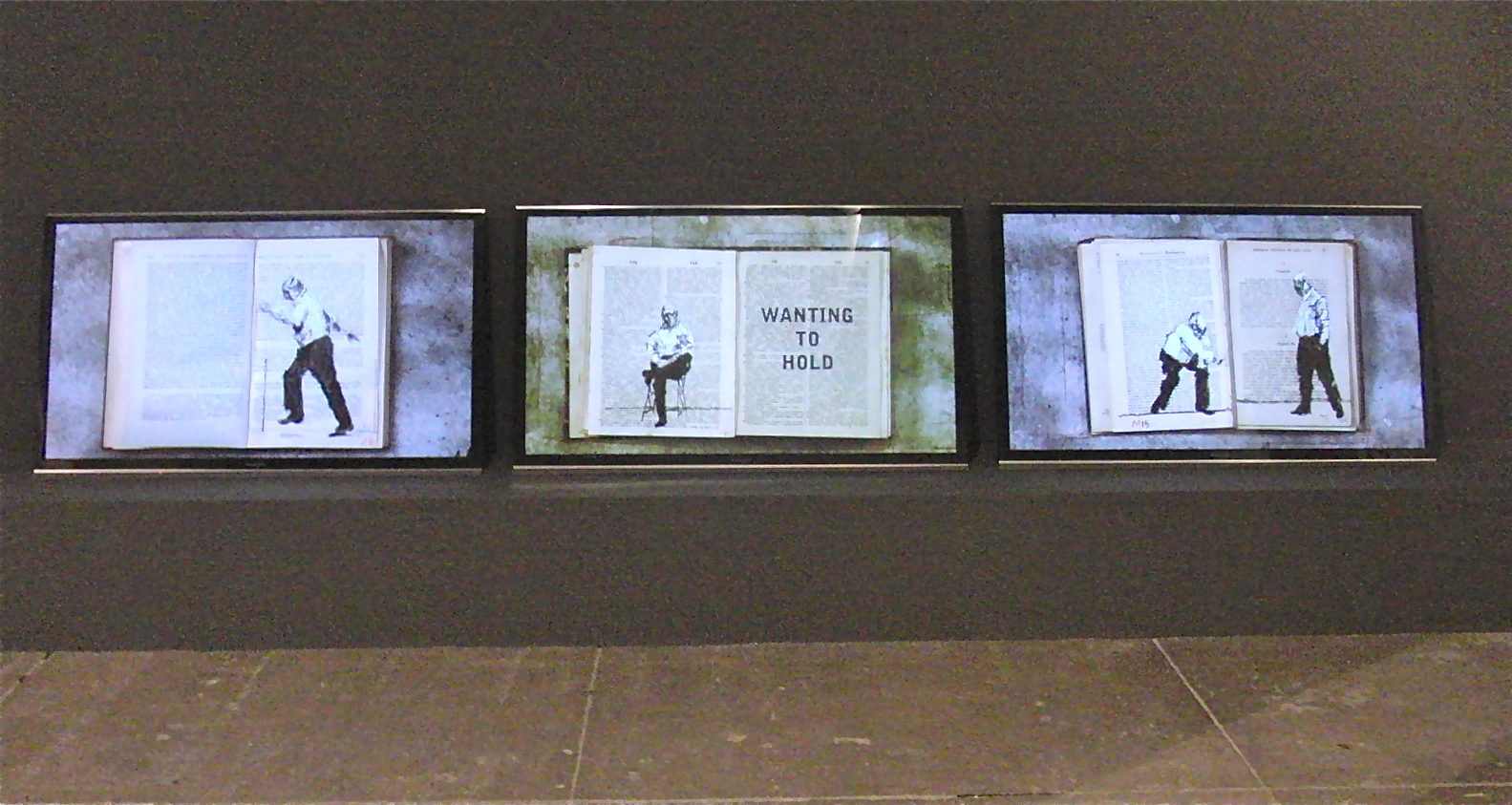
In the North Viewing Room, the triptych flip-book “NO, IT IS” consists of three extremely entertaining continuous and simultaneous flipbook videos (Workshop Receipts, The Anatomy of Melancholy, and Practical Enquiries) of black-and-white images and different-colored geometric shapes on pages from an old technical encyclopedia. As the pages turn, Kentridge walks across them, takes a seat, and dances with a woman; at the beginning and end, Kentridge’s hand can be seen opening and closing the book. The drawings used for the films hang on the walls of the small space.

(photo by twi-ny/mdr)

William Kentridge, “NO, IT IS,” triptych of three flipbook films, HD video, 2012 (photo by twi-ny/mdr)

In the Conference Room, linocuts of trees are printed on sheets taken from the Shorter Oxford English Dictionary and the Encyclopedia Britannica, while silkscreens on pages from the 1746 Septem Linguarum Calepinus, the 1757 AD Pandectas Duobus Tomis Dilftributus, and other books declare in bold red, “A Safe Space for Stupidity,” “The Full Stop Swallows the Sentence,” and “Against Argument (But Not This One),” phrases Kentridge wrote down while preparing the Harvard lectures.

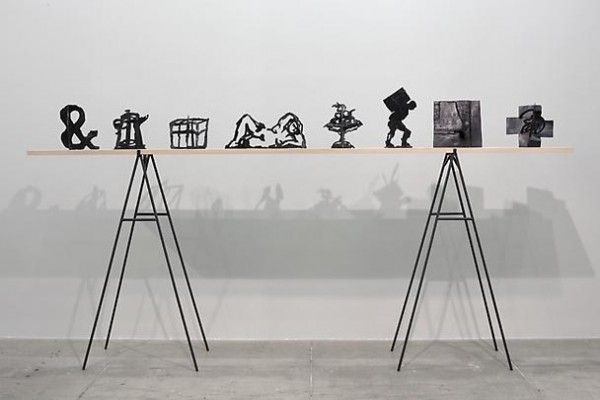
William Kentridge’s “Rebus” sculptures are best experienced from multiple angles (photo courtesy Marian Goodman Gallery)

William Kentridge’s “Rebus” sculptures are best experienced from multiple angles (photo courtesy Marian Goodman Gallery)

In the South Gallery in the back, two rows of “Rebus” sculptures consist of black bronze works that are like puzzles, changing when viewed from different angles. A lithograph of nine black-and-white typewriters reminds us of how words were at one time put onto the page. “Let Us Enter the Chapter” and “All the Trees in the Library” comprise small drawings on pages of the Shorter Oxford English Dictionary with such words at the top as “Abuse,” “Advocate,” “Wrath,” “Void,” “Symptom,” “Graveyard,” and “Indecipherable.” The show culminates with the poetic seven-minute flipbook film “Second-hand Reading,” which is composed of the many disparate elements in the South Gallery as a concerned Kentridge makes his way across pages from Cassell’s Cyclopædia of Mechanics on which he has added such phrases as “Whichever page you open, there you are” and a cheerleader with a cross on her outfit waves flags as if sending a message, all set to a beautiful score by Neo Muyanga. The exhibit as a whole places Kentridge’s art very firmly in a different kind of age of mechanical reproduction while laying bare his thought process. He is “taking sense and deconstructing it, taking nonsense and seeing if sense can be constructed from it,” as he recently explained, and asking the viewer to participate in the ultimate creation of meaning. The title of the show itself evokes a multitude of meanings, as “second-hand” could refer to Kentridge’s reuse of found objects, the portrayal of his own actual hand, his breathing life into pages from old texts that people can now read in a new light, and the endless passage of time, which hovers over everything. But even more important, it’s all a helluva lot of fun.

(Kentridge fans can still see his visually stunning production of The Nose at the Metropolitan Opera on October 26 and in theaters October 26 and 30, and the Metropolitan Museum of Art just opened their latest Kentridge acquisition, “The Refusal of Time,” which runs through May 11. To read our 2011 twi-ny talk with Mr. Kentridge, please go here.)