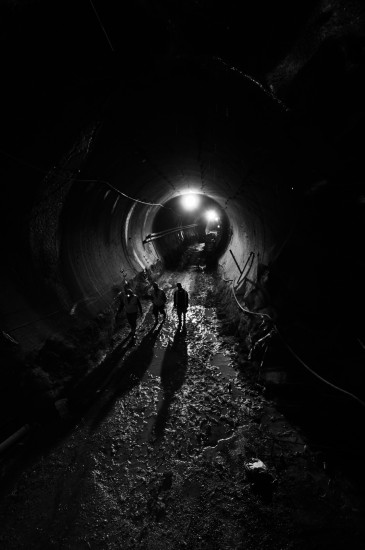
Hiroyuki Suzuki documents construction of LIRR/GCT tunnel in show at Transit Museum Gallery Annex (photo by Hiroyuki Suzuki)
New York Transit Museum Gallery Annex
Grand Central Terminal Shuttle Passage
Shuttle Passage next to the Station Masters’ Office
Open daily through October 27, free, 8:00/10:00 am – 6:00/8:00 pm
718-694-1600
www.grandcentralterminal.com
The New York Transit Museum Gallery Annex concludes its yearlong celebration of the one hundredth anniversary of Grand Central Terminal with a gorgeous exhibit that looks to the future. In “The Next Level: East Side Access Photographs by Hiroyuki Suzuki,” the Japanese photographer documents the construction of the tunnel that will link the Long Island Rail Road’s Main and Port Washington lines to a new portal eighteen stories beneath Grand Central, a project now expected to cost more than eight billion dollars and that won’t be completed until 2019. Suzuki — not to be confused with the world yo-yo champion of the same name — is a short-story writer and fashion-show producer (his wife is designer Junko Koshino) who turned to photography in 2006, previously documenting such construction sites as the Metro in Dubai, a downtown Tokyo expressway, the Tokyo Gate Bridge, natural gas production facilities in Qatar, and the rebuilding following the Tohoku earthquake. Using a Nikon D90, Suzuki ventured far below the ground to capture stunning black-and-white images of long, dark passageways with small circles of light and puddles of water, sandhogs either hard at work or taking a break, complicated equipment, and other mesmerizing scenes. Weaving your way through the exhibit, which includes fifty-five photographs, gives you the feeling that you’re underground with Suzuki, which is both thrilling and a little frightening. “The Next Level” is on view daily through October 27, and admission is free.
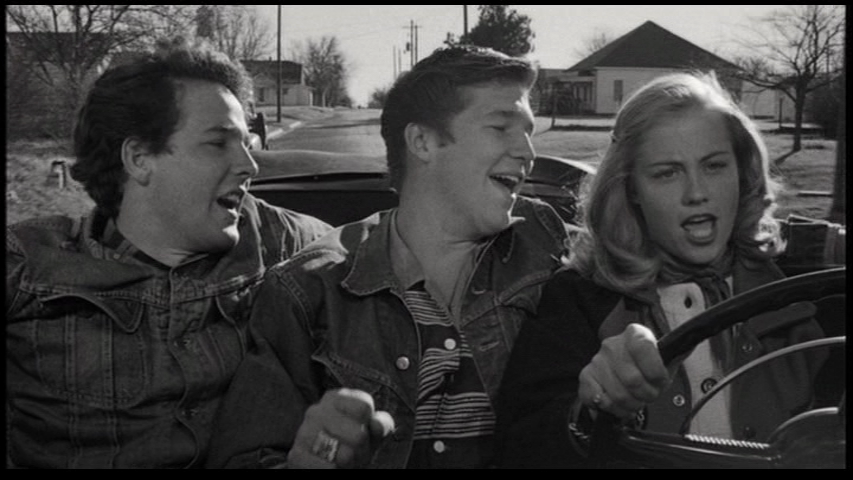
 Peter Bogdanovich’s The Last Picture Show is a tender-hearted, poignant portrait of sexual awakening and coming-of-age in a sleepy Texas town. Adapted from the Larry McMurtry novel by the author and the director, the film is set in the early 1950s, focusing on Sonny Crawford (Timothy Bottoms), a teenager who works at the local pool hall with Billy (Timothy’s brother Sam), a simple-minded boy who needs special caring. Sonny’s best friend, Duane Jackson (Oscar-nominated Jeff Bridges), is dating the prettiest girl in school, Jacy Farrow (Cybill Shepherd, in her film debut), who is getting ready to test out the sexual waters, sneaking away on a date with Lester Marlow (Randy Quaid), who takes her to a naked-swimming party in a wealthier suburb of Wichita Falls. Meanwhile, Sonny breaks up with his girlfriend, Charlene Druggs (Sharon Taggart), and becomes drawn to the sad, unhappy Ruth Popper (an Oscar-winning Cloris Leachman), the wife of his football coach (Bill Thurman). The outstanding all-star cast also features Oscar-nominated Ellen Burstyn as Lois, Jacy’s mother; Eileen Brennan as a waitress in the local diner who makes cheeseburgers for Sonny; Clu Gulager as a working man who has a thing for Lois; Frank Marshall, who went on to become a big-time producer, as high school student Tommy Logan; and Oscar winner Ben Johnson as Sam the Lion, the moral center of the town and owner of the pool hall, diner, and movie theater, which shows such films as Father of the Bride and Red River. Cinematographer Robert Surtees shoots The Last Picture Show in a sentimental black-and-white that gives the film an old-fashioned feel, as if it’s a part of Americana that is fading away. Bogdanovich also chose to have no original score, instead populating the tale with country songs by Hank Williams, Bob Wills and the Texas Playboys, Lefty Frizzell, Tony Bennett, and others singing tales of woe. In many ways the film is the flip side of George Lucas’s 1973 hit American Graffiti, which is set ten years later but looks like it’s from another century; it also has a lot in common with François Truffaut’s 1962 classic Jules and Jim. Nominated for eight Oscars including Best Picture and Best Director, The Last Picture Show is an unforgettable slice-of-life drama that will break your heart over and over again. It is screening in a DCP projection at the IFC Center October 11-14 at 11:00 am as part of the Weekend Classics series “Lone Star Cinema: Texas On Screen,” which continues October 18-20 with Robert Mulligan’s Baby the Rain Must Fall and October 25-27 with S. R. Bindler’s Hands on a Hard Body.


 The delightful documentary David Bromberg Unsung Treasure sings the well-deserved praises of a rather unusual character — a white, Jewish bluesman from ritzy Tarrytown, New York. For more than forty years, masterful guitarist and songwriter David Bromberg has been singing his entertaining brand of the blues and bluegrass, either solo, with his Big Band, or with the Angel Band. A consummate musician, engaging raconteur, and outstanding live performer, he trained with the Rev. Gary Davis before going on to play with such superstars as Bob Dylan, Jerry Garcia, George Harrison, Jerry Jeff Walker, and a litany of others. A big man with an ever-present beard, mustache, and glasses, Bromberg is an utterly charming figure, speaking honestly and openly about his life and career, often mentioning how deeply he was affected by the way he was raised and how that helped instill the blues in him. Beth Toni Kruvant (The Right to Be Wrong, Heart of Stone) traces his early years through wonderful archival footage and old photographs, then delves into his departure from playing music in the late 1980s and 1990s, when he and his wife, singer Nancy Josephson, moved to Wilmington, Delaware, where he established a well-respected