Alonzo King LINES Ballet makes Lincoln Center debut with Deep River
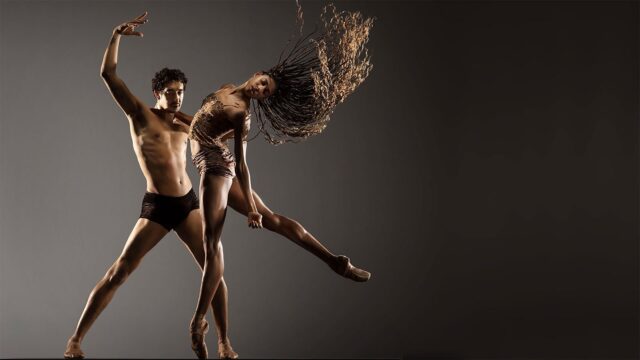
Who:Alonzo King LINES Ballet What: Lincoln Center debut Where:Rose Theater, Broadway at West Sixtieth St., fifth floor When: February 22-24, choose-what-you-pay (suggested admission $35), 7:30 Why: San Francisco–based Alonzo King LINES Ballet makes its Lincoln Center debut this week with Deep River, an evening-length piece that kicked off its fortieth anniversary season last year. The title is taken from the popular spiritual performed by such singers as Marian Anderson, Paul Robeson, Odetta, Johnny Mathis, Mahalia Jackson, and Beverly Glenn-Copeland. The sixty-five-minute work features an original score, incorporating Jewish, Indian, and Black traditions, by multidisciplinary artist and longtime King collaborator Jason Moran and is sung live onstage by vocalist Lisa Fischer, alongside music by Pharoah Sanders, Maurice Ravel, and James Weldon Johnson, who wrote “Lift Every Voice and Sing.”
The company consists of dancers Babatunji, Adji Cissoko, Madeline DeVries, Theo Duff-Grant, Lorris Eichinger, Shuaib Elhassan, Joshua Francique, James Gowan, Ilaria Guerra, Maya Harr, Marusya Madubuko, Michael Montgomery, and Tatum Quiñónez, with lighting by Jim French, costumes and sets by Robert Rosenwasser, and sound by Philip Perkins. King, who was born in Georgia to parents who were staunch civil rights activists, notes in a statement about Deep River, “Love is the ocean that we rose from, swim in, and will one day return to.”
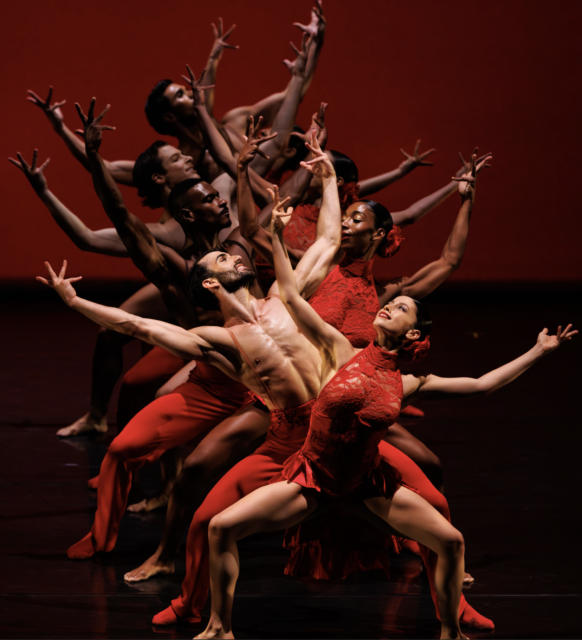
Annabelle Lopez Ochoa’s Línea Recta is part of special Ballet Hispánico program at 92Y (photo by Ben McKeown / courtesy of the American Dance Festival)
Who:Ballet Hispánico What: Celebrating 150th anniversary of the 92nd Street Y Where:The 92nd Street Y, Kaufmann Concert Hall, 1395 Lexington Ave. between Ninety-First & Ninety-Second Sts. When: Wednesday, February 21, $10-$40 in person, $20 virtual, 7:30 Why: As part of the 92nd St. Y’s continuing celebration of its 150th anniversary, New York City–based Ballet Hispánico will present a special evening at Kaufmann Concert Hall that can be seen live in person February 21 or online February 22-24. The night features a restaging of Talley Beatty’s 1985 Recuerdo de Campo Amor, Annabelle Lopez Ochoa’s 2016 flamenco piece Línea Recta, and Pedro Ruiz’s 2000 Cuban-infused Club Havana. Ballet Hispánico celebrates the fifteenth anniversary of artistic director Eduardo Vilaro in its spring season, which arrives April 25-28 at City Center, consisting of the world premiere of Vilaro’s Buscando a Juan, a restaging of Ochoa’s 2010 House of Mad’moiselle, and Gustavo Ramírez Sansano’s 18+1.
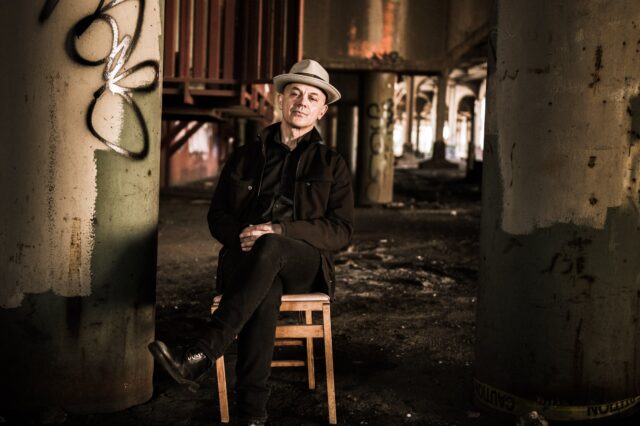
I first met James Mastro in the late 1980s, when he had a side gig as a freelance proofreader and I worked at a small publisher and used to assign him work. I already knew who he was from his time in the iconic Hoboken band the Bongos; he would go on to form Strange Cave and the Health & Happiness Show before joining Ian Hunter’s Rant Band in 2001.
Mastro started playing in New York City when he was teenager in the late 1970s, eventually performing with Patti Smith, John Cale, the Jayhawks, Alejandro Escovedo, Richard Lloyd, Garland Jeffreys, the Feelies, Jesse Malin, Amy Speace, Jill Sobule, and Robert Plant, among so many others throughout his career. He opened Guitar Bar in Hoboken in 1996 as a place where musicians could not only shop but play live and hang out. He has now followed that up with 503 Social Club, an art gallery that hosts live events, including recent concerts by Sobule, Freedy Johnston, and Bobby Bare Jr.; Jon Langford performed there with friends amid his paintings on the walls.
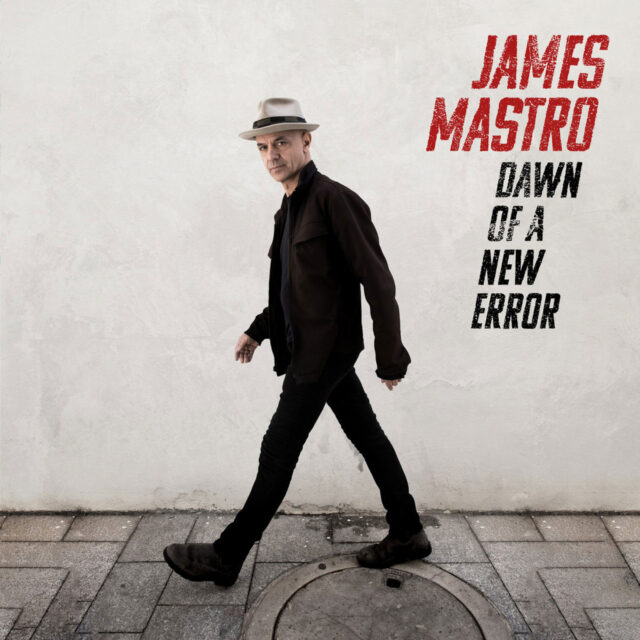
At long last Mastro has made his debut solo album, Dawn of a New Error, out from MPress Records on February 21. The title has multiple meanings, referring to the state of the world, Mastro’s shift to being the main man, and, at least to me, those old days when I was hiring him to find mistakes in kids books. Longtime Smith bassist and New Jersey native Tony Shanahan produced and plays bass and keyboards on the LP, which ranges from jangly pop, acoustic folk, and romantic ballads to gospel and country, celebrating such influences as the Beatles, the Ramones, T-Rex, Roxy Music, Bob Dylan, and David Bowie. Reilly and Hunter each appear on three tracks, with Hunter as “the voice of god” on “The Face of the Sun.” Mastro takes on faith and religion in “My God,” death and loss in “Never Die,” true love in “Gangster Baby” and “Three Words,” and fake news in “Right Words, Wrong Song.” “Trouble” was inspired by Dr. Seuss and Levon Helm.
Mastro will have album release parties on February 21 at Bowery Electric and February 24 at Transparent Clinch Gallery in Asbury Park. We recently spoke over Zoom, discussing music, art, family, hats, and stepping out into the spotlight.
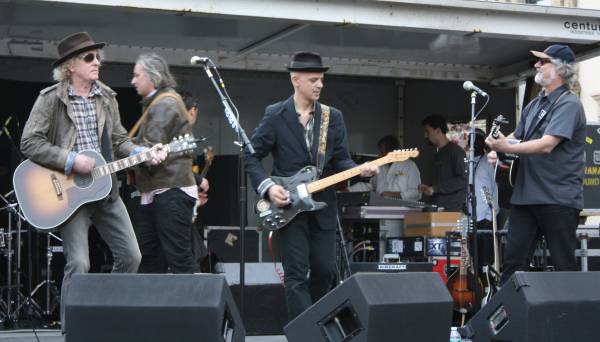
James Mastro plays with Ian Hunter and R.E.M’s Peter Buck and Scott McCaughey of the Baseball Project at the 2011 Hoboken Music & Art Festival (photo by twi-ny/mdr)
twi-ny: We’ve known each other for thirty-five years. Back in the late 1980s and early ’90s, I would send you freelance work while you were out on the road. What was that like to be playing in bands and proofreading children’s nonfiction books?
james mastro: I had a family to feed, by any means necessary. And luckily, I was doing two things that I love to do: playing music and reading books. So it was a good marriage.
For us too; you did both exceptionally well. How has the road changed for you since then?
jm: With Ian Hunter, it definitely got a little bit more comfortable. The things I love about it I still love, always trying to take the dirt road as opposed to the highway. Touring can be a drag, but you can also make it incredibly great and fun. We would plan out an agenda every time. It’s worth it to get up an hour or two earlier to take a little trip and go see a museum or something crazy that a friend told you about.
twi-ny: Back in 2011, you very generously played at twi-ny’s tenth anniversary party with Megan Reilly at Fontana’s, which is gone. New York City has had such a turnover of music venues. Are there specific clubs that you miss from the old days? Obviously, I think we’re going to mention Maxwell’s.
jm: CBGBs especially will always hold a place in my heart, just playing there as a teenager and getting to see some of the bands that inspired me to play and getting to play with some of them. So CBs and Maxwell’s, yes; huge holes that were left. I miss Fez under Time Cafe a lot; it was just a really special place. Usually what makes a place special — I was thinking about Maxwell’s this morning and CBs — are the people that ran it. Maxwell’s, I remember, was one of the first clubs that would feed you, no matter who you were; if you were playing there, they would feed you, which for a musician is huge. You may not get paid, but at least you knew you were getting fed. [Maxwell’s owner] Steve Fallon always treated musicians well, Hilly Kristal at CBGB. It starts at the top if you have great people running a space.
twi-ny: Maxwell’s was such a fan-friendly venue. I saw your bands, Robyn Hitchcock, the Mekons, Bob Mould. So you played that tenth anniversary show with Megan, who sings backup on several songs on your new record. What is it about you and Megan that gels so well over the years?
jm: I think she’s one of the finest singers out there right now. I mean, her voice just kills me. It’s kinda like beauty and the beast. I’m not crazy about my voice, so anything that will complement it, like a voice like Megan’s, I love singing with. And just musically, she’ll show me a song of hers and right away I don’t even have to think about it; these parts come out because the way she writes is so dreamy and from a special place. I connect with that so well. The other day she and I just did a rehearsal together, the two of us playing and singing for my show coming up. And I was just thrilled. I’d be happy just doing that too. She’s a very special person musically, and as a person. Just very talented.
twi-ny: On “Three Words” she really just takes it and builds to that finale.
jm: It’s like from the purr of a lion . . . She starts off so subtle and by the end of that song, she takes it to a place I never would’ve thought of going. I don’t think that that song would’ve made it on the record if she didn’t sing on it. I really think she sells it.
twi-ny: You’re very self-deprecating about your voice. On the record you say a couple of things that really lends insight to you. I’ve been listening to you play for decades. I’ve seen you in bands that you lead and bands that you’re the guitarist, the backup vocalist. So to hear you front and center on an entire record and writing songs that sound very intimate and personal, I’m learning things about you that I never knew.
jm: Therapy begins. [laughs]
twi-ny: On “Right Words,” you sing, “The lead singer at the mic wants so badly to be liked.” And on “Three Words,” you claim, “I’m not a singer and I can’t write songs.”
jm: Mm-hmm.
twi-ny: But clearly you can sing and you can write songs.
jm: Mm-hmm.
twi-ny: Humble as ever. What’s it like to finally have a solo album under your own name? Songs you wrote, songs you’re singing lead on. Why now?
jm: Good question, Why now? Well, I’ve really enjoyed being a side guy all these years, and especially when you’re working with someone like Ian Hunter, or Patti or John, anyone I’ve worked with, Megan. So it’s been nice to go in and try to contribute and watch how other people work. It takes a lot of pressure off. Running a band is a pain in the ass; you gotta make sure the drummer doesn’t get arrested —
twi-ny: Is that a Steve Holley problem?
jm: No, no, not at all. [laughs] At that time in my life, it was very nice to just take some of the responsibility off. Even though I started recording these songs before Covid just kind of as fun, with no pressure or no idea of making a record, when Covid hit, that really made me realize, Well, I’ve got time on my hands. Everything is kind of slowed down. Let’s take a look at these songs and see if we have an album here.
twi-ny: So the songs were already written?
jm: Yes, they were. Most of them were either recorded or just about finished. Tony Shanahan had just opened a studio in Hoboken. He called me up and says, Hey, I wanna just check out the room and the gear and see how things go in here. Do you have any songs? We’ll record. I was like, great. So we went in and it was just me, him, and, for the first few, Louie Appel on drums. Three friends just playing some songs.
I’d show them the songs right then and there. There was a great spontaneity and contribution from them. And it was really fun, so we just did that over a course of a few years, on and off, whenever the studio was open.
twi-ny: No pressure.
jm: No pressure.
twi-ny: So now, not only are you front and center, on lead vocals, you’re turning to people like Ian Hunter to participate. Ian hasn’t been performing because he’s got tinnitus?
jm: Tinnitus, yeah.
twi-ny: What was his reaction when you asked him to be on the album?
jm: He did one track, “Right Words, Wrong Song,” and it was perfect. It’s exactly what I wanted. He sounded just like Ian Hunter, you know? And then he finished that and he’s like, What else you got? And so he sat and I locked the door right away.
twi-ny: Oh, so he was with you in Tony’s studio?
jm: Yeah. He came down to do that. So we played him songs. He is like, “Oh, I hear a part on this. Let me try this. This is great.” He’s a very musical guy, a very giving guy. And so for me, having the guy that inspired me to pick up a guitar sing on my record after I worshiped his, it was a nice little payback.
twi-ny: And then you get to direct him in a video. You directed it, you star in it, you’ve got Tammy Faye Starlite, you’ve got Ian, you put on these great wigs. To me it’s a throwback to the early days of MTV. Is that what you were going for?
jm: Definitely. I think it was a mix of early MTV and the Colbert show and The Daily Show. I guess you could say it could be a serious song, but I think sometimes you can get a point across better by being a little irreverent about it.
twi-ny: It looks like it was fun to shoot.
jm: It was a riot. I usually backpedal at things like this. I’ve been asked to be in other videos, and I’m just like, Oh, no, I can’t. So I went into this with a little trepidation, but we had a great time.
twi-ny: How often before have you gotten to act without a guitar in your hand? Has that happened a lot?
jm: You know, since high school.
twi-ny: So you have a little acting bug inside you?
jm: It’s a good career to have to fall back on if music doesn’t work out. It’s a good safety net. Do some acting.
twi-ny: It looks to me like you’re sitting right now in 503 Social.
jm: I am. Yeah.
twi-ny: In 1996, you started Guitar Bar, which revolutionized the music scene in Hoboken. And now you’ve expanded it with 503 Social Club. How did that get going?
jm: Well, all these projects are done for selfish reasons. Guitar Bar was because I just got tired of going into New York to buy strings, and Social Club, it just popped up. A friend of mine told me about this space that became available for rent, and he’s like, You gotta go see it. The last thing I need is something that takes more sleep away from me. But it was just crying to be something. There are so many talented people in this area and there’s a lack of venues, be it for artists or musicians. So I just felt, let’s give it a shot. It’s selfish because I get to see my friends’ artwork up close and see my friends play. So it’s a labor of love, but it’s been really fun, and the feedback’s been great.
twi-ny: You had a big night there with the great and mighty Jon Langford.
jm: He’s a dynamo in every way. I love his artwork, and so he had a great show. I thought he was just gonna come in solo, but he brought half the Mekons with them, Sally [Timms] and some of the others. And they just tore this place apart.
twi-ny: I’m mad that I missed that.
jm: I understand. Well, he’s coming back. So the fact that I can get people like that here . . . it’s very fun and special for me and inspiring.
twi-ny: Speaking of inspiring, you’ve been married for thirty-one years, you’ve got two daughters, and at least one of them is a musician.
jm: Yeah, Lily is in Long Neck, her professional name and band. [Daughter Ruby, a London-based sound designer and filmmaker, edited the “Right Words, Wrong Song” video.]
twi-ny: So is music just in the Mastrodimos blood?
jm: Neither of my parents were musical. Both my brother and I were, and, my kids by default. There were always guitars in the house, music playing.
twi-ny: Is your wife musical?
jm: She is; she doesn’t play, but she sings great. She has no desire to do that. I truly think the kids get their talent from her, not me.
twi-ny: On February 21, you’ll be at Bowery Electric for the album release party. You’ve told us that you’re gonna be playing with Megan; who else will be joining you?
jm: It’s a great band and people. I’m really happy to be playing with Tony, who produced the record and has been with Patti Smith for years.
twi-ny: He’s doing a special Lunar New Year show with Patti at Bowery Ballroom on February 10.
jm: Yes, I will be there.
twi-ny: Awesome. I will be there too. So you’ve got Tony.
jm: He and I have been playing together for thirty-something years. So that’s easy. Dennis Diken from the Smithereens will be on drums. Megan will be singing, playing some guitar, and I got her playing some keyboards. She’s excited about that. The other guitar player, Chris Robertson, he’s in a band now called Elk City; he was in the Psychedelic Furs side project Feed and played with Richard Butler, just great, another friend. If I’m gonna do this, I want it to be fun for me, and if it’s fun for me, hopefully it’ll be for everybody else. These are good mates to be in a room with.
twi-ny: Okay, so one last question, something I’ve always wanted to ask you. You have always worn hats onstage; how many do you have, and how did the hat thing get started?
jm: I always wore boleros or something. I just I love that era. My dad used to wear hats, and I love that era when you look at old photos of Yankee Stadium, and men are in suits and in hats, like the whole crowd is at a baseball game but they’re dressed to the nines. So I just always have loved hats. How many do I have? Not as many as you would think. Not as many as Alejandro Escovedo — talk about a snappy dresser. I aspire to be him when I grow up. He and I are always going out hat shopping when we’re on the road.
twi-ny: Oh, speaking of which, you’re about to go out on the road with him again.
jm: I am. Yeah.
twi-ny: He previously played with the Rant Band when Ian couldn’t tour.
jm: Right. Alejandro’s got a new album coming out too [Echo Dancing], and it’s really a great, interesting record. He’s kind of revisited some of his old songs but totally deconstructed them. I don’t want to say it’s techno, but it’s unique and great. So it’s gonna be a little different from what people might expect from him. It’s kind of what John — he’s worked with John Cale also — it’s what John would do. Nothing was sacred to Cale. We’d go onstage and he’d be like, You know what, let’s change this song (that we had done the night before). But he would just totally revamp it. And I love that. Nothing should be set in stone. So that’s kind of what Alejandro’s done. I’ll be playing with him in that, but I’m also opening the shows acoustically and, depending on what town we’re in, if I have some friends there, I’ll ask them to come up and join me.
So I’m looking forward to it. Traveling with good friends and playing music, what could be better, you know?
twi-ny: You’re just having a ball, right? Just loving life?
jm: It may sound like a cliché, but if I wake up in the morning, it’s a good day. Anything after that is icing on the cake.
[Mark Rifkin is a Brooklyn-born, Manhattan-based writer and editor; you can follow him on Substack here.]
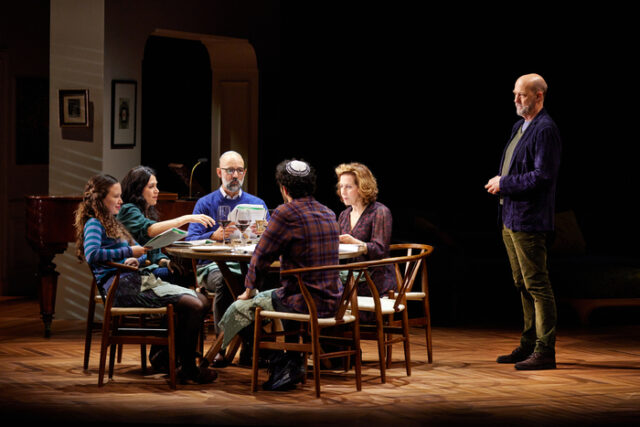
Patrick (Anthony Edwards) watches his family in Joshua Harmon’s Prayer for the French Republic on Broadway (photo by Jeremy Daniel)
PRAYER FOR THE FRENCH REPUBLIC
Samuel J. Friedman Theatre
261 West Forty-Seventh St. between Broadway & Eighth Ave.
Tuesday – Sunday through March 3, $94-$318 www.manhattantheatreclub.com
Success off Broadway is no guarantee of a hit on Broadway. Transferring to a bigger house, the passing of time, tweaking the script, cast changes, and sociopolitical events can all have an impact on a play or musical moving to the Great White Way.
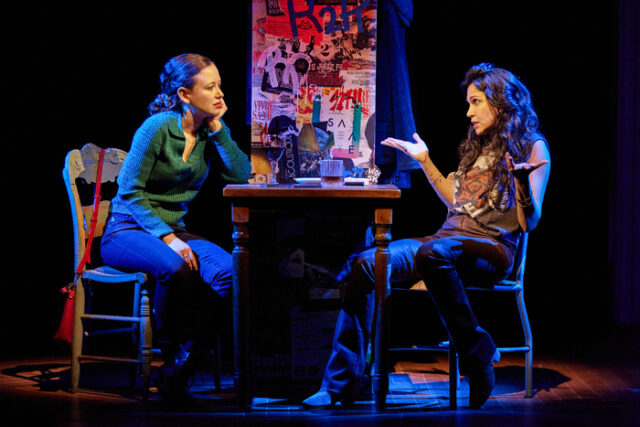
Molly (Molly Ranson) and Elodie (Francis Benhamou) argue about Israel in Prayer for the French Republic (photo by Jeremy Daniel)
I loved Prayer for the French Republic when it debuted at MTC at New York City Center, but two years later, it doesn’t feel as sharp and incisive at the Samuel J. Friedman, and I’ve been scratching my head to try to figure out why. Joshua Harmon’s play is still an impressive piece of work, but it doesn’t have the same power now that it had then. It was named Outstanding Play at the 2022 Drama Desk Awards, receiving my vote, but I wouldn’t have voted for this current version.
The story takes place in Paris in 1944–46 and 2016–17, following the trials and tribulations of the Salomon family, who have been making pianos since 1855. During WWII, Irma and Adolphe choose to remain in France as they worry about the fate of their children. In contemporary times, their descendants face a vicious antisemitism that forces them to question whether they have to leave their home. The script and the creative team are essentially the same, including the director, David Cromer, who guided The Band’s Visit to a slew of awards both on and off Broadway. Only five of the eleven cast members are back, so that could be part of the issue. One is notably stronger than his predecessor, but another sadly falters in a key role.
However, the scintillating scene between Elodie and her distant cousin Molly as they argue about Israel is played by the same actors on the same set, yet it fails to ignite as it previously did. I think it was more than just moving to a bigger venue; the events of October 7 and the aftermath involving Hamas’s terrorist attack and Israel’s military response have impacted everyone’s views of the Middle East. The glue that held the off-Broadway show together was Rich Topol as Patrick, the Salomon brother who also serves as narrator and who has a different view of Judaism than the rest of his family. Notably, Topol just finished a run as a Jew who leaves Poland shortly before a brutal 1941 pogrom in Igor Golyak’s poignant and inventive adaptation of Tadeusz Słobodzianek’s Our Class, which is filled with a frightening sense of urgency.
Two previous Harmon shows — Significant Other and Bad Jews — were just as good, if not better, when they transferred to bigger venues; Prayer is a conundrum.
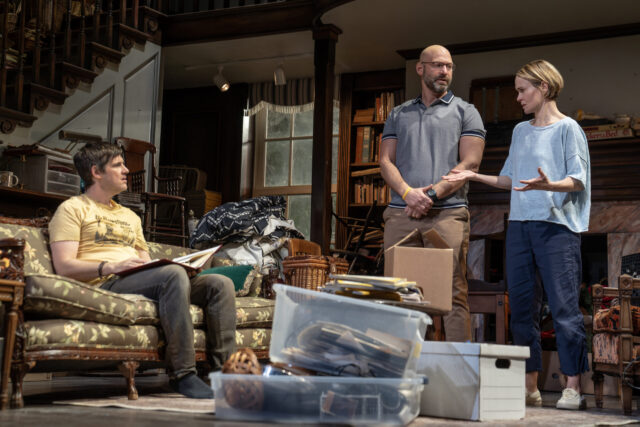
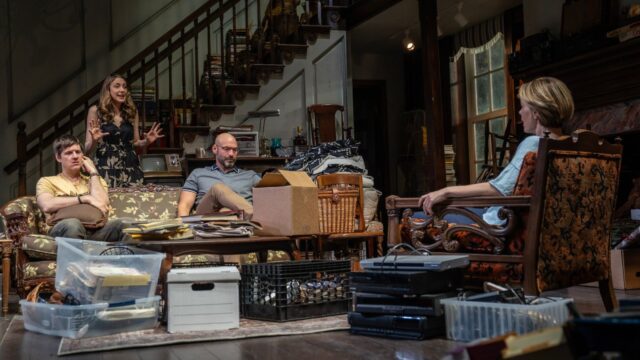
Three siblings battle over their family’s legacy in Appropriate (photo by Joan Marcus)
APPROPRIATE
Helen Hayes Theater
240 West 44th St.
Tuesday – Sunday through March 3, $209-$269
Moving to the Belasco Theatre March 25 – June 30, $79-$318 2st.com
Ten years ago, I saw Branden Jacobs-Jenkins’s Appropriate at the Signature. The play is about three siblings of the white Lafayette family who have returned to the clan’s dilapidated southern plantation to sell it to pay off debts following the death of their father. The siblings are not very close — youngest brother Franz has not been heard from in a decade — but their relationships are further strained when a home-made book of photographs of lynched black men is found in the house. The possibility that their father was a racist infuriates Toni, who cared for the ailing patriarch, and she becomes even more incensed when her Jewish sister-in-law, Rachael, who is married to Bo, claims that he was antisemitic as well.
The Signature show was directed by Liesl Tommy and starred Johanna Day, Michael Laurence, and Maddie Corman as the siblings. In 2014, I wrote, “Appropriate begins with solid character development while raising intriguing social and moral issues without getting didactic. But the story goes off the rails in the second act as various secrets emerge and the vitriol reaches even higher levels. Perhaps most unfortunate, there’s a moment that seems like the perfect ending; the lights go out, and just as the audience is ready to applaud, the play continues through a disappointing, unnecessary coda. Jacobs-Jenkins clutters what is a fascinating premise with too many disparate elements.”
I still feel the same about the ending, even with an insightful added finale, but everything else about the play, at the Helen Hayes through March 3 before moving to the Belasco for three more months, is better this time around. Jacobs-Jenkins (The Comeuppance,An Octoroon), a relentless reviser, has improved the script immensely, with dialogue that hits harder and deeper. Director Lila Neugebauer grabs hold of the complex plot and never lets go; the confrontations among the siblings, their significant others, and the next generation are scintillating; at times it’s so severe and merciless, so intimate, that you feel guilty for watching it unfold but you can’t look away for a second.
Branden Jacobs-Jenkins’s Appropriate is reborn on Broadway (photo by Joan Marcus)
Sarah Paulson is a force of nature as Toni, an embittered woman with deep scars and no filter, exploding with vitriolic accusations she will never be able to take back. Corey Stoll goes toe-to-toe with her as Bo, who is having financial difficulties that may be affecting his ethics, while Natalie Gold is tough as nails as Rachael, who is not afraid to get in the ring with them. Michael Esper imbues Franz with a gentleness that belies the character’s past, while his younger girlfriend, a flower child named River played sweetly by Elle Fanning, stands firmly by his side. And the set, by dots, becomes more of an integral element, both what’s inside and lurking outside.
The Broadway production of Appropriate, the title of which has several different meanings and pronunciations, feels both of its time and timeless, an intense tale about the Black experience in America that has no people of color in its cast. A lot has changed in the world since 2014: Barack Obama finished his second term, followed by Donald Trump, both having defeated Hillary Clinton, the former in the primary, the latter in the general. The police killing of George Floyd led to the Black Lives Matter protests and a reckoning with this country’s shameful legacy of slavery and racism. And antisemitism is again on the rise, with October 7 only making it worse.
This vital new adaptation of Appropriate captures all of that and more in unforgettable ways.
[Mark Rifkin is a Brooklyn-born, Manhattan-based writer and editor; you can follow him on Substack here.]
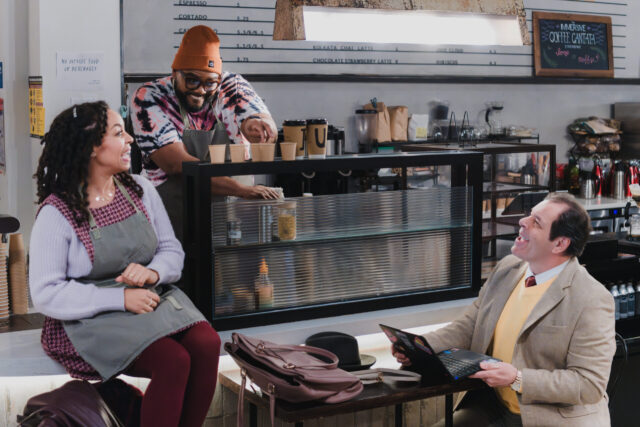
Christine Lyons, Bernard Holcomb, and Philip Cokorinos star in The Immersive Coffee Cantata (Dan Wright Photography)
THE IMMERSIVE COFFEE CANTATA EXPERIENCE
The Lost Draft
398 Broome St. between Lafayette & Mulberry Sts.
February 14-25, $40 osopera.org thelostdraft.com
I have never been a coffee drinker. In fact, I have not had a sip of any type of java in more than forty years. But On Site Opera’s (OSO) latest site-specific production, The Immersive Coffee Cantata, is my kind of cuppa.
Coffee first made its way into Germany around 1670. In 1735, composer Johann Sebastian Bach and poet and librettist Christian Friedrich Henrici, known as Picander, teamed up for Coffee Cantata (Schweigt stille, plaudert nicht, BWV 211), a tasty tale of a father who insists his daughter give up coffee if she ever wants to get married.
OSO, which has staged shows at Wave Hill, at a barbecue market, in a soup kitchen, and on board ships at the South Street Seaport, this time moves into the Lost Draft coffee shop in SoHo, which, in its mission statement, explains, “Art is an expression that can never be perfected. It is indefinite, ever-evolving. Artists reveal the highest versions of themselves when they are lost in their work. There is no final draft. There is only the draft that best represents you as an artist. And what artist doesn’t love coffee? That is the inspiration behind the Lost Draft. A creative space for creative people who love coffee.”
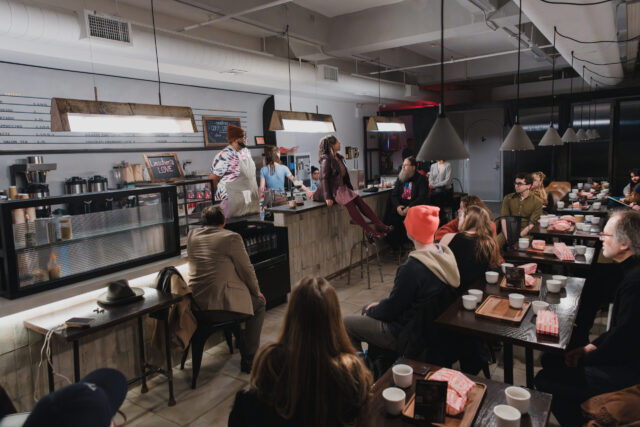
The Lost Draft is a long, narrow shop with the counter on the left and small tables on the right. On each table are several empty coffee cups, two boxes of popcorn, and freshly baked cookies that you can start on while the four-piece band warms up. (If you’re lucky, you’ll get the scrumptious passion fruit red velvet delights along with the chocolate espresso cookie.) You can also take a coffee quiz by scanning the QR code on the card on your table.
The Immersive Coffee Cantata takes place in the Lost Draft coffee shop in SoHo (Dan Wright Photography)
The show begins with Joe, the barista and narrator (tenor Bernard Holcomb), advising us, “If you’ll pipe down, and put your phones on mute, / You’ll overhear a family dispute: / Here comes Herr Schlendrian, / His daughter Lieschen close behind. / He’s about to lose his mind — / Or maybe it’s already gone.”
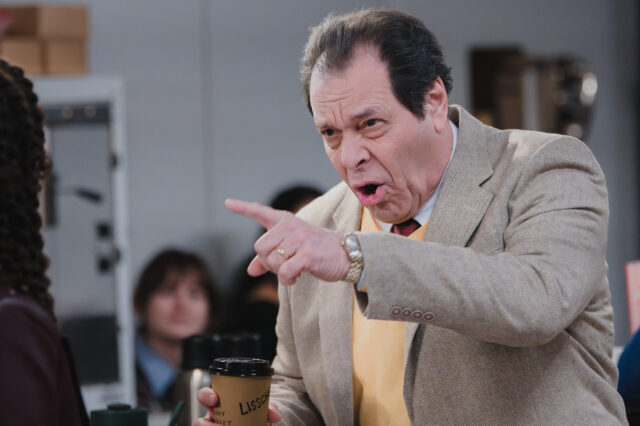
Schlendrian (bass-baritone Philip Cokorinos) enters, upset that his daughter, Lieschen (soprano Christine Lyons), is late and never listens to him. When she finally arrives, he yells at her, “You stubborn child, don’t drink that gritty mixture!,” but she declares, “My whole world floats in a cup or mug, / Revolving around Heaven’s true wonder drug / Thirsty for nectar from above. / Coffee, coffee: I’ve got to have it, / And it’s such a victimless habit. / Coffee is my liquid love!”
The sweet new libretto by Geoffrey McDonald, who also did the lovely orchestrations, quickly makes it clear that coffee is a stand-in for a man; fathers usually complain about a daughter’s choice in partners, but soon Schlendrian is checking the online matchmaking site Duetto to find Lieschen an acceptable future husband. Among the stickers on the back of Lieschen’s laptop is one of the iconic New York Greek coffee cup.
“Marital bliss: / Father, I want true love’s kiss! / Yes, a spouse! / Raise a family, buy a house!” she sings. “But I want a worthy suitor, / One who treats me like a queen. / I’ll agree to quit caffeine, / If you’ll serve as my recruiter!” And off they go, determined to make their dreams come true, demonstrated by a clever use of large and small paper coffee cups.
Schlendrian (Philip Cokorinos) is concerned for his daughter’s future in The Immersive Coffee Cantata (Dan Wright Photography)
During the forty-five-minute presentation, the actors and staff pour three tastings, Mama Mina, Kahawa Chungu, and the Queen’s Cup, the last also available in a go-cup. Meanwhile, the score is performed in a near corner by members of the American Modern Ensemble, featuring Valeriya Sholokova on cello, Nikita Yermack on violin, John Romeri on flute and recorder, and Dan Lippel on guitar, not all instruments Bach intended, but it works.
The Immersive Coffee Cantata is the first production under new OSO artistic director Sarah Meyers, who helms the show with an intimate, friendly touch. Cofounding general and artistic director Eric Einhorn, who stepped down at the end of last year, was chosen as one of Lieschen’s potential suitors in an earlier performance.
Met Opera veteran Cokorinos is terrific as the concerned father who wants only the best for his daughter, his face bold and expressive. Holcomb is welcoming as the amiable Joe, and Lyons is charming as Lieschen, who is forced into choosing between mocha and a man. Cokorinos’s diction is impeccable; you might have to refer to the online libretto for certain lines sung by Holcomb and Lyons, both of whom have exceptional voices.
My only quibble with the show is that it’s too short; I wanted to spend more time with the cast and crew, if not with the coffee itself.
[Mark Rifkin is a Brooklyn-born, Manhattan-based writer and editor; you can follow him on Substack here.]
Justin Gauthier serves as the narrator while playing numerous other roles in Between Two Knees (photo by Jeremy Daniel)
BETWEEN TWO KNEES
Perelman Performing Arts Center (PAC NYC)
251 Fulton St.
Tuesday – Saturday through February 24, $29-$79 pacnyc.org www.1491s.com
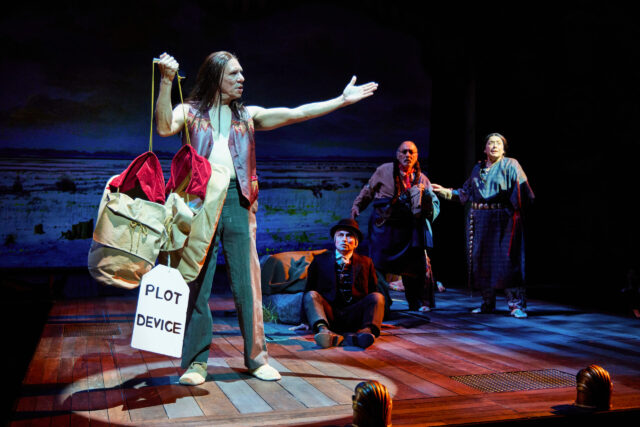
White people receive quite a spanking in the New York premiere of the 1491s’ irreverent, hilarious, and scattershot theatrical history lesson, Between Two Knees.
The 1491s are a Native American sketch comedy troupe from Minnesota and Oklahoma whose members have been involved in such television series as Rutherford Falls and Reservation Dogs. In Between Two Knees, they lead the audience on a wild ride from the Wounded Knee Massacre of December 29, 1890, to the American Indian Movement’s (AIM) occupation of Wounded Knee beginning on February 27, 1973. The narrative traces several generations of an Indian family as they try to find their place in a country that only knows how to take from them, treating them with disrespect and violence every step of the way.
As the crowd enters the theater at the Perelman Performing Arts Center (PAC NYC), themed music plays, including such songs as Cher’s “Half-Breed.” Regina García’s set features a thrust stage and a backdrop with cardboard cutouts of former Cleveland Indians logo and mascot Chief Wahoo (the team was recently renamed the Guardians), the Chicago Blackhawks’ logo of an Indian head (inspired by the real-life Black Hawk of Illinois’s Sac and Fox Nation), and the Land o’ Lakes woman with a target on her stomach. A red curtain opens and closes as scenes change like vaudeville acts. Props range from a covered wagon, US army and FBI rifles and guns, and a tiny western house to a small kitchen, a hippie pedestal, and Custer’s Last Stand Bar. Lux Haac’s costumes are often tongue-in-cheek versions of traditional Native clothing.
The fun kicks off with the opening announcement telling everyone to turn off their phones, followed by a riff on the standard land acknowledgment. Introducing the play, the emcee, Larry (Justin Gauthier), provides a content warning: “Good evening, fellow Indians, and other. Take a deep breath. Ahhh, you smell that? It smells like inherited wealth, privilege, and a tad bit of guilt in this room. White people! It’s good to see you here, aho! Bet you haven’t heard that in a while. Thank you for coming to this Native American Indian show. I just want you to know, you’re about to see some heavy stuff. I mean, let’s be honest here, we’re talking about INDIANS. And Indians have been through some pretty dark shit. I mean, DARK shit. All caused by you people. Yup. You all tried your best to wipe us out and clean us off the map. I mean, can you imagine how hard it was to cast this play? We had to use a Chinese guy to play one of the Indians.”
The actor steps forward and explains, “Actually, Korean. But whatever,” a revealing joke about personal identity.
Members of the 1491s pose as a museum diorama in New York premiere at PAC NYC (photo by Jeremy Daniel)
Larry continues, “We’re gonna make this fun. We’re gonna talk about war and genocide and PTSD and molestation. So it’s ok to laugh. You are going to feel some guilt watching this. But don’t worry. That’s just what it feels like to be confronted with the source of your social power. That’s why we are passing a donation bin around the audience tonight. For just the price of a cup of coffee, you . . . can help a grown Indian child in need. Yup, yup. Just pass the can along. Don’t be cheap now. I promise, when you leave, you will still own everything. And Indians, if you’re in the audience and you got those free tickets, I better hear some quarters dropping into that can. C’mon, don’t be a stereotype. Everybody already thinks we get free college.”
The first skit involves spinning the Wheel of Indian Massacre, which first stops on the Pound Ridge Massacre, then the Raritan Massacre, and finally Wounded Knee, which gets the main plot underway. But Larry promises, “THIS is not a story about death. This is a story about life.”
Over the course of a far-too-long two hours and forty-five minutes (including intermission), Pale Face and Witko try to protect Ina from a white soldier; an Indian baby is sent to a Christian reeducation boarding school and renamed Isaiah, where he meets the feisty Irma, who refuses to give in to the evil priest and strange nuns; Indians are sent off to fight in WWII and Vietnam; and AIM returns to Wounded Knee, proclaiming, “Time to unite and defend the people!” Through it all, a pair of tiny baby moccasins ties everything together, passing along trauma and hope to the next generations.
Eight ensemble members — Gauthier, Rachel Crowl, Derek Garza, Shyla Lefner, Wotko Long, James Ryen, Shaun Taylor-Corbett, Sheila Tousey — portray more than seventy characters, from Jesus, Satan, Ghost of Lakota Woman, and Singing Deer to a sexy temptress, a man with an eagle in his pants, Vanna White, and the Vietnam War as Interpretive Dance. Along the way we learn about and are reminded of various anti-Indian laws, manifest destiny, spirit animals, cultural appropriation, Native American rituals, colonization, and “the atrocities of the United SNAKES of Amerika.”
Much of the show is clever and heartfelt, its sociopolitical points emerging sharply from all the joking around, performed by likable actors who make connections with the audience, which, at the matinee I attended, was filled with more Native Americans than I had ever seen in a theater before. The Indians and the non-Indians didn’t always respond the same way to certain lines and bits; the 1491s are expert at making white people laugh at themselves amid the guilt and privilege but are careful not to cause too much discomfort.
However, some scenes are others are over-the-top farce that lose their power with random silliness. Obie-winning director Eric Ting (The Far Country,The World of Extreme Happiness) lets too many scenes run on, with a bevy of stray parts. The DIY feel extends to Elizabeth Harper’s playful lighting, Ty Defoe’s humorous choreography, and Shawn Duan’s projections, but the self-deprecating emphasis on the company’s supposed lack of technical expertise peters out. The five musical numbers, including “Touchy Touchy Tickle Touchy,” “The Song of Eddie Wolf,” and “Aimstas Paradise,” are as hit-or-miss as the comedy sketches.
The lavish PAC NYC is the right place for Between Two Knees. At intermission, I walked outside to the 9/11 Memorial, the moving tribute to the nearly three thousand men, women, and children killed in the terrorist attacks of September 11, 2001. The World Trade Center — among numerous other NYC buildings — was built by hundreds of Mohawk Skywalkers, and Native Americans arrived in force to the site after 9/11 to help in the dangerous cleanup. So Native Americans know all about 9/11, but non-Indians know little or nothing about December 29, a critical date in the history of this nation.
After intermission, Larry says, “Good evening, friends and relatives. Welcome back to Between Two Knees, an intergenerational tale of familial love, loss, and triumph. Thanks for returning. I know it can be a real slog to sit through these diversity shows. But if you’re still here with us, you’ve clearly been gifted with elevated artistic tastes. Everyone else ran home to rewatch their favorite Yellowstone spin-offs. Please note that those who left in a huff during intermission have been refunded the fair market value of their ticket, in beads. Aho, good trade.”
The show continues at PAC NYC through February 24. Tickets are $29 to $79; beads are not accepted.
[Mark Rifkin is a Brooklyn-born, Manhattan-based writer and editor; you can follow him on Substack here.]
Kimi Takesue’s Onlookers is a uniquely visual film that looks at tourists and locals in Laos
ONLOOKERS (Kimi Takesue, 2023)
Metrograph
7 Ludlow St. between Canal & Hester Sts.
Opens Friday, February 16
212-660-0312 metrograph.com www.onlookersfilm.com
“Seeing comes before words. The child looks and recognizes before it can speak,” John Berger writes in the seminal text Ways of Seeing. “But there is also another sense in which seeing comes before words. It is seeing which establishes our place in the surrounding world; we explain that world with words, but words can never undo the fact that we are surrounded by it. The relation between what we see and what we know is never settled.”
In documentary filmmaker Kimi Takesue’s Onlookers, which opens theatrically February 16 at Metrograph as part of the series “Fire Over Water: Films of Transcendence,” there are no words, no dialogue — just seventy-two minutes of stunning visuals exploring what we see and what we know, what we are present for and what we are absent for.
The film takes place in various parts of Laos as director, producer, cinematographer, sound recordist, and editor Takesue sets up her camera and leaves it there as scenes unfold in real time and with natural sound, from a breathtaking fourteen-second sunset to five and a half minutes of six women sitting by the side of the road, preparing to fill begging bowls for a long line of Buddhist monks. Animals graze in a temple courtyard as bells chime. Women sell goods at an open-air market. Rivers flow, wind rustles trees, roosters crow, birds chirp, a cat rests on a step, a man relaxes in a hammock, all taking their time, no one in a hurry.
Then the tourists arrive; a few run up to take pictures of a monk beating a drum, then walk away, not actually stopping to watch and listen. A woman snaps a photo of three fellow sightseers standing atop a small, raging waterfall as a man fishes below. A local worker waits as a woman checks her cell phone, as if he isn’t there, standing next to her. A group of backpackers gets a prime view at a boat racing festival while locals observe from the shore. On a mountain, six tourists search for the best angle to take selfies. Visitors at a guest house sit in an outdoor lounge and watch Friends.
Born in Colorado and raised in Hawai’i and Massachusetts, Takesue has previously made Where Are You Taking Me? in Uganda, Heaven’s Crossroad in Vietnam, and 95 and 6 to Go in Hawai’i, about reconnecting with her grandfather. In Onlookers, she is not necessarily criticizing the tourists or celebrating the Laotian locals; she’s merely showing how people witness and experience the world, particularly when it comes to travelers and residents. (95 and 6 to Go and Where Are You Taking Me? will both be available to stream on Metrograph at Home beginning February 16.)
Takesue beautifully captures this relationship in a short but captivating scene that begins with a static shot of an old religious shrine that looks like it hasn’t been in operation for years. A young woman enters the frame, sits down, poses for a selfie, stands up, snaps a photo of the shrine, then saunters off, never once stopping to just look at the shrine itself. The camera lingers on the building for several seconds, with nobody around, just the decaying structure set against a blue sky and between lush greenery.
We see what we want to see, when we want to see it, not always recognizing what is right in front of us, whether we’re at home or on vacation. It reminded me of people who go to a museum and take pictures of classic artworks but only see them through the lens of their phone rather than experiencing them with their own eyes. In fact, each frame of Onlookers is composed like a painting that slowly comes to life.
“The way we see things is affected by what we know or what we believe,” Berger writes in his book. “Yet this seeing which comes before words, and can never be quite covered by them, is not a question of mechanically reacting to stimuli. (It can only be thought of in this way if one isolates the small part of the process which concerns the eye’s retina.) We only see what we look at. To look is an act of choice. As a result of this act, what we see is brought within our reach — though not necessarily within arm’s reach. To touch something is to situate oneself in relation to it. . . . We never look at just one thing; we are always looking at the relation between things and ourselves. Our vision is continually active, continually moving, continually holding things in a circle around itself, constituting what is present to us as we are. Soon after we can see, we are aware that we can also be seen.”
In all films, the audience might not have a choice of what they’re looking at, but they can decide for themselves what they’re seeing. And in the case of Onlookers, what they’re seeing is a gorgeous portrait of ourselves that no selfie can catch.
Kimi Takesue’s Where Are You Taking Me? will stream on Metrograph at Home
Takesue will be at Metrograph for introductions and Q&As before and after four screenings: February 16 with Inney Prakesh, February 17 with Dessane Lopez Cassell, February 18 with Lynne Sachs, and February 21 with Ari-Duong Nguyen.
“Fire Over Water” also features Michaël Dudok de Wit’s The Red Turtle, Phạm Thiên Ân’s Caméra d’Or winner Inside the Yellow Cocoon Shell, and Apichatpong Weerasethakul’s Cemetery of Splendour.
[Mark Rifkin is a Brooklyn-born, Manhattan-based writer and editor; you can follow him on Substack here.]