twi-ny recommended events

SALESMAN 之死

New play explores Arthur Miller’s 1983 experience in China directing Death of a Salesman (photo by Maria Baranova)

SALESMAN 之死
Connelly Theater
220 East Fourth St. between Aves. A & B
Through October 28, $45-$99
www.yzrep.org
www.connellytheater.org

In 1983, Harlem-born playwright Arthur Miller went to Beijing to direct the first-ever Chinese-language version of his 1949 Pulitzer Prize–winning classic, Death of a Salesman, at the prestigious Beijing Renyi Theater (the People’s Art Theater), even though he could not speak a word of Mandarin and most of the cast did not understand English. He was invited by artistic director Cao Yu and actor and future vice minister of culture Ying Ruocheng, who he had met when Miller and his third wife, Austrian photographer Inge Morath, visited China in 1978.

Manhattan-based Yangtze Repertory Theatre, in conjunction with Gung Ho Projects, tells the story of that seminal production in the funny and poignant Salesman之死, which opened tonight at the Connelly Theater.

In his 1984 diary, Salesman in Beijing, Miller wrote, “The truth was that I had no way of knowing if the Chinese authorities were merely interested in using the play for political purposes or if the absence of salesmen in China and the presence of exotic American elements in the play would make it little more than a misunderstood curiosity in Beijing. . . . There would be something impudent in speaking of Chinese isolation from the world rather than the world’s from China were it not that she herself now recognizes modernization as her first priority, and that means taking what she finds useful from the West. In the theater and other arts, however, the decade of the Cultural Revolution completed her total break with quite literally everything that was going on beyond her boundaries and indeed from her own past accomplishments.”

Jeremy Tiang’s hundred-minute Salesman之死 was inspired by Miller’s memoir and interviews with original company members as well as Shen Huihui, the Peking University professor who was hired by Ying to serve as interpreter despite her total lack of experience as a translator. He had chosen her because she could speak English and had written her dissertation on Death of a Salesman. Shen (Jo Mei) serves as the narrator of the play, occasionally directly addressing the audience, who are seated around three sides of the stage. Chika Shimizu’s initially spare set features a central platform with chairs; in the back right corner, Xingying Peng operates the surtitles and indicates scene changes by softly banging on her desk. The curtain in front of the main stage eventually opens to reveal the more crowded set for the presentation of excerpts from Renyi’s Death of a Salesman.

Miller (Sonnie Brown) arrives carrying a suitcase, evoking his main character, Willy Loman, who will be portrayed by Ying (Lydia Li). Theater legend Zhu Lin (Sandia Ang) is Willy’s wife, Linda, with Li Shilong (Julia Gu) as Biff, Mi Tiezeng (Claire Hsu) as Happy, and Liu Jun (Hsu) as the woman from Boston. After the first reading, Miller is concerned that it took four hours, the actors spoke way too slowly, and no one is going to be able to make sense of any of it. The cast is more worried that the audience will miss their buses home, thinking that in New York, at least they had the subway, which runs all night long. That comparison is the first of many between East and West, from the use of makeup in theater to the differences between capitalism and communism and the concept of freedom. The cast has no idea what football is (Biff was a high school gridiron star), has trouble deciphering the scene in which Biff catches Willy with his Boston mistress, and doesn’t even know what a traveling salesman or insurance is.

Arthur Miller (Sonnie Brown) doesn’t like what he sees in Chinese version of Death of a Salesman (photo by Maria Baranova)

“In America, they have this thing called ‘insurance.’ People get money for dying,” Shen tells the actors. When Miller explains that Willy’s family might not get any money if it’s proved that he died by suicide, Mi says, “What, so he died for nothing?” Li responds, “Obviously. If you could earn a chunk of money so easily, you’d have people killing themselves all over the place.”

As Miller noted in his diary, “The cast did not seem any more tense than an American one on the first day, but it is still hard to judge the actors’ feelings. One has only their controlled expressions to go by. I am like a deaf man searching their eyes for emotions, which finally I cannot read.”

The most cynical one of all is longtime Renyi designer Huang (Gu), who is upset that Miller has rejected nearly all of his ideas, from costumes, the bedroom, and wigs to lighting, a refrigerator, and the empty space Miller insists must be in the front of the stage for Willy’s memories. “When Willy steps past this wall, he’ll be in his memory,” Shen says to a confused Huang, who steps forward and back several times, declaring, “Really! Reality! Memory! Reality! Memory! Reality! Amazing!” Miller asks, “Is he okay?” Shen replies, “He’s just excited. Renyi plays never have people walking through walls.”

As opening night approaches, more cultural differences arise and just about everyone worries that this undertaking was a big mistake.

Chinese company performs scene from Death of a Salesman in play-within-a-play (photo by Maria Baranova)

The world premiere of Salesman之死 comes at a challenging time, with relations between the United States and China teetering dangerously on the edge. It’s now more than fifty years since President Richard M. Nixon made his historic visit to China, shaking hands with Premier Zhou Enlai, and forty years since Renyi staged Death of a Salesman. Tiang’s Salesman之死 captures a moment in time when the two nations worked together culturally, resulting in a stirring success. Obie-winning director Michael Leibenluft (I’ll Never Love Again, The Subtle Body) ably guides the show through its multiple languages and doubling of parts, which sometimes requires fast costume changes. The costumes are by Karen Boyer, with lighting by Daisy Long, sound by Kai-Luen Liang and Da Xu, and projections by Cinthia Chen that include clips from Renyi’s production of Cao’s (Ang) 1979 Thunderstorm and the final version of Death of a Salesman. You can watch the full Chinese Death of a Salesman from 1983 here.

Mei (Lunch Bunch, Anatomy of a Suicide) leads a solid and engaging all-female Asian cast as Shen, who is more than just an interpreter; she is a bridge between the US and China, one that we could use today. Shen is a steadying influence amid all the disagreements and misunderstandings among the company and Miller as Tiang (A Dream of Red Pavilions, State of Emergency), who has translated more than two dozen Chinese plays and novels into English, reveals how universal the themes of Miller’s play are, as well as the creation of theater itself.

As Miller wrote in his diary, “The current, post-Mao political line seems to come down to ‘Enrich Yourselves!’ Has the moment arrived when capital must be accumulated in China, whatever the cost? Salesman is fundamentally related to this situation. Willy Loman fell off the horse reaching for the brass ring, but he was deep in the game everyone else was playing.”

Salesman之死 is an enriching experience, no matter one’s cultural heritage.

[Mark Rifkin is a Brooklyn-born, Manhattan-based writer and editor; you can follow him on Substack here.]

EDGAR OLIVER: RIP TIDE

Edgar Oliver returns to his early days at the Pyramid Club in Rip Tide (photo by Regina Betancourt)

RIP TIDE
Axis Theatre Company
One Sheridan Sq. between West Fourth & Washington Sts.
Wednesday – Saturday through October 28, $10-$40, 8:00
866-811-4111
www.axiscompany.org

Master storyteller Edgar Oliver returns to the beginning of his oratory skills in Rip Tide, the latest of his deeply personal solo shows to be presented by Axis Theatre Company, directed by Randall Sharp.

In such previous Axis works as In the Park, East 10th Street, and Attorney Street, in addition to Helen and Edgar and London Paris, Edgar explores key moments from his past, from his upbringing in Savannah, Georgia, to his move to New York City with his sister, painter Helen Oliver Adelson, and his development as a beloved downtown playwright, poet, and raconteur.

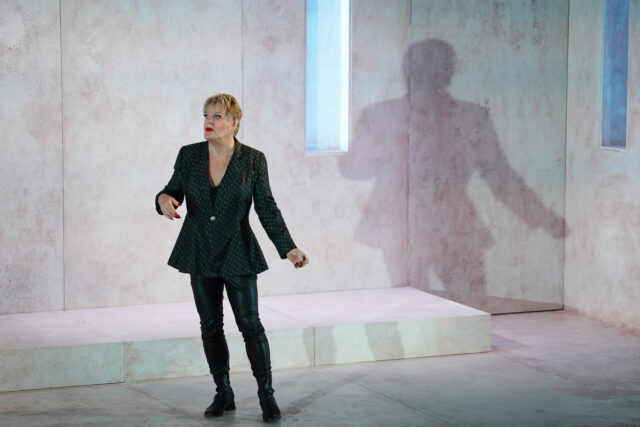
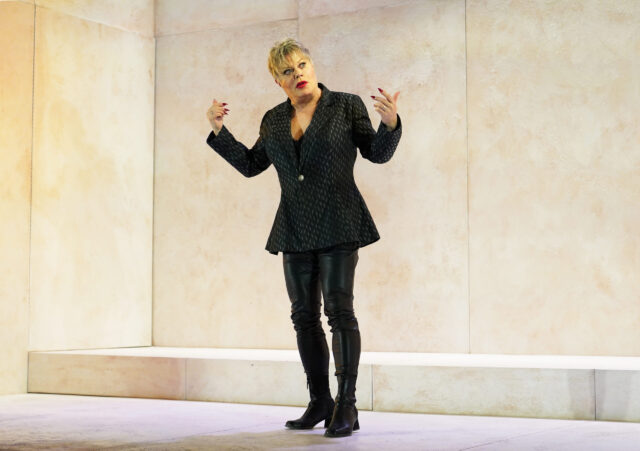
Rip Tide begins humbly enough. “I want to tell you something that happened to me. When it happened it was so simple and unexpected — so simple yet so magical — I almost didn’t realize it was happening,” he says at the start. Dressed in all black, he walks across a black platform with a step on two sides, where he sometimes takes a seat or meanders onto the main floor. He moves slowly, using his hands to express himself with unusual motions, and speaks in his trademark tone: affected yet elegant and luxurious, enchantingly otherworldly, part Shakespeare thespian, part late-night horror-film host; you’ll be entranced just by the way he pronounces “ar.”

What happened was that Edgar and Helen had been swept past the velvet rope and into the Pyramid Club, the hot nightspot for alternative performers (John Kelly, Penny Arcade, Kembra Pfahler), drag queens (RuPaul, Lady Bunny), punk bands (Butthole Surfers, Flaming Lips), and cultural icons (Andy Warhol, Debbie Harry) that opened in 1979 at 101 Ave. A between Sixth and Seventh Sts. Oliver was twenty-three and Helen twenty-four, on the brink of their artistic careers and bohemian lifestyle.

“The Pyramid became our world. We realized there were others like us,” he says. “There was a world of drag queens and lost souls sitting on the lip of a stage in the back of an old bar full of lunatics at night on Ave. A.”

Edgar Oliver shares deeply intimate stories in latest monologue at Axis (photo by Regina Betancourt)

Oliver was shocked when Pyramid cofounder Bobby Bradley asked him to perform, something Edgar had never done before. But he immediately says “OK!” — a running gag in the play is how quickly Edgar agrees to just about anything — and performs his poem “Rip Tide” onstage, accompanied by two dancers and music from Nino Rota’s score for Fellini’s La Dolce Vita. “The disgorged jaws of petrified sharks are / yanked up by rip tides / from the smooth graveyard forever below ebb / and harry the coast,” Oliver remembers, with Rota’s music played live by Paul Carbonara on guitar, Samuel Quiggins on cello, and Yonatan Gutfeld on piano. Sitting in a far corner, the trio also plays original music throughout the show.

Soon Oliver is performing regularly at the Pyramid, including a horror play called Motel Blue 19, part of which he acts out. He introduces us to Brian Butterick, aka Hattie Hathaway, who ran the Pyramid after Bradley disappeared, and Brian Damage, an artist and designer who made a wild costume for Oliver to wear in the Final Fashion Solution contest and was working on a large painting titled Dreamland Burns when he died, a canvas about the fire that destroyed Coney Island in 1911 and serves as a metaphor for Oliver’s memories, particularly of the AIDS crisis, which was just breaking out.

Despite some verbal repetition, Rip Tide is another gripping monologue from the eccentric Oliver. Carbonara’s sound design and David Zeffren’s lighting give the show a haunted quality, which fits not only with this specific story but with Oliver’s life; per previous tales, his mother might have been a witch, and at one point he was the only person left living in his building in the East Village. Sharp, who has directed numerous Oliver shows and cast him as an erudite oddball in Worlds Fair Inn, expertly gets the most out of the sparse, dark proceedings, eschewing pure nostalgia in favor of a pervasive gothic eeriness.

The narrative focuses not only on the creation of art but on innocence and loneliness. Oliver shares two potential sexual encounters with men that are absolutely heart-wrenching. “I felt I was a failure as a gay person. . . . I just thought my destiny was to be solitary,” he admits with more than a touch of shame.

“I think I set out onstage to explain the beauty and sorrow of my solitude,” he says just past the halfway mark. “And even if I was unable to do that back then — I hope that somehow I will be able to do that now. I guess that’s what I’m trying to do in this show.”

Mission accomplished, And that’s nothing to be ashamed of.

[Mark Rifkin is a Brooklyn-born, Manhattan-based writer and editor; you can follow him on Substack here.]

HOPE BOYKIN WANTS YOU TO HAVE THE BEST DAY EVER

Hope Boykin makes her Joyce debut with States of Hope (photo courtesy HopeBoykinDance)

STATES OF HOPE
The Joyce Theater
175 Eighth Ave. at 19th St.
October 17-22 (Curtain Chat October 18), $52-$72
212-691-9740
www.joyce.org
www.hopeboykindance.com

“You have the best day ever,” Hope Boykin told me at the end of our lively Zoom conversation a few weeks ago. And I set out to do just that, as it’s impossible not to be affected by her infectious positivity, encased in a warming glow.

A self-described educator, creator, mover, and motivator who “firmly believes there are no limits,” the Durham-born, New York–based Boykin began dancing when she was four and went on to become an original member of Dwight Rhoden and Desmond Richardson’s Complexions, performed and choreographed with Joan Myers Brown’s Philadanco!, then spent twenty years with Alvin Ailey American Dance Theater, first under Judith Jamison, then Robert Battle. A two-time Bessie winner and Emmy nominee, Boykin was busy during the pandemic lockdown, performing the “This Little Light of Mine” excerpt from Matthew Rushing’s 2014 Odetta for the December 2020 Ailey Forward Virtual Season, making several dance films, collaborating with BalletX and others, and preparing October 2021’s . . . an evening of HOPE, a deeply personal hybrid program at the 92nd St. Y that investigated Boykin’s truth and her unique movement language.

Next up for Boykin is another intimate presentation, States of Hope, running October 17–22 at the Joyce. Boykin wrote, directed, and choreographed what she calls her “dance memoir,” which features an original score by jazz percussionist Ali Jackson, lighting and set design by Al Crawford, and costumes by Boykin and Corin Wright. The work, in which she explores different parts of herself, will be performed by Boykin as the Narrator, Davon Rashawn Farmer as the Convinced, Jessica Amber Pinkett as the Determined, Lauren Rothert as the Conformist, Bahiyah Hibah Sayyed or Nina Gumbs as the Daughter of Job, Fana Minea Tesfagiorgis or Amina Lydia Vargas as the Cynical, Martina Viadana as the Angry, and Terri Ayanna Wright as the Worried.

On a Wednesday morning, Boykin, evocatively gesticulating with her hands and smiling and laughing often, discussed transitioning from dancer to choreographer, making dance films, seeing Purlie Victorious on Broadway, avoiding ditches, and seeking radical love in this wide-ranging twi-ny talk.

twi-ny: You are in rehearsals for your Joyce show. Where are you right now?

hope boykin: I’m at the 92nd Street Y. I got here early because I was a fellow for the Center for Ballet and the Arts [at NYU] for 2022–23, and then they extended it through the academic year, then they extended it through the summer, but they have new fellows now. And so I will never take an office space and stairs down to the studio for granted again.

Now that I’m a New Yorker, I can say I was schlepping all of the cameras and the computers and the music, and so I found a corner here in the newly renovated Arnhold Dance Center. I give everybody a warmup at 10:15 before we get started. So I’m here early.

twi-ny: I’ve previously interviewed Matthew Rushing and Jamar Roberts, who are two other longtime Alvin Ailey dancers who became choreographers for Ailey while they were still dancing with the company. When you started at Ailey, did you anticipate becoming a choreographer in the way you have?

hb: I don’t think anything was in the way that I had; I definitely didn’t have that thought. I was always making work because at Philadanco!, Joan Myers Brown put into practice a summer event called Danco on Danco!, and so she allowed dancers in the company to choreograph on other dancers in the company, then in the second company, and there was also an evening that would showcase D/2, the second company. The concert was in a small theater. I mean, she gave us tech time and rehearsal so we could see our work on a stage.

That also happened at Ailey once I got there, but I feel like I was able to really create work there. And then I was also an adjunct professor and did choreography at University of the Arts. And so I was choreographing and then seeing things on stages there. But never would I have thought that I would wake up in the morning and say, This is what I do for a living. I mean, it’s a little bit wild. And then in this stage now, having the opportunity to do things under my own name — having commissions is incredible.

It’s not just satisfying because you’re able to travel, but you’re able to meet people and you’re challenged with different environments, you’re challenged with different artists, different genres of dance, and so that’s wonderful. But having your name on it, being responsible to make sure that everyone’s paid on time, having a physical therapy schedule, will that schedule work with the schedule that I made, it’s a different animal.

twi-ny: In some cases you’re choreographing on friends and colleagues you’ve worked with for years, and in other cases you’re working with completely new teams you’re not as familiar with. Is one harder than the other?

hb: That does get a little bit difficult.

twi-ny: You have to boss friends around sometimes.

hb: Well, yeah. You just have to remind them what you want and that as much as they know you and want the best for you, you may not have the answer for why you’re doing something right away, but they have to trust you. And they do. They ultimately do.

Sometimes, it’s funny; you still have to watch your words when they’re people who you love. I love to talk about the found family. And when you have people who are committed to you and they want the best for you, and they maybe think that their opinion’s going to help . . . what really helps above all is their support, not having to pretend or perform when you’re in front of people who don’t know you. You have to show up. You have to do the smiling thing. I mean, we always have to watch our words, especially now. I’m super conscious of how I speak to other artists, but I feel like I’ve always been conscious of that because of things I didn’t like. So I wanted to be one of those people who could tell you the truth and tell you no and tell you I don’t like that, let’s fix it.

twi-ny: Right. Tell them, “I still love you.”

hb: Exactly, “I still love you.” And so I feel that it’s easier for me. We were away during our technical residency in the Catskills, and I just had a yucky morning, and three of the women who I knew I could cry in front of and that they would pray with me did. We started late that day. I was weeping. I said, “I need some help.” They put their arms around me in a group, and then the day got started after that. It was just heavy times. But when you have people who’ve known you, they can also pick up some of the slack when you don’t feel a hundred percent; they fill in the rest.

twi-ny: In your PBS First Twenty episode Beauty Size & Color, you talk about “renegotiating and forcing a change of narrative,” which relates to something that comes up a lot in your work. You talk about finding your own path, that your path is different from someone else’s path. Are we on the right path as a society?

hb: Yes. It’s so interesting. Lately, especially because I’ve been applying for grants — I don’t mean foundational grants, I mean the creative grants — you are competing against hundreds of applications. You’re lucky if someone recognizes your name; maybe recognizing your name will move you forward, but maybe it also won’t. They’re really just trying to look at the topic. And if my topic of what I want to make is not radical enough, if it is not wild enough, if it is not socially piercing enough, if I’m not saying the words that people want to hear from a huge activist, I mean, I’m not saying that I’m not. I’m just saying if those words aren’t the words people want to hear, then it feels like I’m not in those rooms.

So I want to be clear about that. But it feels like you’re not chosen. And I think that love is the most radical thing we should work on. If we were radical with our love, we wouldn’t watch someone fall and then just look at them. We would pick them up. If we were more radical with our love, we would have compassion for those who didn’t have homes. If we were more radical with our love, we would not necessarily need to walk into a school with some sort of weapon. I’m going to tell you when it changed for me: There was a woman who looked fine. She did not look homeless. She was a young white woman, and she was walking in my neighborhood — I live in Harlem, but it’s gentrified. And then she pulled down her pants to take a wee.

And I said to myself, Excuse me, what are you doing? I didn’t judge; she looked perfectly fine. But at some point she was not able to walk into a place and say, May I use the bathroom?

twi-ny: Or someone said no.

hb: Or someone said no. I checked myself in the moment; instead of me saying, How dare you! I should have said, How could I help you? But please understand. I did not think that first; I thought that third or fourth after all of the other things. But if I were more radical with my love, maybe I would’ve said to her, How can I help you? Is there something I could do? I don’t know what her situation was.

twi-ny: Exactly. You don’t know.

hb: And so I want to speak about this love and trying to understand why I felt the lack and why I felt like I was in constant competition with things that I could not control. There are a lot of things I could control. So once again, let me be clear. I’m not trying to be a hypocrite, but if I’m in competition with you simply because you’re bald — I’m usually bald.

twi-ny: I know, I know.

hb: It’s a little bit long today.

twi-ny: Yeah, mine too. Mine too.

hb: But if that’s the case, I’m in the wrong business. I love to go into new studios and tell people, if it were about being tall and blond with a bun, I would not have been working for over twenty years. But I did. Which means that there is room for me; which means that there’s room for you. Now, it doesn’t feel like a lot of room at the time, but if I can make room, if my path is this wild and then I am able to do this, then that means someone else can come in and then they can, and then we can, and then they can. And then we can.

Even on Broadway right now. I went to see Purlie Victorious.

twi-ny: I saw it last night. Unbelievable.

hb: Unbelievable. I’m sure that they thought that the musical, Purlie, was going to be a better moneymaker. What’s the reasoning behind us not seeing that? Yes, the musical, yay, we’re not cutting it. Yay. We love a musical, song and dance. But that piece of art. That was written, what? More than sixty years ago?

twi-ny: Yes. And it felt like it could have been written yesterday. The friend I went with, she saw the musical with Cleavon Little and Patti Jo. She even brought her program from 1972, and she asked, Why is this a musical? Now that she’s seen the play, it’s like, wow.

hb: Yeah, I’m friends with [Purlie Victorious star] Leslie Odom Jr. And he was like, “You think Ms. Jamison wants to come?” I said, “Yeah.” So I called her and she said, “You mean Purlie? I said, No, I mean Purlie Victorious. She said, “Purlie.” I said, “No, Judy. The prequel.”

twi-ny: And to be that funny sixty years ago about this topic. We laughed our heads off while facing this truth.

hb: It’s unbelievable. All of that to say there is a radicalness that can change our view on what truth is. Do you know what I mean? And I’m not thinking in this log line; I call it my log line. It doesn’t really explain the work, but I say in this evening-length, fully scripted new dance theater work. It’s not new because I’m making something no one has ever seen. It’s new for me. It’s a new way for me to express myself. It’s a new way for me to make work that I feel deserves to be spoken about just because it’s my experience. And once again, here I am trying to broaden a path that I feel like other people just need to — I don’t want them to walk the way that I walk. I just want them to feel they’re given the ability to actually walk forward and not feel stunted.

twi-ny: Kara Young, who plays Lutiebelle Gussie Mae Jenkins [in Purlie Victorious], she’s like a dancer at times; she speaks volumes with her body even when not saying anything.

hb: She’s studied and trained in all the disciplines because you can’t move like that, I’m sure, without that agility and understanding. [ed. note: Young studied at the New York Conservatory for Dramatic Arts.] It’s not just being flexible; it’s about awareness. I don’t know all of her story, but I could say I can’t imagine that she didn’t. But I do know that Leslie studied at Danco. That’s where I met him when he was fifteen or sixteen years old. So I know he’s a mover. And his agility — that scene where he kept running back to the window, oh my God. Oh my. The timing. I was like, look at my friend. But anyway.

[ed. note: . . . an evening of HOPE opened with Deidre Rogan dancing to Odom’s rendition of “Ave Maria.”]

twi-ny: One of the things you say is your journey is yours, and your journey is yours. We’re not all on the same journey, even if we’re spending an hour and a half or two hours together in a safe space. Your recent work, first with . . . an evening of HOPE, a beautiful and fascinating thing to experience, and now with States of Hope, is very personal. It can’t get much more personal. You’ve taken this other meaning of your name — the work is very much about moving forward, evolving; hope is an essential theme. And now you’re baring your soul out there. Every choreographer and dancer puts themselves into it, but you’re putting Hope Boykin into it. Is that difficult to do?

hb: It is and it isn’t. Sometimes people are like, “Oh, it must be very healing.” And I was actually having to hear it every day. Getting it out was the part that was the healing part’ hearing other people voice these things has become something a little bit different. Matthew Rushing came to Bryant Park to see me perform a solo. The year before I was rained out; everyone was able to perform except for me. It started raining more. So then the next year, I was just going to do the same work, but no one was available. So I ended up dancing it; I did a recorded voiceover, and then I performed. He was like, “Wow, you really laid it out there. You all right?”

Because not only was it my voice, but you were watching me and hearing my voice. That was sort of the turning point for me. I had taken this memoir writing class during the pandemic here at the 92nd St. Y. And that was also another way that I understood that I could tell my story differently, that I could use prose as well as those poetic sounds. I call them my poetic moments. But I could speak. And I said, Well, what if I turned this around? I was acquainted with Mahogany L. Browne, and I was telling her I wanted to work on this project. And she was like, “Oh, sure, I can help you.” And so she’s called herself my script midwife, and she basically said, “Give me your text.” And she said, amongst other exercises and examinations, “How do you feel about this from this person’s perspective? Write this from your mother’s perspective.”

So then she is teaching me how to take a situation and bring it in together so that these perspectives can have a conversation. Then we named the people, and then the people got ideas. And then instead of them actually having names —because at first I thought they might have names; I just thought that we would hear their characteristic in their name. And she’s like, “Are you sure?” I’m like, “Yeah, I think this is the best way.” And then all of a sudden I was able to have one of them speak to the other. But that’s exactly what’s going on in my mind. Should I buy that purse? It’s pretty expensive. Well, did you pay the rent? Yes, I paid the rent. That’s the logical person. Well, did you buy groceries? Yeah, I bought groceries, dah, dah, dah. But you have that bag. You have another bag that looks just like that bag. So all of these ideas are floating around. Well, should you get it? Because if you just save that money, maybe you could put that money away. That’s the worry. You know what I mean? Maybe you could put that money someplace else. And then the Angry says, of course I buy the bag. I’m worth it. I want to buy it. And so all of these ideas — I’m not going to say people, but these states, these parts, these slivers of me are living together.

twi-ny: You’re talking about the Determined, the Conformist, the Cynical, the Convinced, the Angry, the Daughter of Job, and the Worried.

hb: And the Worried. Yes.

twi-ny: All parts of you and parts of other people in your life.

hb: Yes. Parts of me hearing other people. There are parts of me, but they also represent experiences that I’ve had. Matthew, when he was creating Odetta, he told the whole cast, “The turning point for me being able to make this piece was realizing that all of the people and all of my influences were inside of me, that they’re all an ingredient. And so there’s no point in trying to pretend that this doesn’t have some Ailey in it. It doesn’t have some Judy in it. It doesn’t have some [Ulysses] Dove.”

[ed. note: Boykin performed the “This Little Light of Mine” excerpt from Odetta for the December 2020 Ailey Forward Virtual Season.]

He said, “I’d be ridiculous to think that all of those influences weren’t coming out of me.” Because we’re always trying to do something brand new, right? But there’s nothing new under the sun. So we have to just know that all of those people are a part of me. So when my mother makes a statement to me, I make that statement to another person, who’s younger, because I learned that lesson. If I fall in the ditch — I’m from North Carolina; we had ditches. So if I fall in the ditch —

twi-ny: We have potholes here.

hb: Right? But if I can tell someone, “Hey, there’s a ditch about three feet from there, just go around it,” and they don’t listen, then they’re like, “Hope told me about that ditch.” It won’t be, “I didn’t know there was a ditch there.” And so all of those people have played a part of who those characters turn out to be and will be. It’s interesting, and it’s challenging, but I want to do it. I feel it’s important.

twi-ny: I’m looking at the seven characters, and I guess you’re the eighth.

hb: Oh, yeah.

twi-ny: All of us fit into every one of those characters. I was even thinking about the Book of Job the other day. So, in choosing the dancers, did you have ideas for who you wanted for each part? Did you have auditions, or did you say, Oh, I already know who’s going to be doing this and who’s doing that?

hb: There were a few people that I knew I wanted. There was all dance first. There were people who I know dance and then act; one of the dancers is on Broadway right now. Some of them have been in movies and television, but I’ve met most everyone through my relationship with the Ailey organization. Two of them are former students of mine from USC. So everything is dance first. And I let people know that we have to read and we have to act. And I let them know that I’ll help you do that. Not because I can, because I know people who can.

twi-ny: Well, that’s key.

hb: Yes, it’s key. Yes. And so a couple of the dancers had never read before. So I said, I want you to read this. And then I would say, “No, try reading it with this tone; here’s the back story for that person. Read it like this.” And then once the nerves are gone, and once they understood, all of a sudden the person who can physicalize pain without speaking can now speak pain and physicalize it at the same time, in my opinion, is probably going to be better than the person who has to learn to move. Because we do. We go onstage hungry, experiencing loss. I’ve danced directly after my father’s funeral. There’s just this thing. We are just experiencing things, but we don’t get to say it. So imagine if I can scream, “I’m still angry! I’m still angry!”

Hope Boykin will get personal in States of Hope at the Joyce (photo courtesy HopeBoykinDance)

Watching them do that is just amazing. The sweetness of Daughter of Job says, “Well, are you sure this is the way you want to move?” And then Cynical says, “Well, I don’t know.” So it wasn’t an audition per se, but some of them I needed to let them know, “I do need you to read this. I need to understand.” But I think it’s perfectly cast. I think there are challenges to everyone’s level. Another friend of mine said to me, “You realize that actors ask why. And dancers say okay.” So now I have to have these dancers ask me why all the time. And I’m like, “Can you just try it?”

twi-ny: At the Joyce, of all places. This is the big time for them, for all of you.

hb: It’s a big time for me. And I am excited and nervous, but it’s successful already because of the people in the room. It’s successful because they’ve already not just agreed but taken on the weight of this work in a way that is just — I’m just really blessed.

twi-ny: It’s got to be so gratifying for you.

hb: Yes.

twi-ny: You have said, “I’ve waited, sometimes patiently, for my turn, permission to be given. Who have I been waiting on and why? I can’t wait anymore.” What’s the next, as you call it, “hope thing” after the Joyce?

hb: I have some projects that are simmering, and they’re the ones that you can’t forget about, the ones you don’t need to write down, the ones that you are, like, Oh, I can see this happening.

You mentioned Beauty Size & Color. Three of the four cameras that were used to film that I own, the microphones are mine, the lights are mine. I mean, of course I had support from the spaces that we were in, but there’s something about being behind the camera that is so thrilling, because as a person who moves bodies in space, I see dance on film in a way that is scripted, much like what I’m working on right now with States of Hope.

So that’s just me dropping a little bit of some simmering plans, a scripted dance film that is moving while speaking. It’s not just moving instead of the word, but they’re working in tandem, which is why this States of Hope process feels difficult because everyone has to learn their lines, then you block them in the space. Or we work with choreography in the morning, and then I say, Oh, we’re going to do this choreography with this scene. And at first it’s like, Well, I can’t say that and do that. And then it’s like, Oh, okay, maybe I could say that and do that. Well, you know what? Then all of a sudden they’re literally moving and speaking at the same time. So the layers upon layers upon layers of trying to add to this presentation is what the challenge has been. But I’m happy right now. I don’t think it’ll be complete. I don’t think it’ll be finished by October 17. I think that I will still have to add and see things that I was like, Oh, I should have done that. But I have time.

twi-ny: So you’re still a little worried, who is one of the characters, and you’re happy, who is not. The happy person is not one of the people. But you’re not angry either.

hb: I’m not angry. [laughs] No, I’m not angry.

[Mark Rifkin, who wants you to have the best day ever, is a Brooklyn-born, Manhattan-based writer and editor; you can follow him on Substack here.]

JOB

A therapist (Peter Friedman) and his new patient (Sydney Lemmon) fight for survival in Max Wolf Friedlich’s Job (photo by Danielle Perelman)

JOB
SoHo Playhouse
15 Vandam St. between Varick St. & Sixth Ave.
Tuesday – Sunday through October 29
www.sohoplayhouse.com

The title of Max Wolf Friedlich’s intense generational thriller, Job, can be pronounced either with a soft o, meaning the type of work someone does, or with a hard o, referring to the biblical figure. Both characters in the world premiere at SoHo Playhouse will have to display patience and an innate understanding of their employment if they are going to survive this intense tale.

The show takes place in January 2020 in the San Francisco office of a therapist named Loyd (Peter Friedman), a sort of 1960s throwback who has to determine whether Jane (Sydney Lemmon) can return to her position in the tech world after having suffered a terrible psychological meltdown that went viral. As the play opens, Jane is holding a gun on Loyd.

“Thanks for squeezing me in,” she says plaintively, sitting down. “My pleasure. In general, do Wednesdays at this time work?” he asks, trying to ignore that his life appears to be in grave danger. For the next eighty minutes, Jane and Loyd play a kind of verbal cat-and-mouse game as facts slowly emerge explaining how it came to this.

Jane insists she is not a gun person but that her mental state is on the edge. She tells him, “I can’t imagine how scary that was for you — it was scary for me too — but I promise, I swear like . . . I will do whatever you need me to do just . . . I can’t be outside right now, I — I haven’t slept in a couple days, I haven’t — I can’t be outside, I just need to get back to work.”

Jane (Sydney Lemmon) believes she desperately needs to get back to work in Job (photo by Danielle Perelman)

Meanwhile, Loyd, responding to the shame Jane says she feels for having the gun, explains, “I’m not an especially spiritual person — at least not in the traditional sense — but I will contend that the people who wrote the Bible down were some very very clever people. We’re told that Adam and Eve eat the sort of magical wisdom apple, right? They eat the apple, realize they’re naked, and then . . . they feel shame. So shame is the very first feeling mentioned in the Bible — wisdom and shame are connected.”

Those two elements also arise in the Book of Job. “But where can wisdom be found? And where is the place of understanding? Man does not know its value, nor is it found in the land of the living,“ Job says to his friends. Shortly after, God says to Job, “Your enemies will be clothed in shame, and the tents of the wicked will be no more.”

As the two protagonists continue to battle it out, an underlying theme begins to emerge, one of the young fighting against the old. Jane is in her twenties, working in the tech profession in a role that didn’t exist a mere ten years before, while Loyd, in his sixties, is a laid-back Berkeley grad with outdated sensibilities.

“It’s the field that’s the problem,” Jane tells him. “Because people with your job come into work wanting to connect trauma A to trauma D, so they always do — it’s a self-fulfilling prophecy or whatever.” When Jane explains how a creepy guy on a train both hit on her and insulted her at the same time, Loyd defends it as “a misguided attempt at being friendly — generational miscommunication.” She also asks Loyd, “Like why are you so terrified of progress?”

Loyd delves into Jane’s upbringing, looking for clues regarding her meltdown, but keeps coming up empty. “It was a perfectly nice granola middle class existence — nothing to cry about,” she insists. Jane, however, often turns the tables on Loyd, asking him personal questions that he does answer, perhaps out of fear knowing that there’s still that gun in her bag. But once he’s said enough, a major twist leads to an intense finale.

Loyd (Peter Friedman) is the arbiter of Jane’s fate in world premiere at SoHo Playhouse (photo by Danielle Perelman)

No matter how you pronounce it, Job is a nail-biter about patience, wisdom, and, primarily, responsibility, about people being accountable for their actions and living up to their obligations. Both Jane, who works in “user care,” and Loyd have jobs in which they help people, though in different ways, through a kind of protection.

In his off-Broadway debut, director Michael Herwitz keeps the drama at high-boil, making good use of Scott Penner’s basic set, a few chairs facing each other atop a rectangular, carpeted platform, with two small tables, an ottoman, and a lamp. Mextly Couzin’s lighting features several eerie blackouts, accompanied by Jessie Char and Maxwell Neely-Cohen’s effective sound. The costumes by Michelle Li consist of casual pants and an unbuttoned shirt for Loyd and green pants and a belly-revealing striped shirt for Jane.

Ever-reliable Tony nominee Friedman (The Nether, Ragtime) is phenomenal as an easygoing therapist who suddenly find his life on the line, while Lemmon (Tár, Helstrom) — the daughter of Chris Lemmon and granddaughter of Jack Lemmon — is exceptional in her off-Broadway debut, stretching her long body, clasping her hands, and holding tight to her gun as she slowly reveals some hidden truths. (Friedman played series regular Frank on Succession, while Lemmon appeared in three episodes as Jennifer, who’s starring in Willa’s play.)

The twist is a biggie and will turn some people off, as will the open-ended finale. But everything up to those points is taut and nerve-racking. It’s not going to hurt any of the participants to have this Job on their resume.

[Mark Rifkin is a Brooklyn-born, Manhattan-based writer and editor; you can follow him on Substack here.]

BIG TRIP: THREE LOVE STORIES NEAR THE RAILROAD

Krymov Lab NYC makes big debut with the two-part Big Trip at La MaMa

BIG TRIP
La MaMa Experimental Theatre Club
The Ellen Stewart Theatre
66 East Fourth St. between Second Ave. & Bowery
September 24 – October 15, $45
212-475-7710
www.lamama.org
www.krymovlabnyc.com

Moscow-born director, designer, and visual artist Dmitry Krymov makes a smashing debut with his new company, Krymov Lab NYC, in Big Trip, two shows running in repertory at La MaMa through October 15.

Krymov was preparing a production of The Cherry Orchard in Philadelphia in February 2022 when Russia invaded Ukraine. Condemning Putin’s actions, he became an exile and moved to New York City with his wife, Inna, where he started Krymov Lab NYC. The first part of Big Trip is Pushkin “Eugene Onegin” in our own words, an absurdist adaptation of Alexander Pushkin’s classic serial novel in verse, following the adventures of four Russian émigrés in downtown Manhattan.

You don’t need to have seen the first part to fall in love with the second, Three Love Stories Near the Railroad, Krymov’s wild and woolly, wholly unpredictable retellings of Ernest Hemingway’s four-pages-each “Hills Like White Elephants” and “A Canary for One,” followed by act two, scenes two and three of Eugene O’Neill’s Desire under the Elms.

With a dash of Brecht here and a dollop of Ionesco there, Krymov brings a circusike atmosphere to La MaMa, where most of the audience sits in rising rafters but some in semicircular rows on the stage. Emona Stoykova’s set is anchored by a dilapidated wall of cardboard splashed with white paint, with random objects on the floor buried in the rubble.

Host and guitar player Jackson Scott introduces the show. He constructs a table and chairs from the detritus. He tells clarinetist Erich Rausch that he’s not supposed to be here tonight and that the union will not allow him to get paid if he stays. The cast of nine sits stage right and makes costume changes in front of the audience because, as Jackson explains, “The dressing rooms at La MaMa are incredibly far away, and the last time we did this show, sometimes the actors didn’t manage to get here in time for their entrances. So that’s why they are all going to sit here, alright?”

Props are casually tossed around in Dmitry Krymov’s unpredictable Big Trip

Jackson orders the audience not to clap until all three works have concluded. “It is one single piece, like a symphony,” he says. Jackson also unveils the train, a model that putt-putts across the stage in the back.

Thus, right from the start, we are aware that this evening will be as much about the art of making theater as it will be about the art of performance itself.

In “Hills Like White Elephants,” a young couple (Tim Eliot and Shelby Flannery) is on a train going from Madrid to Barcelona. Although they never say the word abortion — echoing O’Neill’s 1914 one-act, Abortion, in which the title word is never uttered — it appears that they are on their way to end the woman’s pregnancy. “I know lots of people who have done it and it’s really very simple,” the man assures the woman. “And things will be like they were and you’ll love me again?” the woman asks. They order two Budweisers in a café and the bartender (Jeremy Radin) brings them two cups of shaving cream. A tall, bare-chested man (Kwesiu Jones) representing the unborn child dances around the woman and lays his head in her lap.

In “A Canary for One,” the bartender has taken over the narration, complaining about his disintegrating underwear. A man and a woman (Eliot and Flannery) are on their way to Paris to end their marriage. In their compartment is an older American woman (Annie Hägg) traveling with a shedding yellow canary. The scenery unfolds behind them from a scroll pulled open by an assistant named Shlomo (Anya Zicer) consisting primarily of black-and-white drawings of houses, people, and landscapes, as the host relates the tale, with limited spoken dialogue. Inventive things are done with luggage, cigarettes, and bread as the train continues on its way.

Big Trip concludes with scenes from Desire under the Elms

The evening finishes with a farcical reinvention of two scenes from Desire under the Elms involving the elderly Ephraim Cabot (Jones); his young wife, Abby (Flannery); and Ephraim’s ne’er-do-well son, Eben (Eliot). Cabot berates his son, calling him “a waste of my seed.” Abby loves Eben, who only has eyes for his dead mother. Ephraim and Eben walk around on long metal stilts, making movement comically difficult and ridiculous as they tower over Abby. Beneath all the pain and anguish, Abby has hope. “I hate you. I don’t need anything from you,” Eben tells Abby, who replies, “Don’t lie to me. I could feel the tenderness in your hands.”

The ninety-minute Big Trip is fun and frantic, filled with delightful non sequiturs, playfully silly song and dance, and hilarious self-referential nonsense. Each member of the crew deserves kudos: The choreography is by Baye&Asa and Rachel McMullin, with costumes and puppets by Luna Gomberg, sound by Kate Marvin, lighting by Krista Smith, and projections by Yana Biryukova.

The play also has a serious edge, with a dark take on relationships, whether between husband and wife or parent and child. Both Hemingway stories are drawn from his seminal 1927 collection, Men without Women, published just as Hemingway was gaining success as a writer, during the three-year period that included The Torrents of Spring, The Sun Also Rises, and A Farewell to Arms as well as his divorce from Hadley Richardson and marriage to Pauline Pfeiffer, the second of his four wives. Desire debuted in 1924, while O’Neill was married to the second of his three wives, Agnes Boulton.

“They never know what they want, these directors,” the host tells a stagehand. But writer, director, and adaptor Krymov knows precisely what he wants, even amid improvisation, building a unique kind of theater by exposing and transforming its conventions. As the script notes about “A Canary for One”: “This is a small scene. It doesn’t even pretend to be a play. It’s an idiotic, very small scene. But it is honest about what it is.”

[Mark Rifkin is a Brooklyn-born, Manhattan-based writer and editor; you can follow him on Substack here.]
JUDY CHICAGO IN CONVERSATION

Judy Chicago and Massimiliano Gioni will discuss artist’s career survey at New Museum on October 12 (photos by Donald Woodman; Christine Rivera)

Who: Judy Chicago, Massimiliano Gioni
What: Livestreamed talk
Where: New Museum YouTube page
When: Thursday, October 12, free with advance RSVP, 6:30
Why: “Art history is a patriarchal paradigm, and my work challenges that entire paradigm,” Judy Chicago proclaims in a promotional video for her latest show, “Judy Chicago: Herstory.” On view October 12 through January 14 at the New Museum, this first career museum survey of the artist born Judith Sylvia Cohen in Chicago on July 20, 1939, features painting, sculpture, installation, drawing, textiles, photography, stained glass, needlework, and printmaking spread across three floors, one of which is dedicated to materials from more than eighty women artists (“City of Ladies”). To kick off the show, Chicago will be in conversation with New Museum artistic director Massimiliano Gioni on October 12 at 6:30; the in-person event is at capacity, but the talk will be livestreamed for free on YouTube.

“Working with Massimiliano Gioni has been both a challenge and an absolute joy!” Chicago recently declared on Instagram. “He is one of the best curators I have ever worked with and I am looking forward to the first exhibition of my work that will provide an appropriate context, one that challenges the idea that art history is universal because it leaves out or marginalizes all the women artists upon whose shoulders we stand.”

[Mark Rifkin is a Brooklyn-born, Manhattan-based writer and editor; you can follow him on Substack here.]
MY LOVE AFFAIR WITH MARRIAGE

Three winged Mythology Sirens (Trio Limonāde) teach Zelma (Dagmara Dominczyk) old-fashioned ideas in My Love Affair with Marriage

MY LOVE AFFAIR WITH MARRIAGE (Signe Baumane, 2022)
Quad Cinema
34 West 13th St. between Fifth & Sixth Aves.
October 6-12
212-255-224
quadcinema.com
www.myloveaffairwithmarriagemovie.com

“I am a girl and I am weak,” seven-year-old Zelma (voiced by Dagmara Dominczyk) is taught in Signe Baumane’s wonderful animated feature, My Love Affair with Marriage.

In her 2014 debut, Rocks in My Pockets: A Crazy Quest for Sanity, the Latvian-born, Brooklyn-based filmmaker explored her family history of mental illness. In My Love Affair with Marriage, she follows the life of Zelma, from conception through childhood and the adult quest to find an identity.

Writer, director, animator, and designer Baumane combines hand-drawn animation, papier-mâché constructions, photographed backgrounds, and stop-motion animation to create a beguiling world that mixes reality with fantasy as Zelma goes through “Inception,” “Formation,” “Implementation,” and “Reconsideration.” Poignant scenes from her life — defending herself at school, moving to new countries, losing a friend, falling in love — are supplemented by songs performed by a Greek chorus of three winged Mythology Sirens (Trio Limonāde, consisting of Iluta Alsberga, Ieva Katkovska, and Kristine Pastare) who serenade her with old-fashioned notions about soul mates, virginity, sex appeal, shaming, weakness, and other concepts of life and romance. The heavenly music and songs are by Kristian Sensini, with lyrics by Baumane.

“It’s not a war / Not a tear / Not a wound / It’s the start of your monthly cycle,” the chorus tells Zelma. “You are on your way to becoming a woman / The worst is ahead of you / The world is full of traps set just for us women / Beware of everything / especially men / There are three simple rules for a woman to succeed in life / One: Be a virgin until you marry / Two: Choose and marry well / Three: Hold the marriage together whatever it takes.” Zelma responds, “But how about love?”

Zelma (Dagmara Dominczyk) is ogled by an older man on a train (Keith Randolph Smith) in My Love Affair with Marriage

As Zelma encounters new situations that she doesn’t understand, Baumane cuts to wildly inventive biology lessons animated by Yajun Shi in which an adorable smiling neuron (Michele Pawk) discusses fallopian tubes, the limbic system, major histocompatibility complex, the effects of oxytocin and dopamine, hormones, various parts of the brain, human microbiomes, and a bevy of scientific facts that impact how and why Zelma reacts to specific stimuli.

She is told early on that “ignorance is a girl’s bliss,” but she spends the film battling her biology and gender expectations to search out happiness and fulfillment, discovering that traditional ideas of subservience and marriage are not making her feel complete. Her relationships with such men as Bo (Matthew Modine), Sergei (Cameron Monaghan), and Jonas (Stephen Lang) bring her ever closer to who she is, but it is not going to be easy, especially as she still fights off the repression that was forced into her by growing up in the Soviet Union.

My Love Affair with Marriage is an engaging film that effectively turns stereotypical tropes inside out and upside down while avoiding becoming academic, moralistic, or didactic. Baumane uses different forms of animation for the personal, biological, political, and imaginary aspects of Zelma’s life, which helps maintain the fast pace of the 108-minute film. The entrancing visuals include works by Lasse Persson, Douglas Fitch, and Sandra Osip and art historical references, from Munch to Escher.

Dominczyk (Succession, The Lost Daughter) brings a childlike wonder to Zelma, while Tony winner Pawk (Crazy for You, Cabaret) is mesmerizing as Biology; if they ever make any kind of Biology collectible, count me in. Also in the voice cast are Erica Schroeder as Elita, Emma Kenney as Sarma, Clyde Baldo as Eduards the bully, Florencia Lozano as Zelma’s mother, Ruby Modine as Nina, Carolyn Baeumler as Darya, Christina Pumariega as Darya’s mother, Tracy Thorne and Laila Robins as emcees, Dale Soules as a Soviet official, and Michael Laurence as the Big Man.

But the focus is what’s happening in Zelma’s mind and body — which represents what’s going on in the viewer’s mind and body as well, regardless of gender. It might be an all-too-familiar story, but Baumane infuses it with a bold and intriguing freshness. Her depictions of kisses, coffins, clouds, and interior spaces are captivating, showing that life as a woman is no automatic fairy tale.

“To be a woman is dangerous and can be deadly,” Zelma, who turns into an animal when threatened, says. “I was so afraid to be a woman.” But that was once upon a time.

My Love Affair with Marriage opens October 6 at the Quad, with Baumane on hand for Q&As at the 2;30, 5:00, and 7:30 screenings every day through October 11.

[Mark Rifkin is a Brooklyn-born, Manhattan-based writer and editor; you can follow him on Substack here.]