twi-ny recommended events

THE LIFE AND DEATH OF MARINA ABRAMOVIC

Willem Dafoe

Marina Abramović’s life — and death — takes center stage with the help of Willem Dafoe, Antony, Robert Wilson, and others

Park Avenue Armory, Wade Thompson Drill Hall
643 Park Ave. at 67th St.
December 13-21, $135, 7:30
212-933-5812
www.armoryonpark.org

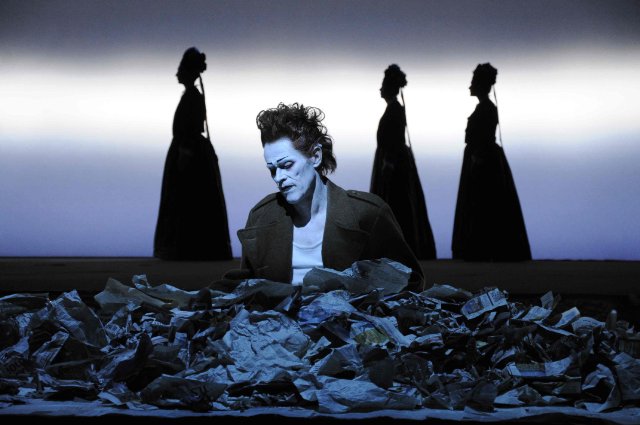
Performance artist extraordinaire Marina Abramović has been undergoing a career renaissance this century, highlighted by an exciting, vibrant 2010 MoMA retrospective, “The Artist Is Present,” and the 2012 documentary about the making of the exhibition. The Serbian-born, New York-based Abramović is a regular at fancy galas, and she even recently performed at Pace Gallery with Jay-Z. So what does the sixty-seven-year-old artist do, just as her life and career have become rejuvenated? Well, she stages her own funeral, of course. Actually, Abramović has decided to hand her biography over to experimental theater maestro Robert Wilson, the man behind such innovative and unique collaborations as The Black Rider with William S. Burroughs and Tom Waits, Einstein on the Beach with Philip Glass and Lucinda Childs, and The Temptation of Saint Anthony with Bernice Johnson Reagon and Geoffrey Holder. In The Life and Death of Marina Abramović, the woman behind the “Rhythm” series and so many other cutting-edge works plays herself and her mother, with Willem Dafoe serving as narrator and songs by Antony Hegarty. Conceived and directed by Wilson, it is another audiovisual spectacle that has already had a documentary made about its creation; “Marina is the landscape, Bob the mind, Antony the heart, Willem the body,” director Giada Colagrande explains. The Life and Death of Marina Abramović will fill the Park Ave. Armory’s Wade Thompson Drill Hall December 12-21; on December 15 at 6:15, armory artistic director Alex Poots will moderate an artist talk with Abramović and Dafoe in the Veterans Room as part of the Malkin Lecture Series.

RICHIE’S FANTASTIC FIVE — KUROSAWA, MIZOGUCHI, OZU, YANAGIMACHI & KORE-EDA: LATE AUTUMN

A trio of yentas in LATE AUTUMN

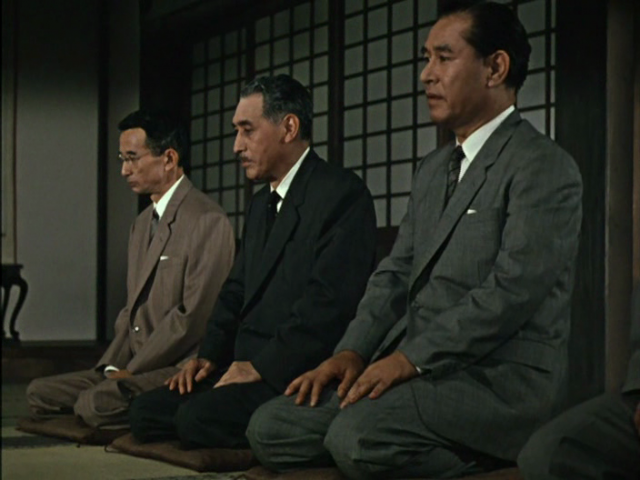
Nobuo Nakamura, Ryuji Kita, and Shin Saburi play a trio of matchmaking yentas in Ozu’s LATE AUTUMN

LATE AUTUMN (AKIBIYORI) (Yasujirō Ozu, 1960)
Japan Society
333 East 47th St. at First Ave.
Thursday, December 12, $12, 7:00
Series runs monthly through February
212-715-1258
www.japansociety.org

Yasujirō Ozu revisits one of his greatest triumphs, 1949’s Late Spring, in the 1960 drama Late Autumn, the Japanese auteur’s fourth color film and his third-to-last work. Whereas the black-and-white Late Spring is about a widowed father (Chishu Ryu) and his unmarried adult daughter (Setsuko Hara) contemplating their futures, Late Autumn deals with young widow Akiko Miwa (Hara again) and her daughter, Ayako (Yoku Tsukasa). At a ceremony honoring the seventh anniversary of Mr. Miwa’s death, several of his old friends gather together and are soon plotting to marry off both the younger Akiko, whom they all had crushes on, and twenty-four-year-old Ayako. The three businessmen — Soichi Mamiya (Shin Saburi), Shuzo Taguchi (Nobuo Nakamura), and Seiichiro Hirayama (Ryuji Kita) — serve as a kind of comedic Greek chorus, matchmaking and arguing like a trio of yentas, while Akiko and Ayako maintain creepy smiles as the men lay out their misguided, unwelcome plans. Mamiya makes numerous attempts to fix Ayako up with one of his employees, Shotaru Goto (Keiji Sada), but Ayako wants none of it, preferring the freedom and independence displayed by her best friend, Yoko (Yuriko Tashiro), who represents the new generation in Japan. At the same time, their matchmaking for Akiko borders on the slapstick. Based on a story by Ton Satomi, Late Autumn, written by Ozu with longtime collaborator Kôgo Noda, is a relatively lighthearted film from the master, with sly jokes and playful references while examining a Japan that is in the midst of significant societal change in the postwar era. Kojun Saitô’s Hollywood-esque score is often bombastically melodramatic, but Yuuharu Atsuta’s cinematography keeps things well grounded with Ozu’s trademark low-angle, unmoving shots amid carefully designed interior sets.

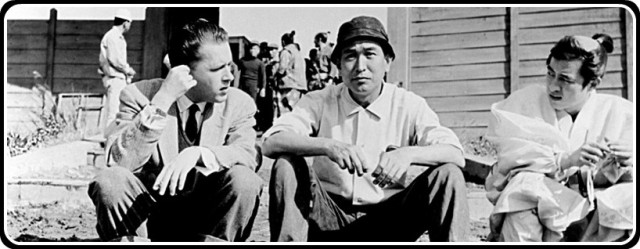
Japan Society series honors Donald Richie (l.) with screening of film by Yasujiro Ozu (c.)

Japan Society series honors Donald Richie (l.) with screening of film by Yasujiro Ozu (c.)

Late Autumn is downright fun to watch, and you can see it on December 12 — Ozu’s 110th birthday, as well as the 50th anniversary of his death — at 7:00 at Japan Society, introduced by director, writer, and producer Atsushi Funahashi, as part of the monthly tribute series “Richie’s Fantastic Five: Kurosawa, Mizoguchi, Ozu, Yanagimachi & Kore-eda,” which honors Ohio-born writer, critic, scholar, curator, and filmmaker Donald Richie, who died in February at the age of eighty-eight. Richie was a tireless champion of Japanese culture and, particularly, cinema, and the series features six works by five of his favorite directors. Here’s what Richie said about Late Autumn: “A daughter is reluctant to leave her widowed mother, even though it is time for her to marry. The story could be seen as a ‘remake’ of Late Spring — and though more autumnal, it is just as moving.” The Late Autumn screening will also be followed by a special Ozu birthday reception. The series continues in January with Mitsuo Yanagimachi’s Himatsuri and concludes in February with Hirokazu Kore-eda’s After Life, appropriately on the one-year anniversary of Richie’s passing.

COSMOPOLIS: 49 WALTZES FOR THE WORLD

COSMOPOLIS

Roberta Friedman and Daniel Loewenthal follow John Cage’s advice and take a waltz around the world in COSMOPOLIS

A VIDEO INSTALLATION BY ROBERTA FRIEDMAN + DANIEL LOEWENTHAL
Baryshnikov Arts Center, Studios 4A + 4B
450 West 37th St. between Ninth & Tenth Aves.
December 11-15, free, times vary
866-811-4111
www.bacnyc.org

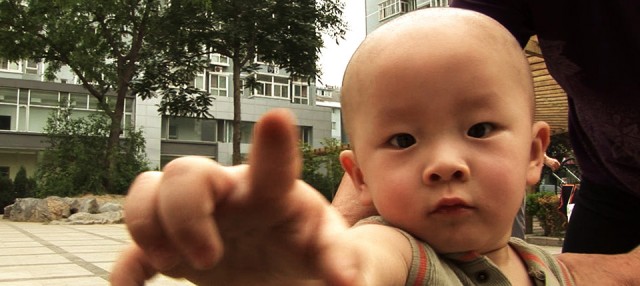
In 1977, avant-garde composer John Cage published the graphic score 49 Waltzes for the Five Boroughs: For Performer(s) or Listener(s) or Record Maker(s), a map of forty-nine triangles marking locations in New York City where people were encouraged to go to experience, take part in, or record the natural, everyday sounds there. The score also offered the following enticement: “Transcriptions may be made for other cities (or places) by assembling through chance observations a list of 147 addresses and then, also through chance operations, arranging these in 49 groups of three.” Experimental filmmaker Roberta Friedman and documentarian Daniel Loewenthal have done just that to create the video installation Cosmopolis: 49 Waltzes for the World, on view December 11-15 at Baryshnikov Arts Center. Friedman and Loewenthal visited such cities as Cairo, Beijing, Graz, Detroit, and New York, filming street scenes, capturing pure, unadulterated human life, then bringing them all together in an installation designed for BAC by Andrew Matusik that immerses the viewer into multiple cultures, sort of a day in the life of the world. Also on display will be Friedman and Loewenthal’s 49 Waltzes for the Gated City, 49 Waltzes for Graz, 49 Waltzes for the Motor City, the work-in-progress 49 Waltzes for Al-Qahira, and the original 49 Waltzes for the Five Boroughs. Admission is free, and no advance reservations are required.

OZU AND HIS AFTERLIVES: STILL WALKING

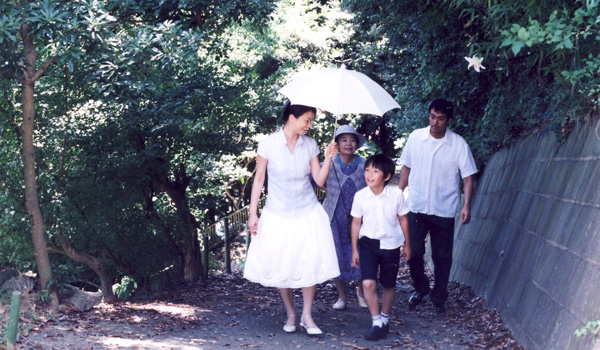
Hirokazu Kore-eda’s STILL WALKING is a special film about a dysfunctional family that should not be missed

Hirokazu Kore-eda’s STILL WALKING is a special film that honors such Japanese directors as Mikio Naruse, Yasujiro Ozu, and Shohei Imamura

STILL WALKING (ARUITEMO ARUITEMO) (Hirokazu Kore-eda, 2008)
Film Society of Lincoln Center
144 and 165 West 65th St. between Eighth Ave. & Broadway
Wednesday, December 11, Francesca Beale Theater, 8:30
Thursday, December 12, Walter Reade Theater, 1:30
Series runs December 4-12
212-875-5050 / 212-875-5166
www.filmlinc.com
www.aruitemo.com

Flawlessly written, directed, and edited by Hirokazu Kore-eda (Maborosi, Nobody Knows), Still Walking follows a day in the life of the Yokoyama family, which gathers together once a year to remember Junpei, the eldest son who died tragically. The story is told through the eyes of the middle child, Ryota (Hiroshi Abe), a forty-year-old painting restorer who has recently married Yukari (Yui Natsukawa), a widow with a young son (Shohei Tanaka). Ryota dreads returning home because his father, Kyohei (Yoshio Harada), and mother, Toshiko (Kirin Kiki), are disappointed in the choices he’s made, both personally and professionally, and never let him escape from Junpei’s ever-widening shadow. Also at the reunion is Ryota’s chatty sister, Chinami (You), who, with her husband and children, is planning on moving in with her parents in order to take care of them in their old age (and save money as well). Over the course of twenty-four hours, the history of the dysfunctional family and the deep emotions hidden just below the surface slowly simmer but never boil, resulting in a gentle, bittersweet narrative that is often very funny and always subtly powerful. The film is beautifully shot by Yutaka Yamazaki, who keeps the camera static during long interior takes — it moves only once inside the house — using doorways, short halls, and windows to frame scenes with a slightly claustrophobic feel, evoking how trapped the characters are by the world the parents have created. The scenes in which Kyohei walks with his cane ever so slowly up and down the endless outside steps are simple but unforgettable. Influenced by such Japanese directors as Mikio Naruse, Yasujiro Ozu, and Shohei Imamura, Kore-eda was inspired to make the film shortly after the death of his parents; although it is fiction, roughly half of Toshiko’s dialogue is taken directly from his own mother. Still Walking is a special film, a visual and psychological marvel that should not be missed. It’s screening December 11-12 as part of the Film Society of Lincoln Center festival “Ozu and His Afterlives,” which honors the 110th anniversary of the master filmmaker’s birth and the 50th anniversary of his death; he died on his birthday at the age of sixty in 1963. The series features Ozu’s Equinox Flower and An Autumn Afternoon in addition to seven works that were either directly or indirectly inspired by Ozu and his unique style, including Hou Hsiao-hsien’s Café Lumiere, Jim Jarmusch’s Stranger Than Paradise, Aki Kaurismäki’s The Match Factory Girl, Claire Denis’s 35 Shots of Rum, Pedro Costa’s In Vanda’s Room, and Wim Wenders’s Tokyo-Ga.

AUGUST WILSON’S HOW I LEARNED WHAT I LEARNED

(photo by Joan Marcus)

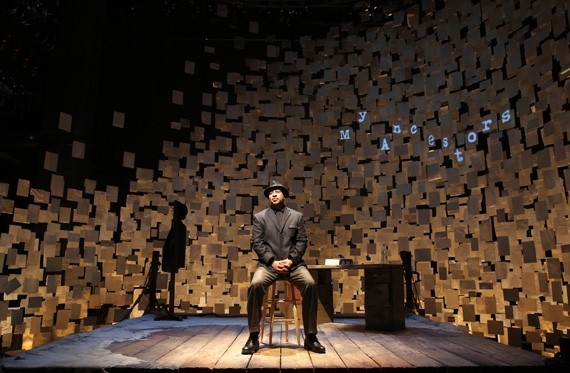
Ruben Santiago-Hudson was August Wilson’s personal choice to take over one-man show (photo by Joan Marcus)

The Pershing Square Signature Center
The Alice Griffin Jewel Box Theatre
480 West 42nd St. between Tenth & Eleventh Aves.
Extended through December 29, $55
212-244-7529
www.signaturetheatre.org

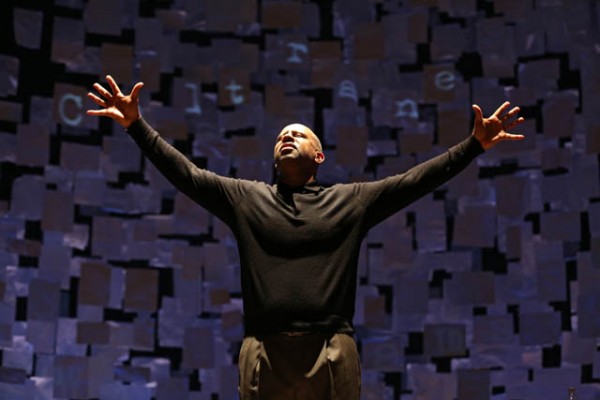
August Wilson’s one-man show, How I Learned What I Learned, has arrived in New York at last, and like any Wilson work, it’s a very welcome event. When the two-time Pulitzer Prize-winning playwright passed away from cancer at the age of sixty in 2005, plans were already under way for a season of his works as part of the fifteenth anniversary celebration of the Signature Theatre. For that 2005 season, Wilson was going to present the New York premiere of his own one-man show and personal memoir, How I Learned What I Learned, which he premiered in Seattle in 2002. Following his death, the season turned into a tribute to Wilson’s vast legacy, with productions of Seven Guitars, Two Trains Running, and King Hedley II. Seven years later, How I Learned What I Learned is finally making its New York debut, in an intimate, intoxicating version running at the Signature through December 29, directed by Todd Kreidler, who conceived the project with Wilson and directed the original. Ruben Santiago-Hudson, Wilson’s personal choice to take over the play, gets to step into Wilson’s shoes and put on his hat and coat — the costumes were chosen by Wilson’s widow, Constanza Romero — for eighty thrilling minutes, sharing fascinating tidbits from Wilson’s life growing up as Frederick August Kittel Jr. in Pittsburgh’s Hill District.

HOW I LEARNED WHAT I LEARNED celebrates the genius of August Wilson (photo by Joan Marcus)

HOW I LEARNED WHAT I LEARNED celebrates the genius of August Wilson (photo by Joan Marcus)

Longtime Wilson set designer David Gallo arranged the sparse stage, featuring just a desk, a chair, and a coat rack set against a backdrop of hundreds of pieces of paper dangling from the ceiling. Santiago-Hudson, who won a Tony as Canewell in Seven Guitars and directed last year’s stellar Signature revival of Wilson’s 1990 Pulitzer Prize winning The Piano Lesson, portrays Wilson with an easygoing, natural grace as he talks poignantly about episodes from his past, including quitting numerous jobs to preserve his dignity, meeting people who would help shape his future, and getting locked up in jail. He strolls amiably across the stage, sits on the desk, and watches as the title of each new section is projected onto the papers behind him, each letter accompanied by the sound of a typewriter stroke. As always, Wilson’s words shine; he doesn’t go out of his way to connect the dots, get heavy-handed about the racism and poverty he experienced, or lament what could have been. Instead, he lets the stories create a path for the viewer to follow to his majestic body of work, which he never brings up, as the play ends prior to his writing his first play. Everything about How I Learned What I Learned feels just right, a labor of love from his friends and colleagues that is a gift to the rest of us.

GIVEAWAY: SKIP THE LINE TO SEE YAYOI KUSAMA’S “I WHO HAVE ARRIVED IN HEAVEN”

David Zwirner
525 West 19th St. between Tenth & Eleventh Aves.
Tuesday – Saturday through December 21, free, 10:00 am – 6:00 pm (line stops around 4:00)
212-727-2070
www.davidzwirner.com
infinity room slideshows

No one knows lines like we New Yorkers do. We line up for burgers, advance movie screenings, new sneaker releases, free Shakespeare in the park. When we see a line, our first thought is to find out what it’s for because it might be something really cool. We particularly pride ourselves on getting on lines to see such lofty, high-culture things as art, and the biggest such line these days is for “I Who Have Arrived in Heaven,” Yayoi Kusama’s dazzling exhibition at David Zwirner in Chelsea. (See below to find out how one lucky twi-ny reader and a guest can get a chance to skip the line to see two of Kusama’s spectacular infinity rooms without having to wait.) Kusama’s first show at Zwirner occupies all three spaces of the Nineteenth St. location, consisting of twenty-seven new paintings, two immersive installations, and a video projection. The canvases, all nearly six feet by six feet square, feature a bright, bold color palette laid out in playful, childlike geometric shapes and patterns, with smiling faces and floating eyes, profiles, green landscapes, blue rivers, and obsessive accumulations of small dots, all coming together in ritualistic compositions that are instantly happy-making, which is Kusama’s intent. “As I’m getting closer to death, I’m still full of big hope that we all have the power to spread the love and peace, and I can do so with my work,” the wheelchair-bound Kusama said through a translator at a press conference held at the gallery the day before the opening. “If you can be happy through my artwork, there’s nothing more joyous than that.” Many of the paintings’ titles have that same positive energy, from “Everything About My Love” and “Praying for Peace in the World” to “Brilliance of Life” and “All the Love Overflowing,” bringing much happiness to the viewer.
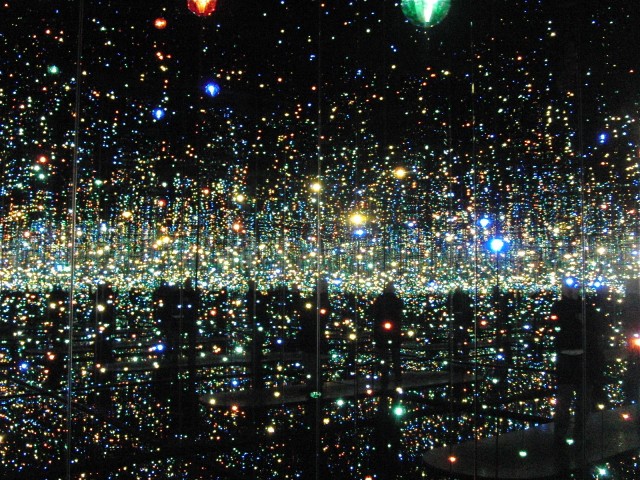
“Infinity Mirrored Room — The Souls of Millions of Light Years Away” (photo by twi-ny/mdr)

“Infinity Mirrored Room — The Souls of Millions of Light Years Away,” wood, metal, glass mirrors, plastic, acrylic panel, rubber, LED lighting system, and acrylic balls, 2013 (photo by twi-ny/mdr)

Now eighty-four, Kusama lives by choice in a psychiatric facility in Japan, and as she makes clear in the title of the exhibit as well as in some of the names of some of the new works, her ultimate fate awaits. While walking around her tantalizingly gorgeous “Love Is Calling” Mirrored Infinity Room, a wondrous forest of light-up spotted leglike rubber and acrylic objects that change colors, she can be heard reciting, in Japanese, the love poem “Residing in a Castle of Shed Tears,” which begins, “When the time comes around for people to encounter the end of their life / having put on years, death seems to be quietly approaching / It was not supposed to be my style to be frightened, but I am / In the shadows of my loved one’s footprints, distress revisits me at the dead of the night refreshing my memories / Being in love with and longing for you, I have locked myself up in this ‘castle of shed tears.’” The serious words play off the scintillating delight of wandering through the room, which extends ad infinitum in all directions. The exhibit is highlighted by her latest Infinity Room: “The Souls of Millions of Light Years Away,” which, like “Fireflies on the Water” in her otherwise underwhelming 2012 Whitney retrospective, puts visitors at the center of a vast, unending universe filled with LED lights sparkling on the water and across the galaxies, playing with the mind as it lifts the spirits, evoking life, death, and the afterlife on three physical planes.
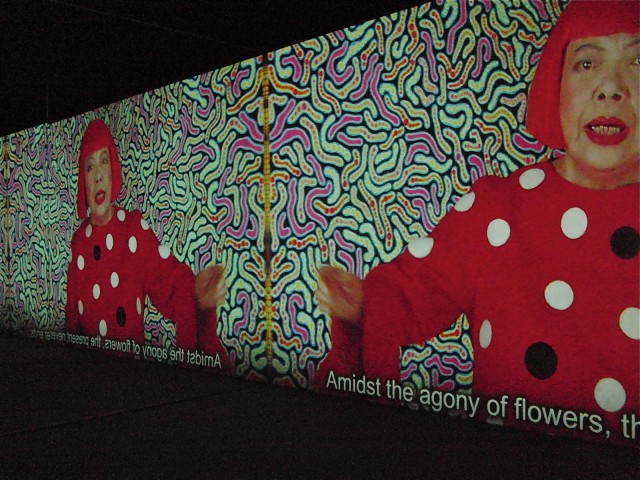
“Manhattan Suicide Addict,” still (photo by twi-ny/mdr)

Still from “Manhattan Suicide Addict,” video projection and mirrors, 2010-present (photo by twi-ny/mdr)

After waiting as much as three hours or more, visitors are allowed forty-five seconds in “Infinity Mirrored Room — The Souls of Millions of Light Years Away” and approximately twice that in “Love Is Calling,” which can fit about eight to ten people at a time. There is no wait to see the paintings or the short music video Manhattan Suicide Addict, in which Kusama sings such lines as “Swallow antidepressants and it will be gone” and “Amidst the agony of flowers, the present never ends,” the single projection being reflected off to the right and the left in an endless succession of Kusamas singing in front of her art. But despite all the mentions of death, “I Who Have Arrived in Heaven” is primarily about life and love, peace and hope, and it is certainly the most happy-making art exhibit in town right now.

SKIP THE LINE! The wait to see “Infinity Mirrored Room — The Souls of Millions of Light Years Away” and “Love Is Calling” is currently estimated to be between one and three hours, and it is likely to only grow longer as the exhibition reaches its closing date of December 21. But twi-ny can offer one lucky couple special access to the two remarkable rooms without having to wait on line. Just send your name, daytime phone number, and all-time-favorite Yayoi Kusama work of art to contest@twi-ny.com by Tuesday, December 10, at 5:00 to be eligible. All entrants must be twenty-one years of age or older; one winner will be selected at random.
THE FEST FOR BEATLES FANS 2014

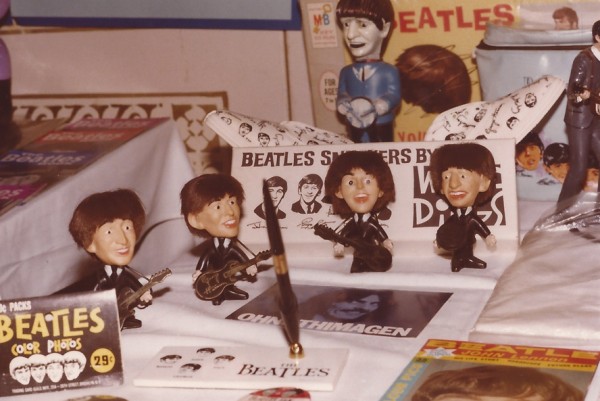
Lots of Fab Four memorabilia will be on sale and on view at the fortieth anniversary of the Fest for Beatles Fans

Lots of Fab Four memorabilia will be on sale and on view at fortieth anniversary of the Fest for Beatles Fans

Grand Hyatt
109 East 42nd St. at Lexington Ave.
February 7-9, adults $55 – $195 (through January 17)
www.thefest.com

When we were mere lads, we got our post-breakup, pre-iTunes Beatles fix by checking out Beatlemania on Broadway, seeing Paul McCartney and Wings at Madison Square Garden, and going to a Beatles Fest convention on Long Island, where we finally got to watch Magical Mystery Tour and went home with all kinds of little trinkets; we still have that Shea Stadium Beatles coin that nearly bankrupted us at six bucks. The elephant in the room back then was the constant speculation of a possible Beatles reunion, with all four Moptops still alive and well. But that all came to a startling end thirty-three years ago today, when John Lennon was assassinated at the age of forty. George Harrison’s death at the age of fifty-eight on November 29, 2001, closed another chapter in the continuing Fab Four saga. Paul and Ringo are still around, touring, making records, and playing new and old songs, but it will never be the same. Even Shea Stadium, where the Beatles played on August 15, 1965, is gone.

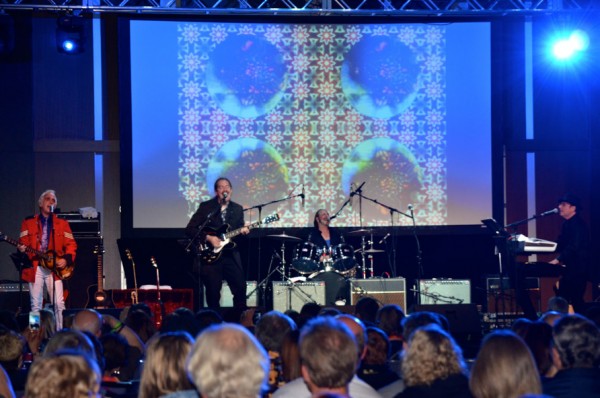
Longtime Beatles cover band Liverpool will be at NYC fest honoring fiftieth anniversary of Beatels' arrival in America

Longtime Beatles cover band Liverpool will be at NYC fest honoring fiftieth anniversary of Beatles’ arrival in America

But the memories will come flooding back February 7-9 when the Fest for Beatles Fans, which began in 1974, takes place at the Grand Hyatt, held in honor of the fiftieth anniversary of the Beatles’ arrival at JFK airport on February 7, 1964, and one of the most famous television appearances of all time, when the Fab Four played on The Ed Sullivan Show. (The Fest will also be in Chicago August 15-17, then move on to Los Angeles October 10-12, cities that actually got two shows back in 1965.) The three-day Manhattan party will feature dozens of special guests giving talks, signing memorabilia, presenting videos and art exhibitions, participating in panel discussions, and playing live sets. Among those confirmed are Peter & Gordon’s Peter Asher; photographers Bob Gruen, Allen Tannenbaum, and Rob Shanahan; “Breakfast with the Beatles” DJ Ken Dashow; Beatles scholar Martin Lewis, who will serve as MC; newscaster Larry Kane; producer Mark Hudson; animator Ron Campbell; and lots of authors, historians, and cover bands. Performers include Chad & Jeremy, Billy J. Kramer, the Smithereens (re-creating the Beatles’ February 11, 1964, concert at the Washington Coliseum), and Donovan, who will also give a meditation lecture. There will be a Beatles marketplace, screenings of the documentary Good Ol’ Freda (with Freda Kelly), an auction, a dance party, costume and trivia contests, a parade, a walking tour, a tribute to the late Sid Bernstein, and much more. Ticket prices through January 17 range from $55 for Friday night to $79 for Saturday or Sunday to $195 for an all-access three-day pass; children six to sixteen are half price and those five and under free.