David Zwirner exhibit features thirteen of Ad Reinhardt’s black paintings
AD REINHARDT
David Zwirner
537 West 20th St. between Tenth & Eleventh Aves.
Tuesday- Saturday through December 18, free, 10:00 am – 6:00 pm
www.davidzwirner.com
DONALD JUDD: STACKS
Mnuchin Gallery
45 East 78th St.
Tuesday- Saturday through December 14, free, 10:00 am – 5:30 pm
www.mnuchingallery.com
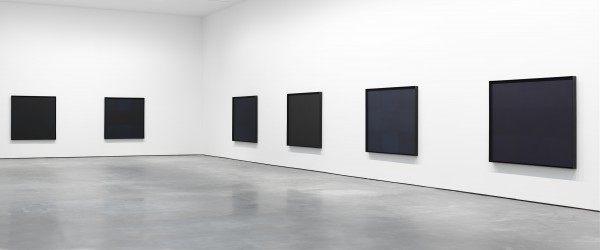
Two of the most important and influential abstract artists of the twentieth century currently have revelatory gallery shows in New York that focus on very specific aspects of their careers. Both men were fairly or unfairly associated with Minimalism, both were key posthumous inclusions in Gagosian’s 2005 group show “Imageless Icons: Abstract Thoughts,” and both handled shape, form, color, and texture in masterful, revolutionary ways. Donald Judd and Ad Reinhardt were contemporaries who defied convention and died relatively young, Reinhardt at fifty-three in 1967, Judd at sixty-five in 1994. At David Zwirner’s Twentieth St. space, thirteen of Reinhardt’s extraordinary black paintings have been brought together, the most since a 1991 retrospective at MoMA. The exhibit, being held in honor of the centennial of the Buffalo-born artist’s birth, is designed to adhere as close as possible to Reinhardt’s exacting specifications regarding such elements as light, placement, and access. At quick glance, of course, the paintings appear to be all-black squares, but upon closer examination it becomes apparent that each one is very different, containing shades of blue, red, and green, composed in cruciform configurations that emerge into smaller squares and rectangles that Reinhardt painted while the canvas lay flat on a table in his studio. The colors and shapes move in and out of focus as one’s gaze continues, every moment morphing into a new joy. It’s a whirlwind display, thrilling and alive, as if each canvas is a living, breathing object. Here’s how Reinhardt described the black paintings: “A square (neutral, shapeless) canvas, five feet wide, five feet high, as high as a man, as wide as a man’s outstretched arms (not large, not small, sizeless), trisected (no composition), one horizontal form negating one vertical form (formless, no top, no bottom, directionless), three (more or less) dark (lightless) no-contrasting (colourless) colours, brushwork brushed out to remove brushwork, a matte, flat, freedhand painted surface (glossless, textureless, non-linear, no hard edge, no soft edge) which does not reflect its surroundings — a pure, abstract, non-objective, timeless, spaceless, changeless relationless, disinterested painting — an object that is self-conscious (no unconsciousness) ideal, transcendent, aware of no thing but art (absolutely no anti-art).” The stellar exhibit also includes a slide show of hundreds of architectural photographs Reinhardt took over the years, as well as dozens of his playful cartoons, from hysterical takes on Hitler to his “How to Look” series.
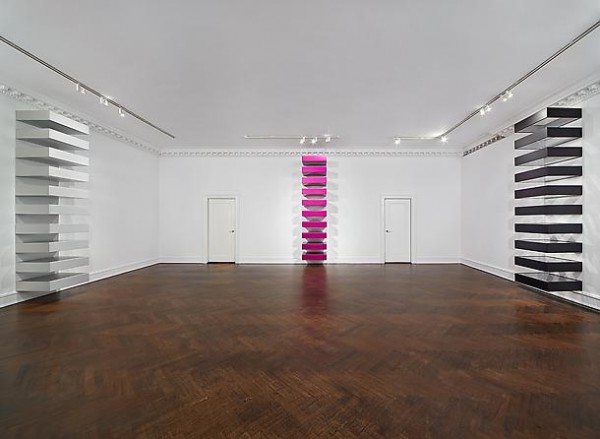
Mnuchin display includes eleven of Donald Judd’s “Stacks” (Tom Powel Imaging, Inc. / © Judd Foundation)
Meanwhile, uptown at Mnuchin, “Stacks” is the first show to concentrate solely on Judd’s signature oeuvre. Spread across several rooms on two floors, the exhibit features eleven stacks from 1968 to 1990, ten of which consist of ten units of equal size and color, constructed of stainless steel, anodized aluminum, galvanized iron, or copper, most often with colored Plexiglas, the units stacked one above the other from floor to ceiling, the space between as important as the physical objects themselves. The light casts intriguing shadows that extend the works, which are composed in blue, amber, yellow, violet, green, white, or black. Just as Reinhardt spoke of brushwork removing brushwork, the Missouri-born Judd said of his stacks, “Well, I am not interested in the kind of expression that you have when you paint a painting with brush strokes. It’s all right, but it’s already done and I want to do something new. I didn’t want to get into something which is played out and narrow. I want to do as I like, invent my own interests. Of course, that doesn’t mean that people who, like Newman, still paint are worn out. But I think that’s a particular kind of experience involving a certain immediacy between you and the canvass, you and the particular kind of experience of that particular moment. I think what I’m trying to deal with is something more long range than that in a way, more obscure perhaps, more involved with things that happen over a longer time perhaps. At least it’s another area of experience.” As with Reinhardt’s black paintings, Judd’s stacks are also deserving of lengthy views to absorb their full impact as they interact with the light, especially in an upstairs room with windows. The Judd show is being held in conjunction with the opening of Judd’s house at 101 Spring St. to the public. Among the works owned by the Judd Foundation and on view in the house is Reinhardt’s “Red Painting.”

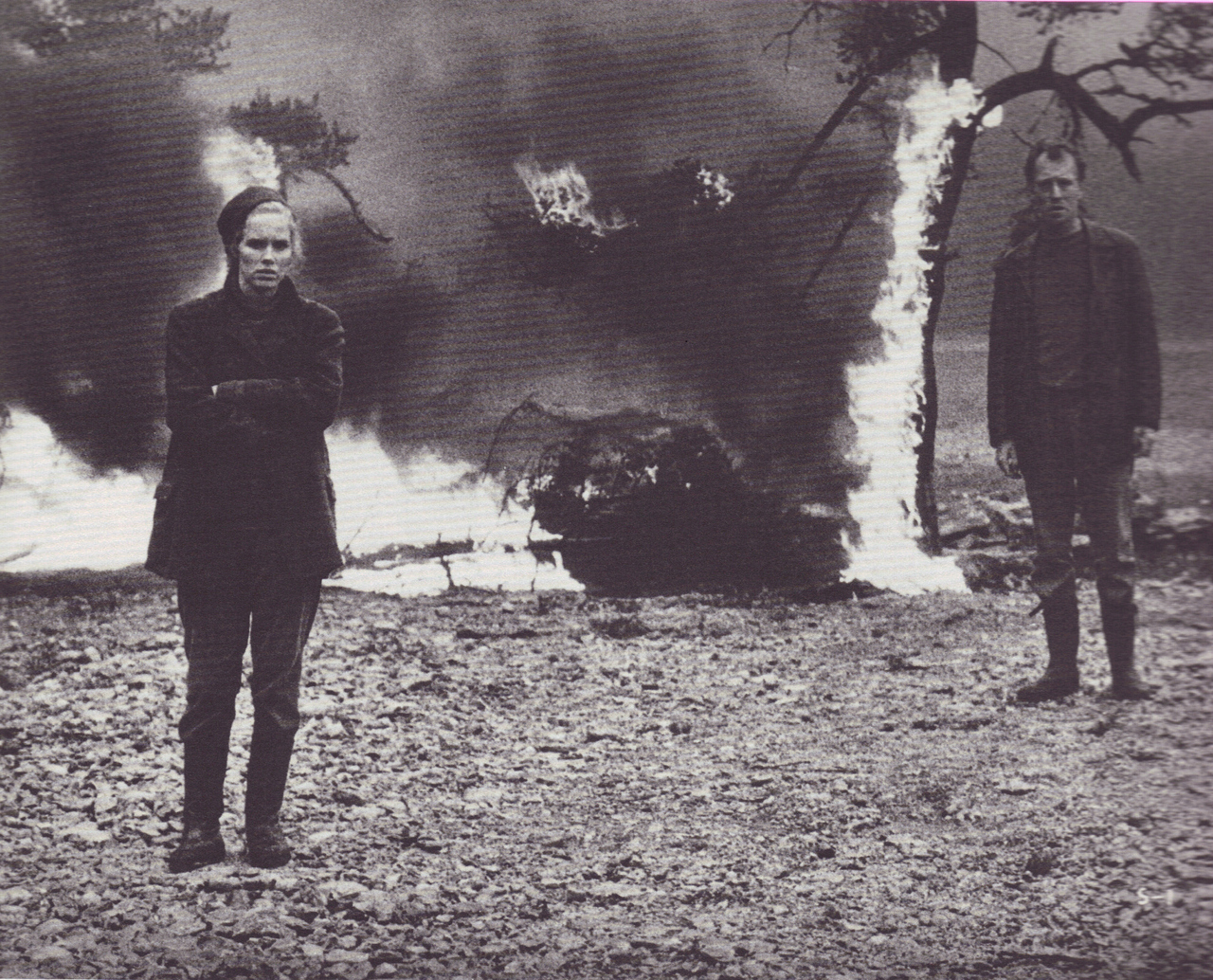
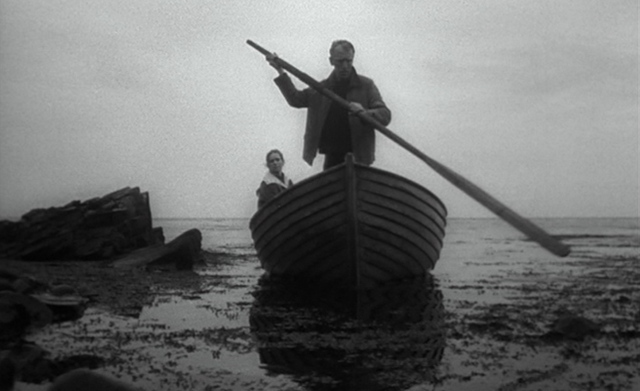
 Ingmar Bergman’s Shame is a brilliant examination of the physical and psychological impact of war, as seen through the eyes of a happily married couple who innocently get caught in the middle of the brutality. Jan (Max von Sydow) and Eva Rosenberg (Liv Ullmann) have isolated themselves from society, living without a television and with a broken radio, maintaining a modest farm on a relatively desolate island a ferry ride from the mainland. As the film opens, they are shown to be a somewhat ordinary husband and wife, brushing their teeth, making coffee, and discussing having a child. But soon they are thrust into a horrific battle between two unnamed sides, fighting for reasons that are never given. As Jan and Eva struggle to survive, they are forced to make decisions that threaten to destroy everything they have built together. Shot in stark black-and-white by master cinematographer Sven Nykvist, Shame is a powerful, emotional antiwar statement that makes its point through intense visual scenes rather than narrative rhetoric. Jan and Eva huddle in corners or nearly get lost in crowds, then are seen traversing a smoky, postapocalyptic landscape riddled with dead bodies. Made during the Vietnam War, Shame is Bergman’s most violent, action-filled film; bullets can be heard over the opening credits, announcing from the very beginning that this is going to be something different from a director best known for searing personal dramas. However, at its core, Shame is just that, a gripping, intense tale of a man and a woman who try to preserve their love in impossible times. Ullmann and von Sydow both give superb, complex performances, creating believable characters who will break your heart. Shame is screening December 14 and 18 at the Elinor Bunin Munroe Film Center as part of the Film Society of Lincoln Center series “Liv & Ingmar: The Films,” being held in conjunction with the theatrical release of Dheeraj Akolkar’s poetic new documentary, Liv & Ingmar; the festival continues with such other Ullmann/Bergman pairings as Scenes from a Marriage, Saraband, The Passion of Anna, and Persona.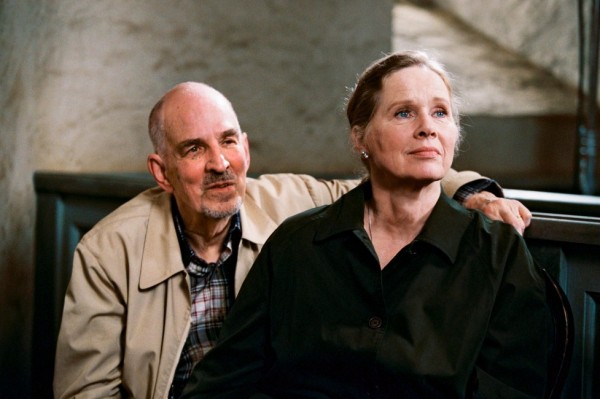
 Two-time Oscar-nominated Norwegian actress Liv Ullmann intimately and poetically discusses her five-decade-long personal and professional relationship with Swedish director Ingmar Bergman in Dheerai Alkolkar’s beautifully rendered Liv & Ingmar. Ullmann returns to Bergman’s house on Faro Island as she openly and honestly shares details of their long involvement, which began in 1965 when they were filming Persona; Ullmann was twenty-five, Bergman forty-six. Each was married and ended up leaving their spouse for what became a tumultuous five-year affair, after which they remained friends and colleagues, ultimately making twelve films together between 1966 and 2004. Alkolkar and cinematographer Hallvard Bræin zoom in on Ullmann’s expressive face as her memories go from love, loneliness, rage, and pain to longing and friendship. Alkolkar intersperses related film clips, behind-the-scenes footage, home movies, and snapshots as Ullmann walks along the beach and reads from her 1977 memoir, Changing; the film also features Samuel Fröler in voice-over reading from Bergman’s letters and autobiography, The Magic Lantern. Among the works featured prominently are Shame and Scenes from a Marriage, which eerily evoke Ullmann and Bergman’s real-life relationship. Liv & Ullmann serves as a lovely coda to this lasting partnership, which continues in its own unique way even after Bergman’s death in 2007 at the age of eighty-nine. In conjunction with the theatrical release of the film at Lincoln Center, the Film Society will also be screening nine works starring Ullmann and directed by Bergman: Shame, The Passion of Anna, Cries and Whispers, Face to Face, Scenes from a Marriage, Saraband, Hour of the Wolf, Persona, and Autumn Sonata.