twi-ny recommended events

THE DISCREET CHARM OF GEORGE CUKOR: HOLIDAY

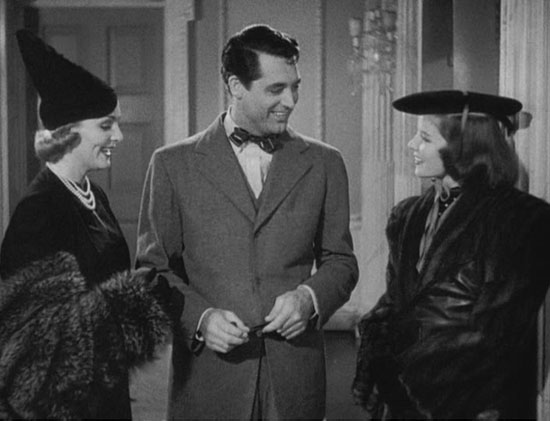
Cary Grant gets caught in the middle of two sisters in George Cukor’s HOLIDAY

HOLIDAY (George Cukor, 1938)
Film Society of Lincoln Center, Walter Reade Theater
165 West 65th St. between Eighth Ave. & Broadway
Wednesday, December 18, 1:00, 5:00, 9:15
Series runs through January 7
212-875-5050 / 212-875-5166
www.filmlinc.com

Although the screwball romantic comedies are perhaps best loved for their madcap antics and fast-paced dialogue, there was also a fascinating underlying motif to many of them — as America came out of the Great Depression and WWII beckoned, the films tackled the theme of the growing disparity between the rich and the poor. George Cukor’s 1938 classic, Holiday, however, looks at the world from a slightly different perspective, pitting the rich vs. the super-rich. Based on the Broadway play by Philip Barry, which was turned into a 1930 film featuring Ann Harding, Mary Astor, Edward Everett Horton, Hedda Hopper, Robert Ames, and William Holden, Cukor’s version stars Cary Grant as Johnny Case, a self-made humble financial wizard who dreams of making just enough money to be able to afford to leave the business and go find himself. Following a whirlwind ten-day courtship with Julia Seton (Doris Nolan) while on vacation in Lake Placid, Johnny is shocked to find out that his fiancée is a member of the Seton clan, one of the richest families in America. Julia’s father, Edward (Henry Kolker), is not about to let his beloved daughter marry just anyone, so he puts Johnny through the ringer. Meanwhile, Johnny bonds with Julia’s sister, the black sheep Linda (Katharine Hepburn, who was the understudy for Linda on Broadway), who is desperate to live her own life but seems trapped in a fantasy, receiving only marginal support from their brother, Ned (Lew Ayres), who is never without a drink and a cynical word about the family, washing away his failure in cocktail after cocktail. “Walk, don’t run, to the nearest exit,” he advises Johnny. Honest, dependable, and a surprisingly good gymnast, Johnny finds solace from the crazy Setons in his longtime friends, Nick (Horton, reprising his role from the earlier film) and Susan (Jean Dixon), simpler folk with a fine sense of humor and little time for high society. As midnight on New Year’s Eve approaches, the main characters’ lives come together and fall apart in hysterical yet serious ways. Holiday is not your average screwball comedy, instead seeking to take on more personal, psychologically intimate issues and succeeding wildly, continually defying expectations and turning clichés inside out. Grant is as cool as ever, but he adds a seldom-seen vulnerability that adds to his charm. Holiday is screening December 18 as part of the Film Society of Lincoln Center series “The Discreet Charm of George Cukor,” which runs through January 7 and consists of all fifty of the Lower East Side native’s films, from Keeper of the Flame and Heller in Pink Tights to Our Betters and Tarnished Lady as well as such unforgettable classics as Sylvia Scarlett, Pat and Mike, It Should Happen to You, Camille, Gaslight, and many others.
AND AWAY WE GO

(photo by Al Foote III)

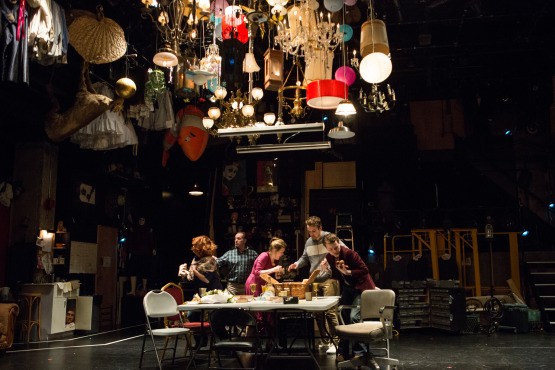
The cast of Terrence McNally’s new play at the Pearl go through multiple time periods in a celebration of live theater (photo by Al Foote III)

The Pearl Theatre
555 West 42nd St. between Tenth & Eleventh Aves.
Extended through December 21, $35-$65
212-563-9261
www.pearltheatre.org

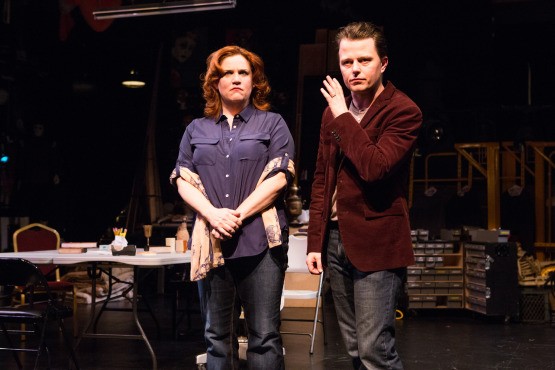
Last year, four-time Tony-winning playwright Terrence McNally (Master Class, Love! Valour! Compassion!) took audiences behind the scenes of the 1835 world premiere of Vincenzo Bellini’s I puritani in Golden Age. Now he’s backstage again, time traveling through six productions in six different time periods in the utterly delightful And Away We Go. Written specifically for the Pearl Theatre Company for its fortieth anniversary season, the one-hundred-minute intermissionless play begins as each of the six actors, four of whom are part of the regular Pearl ensemble, kiss the stage and introduce themselves on Sandra Goldmark’s set, which is littered with theatrical paraphernalia, from multiple chairs and lamps hanging from the ceiling to clothing and posters to a phrenology head and a skeleton in a bathtub. The play then moves to 458 BCE Athens, where a troupe is backstage, putting on Aeschylus’s The Oresteia as part of a theater-festival contest. “One day, Hector, an actor is going to tear his mask off and say to the audience, ‘This is what human suffering looks like,’” Pallas (Micah Stock) says to Hector (Dominic Cuskern) while Dimitris (Sean McNall) desperately awaits his handcrafted mask since it’s nearly time for him to make his entrance as Agamemnon. As in Golden Age, the action remains backstage as the six actors, staying in contemporary costume, shift to the Globe in 1610 London for The Tempest, the Royal Theatre in Versailles in 1789 for a new play by Christophe Durant (Stock), the Moscow Art Theatre in 1896 for the first reading of The Seagull, and finally the Coconut Grove Playhouse in South Florida in 1956 for closing night of the U.S. premiere of Waiting for Godot.

Donna Lynn Champlin is not thrilled that is sharing some inside secrets in AND AWAY WE GO (photo by Al Foote III)

Donna Lynn Champlin is not thrilled that Sean McNall is sharing some inside secrets in AND AWAY WE GO (photo by Al Foote III)

Along the way, McNally and the thirty-six characters skewer theatrical conventions, give away acting tricks and secrets, make inside jokes about donors, subscribers, critics, and open rehearsals, and take plenty of self-referential stabs at themselves as well, having a ball tearing the mask away from Theater with a capital T. “We need new plays. Classics aren’t the answer,” Kenny Tobias (Stock) says in Coconut Grove in an obvious reference to the Pearl itself, which specializes in the classics. “I love the theater,” Gretna (Donna Lynne Champlin) tells Lydia (Carol Schultz) in London, to which Lydia responds, “You attend the theater, which is something altogether different. Everyone loves the theater, very few are of the theater.” Meanwhile, Bert Lahr’s wife, Mildred (Champlin), calls playwriting “a dying profession” and playwrights “miserable sons of bitches.” And back in Moscow, actress Maya Nabokov (Rachel Botchan) tells her lover, set designer Yuri Goldovsky (McNall), “Scenery that frees the actor and doesn’t confine him. I can soar in such a space.” And indeed, the six performers soar in their multiple roles, effortlessly shifting characters under the smooth, fluid direction of the Transport Group’s Jack Cummings III (Queen of the Mist), although there are occasional loud explosions that shake things up a bit and keep the audience on its toes. Another small gem from McNally, And Away We Go, which continues at the Pearl through December 21, is a wonderful treat for people who love the theater, whether they are of the theater or not.

DOCUMENTARY IN BLOOM: TWO LESSONS

Wojciech Staroń documents his girlfriend’s year in Usolye-Sibirskoye as a Polish teacher in poetic SIBERIAN LESSON

Wojciech Staroń documents his girlfriend’s year in Usolye-Sibirskoye as a Polish teacher in poetic SIBERIAN LESSON

NEW FILMS PRESENTED BY LIVIA BLOOM: TWO LESSONS (Wojciech Staroń, 2013)
SIBERIAN LESSON (Wojciech Staroń, 1998) and THE ARGENTINIAN LESSON (Wojciech Staroń, 2011)
Maysles Institute
343 Malcolm X Blvd. between 127th & 128th Sts.
December 16-22, $10 suggested donation, 7:30
212-582-6050
www.mayslesinstitute.org

“I left all my troubles in Poland, all the duties that occupied my days,” Malgosia says at the beginning of 1998’s The Siberian Lesson. “I really wanted to leave them all behind. I wanted a break.” As it turns out, spending a year in Usolye-Sibirskoye does not end up being much of a break for Malgosia, who arrives in a town out of time, looking more like 1956 than 1996. Malgosia has traveled to Siberia to teach her native language to the descendants of Polish exiles who fled the country during tsarist rule, men, women, and children who know little of their homeland; she is joined by her boyfriend, recent Polish Film Academy graduate Wojciech Staroń, who is documenting it all with his 16mm camera. Malgosia, who narrates the film in a dry monotone, immediately discovers that life is extremely difficult for this tight-knit community; the teachers are on strike, and poverty is rampant, the food of survival the potato, which she is told everyone must grow for themselves in order to make it through the hard winter. She meets some rather unique characters during her stay, including Tatar gym owner Zinat, Father Ignacy, and a night watchman named Walery who has dedicated his life to translating the Bible from Polish into Russian. Meanwhile, students of all ages come to her classes, seeking something they can’t otherwise find in their daily existence. Malgosia is also searching for something in her own life, and she finds it in her growing love for Wojciech, who adds beautifully poetic shots of the vast Siberian landscape to accompany Agata Steczkowska’s nearly elegiac piano score.

Janek and Marcia learn some hard truths in sadly beautiful ARGENTINIAN LESSON

Janek and Marcia learn some hard truths in sadly beautiful ARGENTINIAN LESSON

Ten years later, Malgosia and Wojciech are now married, and they move to the remote village of Azara in northern Argentina for two years with their children so Malgosia can teach Polish to the emigres living there. While the first film focused on Malgosia, Argentinian Lesson follows their eight-year-old son, Janek, as he befriends Marcia, a smart eleven-year-old girl who needs to work in order to help support her family; her mother stays at home, suffering from a mental illness, while her father lives far away, toiling in the rice fields for very little pay. It is heartbreaking watching Marcia’s struggle, particularly when she and Janek go on a trip to see her father, whose eyes fill with tears when he bids farewell to his daughter. “It’s not easy,” he tells Wojciech. “It’s not easy.” Argentinian Lesson is a different kind of coming-of-age documentary, one that shows there are no simple answers, especially when children have to grow up so fast. Wojciech once again features gorgeous shots of the local landscape, helping him earn the Silver Bear for Outstanding Artistic Contribution (Camera) at the 2011 Berlinale, among many other awards. The documentaries, each of which runs about an hour, can now be seen together as Two Lessons, which is making its worldwide theatrical premiere December 16-22 at the Maysles Documentary Center in Harlem as part of the bimonthly “Documentary in Bloom: New Films Presented by Livia Bloom” series.

VICE PRESENTS THE FILM FOUNDATION SCREENING SERIES: THE NIGHT OF THE HUNTER

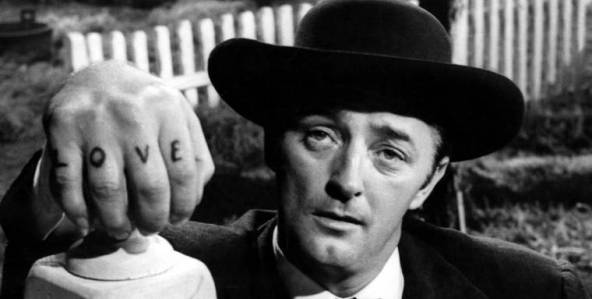
Robert Mitchum gets caught up in some dangerous dichotomies in THE NIGHT OF THE HUNTER

ONE NITE ONLY: THE NIGHT OF THE HUNTER (Charles Laughton, 1955)
Nitehawk Cinema
136 Metropolitan Ave. between Berry St. & Wythe Ave.
Tuesday, December 17, $16, 9:30
718-384-3980
www.nitehawkcinema.com

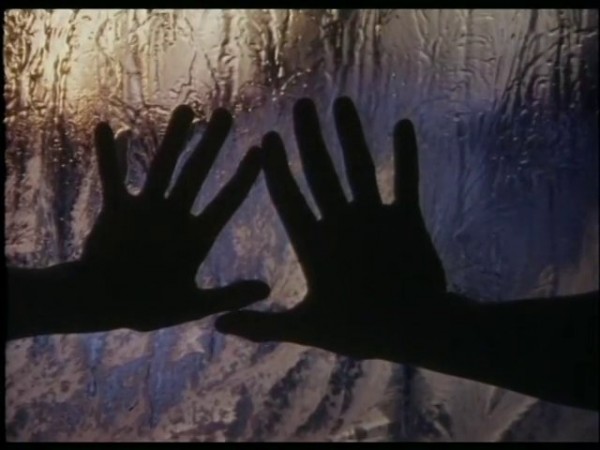
Robert Mitchum stars in Charles Laughton’s lurid story of traveling preacher/con man/murderer Harry Powell, who has the word “love” tattooed on one set of knuckles and “hate” on the other. While in prison, Powell bunks with Ben Harper (Peter Graves), who got caught stealing $10,000 — but the only person who knows where the money is is Ben’s young son, John (Billy Chapin). When Preacher is released from jail, he shows up on the Harpers’ doorstep, ready to woo the widow Willa (Shelley Winters) — and get his hands on the money any way he can, including torturing John and his sister, Ruby (Gloria Castillo). Laughton’s only directorial effort is seriously flawed — the scenes in the beginning and end with Lillian Gish are wholly unnecessary and detract from the overall mood. Stanley Cortez’s cinematography is outstanding, featuring his unique use of shadows, the battle between light and dark (which plays off of several themes: old versus young, rich versus poor, good versus evil, and men versus women), and some marvelous silhouettes. Based on Davis Grubb’s 1953 novel, the film has made its way onto many best-of lists, from scariest and most thrilling to all-time great and most beautiful. The Night of the Hunter is screening December 17 at 9:30 as part of Nitehawk Cinema’s “One Nite Only” and “VICE Presents: The Film Foundation Screening Series” and will be introduced by fashion photographer and documentary filmmaker Bruce Weber. The screening will be followed by an after-party in the downstairs bar with complimentary Larceny Bourbon drinks. The VICE series continues on January 28 with Barbara Loden’s Wanda and February 25 with Shirley Clarke’s The Connection.

CHRISTMAS TREE AND NEAPOLITAN BAROQUE CRÈCHE 2013-14

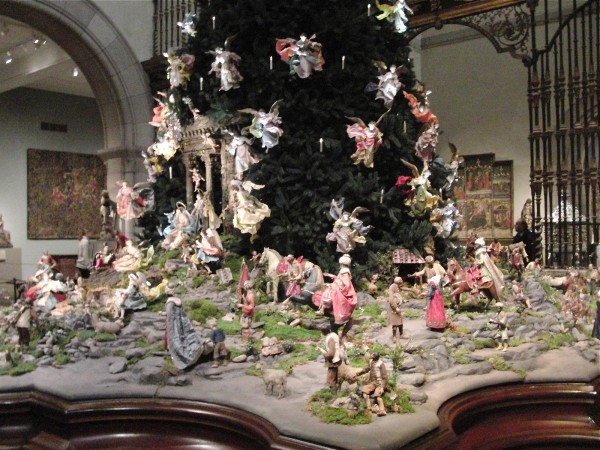
The Three Kings proceed to the Magi in annual Met Christmas tree display (photo by twi-ny/mdr)

The Three Kings proceed to the Magi in annual Met Christmas tree display (photo by twi-ny/mdr)

Metropolitan Museum of Art
Medieval Art Sculpture Hall, first floor
Through January 6, recommended admission $25
212-535-7710
www.metmuseum.org
christmas tree and neapolitan baroque crèche slideshow 2013

Once again the Met’s annual Christmas tree has risen in front of a 1763 Choir Screen from the Cathedral of Valladolid, and it will remain on view through the Epiphany on January 6. The twenty-foot-tall spruce is surrounded by twenty-two eighteenth-century cherubs, fifty-five angels, sixty-nine miniature Neapolitan handmade men, women, and children, and fifty animals, from the collection of Loretta Hines Howard. The terracotta polychromed figures, some created by such well-respected sculptors as Giuseppe Sammartino, Salvatore di Franco, Giuseppe Gori, and Angelo Viva, act out the Nativity (or crèche) and the Procession of the Magi as daily business goes on. The tree was originally designed by Howard and is now overseen by her daughter, Linn, along with Linn’s artist daughter, Andrea Selby Rossi, who add new touches to the settings every year; the display also has music to further the holiday spirit. The Met first displayed the figures in 1957, adding the tree, which was also donated by Howard, in 1964. Be sure to walk all around the area to see all the little scenes that are going on throughout the bustling town. And the Met now allows non-flash photography of the tree, so you can take pictures as well. A lighting ceremony is held every day, at 4:30 Sunday through Thursday and at 4:30, 5:30, and 6:30 on Friday and Saturday, and an Audio Guide is available too ($7). The Met’s celebration of Christmas also continues with such holiday-themed events as “The Crossing: A Christmas Concert” on December 22 and the Salomé Chamber Orchestra playing seasonal music on December 20, both in the Grace Rainey Rogers Auditorium. Meanwhile, the Cloisters will host “The Waverly Consort: The Christmas Story” on December 15, “ETHEL and Friends” December 20-21 and 27-28, and “Lionheart Laude: Joy and Mystery in Medieval Italy” December 22.

HOUSEWARMING: NOTIONS OF HOME FROM THE CENTER OF THE UNIVERSE

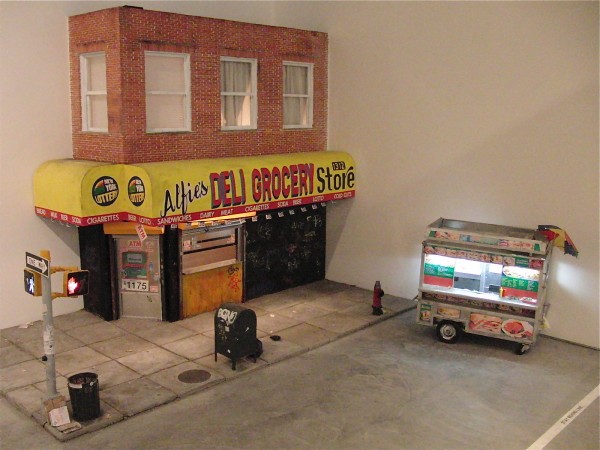
Drew Hamilton’s “Street-Corner Project” is part of inaugural “Housewarming” show at BRIC House in Brooklyn (photo by twi-ny/mdr)

Drew Hamilton’s miniature “Street-Corner Project” is part of inaugural “Housewarming” show at BRIC House in Brooklyn (photo by twi-ny/mdr)

BRIC Arts | Media House
647 Fulton St.
Through December 15, free, 10:00 am – 8:00 pm
718-683-5600
www.bricartsmedia.org

There’s an artistic revolution going on in downtown Brooklyn on the other side of the LIRR station from where the Barclays Center now resides. BAM has added the Fisher to the Howard Gilman Opera House and Harvey Theater, right near the Mark Morris Dance Center, and down the street is Theatre for a New Audience’s dazzling new Polonsky Shakespeare Center, which is currently presenting its first production, Julie Taymor’s A Midsummer Night’s Dream. Another new entry in this growing community is the gorgeously revamped BRIC House, a multidisciplinary arts center that opened in its old digs at the corner of Rockwell and Fulton Sts. in October. Sunday is the last day to see its inaugural art exhibition, the appropriately titled “Housewarming: Notions of Home from the Center of the Universe.” Curated by BRIC director of contemporary art Elizabeth Ferrer, the display features works by twelve Brooklyn-based artists, including eight pieces specifically commissioned for this show, in the downstairs three-thousand-square-foot gallery. Keisha Scarville’s photographs from her “I am here” series offer dark, quiet contemplation of objects that recall home. Garry Nichols’s café mural and weather vanes evoke his Tasmanian birthplace. Abraham McNally’s small-scale wall sculptures contain fragments of a physically broken home. Margaret Reid Boyer’s “Household Objects” photos consists of domestic interiors in which something is often not quite right. Vargas-Suarez Universal’s “Star Chamber” can be seen on the building’s facade. Drew Hamilton re-creates the scene he used to see from his second-floor window at Graham Ave. and Merserole St. in Bushwick in the miniature replica “Street-Corner Project.” There are also works by Njideka Akunyili, Sonya Blesofsky, Esperanza Mayobre, Katarina Jerinic and Chad Stayrook, and Nathan Wasserbauer. It all makes for a tender welcome home to BRIC, which in the next few weeks is also hosting free dance classes with Ronald K. Brown / Evidence and Samita Sinha’s work-in-progress, Cipher, with David Levine, Christian Hawkey, and Joe Diebes’s “Wow” scheduled for January.

CAPTAIN PHILLIPS

Tom Hanks

Tom Hanks fights for his crew and his ship in another tense thriller from expert director Paul Greengrass

CAPTAIN PHILLIPS (Paul Greengrass, 2013)
In theaters now
www.captainphillipsmovie.com

Based on the true story of Somali pirates hijacking a Maersk container ship in the spring of 2009, Paul Greengrass’s Captain Phillips is a nonstop action thriller, a gripping film that is solidly one of the best of the year. Tom Hanks gives a riveting performance as Captain Richard Phillips, a merchant marine guiding the MV Maersk Alabama on its mission to deliver relief supplies to Somalia, Uganda, and Kenya, in addition to more standard cargo. A family man, he kisses his wife, Andrea (Catherine Keener), goodbye, then heads out on his journey, paying close attention to a memo warning of possible pirate activity. When small motorboats do indeed start approaching, Phillips tries diversionary tactics — the ship and crew were not permitted to carry any weaponry whatsoever back then — but he knows that it’s only a matter of time before they come back, and indeed the Alabama is soon boarded by four armed pirates led by Abduwali Muse (Barkhad Abdi), who capture Phillips and take over the ship. But things don’t go quite as planned for Phillips or the pirates, leading to a marvelously staged showdown finale. Greengrass, who has made such previous expert thrillers as Bloody Sunday, The Bourne Supremacy, and United 93, once again builds unrelenting tension every step of the way, even for those in the audience who might already know the outcome. The film centers on the complex relationship between the relatively easygoing Phillips and the desperate Muse, their eyes constantly meeting in penetrating gazes as they play an intense psychological game of cat and mouse. Hanks is a marvel as Phillips, giving brilliant nuance and texture to what could have been a one-note role but instead ends up being one of the finest of his outstanding career. All along the way, Greengrass keeps upping the ante, whether in a chase on the high seas or a claustrophobic battle of wills inside a lifeboat. There has been some controversy over the factual accuracy of the film, which is based on Phillips’s bestselling A Captain’s Duty: Somali Pirates, Navy SEALs, and Dangerous Days at Sea (written with Stephan Talty), but that doesn’t take anything away from what is a breathtaking cinematic experience.

Nominated for six Academy Awards: Best Picture, Best Actor in a Supporting Role (Barkhad Abdi), Best Adapted Screenplay (Billy Ray), Best Film Editing (Christopher Rouse), Best Sound Editing (Oliver Tarney), Best Sound Mixing (Chris Burdon, Mark Taylor, Mike Prestwood Smith, Chris Munro)