twi-ny recommended events

TICKET ALERT: CHOICE EATS 2014

choice eats

THE VILLAGE VOICE CHOICE EATS SEVENTH ANNUAL TASTING EVENT
Basketball City at Pier 36
299 South St. at Montgomery St.
Tuesday, March 25, $60 general admission, 7:00 – 10:00
21 and over only
www.villagevoice.com/choiceeats

There’s still time to get tickets to the seventh annual Village Voice Choice Eats festival, but you’ll need to move fast to score access to tastings from more than sixty New York City eateries, plus complimentary drinks, backgrounded by DJ DIIV and boasting a special Choice Sweets section upstairs. (Hint: Do not miss the Butter & Scotch table.) Dine and dash from line to line, meeting the chefs, but with access to so many vendors, Choice Eats can feel overwhelming. Make a plan: There are techniques for approaching this near-surfeit of goodness: Do a Manhattan vs. Brooklyn “lobster-off,” testing the rolls of East Seventh St.’s Luke’s Lobster vs. Van Brunt St.’s Red Hook Lobster Pound, or try to stay genre specific, pitting the meats of Mable’s Smokehouse in Brooklyn against Long Island City’s John Brown or Fletcher’s Brooklyn Barbecue. Or take an Asian tour from Larb Ubol’s Isan Thai to the Kati Roll Company to Tabata Noodle. You can also strategically make a trip across four boroughs by adding Staten Island’s Indian Clove to your culinary journey, but, alas, there are no eateries hailing from the Bronx. Every establishment has been featured on the pages of the Voice; among the other participating restaurants are Devi, Fonda, Max, Pete Zaaz, Sheep Station, the Pines, Bear, and Egg. Buy now; all the VIP tickets are already gone, and general admission will also sell out well in advance of the twenty-one-and-over-only March 25 event at Basketball City.

VIDEO OF THE DAY: “SLOW BLUES” BY ALBERT CUMMINGS

On Monday night, February 10, City Winery is hosting a night of the blues, with two great coheadliners. Blues legend John Hammond, son of the Columbia Records executive who signed Bruce Springsteen, Bob Dylan, and Leonard Cohen and organized the “From Spirituals to Swing” concert at Carnegie Hall in 1938, will be celebrating the release of his new live album, Timeless (Palmetto, January 2014). Recorded at Chan’s in Woonsocket, Rhode Island, the disc pays tribute to his fifty-year career with such tracks as Jimmy Rodgers’s “Going Away Baby,” Lightnin’ Hopkins’s “Last Night,” Skip James’s “Hard Times,” Tom Waits’s “No One Can Forgive Me But My Baby,” and Hammond’s own “Heartache Blues.” Sharing the bill is Massachusetts-born singer-songwriter Albert Cummings, who was on the bluegrass trail until he discovered Stevie Ray Vaughan, turning to the blues when he was twenty-seven. An electrifying guitarist with a strong voice, Cummings has examined his life and let his six-string rip on 2002’s From the Heart, 2004’s True to Yourself, 2006’s Working Man, 2008’s live Feel So Good, and his most recent disc, 2012’s No Regrets, several of which feature Vaughan’s Double Trouble. Cummings will be opening with a full set at City Winery, so be sure to get there early; you might also want to order a specially produced bottle of Albert Cummings Zinfandel, which is described as “a fruit-driven, zesty Zinfandel from Lodi, CA. Red fruit with hints of spice & smoke, powerful and youthful, with an abundance of fresh red cherry, plum, and blackberry characteristics. Palate is big and boisterous, with red fruit offset by bright mouth feel.” That description fits Cummings as well, an engaging shredder with a unique approach to the blues.

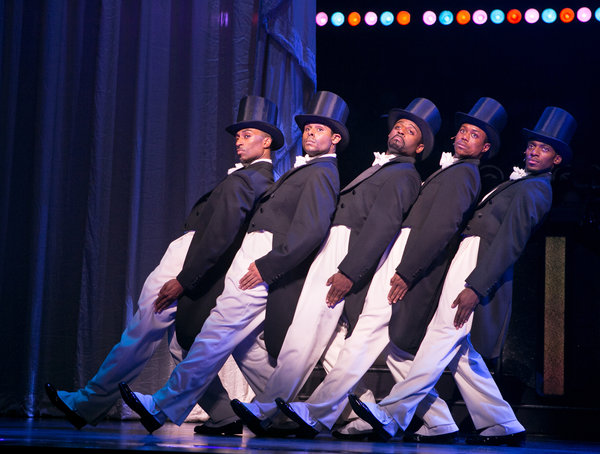
AFTER MIDNIGHT

(photo by Matthew Murphy)

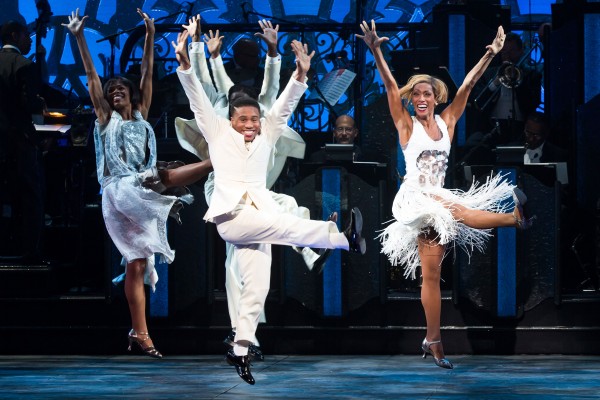
AFTER MIDNIGHT celebrates the music and movement of a thrilling Harlem evening (photo by Matthew Murphy)

Brooks Atkinson Theatre
256 West 47th St. between Broadway & Eighth Ave.
Through August 31, $60-$147
877-250-2929
www.aftermidnightbroadway.com

Initially conceived for New York City Center’s Encores! by series artistic director Jack Viertel, After Midnight is now lighting up Broadway, bringing Harlem to the Great White Way in a dazzling display of music and dance. The Brooks Atkinson Theatre has been transformed into the famed jazz clubs of the Golden Age, the Savoy, the Cotton Club, and the Sugar Cane, as a talented cast of more than two dozen singers and dancers shimmy the night away to the tunes of Duke Ellington. The show is hosted by Dulé Hill (Stick Fly, Psych), who is first seen in a too-cool white suit, leaning against a lamppost, poetically introducing the audience to a Harlem night to remember. Backed by the sixteen-piece Jazz at Lincoln Center All Stars, the performers strut their stuff for ninety glorious, uninterrupted minutes, playing directly to the audience as if in an intimate nightclub. Carmen Ruby Floyd, Rosena M. Hill Jackson, and Bryonha Marie Parham are caught “Between the Devil and the Deep Blue Sea,” Adriane Lenox warns that “Women Be Wise” and later declares “Go Back to Where You Stayed Last Night,” and Julius “iGlide” Chisolm and Virgil “Lil’ O” Gadson slide their way through “Hottentot Tot.” Hill carries a red balloon in “I’ve Got the World on a String,” while he joins Daye, Cedric Neal, Monroe Kent III, and T. Oliver Reid for “Ain’t It de Truth?” highlighted by playful vertical and horizontal group shuffles.

(photo by Matthew Murphy)

Flashy Broadway musical honors the legacy of Duke Ellington and the nightlife of Harlem (photo by Matthew Murphy)

Director and choreographer Warren Carlyle (Chaplin, Finian’s Rainbow) channels Alvin Ailey’s classic “Night Creature” throughout the evening, the moves and grooves often made bigger than life with Isabel Toledo’s stunning costumes. Among the standout dancers are Karine Plantadit (Come Fly Away), who solos on “Black and Tan Fantasy,” and Phillip Attmore and Daniel J. Watts, who have a heated tap-off. The show features several spots for a special guest; through February 9, Fantasia Barrino (American Idol, The Color Purple) makes a star turn singing such sultry numbers as “I Can’t Give You Anything But Love” and “Stormy Weather,” with k. d. lang taking over February 11 and Babyface and Toni Braxton on March 18. While other current Broadway jukebox musicals — Beautiful, Motown, and A Night with Janis Joplin — struggle when they focus on the narrative, the story of After Midnight is the grandeur of the music itself, resulting in a hot evening of jumping, jiving, and wailing, Harlem style.

ALPHAVILLE

ALPHAVILLE

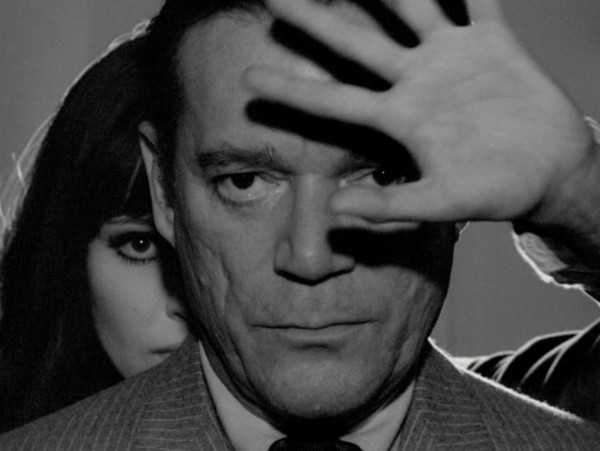
Lemmy Caution (Eddie Constantine) seeks help from Natasha Vonbraun (Anna Karina) in Jean-Luc Godard’s masterful ALPHAVILLE

ALPHAVILLE: A STRANGE ADVENTURE OF LEMMY CAUTION (ALPHAVILLE: UNE ÉTRANGE AVENTURE DE LEMMY CAUTION) (Jean-Luc Godard, 1965)
Film Forum
209 West Houston St.
February 7-13
212-727-8110
www.filmforum.org

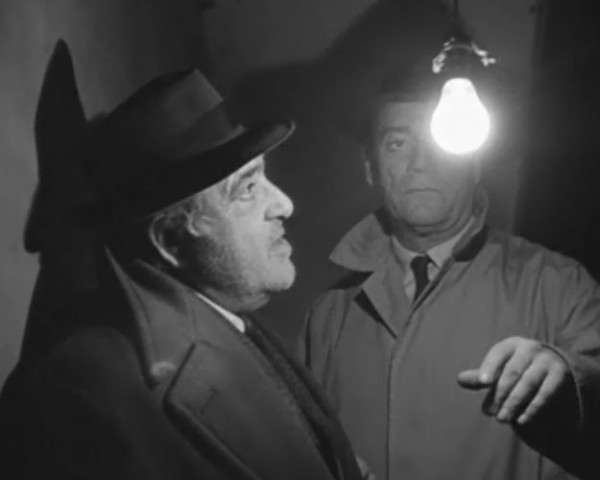
“Sometimes, reality is too complex for oral communication. But legend embodies it in a form which enables it to spread all over the world,” a growly, disembodied, mechanical-like voice says at the beginning of Jean-Luc Godard’s futuristic sci-fi noir thriller, Alphaville: Une étrange aventure de Lemmy Caution. Godard’s 1965 black-and-white masterpiece takes place in an unidentified time period in a dark, unadorned, special-effects-free Paris. A tough-as-nails man in hat and trench coat named Lemmy Caution (Eddie Constantine) has arrived in Alphaville from the Outlands, claiming to be journalist Ivan Johnson, on assignment from the Figaro-Pravda newspaper. But his real mission is to first find fellow agent Henry Dickson (Akim Tamiroff), then capture or kill Alphaville leader and death-ray inventor Professor Vonbraun (Howard Vernon), the former Leonard Nosferatu. A Guadalcanal veteran who drives a Ford Galaxie, Caution — a character Constantine played in a series of films based on the novels of Peter Cheyney, including This Man Is Dangerous, Dames Get Along, and Your Turn, Darling — is a no-nonsense guy who takes nothing for granted. “All things weird are normal in this whore of cities,” he tells a blond seductress third class, who apparently comes with his hotel room. Documenting everything he sees with an Instamatic flash camera, Caution (perhaps a stand-in for Godard himself?) is soon visited by Natasha Vonbraun (Anna Karina), the professor’s daughter, setting off on an Orwellian journey through a grim city where poetry and emotion, and such words as “love,” “why,” and “conscience,” are banned in favor of “because” and “Silence. Logic. Security. Prudence,” where the hotel Bible is actually an ever-changing dictionary and enemies of the state are killed in swimming pools and pulled out by clones of Esther Williams, all overseen by a computer known as Alpha 60 (whose text, based on writings by Jorge Luis Borges, is eerily spoken by a man without a larynx, using a mechanized voice box).
ALPHAVILLE

Henry Dickson (Akim Tamiroff) attempts to shed light on a grim situation in intellectual sci-fi film noir

Meanwhile, Caution travels everywhere with his paperback copy of Paul Éluard’s Capital of Pain, which includes such short poems as “To Be Caught in the Trap,” “In the Cylinder of Tribulations,” and “The Big Uninhabitable House.” Paul Misraki’s relentless noir score fits right in with Raoul Coutard’s bleakly beautiful cinematography, which often shows Caution through glass doors and windows and in enclosed spaces. Godard infuses Alphaville with cinematic flourishes, inside jokes, political statements, and intellectual references, directly and indirectly evoking Jean Cocteau’s Orpheus, Orson Welles’s Mr. Arkadin, Chris Marker’s La Jetée, American cartoons (a pair of white-coated professors who announce a memory problem with 183 Omega Minus are named Eckel and Jeckel, played by Cahiers du cinema’s Jean-Louis Comolli and Jean-André Fieschi), and even his own films, with Jean-Pierre Léaud making a very brief cameo as a waiter. But one of the myriad pleasures of Alphaville — which won the Golden Bear at Berlin and at one time had the working title Tarzan vs. IBM — is that it can be enjoyed on many different levels, as dystopian warning, fascist parable, cinema about cinema, individual vs. the state thriller, or, quite simply, classic French noir. A digital restoration of Alphaville, with a new translation and subtitles by Lenny Borger and Cynthia Schoch, is screening February 7-13 at Film Forum.

THE LAST OF THE UNJUST

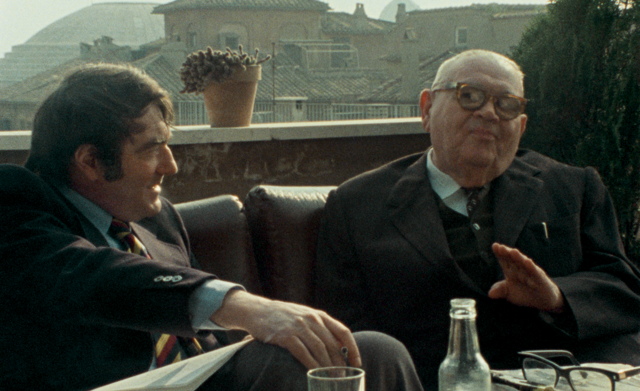
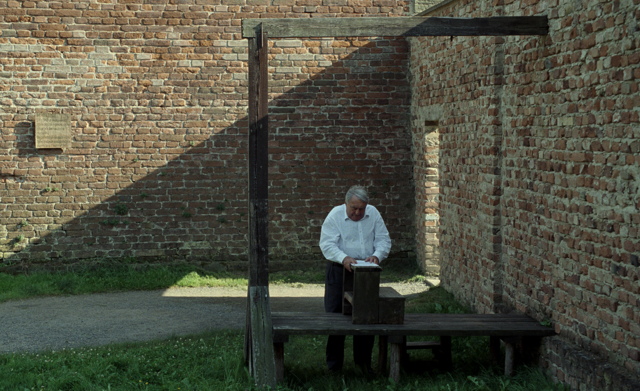
Claude Lanzmann and Benjamin Murmelstein discuss the Holocaust in revealing documentary

Claude Lanzmann and Benjamin Murmelstein discuss the Holocaust in revealing documentary

THE LAST OF THE UNJUST (LE DERNIER DES INJUSTES) (Claude Lanzmann, 2013)
Lincoln Plaza Cinema
1886 Broadway at 63rd St.
Opens Friday, February 7
212-757-2280
www.lincolnplazacinema.com
www.cohenmedia.net

For forty years, French filmmaker Claude Lanzmann has been documenting the Holocaust and the birth of the state of Israel in such provocative and powerful films as Israel, Why; Sobibor, October 14, 1943, 4 P.M.; and his nine-and-a-half-hour masterpiece, Shoah. In 1997, he made A Visitor from the Living, built around a 1979 interview with International Red Cross worker Maurice Rossel, who led a delegation inspecting the Nazis’ so-called “model ghetto” of Theresienstadt, which turned out to be a glorified concentration camp. Lanzmann returns to the Czech camp in The Last of the Unjust, an utterly fascinating 218-minute documentary consisting of a series of interviews he conducted in Rome in 1975 with Rabbi Benjamin Murmelstein, the only Jewish Elder to survive the Holocaust. For years, Murmelstein, who was appointed directly by and reported to Obersturmbannführer Adolph Eichmann, has been declared a Nazi collaborator, by writer Hannah Arendt and many others, even being arrested, imprisoned, and tried by Czech authorities. But in The Last of the Unjust, he paints a vivid portrait of everyday life in Theresienstadt, claiming he was not a collaborator but instead was doing whatever he could to improve conditions for the Jews there.
Claude Lanzmann

Claude Lanzmann visits Theresienstadt in film about the model ghetto’s last Jewish Elder

He poignantly describes not knowing about gas chambers and trains to Auschwitz and proudly defends his actions, referring to himself as the “last of the unjust.” Murmelstein has a spectacular memory, vividly recalling specific moments, answering all of Lanzmann’s questions with a bold honesty and correcting long-held misbeliefs concerning Theresienstadt. A cool, cigarette-smoking Lanzmann is seen in the old interviews and he also appears in new footage shot as he visits the camp and other relevant locations, geographically linking the past and the present. Between Murmelstein’s amazing storytelling ability and Lanzmann’s sharing of his personal perspective, the film never gets boring or repetitive over the course of its three-and-a-half-hour length. In the written introduction, Lanzmann states, “It took me a long time to come to the realization that I didn’t have the right to keep this to myself.” He has indeed done a great service by not keeping this to himself, making yet another poignant document of the Holocaust as seen through the eyes of a unique and thoroughly intriguing witness.

BRAINWAVE 2014: ON MEDITATION

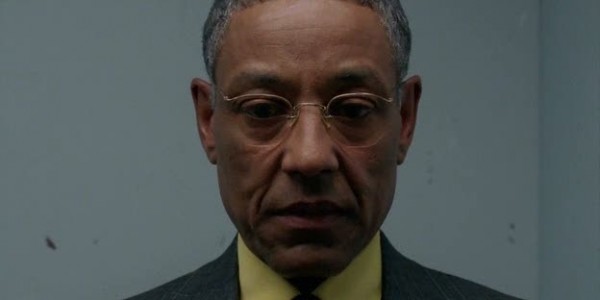
Giancarlo Esposito might have broken bad as Gus Hermanos on BREAKING BAD, but he’ll discuss meditation with neuroscientist Moran Cerf at the Rubin Museum this weekend

Giancarlo Esposito might have broken bad as Gus Fring on BREAKING BAD, but he’ll discuss meditation with neuroscientist Moran Cerf at the Rubin Museum this weekend

Rubin Museum of Art
150 West 17th St. at Seventh Ave.
Begins February 8, $20
212-620-5000
www.rmanyc.org/onmeditation

Need pointers on how to relax in today’s ever-more-crazy world? The Rubin Museum has just the thing, a sidebar to its annual Brainwave programming that focuses on ways to ease the mind, body, and spirit and get on the path to enlightenment. “On Meditation” combines short biographical portraits with talks pairing artists and Zen teachers with scientists. The series begins February 8 with “The Monk,” teaming the Venerable Metteyya with Weill Cornell neurosurgeon Philip E. Steig at 3:00, followed at 6:00 by “The Actor,” with Giancarlo Esposito and neuroscientist Moran Cerf. On February 12, “The TM Teacher” brings together David Lynch Foundation director Bob Roth and NYU experimental psychologist Barry Cohen after a short portrait of Lynch talking about his longtime practice of Transcendental Meditation. On February 19, “The Zen Teacher” focuses on Shinge Roko Sherry Chayat Roshi and Princeton neuroscientist Brent A. Field, spurred by a portrait of Zen Buddhist author Peter Matthiessen. On April 11, Hatha yoga expert Elena Brower and Weill Cornell neuropsychologist Kenneth Perrine will delve into “The Yoga Teacher,” while on May 2 “The Congressman” features Ohio congressman Tim Ryan and cognitive scientist Emma Seppala. Tickets for all events are twenty dollars, and more pairings will be added.

VENGEANCE IS HERS: MS. 45

MS. 45

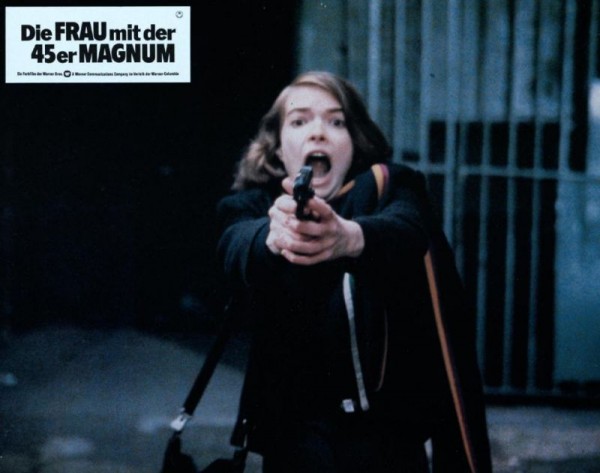
A mute rape victim (Zoë Tamerlis Lund) seeks revenge DEATH WISH-style in Abel Ferrara’s MS. 45

MS. 45 (Abel Ferrara, 1981)
BAMcinématek, BAM Rose Cinemas
30 Lafayette Ave. between Ashland Pl. & St. Felix St.
February 7-9
Series runs through February 18
718-636-4100
www.bam.org
www.drafthousefilms.com

Abel Ferrara’s third film, following the 1976 pornographic 9 Lives of a Wet Pussy Cat and the 1979 gorefest The Driller Killer, is a low-budget grindhouse female revenge fantasy set on the gritty streets of New York City. In Ms. 45 (also known as Angel of Vengeance), Zoë Tamerlis Lund makes her screen debut as Thana, a mute woman working as a seamstress in the Garment District. After being raped twice in one day on separate occasions, she soon goes all Death Wish / Taxi Driver on men seeking a little more from women. Thana — named after Freud’s death instinct, Thanatos, the opposite of the sex instinct, Eros — grabs herself a .45 and quickly proves she is one helluva shot as she goes out in search of potential victims in Chinatown, Central Park, and the very place where Woody Allen and Diane Keaton sat on a bench, romantically looking out at the Queensboro Bridge in an iconic moment from Manhattan. Ferrara, who plays the masked rapist, captures the nightmarish feel of the city at the time, where danger could be lurking around any corner, with the help of James Lemmo’s lurid, pornlike cinematography and Joe Delia’s jazz-disco soundtrack. Lund would go on to cowrite Ferrara’s Bad Lieutenant, in which she plays a junkie named Zoë, before drugs killed her in 1999 at the age of thirty-seven. A cult classic that keeps getting better with age, Ms. 45 is screening in a new digital projection February 7-9 as part of the BAMcinématek series “Vengeance Is Hers,” twelve days of films featuring fabulous woman protagonists and antagonists, including Sissy Spacek in Carrie, Sandrine Bonnaire in Secret Defense, Olivia de Havilland in The Heiress, Lily Ho and Betty Pei Ti Ting in Intimate Confessions of a Chinese Courtesan, and Pam Grier in Coffy.