twi-ny recommended events

MR. TURNER

MR. TURNER

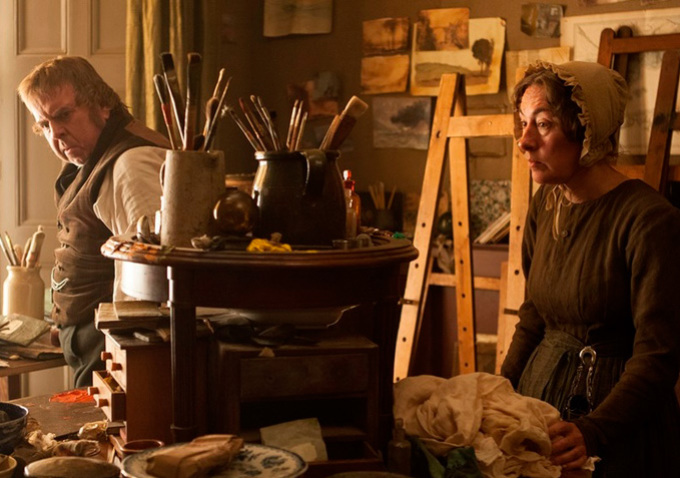
British painter J. M. W. Turner (Timothy Spall) and his devoted housekeeper, Hanna Danby (Dorothy Atkinson), pause for a moment in Mike Leigh’s biopic

MR. TURNER (Mike Leigh, 2014)
Opened December 19
www.sonyclassics.com/mrturner

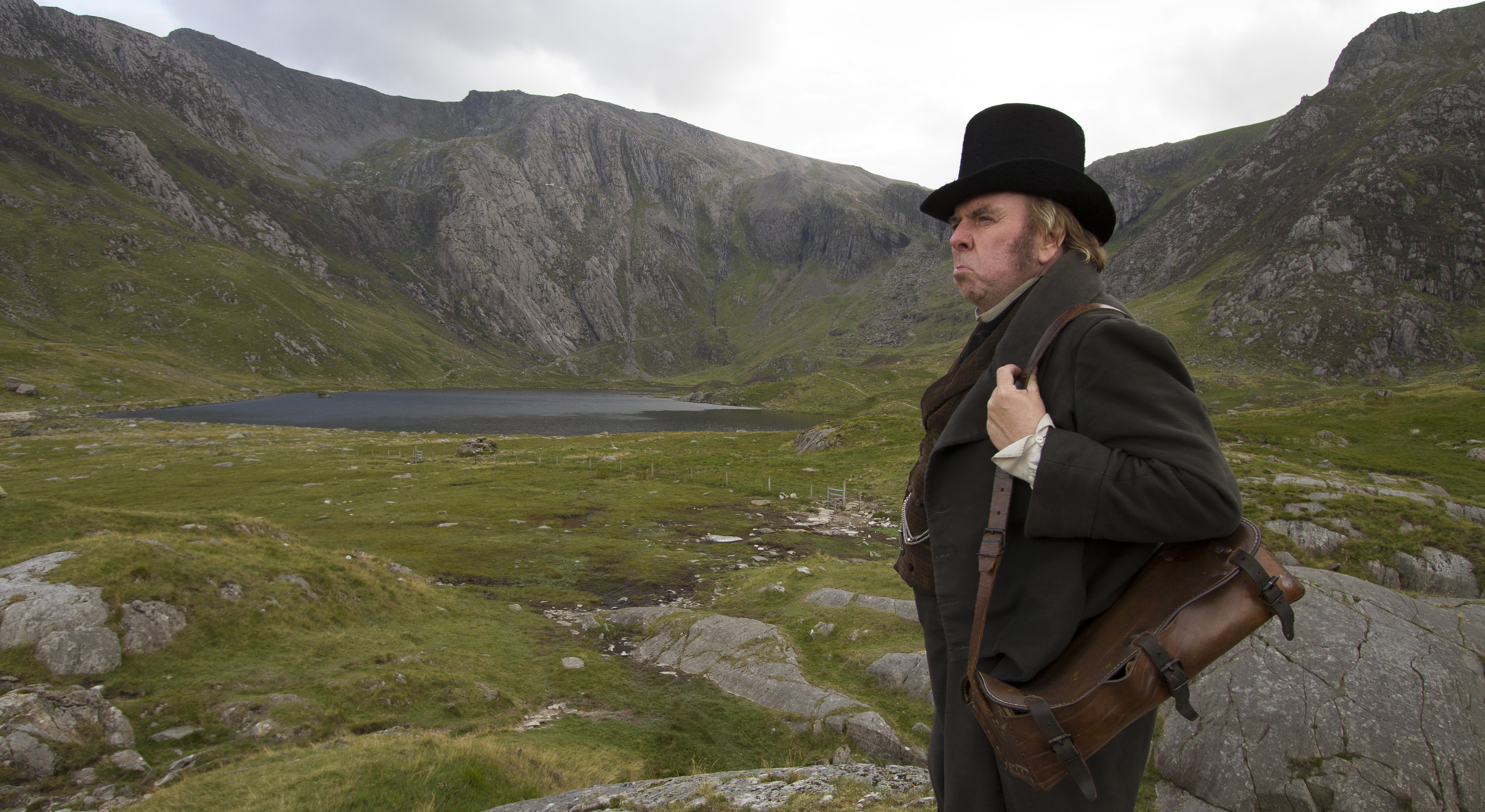
Timothy Spall was named Best Actor at the Cannes Film Festival for his compelling portrayal of British artist Joseph Mallord William Turner in Mike Leigh’s lovely biopic, Mr. Turner. Spall, who played Peter Pettigrew in the Harry Potter series and has appeared in such other Leigh films as Topsy-Turvy, All or Nothing, Life Is Sweet, and Secrets & Lies, portrays Turner as a gruff, self-involved painter who grunts and growls his way through life. At his home studio he is assisted by his aging father, William (Paul Jesson), and his devoted housekeeper, Hanna Danby (Dorothy Atkinson), who he occasionally shags when in the mood. Turner carries his sketchbook wherever he goes, always on the look-out for a beautiful landscape or winter storm that could become the subject of his next painting. With that in mind, he rents a room in a small seaside inn run by Sophia Booth (Marion Bailey), who eventually becomes more than just his landlady. An artist well ahead of his time, Turner becomes frustrated with the men at the Royal Academy of Arts and lisping art critic John Ruskin (Joshua McGuire), who don’t appreciate his work properly, especially when he starts heading toward abstraction.
MR. TURNER

J. M. W. Turner (Timothy Spall) is always on the look-out for a subject to paint in MR. TURNER

Leigh (Naked, Happy-Go-Lucky) does not paint the kindest portrait of J. M. W. Turner, who turned his back on his former mistress, the shrill Sarah Danby (Ruth Sheen), and their two daughters (Sandy Foster and Amy Dawson); doesn’t have the nicest things to say about such contemporaries as John Constable (James Fleet) and Benjamin Haydon (Martin Savage); and refuses to listen to the stern warnings of his doctor (David Horovitch). Turner is an artist first and foremost; everything else takes a backseat in his life. Despite being based on actual events, the film was made in Leigh’s usual style, with the actors improvising within set scenes; Spall, who studied painting for two years in preparing for the role, takes full advantage of the opportunity, often refusing to articulate, grunting and growling as he deals with other people who dare share their thoughts and opinions with him. It’s a very funny conceit that helps define a rather unusual character. As befits a story about a masterful painter, cinematographer Dick Pope, who has shot most of Leigh’s films, beautifully photographs the sun rising and setting over vast landscapes, capturing its glowing light cast over the sea. Leigh keeps the narrative subtle, as when Turner and Sophia sit for a daguerreotype; almost nothing extraordinary happens in the scene, but from a few groaned questions and Spall’s expression, viewers can sense Turner realizing the changes that photography will bring to realist painting, spurring his controversial switch to more abstract canvases. It is not shown as a eureka moment but just another part of Turner’s development in becoming one of the most important and influential artists of the nineteenth century. And then there are the paintings themselves, glorious works that are always a joy to see, especially in a film that is a work of art itself.

VIDEO OF THE DAY: “ONE GIRL / ONE BOY” BY !!!

Who: !!! (Chk Chk Chk)
What: Sacramento-Brooklyn dance-punk band plays four-night stand in its East Coast home borough, with DJ Mister Saturday Night (1/7), DJ Van Rivers (1/8), Cheap Shots with J. and Jay (1/9), and DJ Degal and !!! DJs (1/10)
Where: Union Pool, 484 Union Ave.
When: January 7-10, $10, 9:00
Why: Always fun group behind such albums as Myth Takes, THR!!!ER, and Strange Weather, Isn’t It? is promising a big year, “because 2015 is gonna be our year, and u want to say u started it off with us. and if u don’t then please please please have a very good time doing whatever it is u do to start the year.”

INHERENT VICE

INHERENT VICE

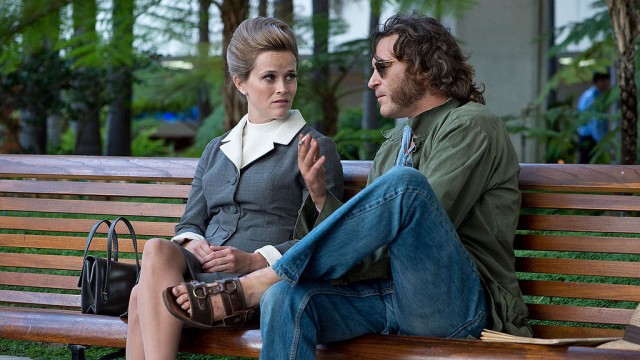
Reese Witherspoon and Joaquin Phoenix reveal that opposites attract in INHERENT VICE

INHERENT VICE (Paul Thomas Anderson, 2014)
Opened December 19
www.inherentvicemovie.com

It makes sense that award-winning writer-director Paul Thomas Anderson, who has made such complex, challenging films as Magnolia, There Will Be Blood, and The Master, has made the first cinematic adaptation of a novel by reclusive, iconoclastic author Thomas Pynchon, who has written such complex, challenging books as Gravity’s Rainbow, V., and Vineland. It also makes sense that the book he chose to adapt is Inherent Vice, probably the most lighthearted and breezy of Pynchon’s tomes. But it also makes sense that the film itself is complex and challenging — and downright confusing. Walking out of the theater, we were pretty sure we liked what we had just seen, even if we didn’t completely understand what had happened. (As Jena Malone said of the making of the film, “The logic becomes the chaos and the chaos becomes the logic.”) The neo-noir takes place in 1970 in the fictional Valley town of Gordita Beach (based on Manhattan Beach, where Pynchon lived for a long time). Joaquin Phoenix stars as Larry “Doc” Sportello, a mutton-chopped ex-hippie who is now a private gumshoe working out of a health clinic. One day his ex, Shasta Fay Hepworth (a transplendant Katherine Waterston), shows up to ask him to get her out of a jam involving her billionaire boyfriend, Mickey Wolfmann (Eric Roberts), who has gone missing, perhaps at the hands of Wolfmann’s high-society wife, Sloane (Serena Scott Thomas). Meanwhile, Doc is also hired by Hope Harlingen (Malone) to determine whether her supposedly dead husband, surf-sax legend Coy (Owen Wilson), is actually alive. As Pynchon himself says in the book trailer, “At that point, it gets sort of peculiar,” and peculiar it does indeed get, as Doc becomes immersed in a web of lies and deceit, dealing with a dangerous cult known as the Golden Fang (where Martin Short plays a sex-crazed dentist with a wild abandon), a curious health facility called the Chryskylodon Institute run by Dr. Threeply (Jefferson Mays), and Det. Bigfoot Bjornsen, a “renaissance cop” who has no time for any of Doc’s hippie crap, as the Manson murders hover over everything. Well, at least that’s what we think the plot is about.
INHERENT VICE

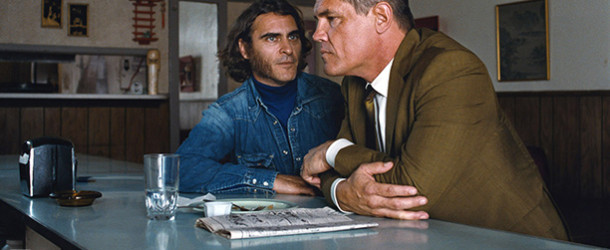
Doc (Joaquin Phoenix) and Bigfoot (Josh Brolin) don’t agree on much in Paul Thomas Anderson adaptation of Thomas Pynchon novel

As with all Anderson films, Inherent Vice looks and sounds great; cinematographer Robert Elswit, who has shot most of Anderson’s films, bathes the quirky drama in hazy, syrupy colors, while Jonny Greenwood’s score is accompanied by songs by Can, Sam Cooke, Minnie Riperton, the Marketts, and Neil Young. (In fact, Young’s Journey through the Past experimental film served as an influence on Anderson when making Inherent Vice, as did David Zucker, Jim Abrahams, and Jerry Zucker’s Police Squad and Naked Gun series, Robert Altman’s 1973 Philip Marlowe movie The Long Goodbye, and Howard Hawks’s 1946 version of Raymond Chandler’s The Big Sleep.) It all has the feel of the Coen brothers’ The Big Lebowski as reinterpreted by Anderson and Pynchon — who might have been on-set during at least some of the shooting and supposedly makes a cameo in the picture. The film is littered with absurdist jokes and oddities, from the way Bigfoot eats a chocolate-covered banana to a trio of FBI agents picking their noses, from the right-wing Vigilant California organization to a clip from the 1952 Cold War propaganda film Red Nightmare. Phoenix once again fully inhabits his character, who putt-putts around in an old Dodge Dart and just wants life to be mellow and groovy. Brolin is hysterical as his foil, the straitlaced, flattop cop who has a penchant for busting down doors. The large cast also includes Benicio del Toro as Sauncho Smilax, Doc’s too-cool lawyer; Reese Witherspoon as Penny Kimball, Doc’s well-coiffed girlfriend; Maya Rudolph (Anderson’s real-life partner and the daughter of Riperton) as receptionist Petunia Leeway; Sasha Pieterse as Japonica Fenway, who hangs with Golden Fang dentist Rudy Blatnoyd (Short); and Joanna Newsom as Sortilège, the film’s narrator (who does not appear in the book). Inherent Vice is yet another unique cinematic experience from Anderson, one that is likely to take multiple viewings to understand just what is going on, but as with his previous films, it is likely to be well worth the investment.

VIDEO OF THE DAY: LOUIS C.K. 1995

Who: Louis C.K.
What: Stand-up comedy tour
Where: Madison Square Garden
When: Wednesday, January 7 & 14, $25-$65, 8:00
Why: Mastermind behind the FX hit Louie and such stand-up specials as Oh My God and Shameless is selling out the World’s Most Famous Arena these days, sharing his unique views on marriage, divorce, children, health, dating, sex, weight, and other topics

VIDEO OF THE DAY: “COPPERHEAD ROAD” BY STEVE EARLE AND SHAWN COLVIN

Who: Steve Earle
What: Annual Winter Residency
Where: City Winery, 155 Varick St. between Spring & Vandam Sts., 212-608-0555
When: Monday, January 5, 12, 19, 26, $45-$75, 8:00
Why: Folk-rock troubadour Steve Earle, whose next album with the Dukes, Terraplane, comes out on February 17, teams up with special guests every Monday in January at City Winery, beginning with Willie Watson on January 5, followed by Shawn Colvin and Kate Davis on January 12, Willie Mason on January 19, and Willie Nile on January 26

BIRDMAN OR (THE UNEXPECTED VIRTUE OF IGNORANCE)

BIRDMAN

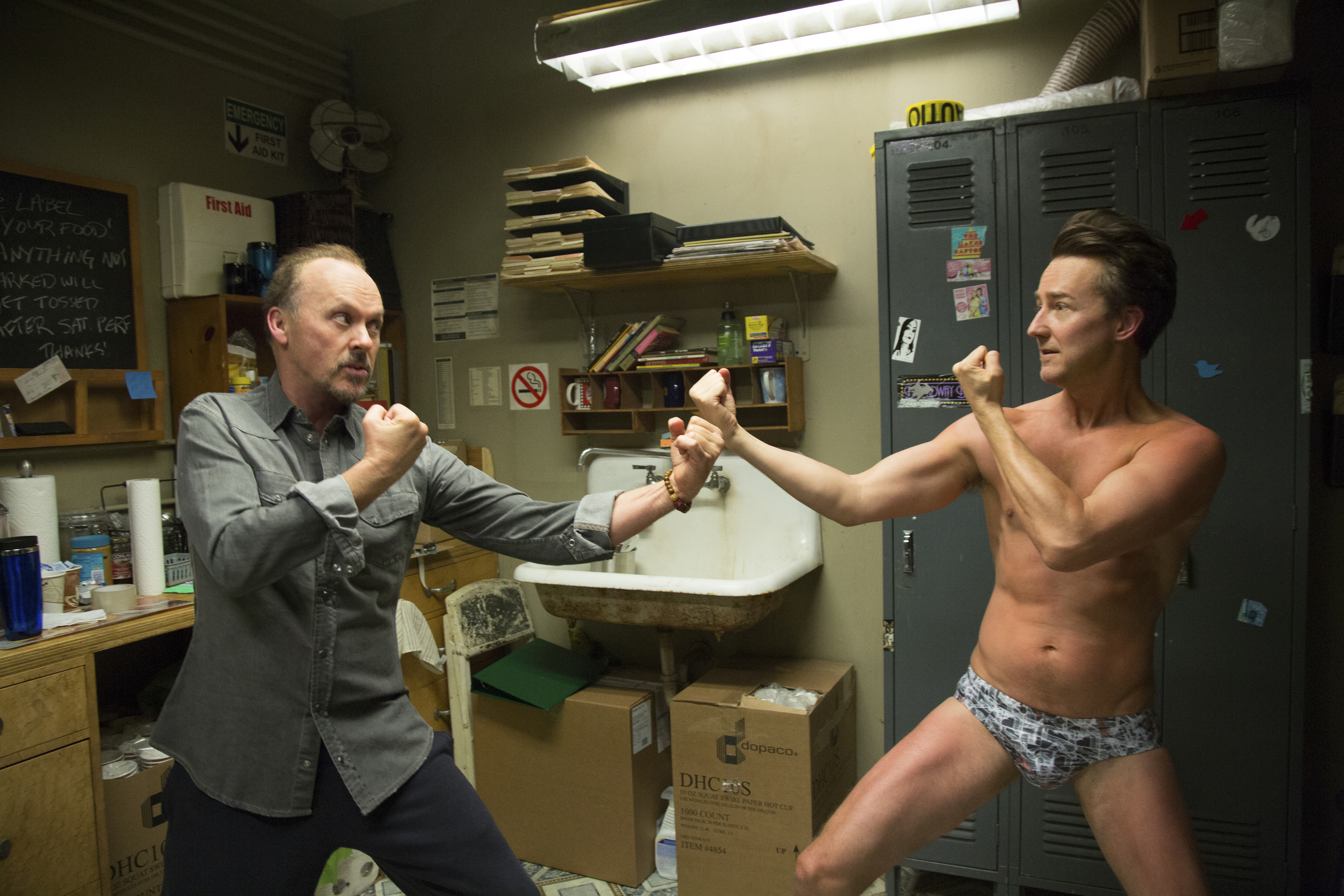
Riggan Thomson (Michael Keaton) and Mike Shiner (Edward Norton) battle it out onstage and off in BIRDMAN

BIRDMAN OR (THE UNEXPECTED VIRTUE OF IGNORANCE) (Alejandro G. Iñárritu, 2014)
Opened October 17
www.birdmanthemovie.com

In Birdman or (The Unexpected Virtue of Ignorance), Oscar-winning cinematographer Emmanuel Lubezki’s swirling camera immerses the audience in Mexican director Alejandro G. Iñárritu’s gripping whirlwind black comedy of a former superhero action star trying to regain respect on the Broadway stage. Onetime Batman star Michael Keaton plays Riggan Thomson, an actor who left his blockbuster Birdman franchise in order to be taken more seriously. Twenty years later, he is considering refinancing his house in order to support his Broadway debut as writer, director, and star of an adaptation of Raymond Carver’s short story “What We Talk about When We Talk about Love.” As he works on the play with costars Mike Shiner (Edward Norton), Shiner’s girlfriend, Lesley (Naomi Watts), and his own girlfriend, Laura (Andrea Riseborough), he battles his inner demons, which take the form of the dark, gravelly voice of his Birdman character (voiced by Keaton). Either his somewhat obscure but vaguely Buddhist spiritual pursuits or his Birdman abilities also apparently give him the ability to move objects with his mind; the first time we see him, he is levitating in front of the window of his dressing room at the St. James Theatre. His team also includes his devoted lawyer, producer, and best friend, Jake (Zach Galifianakis), his stalwart stage manager, Annie (Merritt Wever), and his daughter and personal assistant, Sam (Emma Stone), a bitter and cynical young woman fresh out of rehab. He also has an encounter with vicious theater critic Tabitha Dickinson (Lindsay Duncan), who is licking her lips in anticipation of reviewing his show. With opening night approaching, Thomson must look deep within himself as he reevaluates his life and career.
BIRDMAN

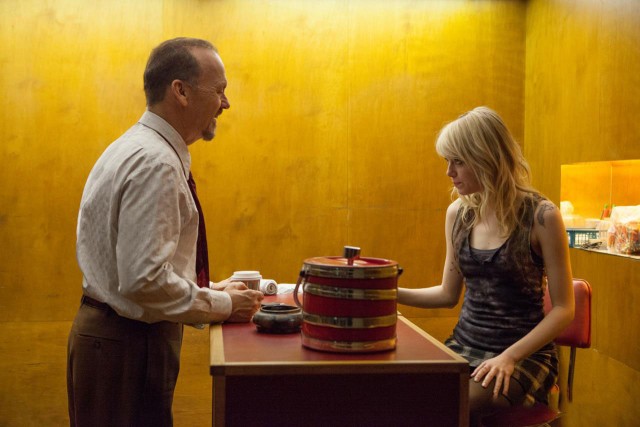
Riggan Thomson (Michael Keaton) tries to reestablish his relationship with his daughter, Sam (Emma Stone), in BIRDMAN

Iñárritu (Amores Perros, Babel) and Lubezki (Gravity, Children of Men) take viewers on a wicked, wild ride in Birdman, which is masterfully made to look as if it is one continuous two-hour shot, the handful of cuts cleverly hidden as the camera roams through the narrow hallways and small dressing rooms of the St. James and into (and above) Times Square, instilling the film with the energy and feel of live theater. The live aspect reaches a new peak when, as Thomson is winding his way backstage accompanied by Antonio Sánchez’s propulsive percussion score, he runs past a man playing the music on the drums. (Think Count Basie leading his band out on the western plains in Blazing Saddles.) Another inside joke occurs when Shiner is shown reading Jorge Luis Borges’s Labyrinths, a short-story collection filled with magical scenes of its own. Keaton gives the best, bravest performance of his career as Thomson, a comeback role that clearly hits home; it seems so tailor made for him that it is hard to believe it was not written specifically for the ’80s star of such hits as Night Shift, Mr. Mom, Gung Ho, and Beetlejuice. Keaton — who has had very limited theater experience — lets it all hang out, as does Norton, channeling his narrator character from Fight Club. The film’s supporting cast is outstanding as well, including Watts, who is now considering making her long-awaited theater debut, and Amy Ryan as Thomson’s ex-wife, but Stone’s big, expressive eyes nearly steal the movie. Birdman is so fresh and potent, so dynamic and spirited, that it’s easy to forgive it its few plot holes. It’s a biting satire of Hollywood and Broadway, of fame and stardom, a magical fantasy that relates to everyone’s fear of becoming insignificant.

HENRI MATISSE: THE CUT-OUTS

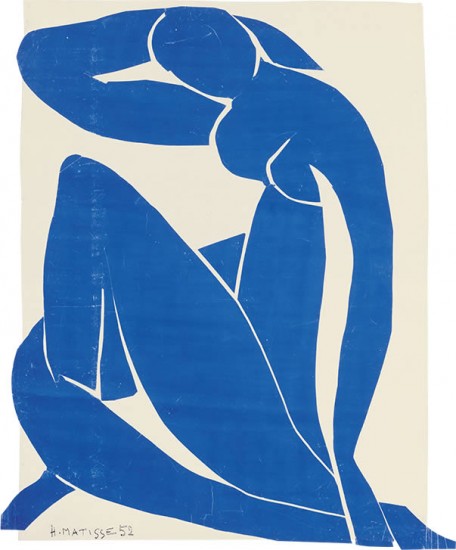
Henri Matisse, “Blue Nude,” gouache on paper, cut and pasted, on paper, mounted on canvas, spring 1952 (Musée national d’art moderne/Centre de création industrielle, Centre Georges Pompidou, Paris)

Henri Matisse, “Blue Nude,” gouache on paper, cut and pasted, mounted on canvas, spring 1952 (Musée national d’art moderne/Centre de création industrielle, Centre Georges Pompidou, Paris)

Museum of Modern Art
The Joan and Preston Robert Tisch Exhibition Gallery, sixth floor
11 West 53rd St. between Fifth & Sixth Aves.
Timed tickets daily through February 10, $25
212-708-9400
www.moma.org

Near the center of “Henri Matisse: The Cut-Outs,” visitors gather to watch excerpts from Frédéric Rossif’s 1950 Matisse film, which show the white-bearded artist at work, creating masterpieces with only painted paper and a pair of scissors. There’s a smile on everyone’s face as the eighty-year-old Matisse cuts shapes out of yellow paper, perhaps a bit more sophisticated than a young child making a row of paper dolls. And that gets right to the heart of why the exhibition is so successful, and why Matisse’s cut-outs are so beloved: It seems so simple, something that anyone can do, but of course that is not quite true, as no one has ever used a pair of scissors quite like Matisse did. In her catalog essay “Bodies and Waves,” Jodi Hauptman discusses Matisse’s methods when beginning his first “Blue Nude.” She writes, “The process was arduous. Matisse labored for a number of weeks, relentlessly revising. His studio assistant at the time, Paule Martin, pushed by Matisse to work with equal rigor, describes the tense conditions: ‘Whereas subsequent forms were cut in a single movement, the first figure demanded such patience and attention on Matisse’s part, but also from me, that it exhausted me and I was on the brink of collapse. He made me pin tiny squares of paper to enhance the curvature of the thigh or some other part of the body, then remove parts of the figure to remove colour strips, then set it back in place as my febrile fingers fumbled with the pins.’ These enhancements and removals along with markings in chalk can be seen in a series of black and white photographs made by [secretary and studio assistant] Lydia Delectorskaya to document each stage, reminding the artist where he was and where he had been in order for him to decide where to go next.” The process was so organic that Matisse used pins to place the cut-outs on the walls of his studio, moving them around in different configurations until he was ready to mount them on canvas; if you look close enough, you can still see the pinholes on these marvelous works, not quite like a child pinning them onto a board in a classroom.

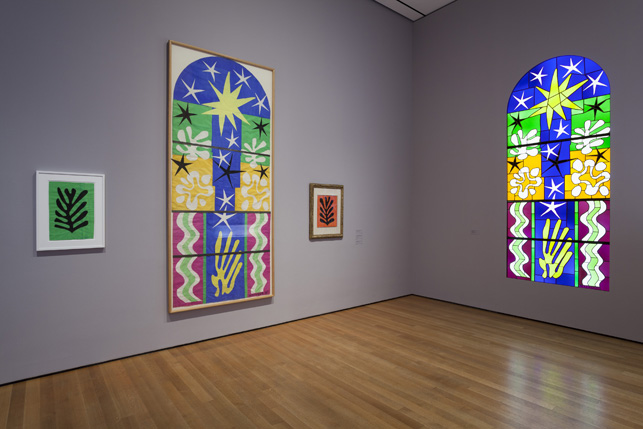
Installation view, “Henri Matisse: The Cut-Outs,” with (from left) “Black Leaf on Green Background,” gouache on paper, cut and pasted, 1952; “Christmas Eve,” maquette for stained-glass window, gouache on paper, cut and pasted, mounted on board, 1952; “Black Leaf on Red Background,” gouache on paper, cut and pasted, 1952; and “Christmas Eve,” stained glass, summer-fall 1952 (photo by Jonathan Muzikar © 2014 the Museum of Modern Art)

Installation view, “Henri Matisse: The Cut-Outs,” with (from left) “Black Leaf on Green Background,” gouache on paper, cut and pasted, 1952; “Christmas Eve,” maquette for stained-glass window, gouache on paper, cut and pasted, mounted on board, 1952; “Black Leaf on Red Background,” gouache on paper, cut and pasted, 1952; and “Christmas Eve,” stained glass, summer-fall 1952 (photo by Jonathan Muzikar © 2014 the Museum of Modern Art)

“Matisse: The Cut-Outs” consists of some 170 cut-outs, drawings, maquettes, stained glass, photographs, screenprints, illustrated books, and other ephemera related to Matisse’s use of cut paper painted over with gouache, which he began in the 1930s but became his preferred medium in the mid-to-late-1940s. This creative resurgence resulted in glorious works that combine a childlike innocence with a complex mastery of space, light, shape, and color, melding abstraction with imagery of the natural world. In “Icarus,” a maquette for the 1947 book Jazz, a silhouetted figure with a red heart floats among yellow stars. (“You have no idea how, during the cut-out paper period, the sensation of flight which emanated from me helped me better to adjust my hand when it used the scissors,” Matisse said. “It’s a kind of linear and graphic equivalence to the sensation of flight.”) Leaflike images come alive in “White Alga on Red and Green Background,” “Two Masks (The Tomato),” and “Composition with Red Cross.” A somewhat figurative element is added in “Black Boxer,” a black image over a red rectangle on a green background. Matisse displays a more spiritual side in his maquettes, studies, and trials for stained-glass windows for the Chapel of the Rosary in Vence. His four blue nudes, dating from spring 1952, are simply breathtaking, as blue geometric shapes and white spaces come together to form seated figures with slightly different body positions like a contemplative four-part dance. That summer, Matisse made the nine-panel room installation “The Swimming Pool,” an extraordinary horizontal swirl about which he said, “I have always adored the sea and now that I can no longer go for a swim, I have surrounded myself with it.” It was MoMA’s conservation of the piece that led to the idea of staging the cut-out exhibition in the first place, so now the work surrounds visitors from around the world.

Matisse at the Hôtel Régina, Nice, April 15, 1950 (photo by Walter Carone © Getty Images)

Matisse at the Hôtel Régina, Nice, April 15, 1950 (photo by Walter Carone © Getty Images)

An April 15, 1950, black-and-white photograph by Walter Carone shows Matisse in his bed, using a long pole to draw on the wall of his room at the Hôtel Régina in Nice with charcoal. The wall already includes elements that would become “The Thousand and One Nights.” It’s a charming photo of the artist, apparently relaxing in bed while continuing to work. Of course, just as the cut-outs themselves are not simple, neither were Matisse’s last years, much of which was spent in bed and in his wheelchair. The catalog essay “The Studio as Site and Subject” notes, “In a 1952 interview with the writer André Verdet, Henri Matisse describes a cluster of colourful cut-paper forms pinned to his studio walls as a ‘little garden.’ ‘You see,’ he explains, ‘as I am obliged to remain often in bed because of the state of my health, I have made a little garden all around me where I can walk . . . There are leaves, fruits, a bird.’ As Matisse speaks, he points to ‘a large mural composition of cut paper that encompassed half the room.’” The artist is referring to pieces that he would use to create “The Parakeet and the Mermaid,” but he could just as well be describing what visitors experience as they walk through this magical exhibition, like meandering through a colorful garden filled with joy and beauty. “Matisse: The Cut-Outs” is a revelatory show, the happiest of the season, displaying a childlike wonder as experienced by an aging yet still determined artist of extraordinary talent.