twi-ny recommended events

MATT BOLLINGER: READING ROOMS

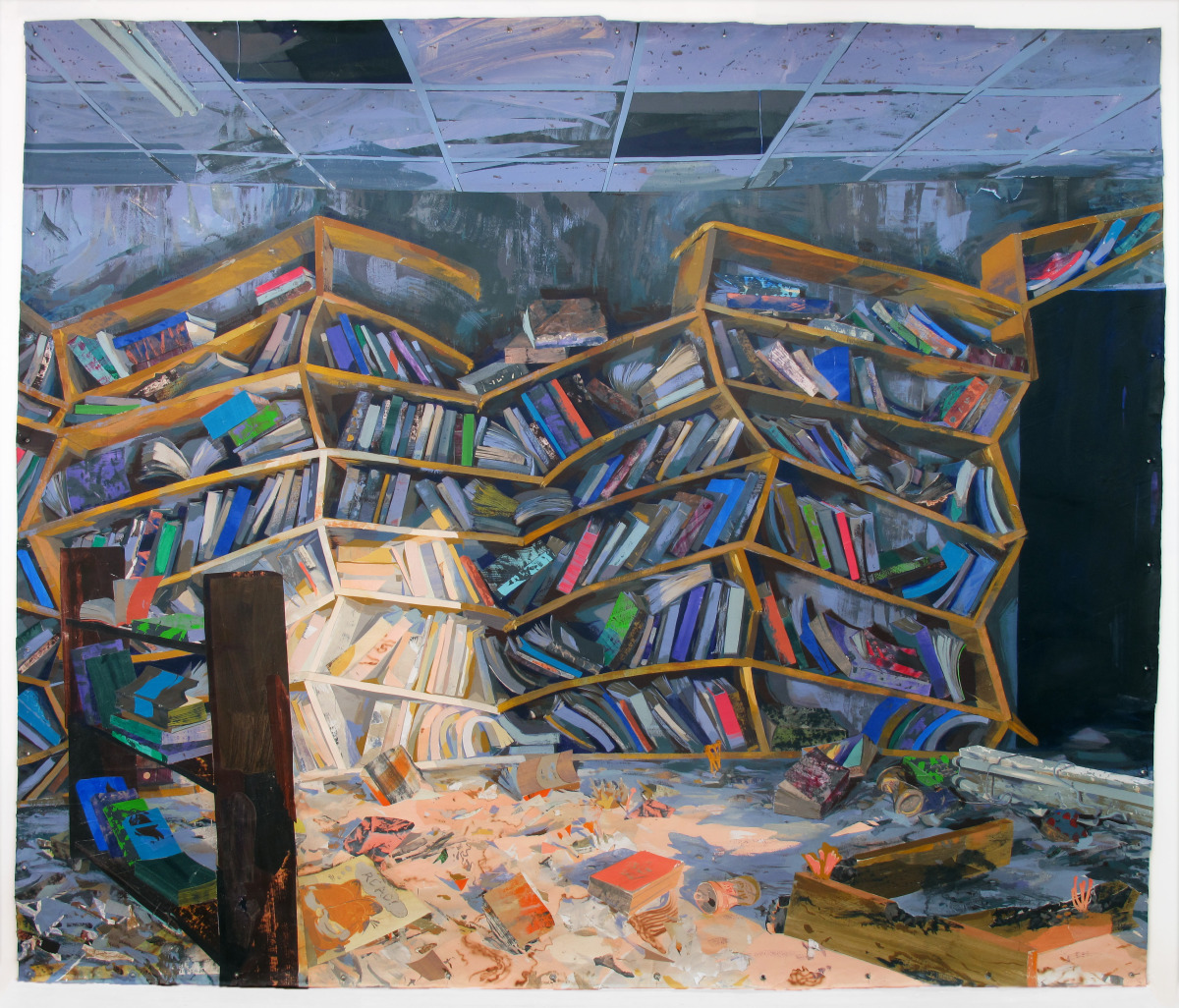
Matt Bollinger, “The Reading Room,” flashe, acrylic, collage on unstretched canvas, 2014

Matt Bollinger, “The Reading Room,” flashe, acrylic, collage on unstretched canvas, 2014

Zürcher Studio
33 Bleecker St. at Mott St.
Tuesday – Sunday through January 30, free, 12 noon – 6:00 pm (Sunday 2:00 – 6:00)
212-777-0790
www.galeriezurcher.com
www.mattbollinger.com

Matt Bollinger’s latest exhibit at Zürcher Studio, “Reading Rooms,” is highlighted by a pair of stunning large-scale canvases, “The Reading Room” and “The Reservoir,” that depict old bookstore shelves; in the former, the shelves are collapsing in on themselves, books, paper, magazines, and garbage strewn about, while in the latter, the shelves are still standing and full, with books piled on the floor, but in both cases it feels like it’s been quite some time since someone has been there. The two works set the stage for the rest of the show, as if all the other paintings are pages from books from these shelves, each merging Bollinger’s — and the viewer’s — past and present. “I used to work in a bookstore,” Bollinger says in a catalog interview for his spring 2014 show at Zürcher in Paris, which also included “The Reservoir.” He continues, “It had a mold-riddled basement that I was always eager to explore; you could find all sorts of stuff down there. I want this picture of a bookstore to operate as a reservoir. A holder, a backdrop, for all the other reservoirs in the show.” Now Bollinger has symbolically transformed Zürcher’s Bleecker St. gallery into a kind of psychological library, with works that are like pages from a book. Among the chapters of Bollinger’s tome are “Mayhem,” “Nancy (Reflection),” “Odd Jobs,” “Brian in Nancy’s Room,” and “Sheet Rock,” featuring repeating characters. In the back room, “Renovations” consists of twenty-eight smaller pieces arranged in rows, creating another kind of narrative; nearby is a painting of the book’s torn cover. However, despite the serious nature of the paintings and how they bring up thoughts of the future of libraries and bookstores and hard copy, Bollinger, who was born in Kansas City and is based in Brooklyn, also says in the catalog, “I’ve been thinking about the obsolescence of the paper book, but I don’t want the pieces to be laments. I want the work to present treasures, private discoveries.” There are many treasures and private discoveries to be found in “Reading Rooms.”

MISS HILL: MAKING DANCE MATTER

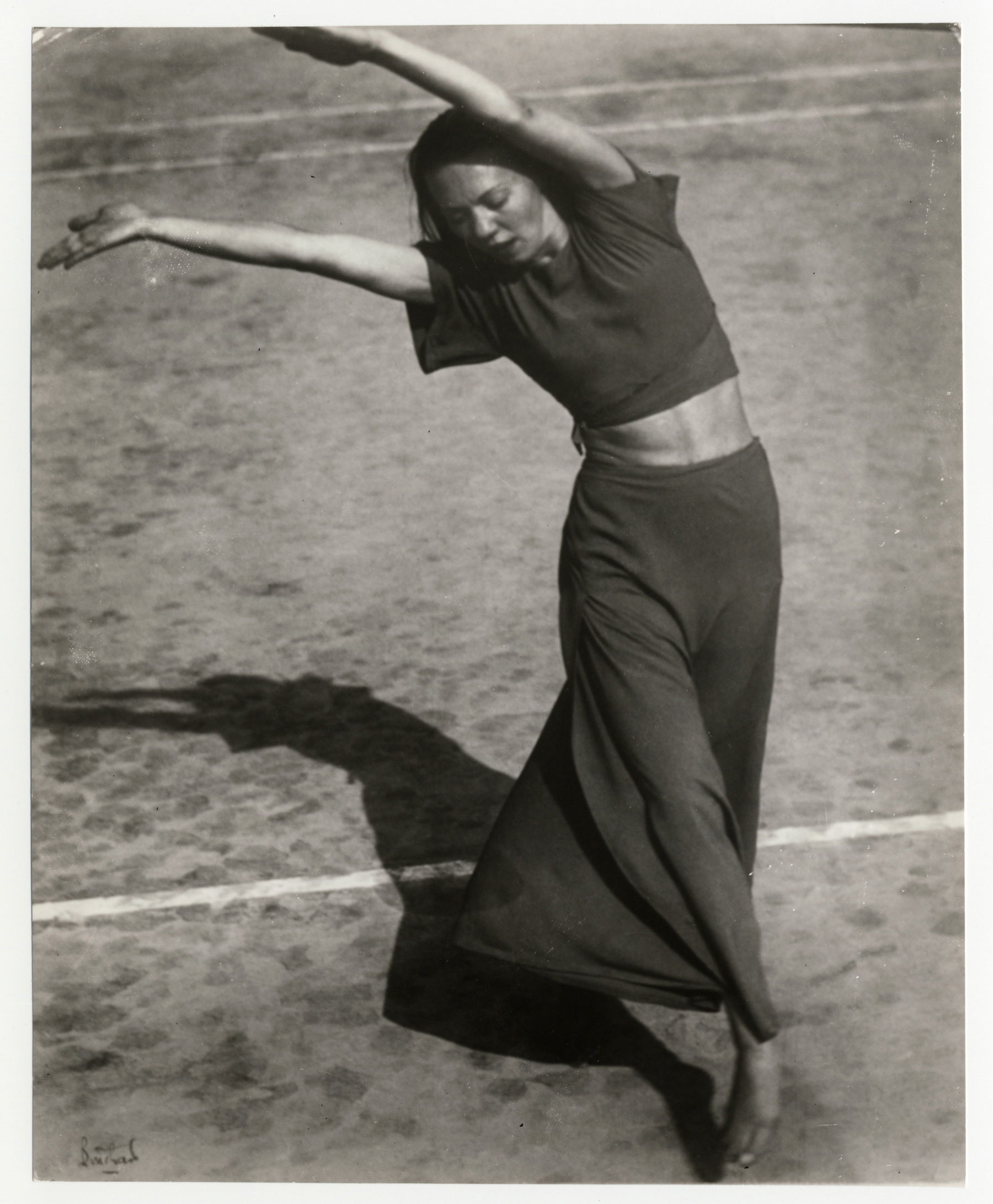
Engaging documentary pays tribute to the life and legacy of Martha Hill, seen here dancing at Bennington in 1938 (photo by Thomas Bouchard)

Engaging documentary pays tribute to the life and legacy of Martha Hill, seen here dancing at Bennington in 1938 (photo by Thomas Bouchard)

MISS HILL: MAKING DANCE MATTER (Greg Vander Veer, 2014)
Quad Cinema
34 West 13th St.
Opens Friday, January 23
212-255-2243
www.quadcinema.com
www.misshillfilm.com

Greg Vander Veer’s Miss Hill: Making Dance Matter is a charming celebration of a woman who had a tremendous impact on the development of modern dance but is still little known outside her tight-knit circle. Born in 1900 in a small town in Bible Belt Ohio, Martha Hill danced with Martha Graham before concentrating on teaching the art form, which as a child she was told was sinful, at Bennington and NYU. But she created her legacy as the first director of dance at Juilliard, where she taught from 1951 to 1985, balancing instruction in both modern dance and classical ballet. Vander Veer (Keep Dancing) and coordinating producer Vernon Scott, who graduated from Juilliard in 1985 and is currently president of the board of directors of the Martha Hill Dance Fund, combine wonderful archival footage of Hill as both a dancer and a teacher, along with old clips of many of her students, including Pina Bausch, Lar Lubovitch, Bessie Schönberg, Hanya Holm, José Limón, and Doris Humphrey, as well as fellow teacher Antony Tudor; there are also new interviews with Paul Taylor, Martha Clarke, Francis Patrelle, Robert Battle, Ohad Naharin, Dennis Nahat, H. T. Chen, and others. “She’s created the dancers of the twenty-first century,” says former Boston Ballet artistic director Bruce Marks. One of the most fascinating parts of the eighty-minute documentary is Hill’s fight to preserve Juilliard’s dance program during the building of Lincoln Center, which pitted her against George Balanchine’s School of American Ballet, the New York City Ballet, and Lincoln Kirstein. Miss Hill displays its subject with clarity, smartly exploring her understanding that dance is more than just language and movement. “Modern dance is not a system, it is a point of view,” Hill explains. Meanwhile, Patrelle gets right to the heart of the matter: “She was dance. She defined it.” A lovely treat for dance fans, Miss Hill opens January 23, at the Quad, with Vander Veer and Scott participating in Q&As following the 7:00 shows Friday and Saturday and the 4:30 shows Saturday and Sunday.

CHOICE EATS 2015

It can get pretty crowded at the annual Choice Eats festival (photo by twi-ny/ees)

It can get pretty crowded at the annual Choice Eats festival (photo by twi-ny/ees)

THE VILLAGE VOICE CHOICE EATS EIGHTH ANNUAL TASTING EVENT
Metropolitan Pavilion
125 West 18th St. between Sixth & Seventh Aves.
Friday, March 13, $65-$99, 6:00 – 10:00 (21 and older only)
choiceeats.villagevoice.com

Tickets are now on sale for the eighth annual Village Voice Choice Eats festival, but you have to move fast if you want access to tastings from more than fifty New York eateries. Last year’s festival was a smash sellout, and for good reason; we thought it was one of the best food events of the year, with generous, unlimited samplings of signature dishes, sides, and desserts from some of the city’s most innovative chefs, along with complementary craft beer pairings and specialty wine and liquor. This year’s event, taking place March 13 at the Metropolitan Pavilion, includes dozens of cool names, many new to the event and others longtime favorites. Among those signed on so far are 2 Duck Goose, 606 R&D, Awadh, Bobwhite Lunch & Supper Counter, Brooklyn Kolache Co., Butter & Scotch, Casa Mono and Bar Jamon, the East Pole, Fletcher’s Brooklyn Barbecue, Gloria’s Carribean Cuisine, Huertas, John Brown Smokehouse, Littleneck, Mable’s Smokehouse, MAX, No. 7, the NoMad, the Queens Kickshaw, Spicy Pot, Thai Rock, and Tuome. We’ll be sure to return to Butter & Scotch’s table, which we declared best in show at the 2014 event, which took place at Basketball City; this year they are celebrating the launch of their first restaurant space. Although the lineup so far contains a generous helping of Brooklyn’s world-famous (or infamous) artisanal offerings, all five boroughs will be represented. General admission at 7:00 is $65; we have never been fans of extra pay for extra play, but the huge and enthusiastic crowds surging through the aisles of Choice Eats can feel overwhelming and make the Early Entry tickets ($85, 6:30) very attractive, while the VIP passes ($99, 6:00) come with a gift bag and private VIP lounge (pssst, with its own facilities, ahem) as well. You can also purchase a Choice Eats / Choice Streets combo ticket ($115-$170), which will also get you into the May 5 food truck fest at the Intrepid.

ORSON WELLES 100: THE LADY FROM SHANGHAI & THE THIRD MAN

Orson Welles

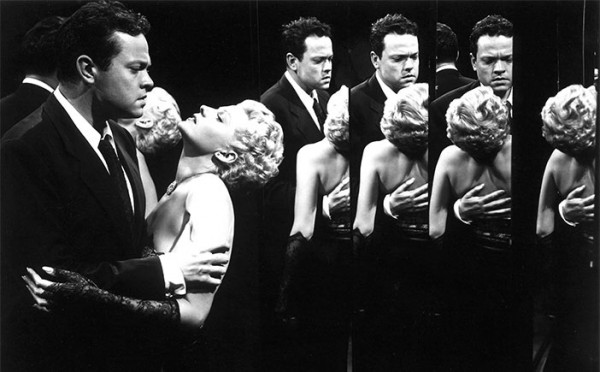
Orson Welles and Rita Hayworth get caught up in romantic intrigue in THE LADY FROM SHANGHAI

THE LADY FROM SHANGHAI (Orson Welles, 1947)
Film Forum
209 West Houston St.
Friday, January 23, and Saturday, January 24, 2:40, 6:35, 10:30
“Orson Welles 100” continues through February 3
212-727-8110
www.filmforum.org

Film Forum’s “Orson Welles 100” festival, a wide-ranging celebration of the centennial of the iconoclastic auteur’s birth, continues with another terrific double feature on January 23-24. In 1947, Welles followed up the creepy black-and-white Holocaust thriller The Stranger with The Lady from Shanghai, a colorful, in-your-face noir about a rogue Irish sea captain and the gorgeous wife of a crippled rich man. Welles plays the shifty seaman, Michael O’Hara, with an in-and-out Irish accent; his estranged wife, Rita Hayworth, is simply breathtaking as the femme fatale, Elsa “Rosalie” Bannister; Everett Sloane is terrifically annoying as Elsa’s husband, wealthy lawyer Arthur Bannister; and Glenn Anders shows off one of the great all-time voices as Grisby, Bannister’s unsuspecting partner. Like The Stranger, the film suffers from awkward moments — Welles famously fought with studio head Harry Cohn over the editing and various stylistic touches — but even as minor Welles it’s an awful lot of fun. Columbia wanted Welles to make sure to show off Hayworth’s beauty, which had recently been on display in such hits as Gilda and Cover Girl, so he goes way overboard here, changing her hair color and zooming in far too close far too often. Based on Sherwood King’s novel If I Die Before I Wake, The Lady from Shanghai is a wicked tale of crime and corruption, lust and revenge. “Talk of money and murder,” O’Hara says at one point. “I must be insane, or else all these people are lunatics.” In another scene, Elsa says to him, “I’m not what you think I am. I just try to be like that.” The film is worth seeing for the spectacular ending alone, which takes place in a funhouse hall of mirrors.

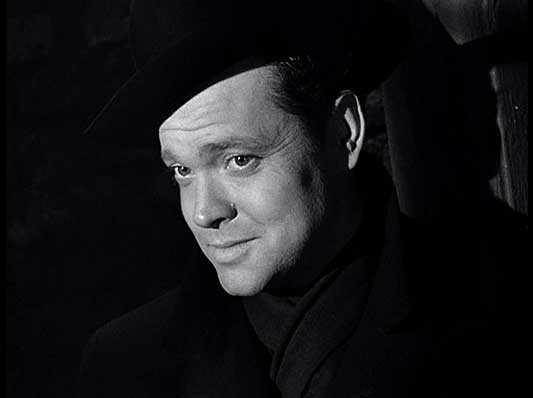
Orson Welles makes one of the greatest entrances in film history in THE THIRD MAN

THE THIRD MAN (Carol Reed, 1949)
Film Forum
209 West Houston St.
Friday, January 23, and Saturday, January 24, 12:35, 4:30, 8:25
“Orson Welles 100” continues through February 3
212-727-8110
www.filmforum.org

Carol Reed’s thriller is quite simply the most entertaining film you’re ever likely to see, the best Orson Welles film not directed by the man who gave us Citizen Kane and The Magnificent Ambersons. Set in a divided post-WWII Vienna amid a thriving black market, The Third Man is heavy in atmosphere, untrustworthy characters, and sly humor, with a marvelous zither score by Anton Karas. Joseph Cotten stars as Holly Martins, an American writer of Western paperbacks who has come to Vienna to see his old friend Harry Lime (Welles), but he seems to have shown up a little late. While trying to find out what happened to Harry, Martins falls for Harry’s lover, Anna (Alida Valli); is told to get out of town by Major Calloway (Trevor Howard) and Sergeant Paine (Bernard “M” Lee); meets a stream of Harry’s more interesting, mysterious friends, including Baron Kurtz (Ernst Deutsch) and Popescu (Siegfried Breuer); and is talked into giving a lecture to a literary club by old Mr. Crabbin (Wilfrid Hyde-White). Every scene is a finely honed work of art, filled with long shadows, echoing footsteps, dripping water, and unforgettable dialogue about cuckoo clocks and other strangeness. SPOILER: The shot in which Lime is first revealed, standing in a doorway, a cat brushing by his feet, his tongue firmly in cheek as he lets go a miraculous, knowing smile, is one of the greatest single moments in the history of cinema. “Orson Welles 100” continues through February 3 with such other gems as Othello, Macbeth, Chimes at Midnight, and A Man for All Seasons as well as such rarities as It’s All True and Too Much Johnsons.
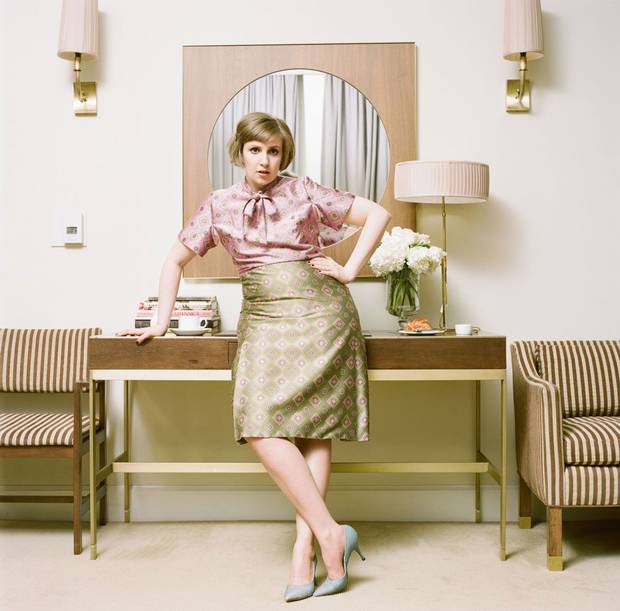
MIRANDA JULY IN CONVERSATION WITH HOST LENA DUNHAM

Miranda July

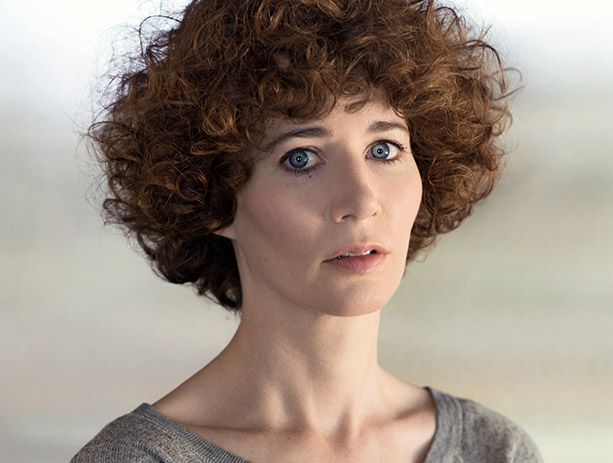
Miranda July will discuss her latest book, THE FIRST BAD MAN, with Lena Dunham at BAM on January 28

BAM Howard Gilman Opera House
Peter Jay Sharp Building
230 Lafayette Ave.
Wednesday, January 28, $35-$50
718-636-4100
www.bam.org

“Miranda July’s ability to pervert norms while embracing what makes us normal is astounding,” Girls creator Lena Dunham says of Miranda July’s debut novel, The First Bad Man (Scribner, January 2015, $25). “Writing in the first person with the frank, odd lilt of an utterly truthful character, she will make you laugh, cringe, and recognize yourself in a woman you never planned to be. By the time July tackles motherhood, the book has become a bible. Never has a novel spoken so deeply to my sexuality, my spirituality, my secret self. I know I am not alone.” On January 28, Dunham, who wrote, directed, and starred in the indie hit Tiny Furniture and whose memoir, Not That Kind of Girl, was released this past September, will host an evening of conversation with July, an influential multimedia artist who writes, directs, and stars in her own films (Me and You and Everyone We Know, The Future), writes short stories (many of her earlier ones have been collected in No One Belongs Here More Than You), has recorded albums (10 Million Hours a Mile, The Binet-Simon Test), developed the personal messaging app “Somebody,” and makes performance pieces and art installations (“Eleven Heavy Things,” “Things We Don’t Understand and Definitely Are Not Going to Talk About”).

Lena Dunham will be at BAM to host a conversation with Miranda July (photo by Autumn de Wilde)

Lena Dunham will host what should be a kooky conversation with Miranda July at BAM (photo by Autumn de Wilde)

In her first book since 2011’s It Chooses You (a companion piece to The Future), July introduces the world to one Cheryl Glickman, a rather persnickety, peculiar, strangely punctilious woman who lives her life and interprets situations a bit oddly. When her carefully laid out existence is suddenly interrupted by the arrival of her bosses’ troubled daughter, Clee, who will be staying with her for an indeterminate amount of time, Cheryl is forced to reevaluate her needs and her “funny way of doing things,” as Clee says. Cheryl suffers from globus hystericus, has a bizarre relationship with her therapist, pines away for an older member of the board of directors where she works, and is constantly in search of Kubelko Bondy, a “baby I think of as mine.” An eccentric both inside and out, Cheryl and her exploits are endlessly charming and plentifully weird as she deals with sexuality, femininity, class, age, and family. And just when you think you might have her figured out, she does yet another thing that surprises, delights, and confounds you. In reviewing No One Belongs Here More Than You, we wrote, “July’s characters live in their own alternate, warped realities, constantly confusing their relationships with friends, family, and even strangers, mistaking nothings for somethings,” a statement that suits The First Bad Man to a tee. The book even has a cool, chic design, courtesy of July’s husband, artist and filmmaker Mike Mills (Thumbsucker, Beginners); the dust jacket and case are all black, the title and author name in plain white sans serif type, but the endpapers are like a groovy psychedelic abstract painting. Seeing July, who was born in Vermont and raised in Berkeley, and Dunham, a New York City native, together at BAM should be endlessly charming and plentifully weird as well, making for one very entertaining evening. We’re hoping for a warped, brilliant view directly into two very particular expressions of contemporary female creative sensibility — and one very kooky discussion.

I’M GONNA PRAY FOR YOU SO HARD

(photo by Ahron Foster)

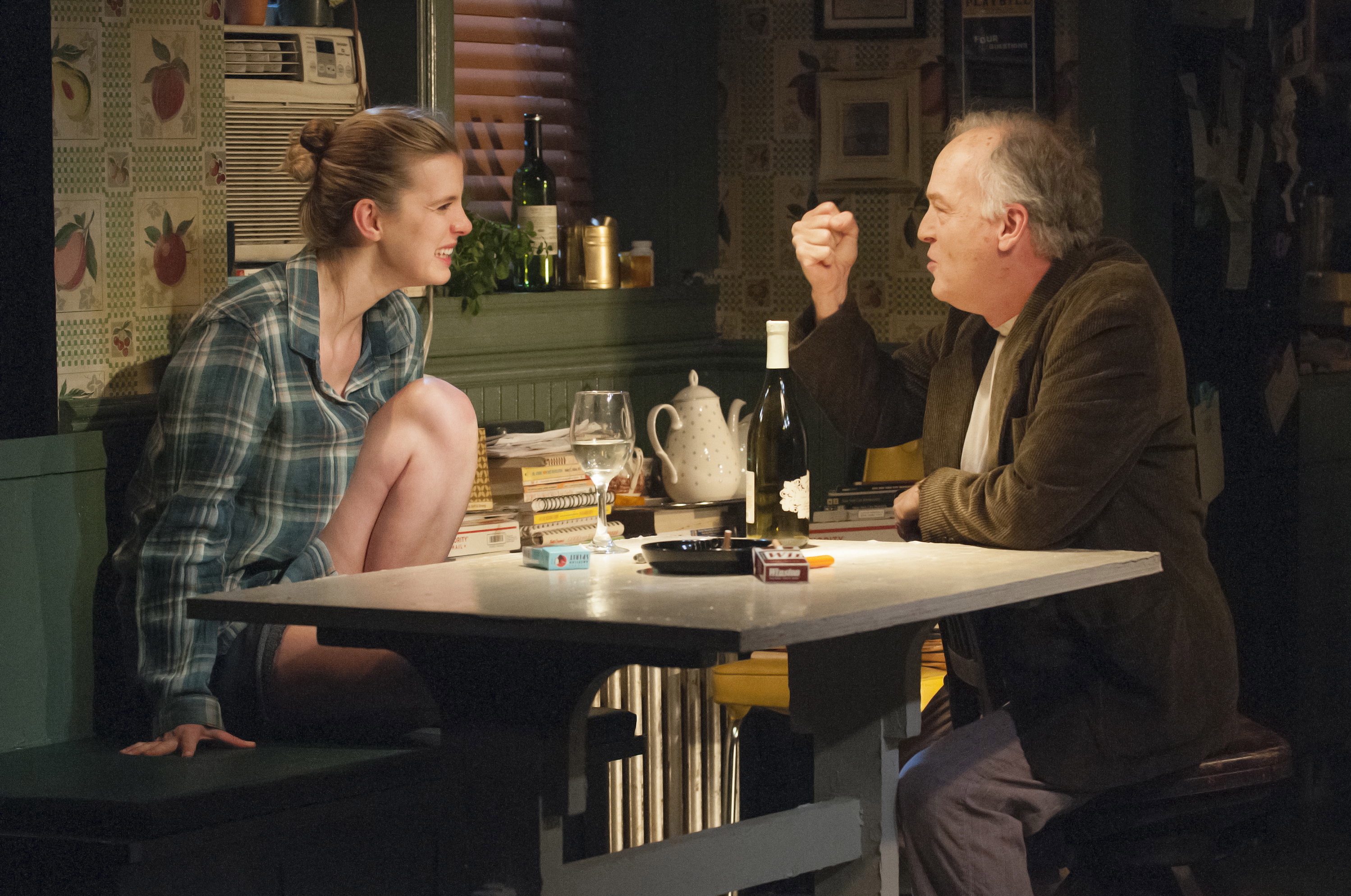
Ella (Betty Gilpin) and David (Reed Birney) share an unusual father-daughter relationship in new Halley Feiffer play (photo by Ahron Foster)

Atlantic Stage 2
330 West 16th St. between Eighth & Ninth Aves.
Tuesday – Sunday through March 1, $20-$45
www.atlantictheater.org

Theater critics are taking quite a beating these days. In Terrence McNally’s It’s Only a Play, F. Murray Abraham portrays a snarky critic who wants to feel included at an opening-night part for a new Broadway show. In Alejandro G. Iñárritu’s Oscar-nominated Birdman, Lindsay Duncan plays a vicious New York Times critic who can’t wait to eviscerate a former Hollywood star’s (Michael Keaton) big debut on the Great White Way. And now in Halley Feiffer’s I’m Gonna Pray for You So Hard, a playwright father (Reed Birney) and his actor daughter (Betty Gilpin) skewer critics right from the start. “They are a sick cadre of pathetic, sniveling, tiny men with micropenises and no imaginations who write out of their asses and who love to tear you down because in truth they know that you are doing exactly what they could never do — that you are doing the only thing they have ever wanted to do — and they are fucking jealous,” David, winner of a Pulitzer and two Tonys for such plays as Gavalt! and Four Questions, lashes out. “You know that, don’t you? How jealous they are? They’re boiling with envy. They want a piece of you. They want in. They wanna get inside you! They wanna climb right in!” That mini-soliloquy, which of course contains more than a morsel of truth, is part of a kind of vitriolic halftime locker-room pep talk David is giving to Ella, who has been passed over for the role of Nina in The Seagull, losing out to a sexy ingénue who, David argues, uses her assets to get what she wants. (Ellas is cast as Masha instead.) Smoking and drinking with a passion, David rips apart theater as a whole, not just critics, barely leaving room for Ella to sycophantically scream back at him such words of shock and agreement (and ecstasy) as “Whoa!” “Wow!” “Right!” “Yes!” and “Oh god!” It’s not a pleasant conversation to listen in on — and one can only hope it’s not based on fact, as Feiffer is an actress (The House of Blue Leaves, The Substance of Fire) as well as a playwright (How to Make Friends and Then Kill Them) and the daughter of Pulitzer Prize-winning cartoonist and writer Jules Feiffer.

(photo by Ahron Foster)

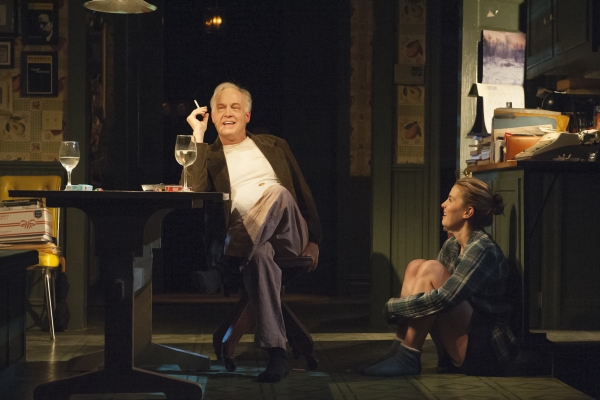
Father and daughter investigate the state of their lives and careers in I’M GONNA PRAY FOR YOU SO HARD (photo by Ahron Foster)

I’m Gonna Pray for You So Hard takes place on Mark Wendland’s cluttered Upper West Side apartment set, which runs three rooms deep instead of across, creating a narrow, claustrophobic space that barely contains the fiery emotions streaming out of David and Ella. The second scene is far shorter than the first, almost more of a coda, taking place on the floor instead of the stage, as the set is now the black box theater itself, a transition that is wholly successful. But Birney (Casa Valentina, Circle Mirror Transformations), one of New York’s most deservedly busiest actors — he’s also starring in Feiffer and Ryan Spahn’s upcoming web series What’s Your Emergency? — and Gilpin (Heartless, Nurse Jackie) make for a rather odd couple, forming an unsettling and hard-to-believe father-daughter dynamic that is often difficult to watch. But then Feiffer and director Trip Cullman (Punk Rock, Murder Ballad) tear it all apart in a brash, brutal finale that is actually a disappointing cop-out. I’m Gonna Pray So Hard for You is a relentlessly nasty and bitter play, and although often that works, in this case, by the end, you’ll be praying for someone, anyone, to just lighten up.

THE DARK SIDE OF THE SUN — JOHN ZORN ON JAPANESE CINEMA: MATANGO

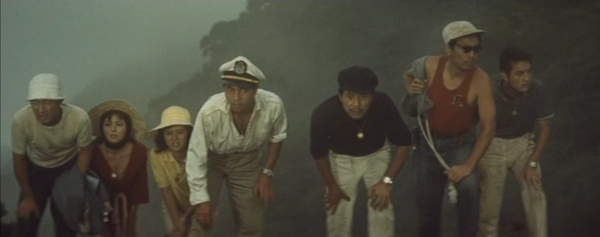
Sherwood Schwartz must have seen MATANGO before creating GILLIGANS ISLAND

MATANGO is a kind of Japanese postwar nuclear GILLIGAN’S ISLAND

MATANGO (aka ATTACK OF THE MUSHROOM PEOPLE) (aka FUNGUS OF TERROR) (Ishirō Honda, 1963)
Japan Society
333 East 47th St. at First Ave.
Friday, January 23, 7:00
Festival runs monthly through February 20
212-715-1258
www.japansociety.org

How can you go wrong with a Japanese monster movie with such alternate titles as Attack of the Mushroom People and Fungus of Terror, directed by the man who gave us Godzilla, Rodan, Destroy All Monsters, and The Human Vapor? Well, you can’t. Ishirō Honda’s 1963 cult classic, Matango, is a postwar apocalyptic tale that evokes Lord of the Flies, The Thing, Invasion of the Body Snatchers, and Antonioni’s L’Avventura while predicting Lost and, yes, Gilligan’s Island. Written by frequent Honda collaborator Takeshi Shimura based on William Hope Hodgson’s 1907 short story “The Voice in the Night” (which was included in the 1958 compilation Alfred Hitchcock Presents: 12 Stories They Wouldn’t Let Me Do on TV), Matango also has its fair share of social commentary, as seven characters on a yachting outing end up stranded on a seemingly deserted island: the first mate, Senzô (Kenji Sahara), the skipper, Naoyuki (Hiroshi Koizumi), the wealthy Kasai (Yoshio Tsuchiya), the writer, Yoshida (Hiroshi Tachikawa), the sultry singer, Mami (Kumi Mizuno), the professor, Kenji (Akira Kubo), and the mousy Akiko (Miki Yashiro). Mushrooms are thriving on the island, but it’s best not to eat them, because they are not exactly the psychedelic fungi beloved by hippies in the mod movies of the ’60s. The film touches on jealousy, resentment, loneliness, hunger, and sanity in the nuclear age, with special effects (courtesy of Eiji Tsuburaya) that make the early years of Doctor Who — and Gilligan’s Island itself —seem like a technological marvel.

Matango is not so much scary these days as just an absolute hoot, a kind of minor time capsule treasure that you can check out on January 23 at 7:00 when Japan Society screens it as part of its monthly film series “The Dark Side of the Sun: John Zorn on Japanese Cinema,” which concludes in March with the U.S. premiere of the made-for-television Nagisa Oshima’s It’s Me Here, Bellett, preceded by eight shorts by Osamu Tezuka. “I had been a huge fan of Japanese music, art, and film since the early 1960s, but late night Tokyo TV provided a peek into an entirely different world outside the classic art film masterpieces of Ozu, Mizoguchi, Kurosawa, and Inagaki,” experimental musician and composer and downtown fixture Zorn explains in his curator statement. “It was a revelation to discover that Oshima’s Cruel Story of Youth and The Sun’s Burial were not so much an isolated vision but actually two examples of an entire cinematic genre, and that directors like Seijun Suzuki, Kinji Fukasaku, Toshio Masuda, Yasuzo Masumura, Teruo Ishii, and others had made incredible and uncompromising films that spoke as much about the Japanese psyche as origami, noh theater, or the tea ceremony ever had. . . . For me, the experimental, adventurous, and uncompromising side of any society is often the home of the deepest truths, and these films each hold their truths to an often uncomfortable extreme. I hope you enjoy the (occasionally blinding) intensity of ‘The Dark Side of the Sun.’”